
CASTELLUM MAGNUM
The Great Fortress · City · Provincia Terminus
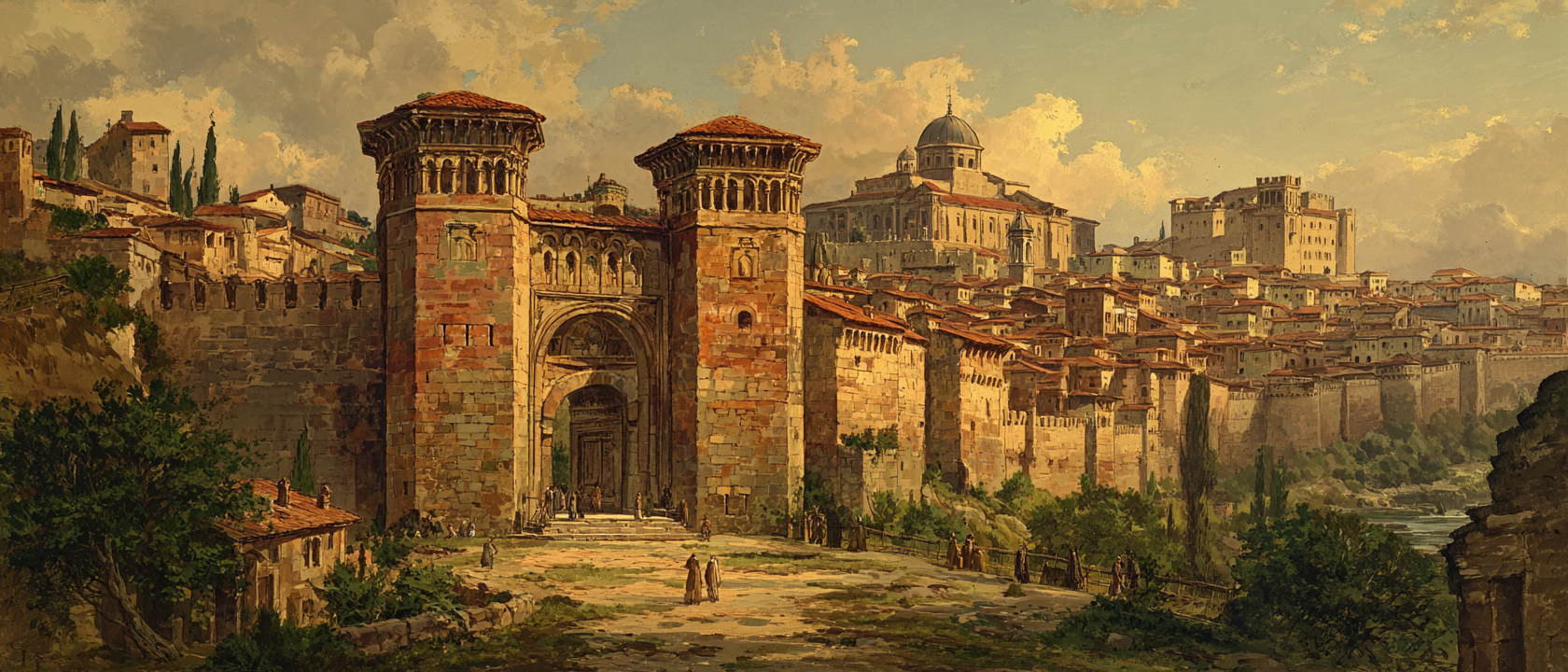
Castellum Magnum is the only city in the Empire that is also a fort. Not a city with a fort in it — Nova Romae has that, and Lacusum, and every provincial capital worth garrisoning. A city that is itself a fortification, built into twelve hundred years of wall and growing backward from it like a scar. The people who live here have the frontier in their architecture and their Latin and their dreams, and they are the most honest Romans I have encountered anywhere in Aethermarch, because honesty is what you get when the question of what Rome is for has a concrete answer that you can see from your bedroom window.
Castellum Magnum is the provincial capital of Provincia Terminus and the operational headquarters of the frontier legions: the administrative, military, and civilian heart of the Empire's western edge. It began as a Legion fort integrated into the first sections of the Arcus Terminus and has grown eastward from the wall over eleven centuries, each generation of expansion adding another layer of civilian city behind the military infrastructure that remains, still functioning, at its core. The wall's hinge point is here, at the largest tower complex of the crescent's eastern anchor — the original fort whose name the city has inherited. The two arms of the Arcus Terminus extend northeast and southwest from this point, each approximately two hundred kilometres long, curving back to anchor in Roman-controlled terrain. Sixty thousand people live in the shadow of a structure that has been the most important military asset in Aethermarch for eight hundred years and that, on still nights, they can hear.
The city is unlike any other in the Empire in ways that take time to see clearly. It looks Roman — forum, temples, academy, senate house, the standard civic infrastructure of a provincial capital — but all of it is built in the heavy, low-slung style of a place that has never been entirely certain it will not need to be defended, and all of it is oriented eastward, toward the river that forms the city's back, as though the civilian city is permanently aware that its function is to stand between the Grakh'tor territories and the interior. The wall is west. The river is east. Everything the city has built, it has built in between.
I arrived in Castellum Magnum from the interior, coming down the Via Militaris from the east, and the first sight of the wall was across the city's roofline — grey stone rising behind everything else, the crescent's anchor towers visible against the western sky. I had seen the wall's sections before, at the border markets and on survey expeditions along its length. I had not seen it as the backdrop to a city of sixty thousand people going about their ordinary lives. The effect is not what I expected. It is not oppressive. It is simply present, the way mountains are present to people who live below them: a condition of existence rather than a source of dread. The dread is what visitors bring. The residents stopped bringing it several centuries ago.
Demographics
A population of approximately sixty thousand with a character found nowhere else in the Empire. The frontier families — Romans whose ancestry here extends ten, twelve, fifteen generations — are the city's core and its most distinctive element. They speak a Latin that has absorbed Orcish loanwords for military concepts that classical Latin didn't require: words for specific kinds of raid, for the quality of silence that precedes an organised attack, for the relationship between a soldier and the section of wall they are personally responsible for. Their children learn these words before they learn to write. They consider this appropriate.
The civilian population includes the families of active Legion soldiers, veterans who have chosen to remain after service, the merchants and artisans whose businesses serve a city with a permanently large military population, and a small community of scholars at the Academy who are either studying the frontier or the Grakh'tor or both. There is a half-orc community of approximately two thousand in the river district — the descendants of frontier interactions over twelve centuries, accepted in Castellum Magnum with the pragmatic tolerance of a place that has had twelve centuries to develop a position on the question and has concluded that the question is less important than people elsewhere think.
Government
Castellum Magnum is governed by two authorities whose relationship is the city's central political fact: the Provincia Terminus administration under Governor Aelia Marciana, in her fourth year, and the frontier legion command under Legatus Legionis Marcus Volusius Ferox, in his fourteenth year. Marciana was appointed by the Senate with a specific mandate to reassert civilian governance over a province that the Senate believes has been effectively run by its military command for two generations. Ferox has been running the frontier legions for fourteen years and considers the Senate's concern about military dominance a misreading of what military dominance looks like when it is working correctly. Both assessments are defensible. Neither party finds the other's assessment interesting.
The tension between them is not hostile in the way of personal animosity — both are competent professionals who respect each other's institutional role — but it is structural and genuine. Marciana controls the provincial budget and the civilian administration. Ferox controls the wall, the legions, and the Speculatores network whose intelligence operations extend well beyond the frontier. The Senate intended the appointment to shift the balance. What it has produced is a situation in which two highly capable people disagree, with increasing specificity, about what the frontier requires in 1200 A.P., and in which every significant decision is preceded by a negotiation that neither party records.
DM ONLYDefences
The Arcus Terminus is the city's primary defence and requires no supplement: twelve hundred years of construction, maintenance, and military investment have produced a structure that no Grakh'tor force has permanently breached. The crescent's anchor point at Castellum Magnum is the most heavily reinforced section in the entire line: the largest tower complex, the original fort's artillery positions still functional, the wall sections extending northeast and southwest manned by rotating Legion detachments at every milecastle. The wall's signal system — the horn signals that carry along the wall's length and that the city's residents hear on still nights without raising their eyes from their dinner — can alert the entire garrison of any section to an incident within minutes.
Legiones VII and VIII garrison the Arcus Terminus from Castellum Magnum; Legio X is the mobile reserve, also based here. Legio IX holds Claustra and the eastern valley approach to the Montes Ferae corridor. Combined strength at Castellum Magnum is approximately nine thousand soldiers, with the province's total military commitment the largest concentration of Legion force outside the capital. The legions rotate wall duty, training exercises, and border patrol in a schedule that Ferox has been refining for fourteen years. It is, by every metric available, the most efficiently managed military rotation in Aethermarch. Marciana has noted this in her reports to the Senate. She has also noted that efficient military management is not the same as appropriate civilian oversight.
Industry & Trade
The city's economy serves the military complex that is its reason for existing, and has developed the specific commercial character of places that have had that function for a very long time: not purely military supply, but a diversified civilian economy that has grown from military need and maintained itself as genuine commerce. The armouries and equipment workshops are the foundation, but the city's craftwork has developed quality and variety beyond Legion specification — the frontier metalwork produced in Castellum Magnum's workshops is sold throughout the Empire as premium goods, its quality a direct consequence of twelve centuries of producing things that soldiers' lives depend on.
The river harbour handles significant inland trade — the Via Militaris connection to Nova Romae carries administrative and military traffic, but the river is cheaper for bulk goods, and Castellum Magnum's position as the province's larger city means that much of what the province consumes arrives either by road or river. The border markets at the designated crossing points generate a commercially interesting flow of Grakh'tor goods: furs, specific mineral pigments, the worked dark-timber objects that orc craftswomen produce and that command premium prices in Nova Romae for reasons that are partly aesthetic and partly the appeal of owning something that came from the other side of the wall.
Infrastructure
The Via Militaris is the finest long road in the Empire: twelve centuries of military investment, garrison waypoints every thirty kilometres, a surface maintained to a standard that allows Legion movement in any weather. It connects Castellum Magnum to Nova Romae in twenty days military march, twenty-four to twenty-six days civilian. The river harbour on the Flumen Terminus provides an alternative connection eastward to the interior, slower for passengers but essential for the bulk goods the city consumes. The aqueduct supplying Castellum Magnum was originally built to Legion military specification — more robust than civilian aqueducts, designed to function under attack conditions — and has never failed in twelve hundred years of continuous operation.
The wall's infrastructure is the city's most significant engineering asset: the signal system, the patrol roads running along the wall's base on both sides, the milecastle network, the supply roads connecting the wall to the city's logistics depots. Ferox's office manages this infrastructure through the Legion's engineering corps, which is the best-resourced engineering organisation in Aethermarch outside the dwarf Holds. The Governor's office manages everything else, a division clear in theory and increasingly contested in practice as the two administrations have disagreed about which infrastructure is military and which is civilian.
Districts
Castellum Magnum's districts reflect its dual character directly. Castellum Primum is the original fort and wall integration point: the military heart, the oldest structure, the place the city began. The Forum District is the civilian administrative core that grew immediately behind the fort. The Vicus Militaris is the soldier-civilian transition zone, where Legion personnel and frontier families have coexisted for centuries. The River Quarter is the commercial eastern edge, backed against the Flumen Terminus. The Academy District is the intellectual presence the Senate insisted on establishing to demonstrate that this was a city and not merely a garrison. The Half-Orc Quarter is the river district's northern extension, the most socially complex neighbourhood in the province and the one that visitors from the interior find most difficult to read correctly.
Guilds and Factions
The frontier legions — VII, VIII, and X at Castellum Magnum — are the city's dominant institutional presence, their collective authority expressed through Ferox's command and the Speculatores network that extends that command's reach beyond the wall. The provincial administration under Marciana is the second power, its authority grounded in the Senate's mandate and its budget control, expressed most visibly through the Academy and the civilian court system. The Frontier Families' Council is the city's third significant faction: not a formal institution, but the organised voice of the fifteen-generation families whose ancestry here predates any current institution and whose opinion on frontier matters carries a weight that both the Governor and the Legatus find it practical to consult.
The Via Obscura has a substantial presence in Castellum Magnum: the frontier intelligence trade is the most complex in the Empire, and the operators who work it are the most specialised. The Speculatores and the Via Obscura maintain a working relationship here more tightly integrated than anywhere else in Aethermarch — some missions require both institutional knowledge and unofficial methods, and the frontier doesn't have the interior's luxury of keeping those capabilities cleanly separated. The Academy's scholars are informal participants in both networks, a position the Academy's director finds professionally uncomfortable and practically unavoidable.
DM ONLYHistory
The original Legion fort at this position was established in the city's first decade, when the surveying parties pushing westward reached the terrain that would define the Empire's frontier. The Arcus Terminus's first sections were built here in approximately 380 A.P., incorporating the fort into the crescent's anchor structure; the first completed section was dedicated in 391 A.P. The civilian settlement grew behind the fort within a generation — soldiers have families, families need markets, markets need artisans — and the pattern of military core and civilian growth has continued ever since. The Bellum Primum of approximately 340 A.P. established the frontier lines that the wall formalised; every significant Grakh'tor conflict since has tested the wall at this position and found it adequate.
The Academy's establishment in 890 A.P. marked the first time the Senate had invested in Castellum Magnum's civic identity rather than its military function, and it changed the city's character in ways that took a generation to become visible. Scholars studying the Grakh'tor began producing work that complicated the Legion's operational picture — not contradicting it, but adding dimensions to it that purely military intelligence missed. The relationship between the Academy and the Legion command has been productive and uncomfortable in equal measure ever since.
For full chronological detail, see: Annales Mundi.
Points of interest
The Castellum Tower (original fort's primary tower, built into the Arcus Terminus, continuously occupied since the first decade A.P.) — the oldest continuously occupied military position in Aethermarch. Its ground floor contains the Legion command's operational centre; its upper floors the observation platforms from which the Grakh'tor territories to the west are permanently monitored. Soldiers assigned to tower observation duty rotate every four hours. The view from the top — the western plains stretching to the orc clanholds' distant treeline, the crescent wall extending northeast and southwest to both horizons — is the defining Castellum Magnum experience and is not available to civilian visitors. Several visitors have attempted to arrange exceptions. All have been declined.
The Forum Magnense (civic centre, dark sandstone, proportions correct, decorative ambition modest) — the city's civilian heart. The Senate House on its northern side is where Marciana administers the province; the Legion's administrative offices on its southern side are where Ferox administers the wall. The two buildings face each other across the forum's width, which is either an accident of planning or a very precise architectural statement, depending on who you ask. The forum hosts a daily market, a weekly legal court, and the periodic public assemblies at which the Governor and the Legion command announce decisions on alternate days, in a scheduling arrangement that has been the subject of three formal disputes in the past two years.
The Murus Memoriae (section of the Arcus Terminus inside the city's boundaries, publicly accessible) — the eastern face of the wall inscribed, over twelve centuries, with the names of soldiers who died in its defence. The inscriptions begin in the first century with broad chiselled letters and grow progressively finer as the centuries pass and the space fills. Current estimates suggest the remaining space will accommodate approximately forty more years of names at current conflict rates. What happens after that has been discussed and not resolved. Standing below the Murus Memoriae and reading twelve centuries of names — the earliest barely legible, the most recent still sharp-cut — is an experience that visitors from the interior find affecting in ways they had not anticipated. The frontier families find the visitors' surprise at being affected mildly puzzling. They have been walking past those names all their lives.
The Academy of Terminus (Academy District, established 890 A.P.) — the Empire's only frontier academy, whose primary research focus is the Grakh'tor: linguistics, anthropology, military analysis, diplomatic history. It produces the only scholars in the Empire with first-hand experience of the frontier's complexity. The Speculatores recruit from its graduates. So does the Via Obscura. The Academy's director has spent twelve years managing a research institution whose graduates are actively recruited by intelligence organisations, whose scholars are informal participants in intelligence networks they did not seek out, and whose work is simultaneously the most academically significant and the most operationally useful body of orc scholarship in the Empire.
Tourism
Castellum Magnum receives two categories of visitor: scholars coming to the Academy or researching the frontier, and people who have come to see the wall. Both categories are welcome and both are watched by the Speculatores with the automatic attention that a frontier city applies to strangers. The wall itself is not accessible to civilian visitors on its military sections, but the Murus Memoriae and the civilian stretches of wall interior are open and constitute the most visited site in the province. The frontier families find the visitors' surprise at being affected by the Murus Memoriae mildly puzzling. They have been walking past those names all their lives.
Architecture
Castellum Magnum's architecture is Roman in structure and frontier in character: the standard forms executed in the dark local sandstone that gives the city its particular colour, a deep reddish-grey that is warmer in morning light and almost black when wet. The buildings are lower than their Nova Romae equivalents and their walls are thicker, built by people whose ancestors understood that walls have purposes beyond keeping the rain out. The forum is large and well-proportioned. The senate house is solid and undecorated. The Academy is the exception — built in lighter stone, its windows larger than military prudence would suggest, a deliberate signal from whoever commissioned it that scholarship was choosing to be visible even here.
The fort at the Castellum tower — Castellum Primum, the first fort — is the oldest continuously occupied military structure in Aethermarch. Its oldest walls are first-century construction, identifiable by the cut of the stone and the mortar technique, still standing after twelve hundred years because the Legion's engineers have maintained them with the reverence that soldiers develop for structures that have held. The newer barracks, administrative buildings, and the principia that serves as the frontier legions' operational command centre have grown around and over the original fort in layers that a military historian can read like a geological section.
Geography
The Arcus Terminus runs in two arms from Castellum Magnum's anchor point — northeast and southwest, each approximately two hundred kilometres long, curving back to anchor in Roman-controlled terrain. The city occupies the ground immediately east of the wall's largest tower complex, extending approximately three kilometres east to the Flumen Terminus, the provincial river that runs west to east through the province's interior before turning south toward the coast. The river is the city's eastern boundary, its harbour on the near bank providing the commercial and supply link to the interior provinces that the Via Militaris supplements overland.
The terrain is flat — the wall's position was chosen partly for the clear sightlines that flat ground provides, and the city has grown across that same flat ground with the grid regularity that Roman engineers apply to level surfaces. The only significant elevation is the wall itself, rising fifteen to twenty metres above the surrounding terrain, its western face looking out over the Grakh'tor territories and its eastern face looking down into the city's military district. The milecastles along the wall's extension in both directions are visible from the city's taller buildings on clear days, their signal towers ready.
Climate
Colder than the interior provinces, with harder winters and shorter summers: the effect of the province's western position and its exposure to weather systems that come off the Grakh'tor territories without the moderating influence of the Inland Sea. The wall, facing west, catches the worst of the winter weather; the city behind it is partially sheltered but not insulated from the climate's character. Frontier soldiers develop a relationship with cold that interior-posted soldiers find excessive. The frontier families consider this a reasonable adaptation to conditions. The summers are short and bright and the city makes the most of them. The winters are long, dark, and the wall's signal horns carry further in cold still air than in any other condition.
Natural Resources
The dark sandstone that gives the city its colour is quarried from the ridge formations south of the city and has been the primary building material for twelve centuries. The Flumen Terminus's fishery provides a significant fraction of the city's protein supply; the river's management for both navigation and food production is one of the few areas of genuine cooperation between the Governor's and the Legatus's offices. The province's interior farmland, east of the city, produces agricultural surplus that feeds both the civilian population and the legions; the Legion's grain contracts with the interior farms constitute Marciana's most significant budget item and one of the few areas where the military and civilian administrations agree on what the money is for.
Frontier metalwork and craftwork (premium export).
River and road trade.
Border market goods from Grakh'tor territory.

Comments