
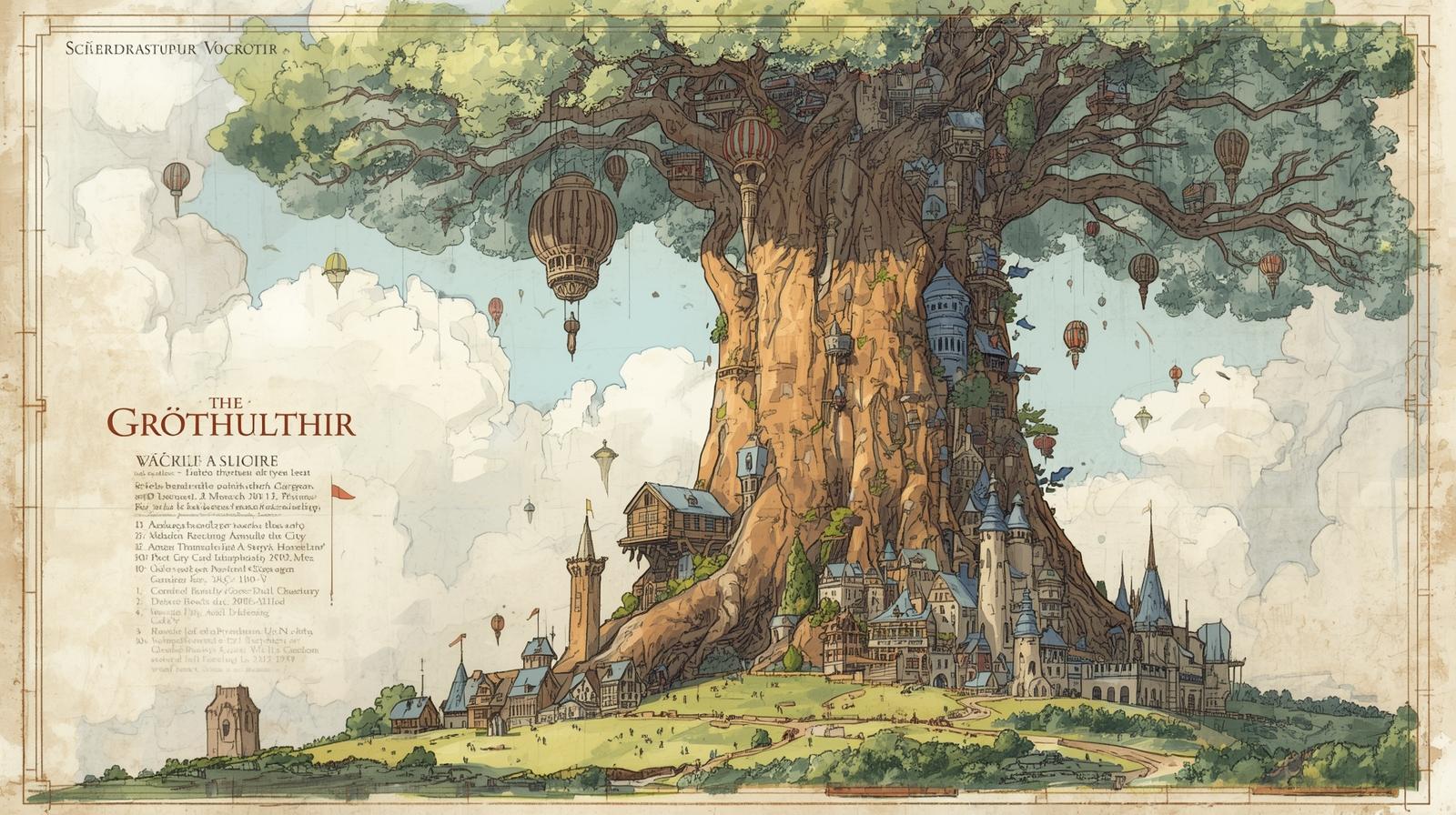
Grothulthi̊r
The Grothulthi̊r: A Colossal Bioengine
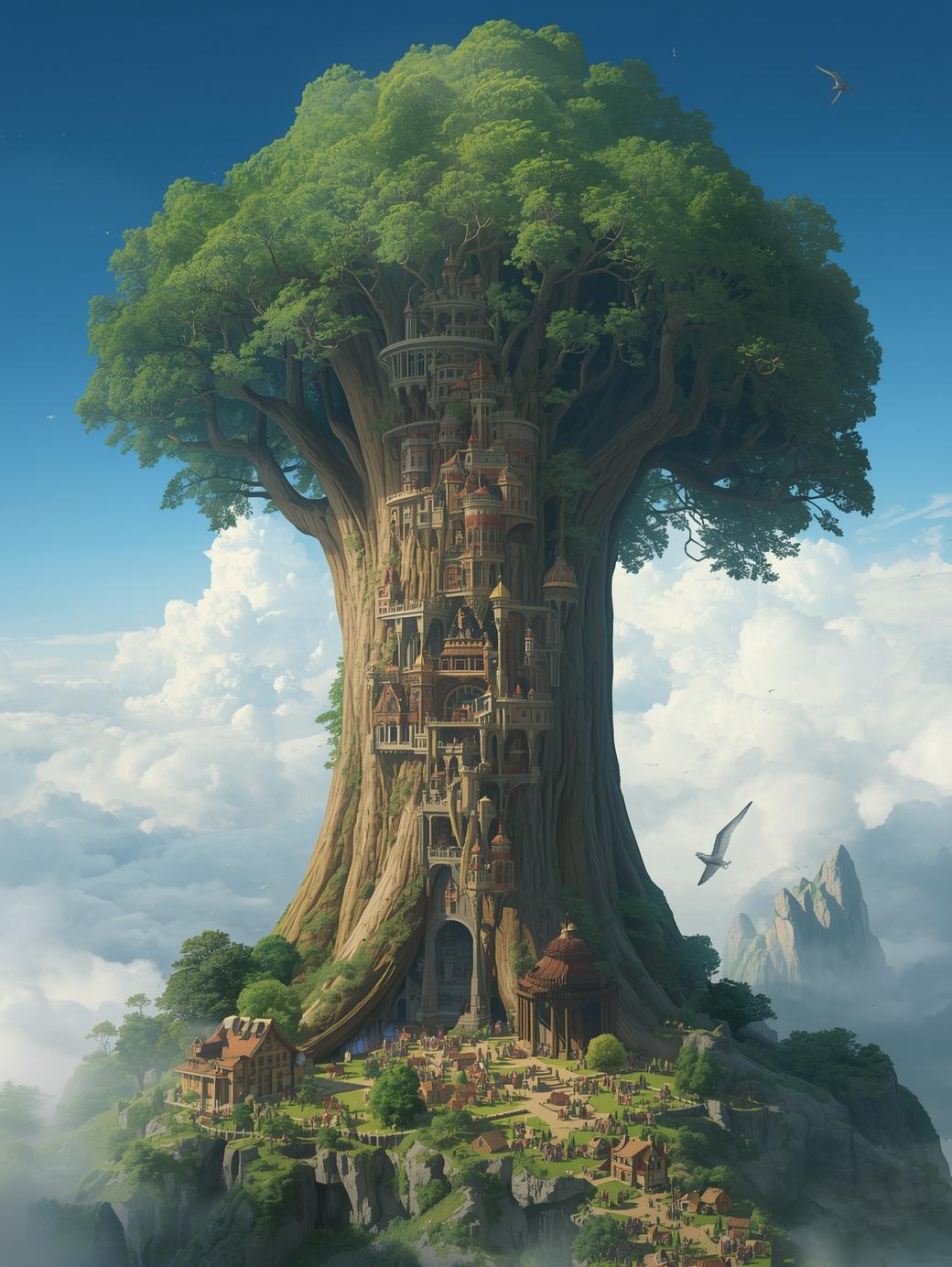
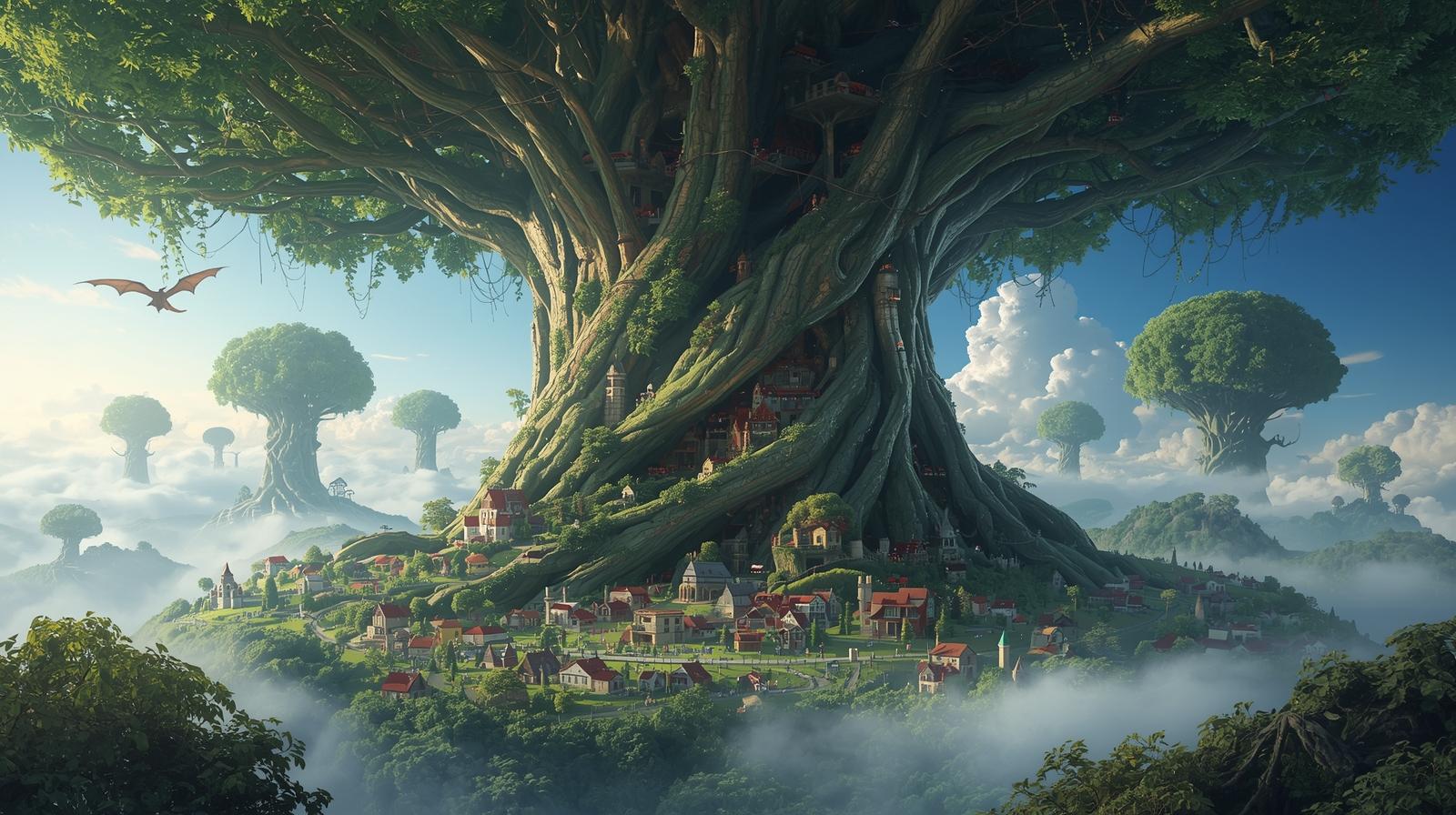
Rising like living continents from the soil of Sölmir, the Grothulthi̊r (also known as Mother Trees) are not merely trees—they are planetary machinery grown from bark, root, and time. Each Grothulthir functions as a colossal bioengine, drawing water from unimaginable depths, exhaling vast quantities of oxygen, and shaping the very air that moves around it (see The Grothulthi̊r Effect. Their trunks dwarf mountains, their canopies seed clouds, and their presence stabilizes climates that would otherwise fracture under Sölmir’s high latitude extremes. Long before cities were raised in their shadows, the Grothulthir had already rewritten the rules of weather, fertility, and survival.
Beneath the surface, their influence deepens. Vast mycelial networks radiate from Grothulthir roots, linking forests, rivers, and soils into a single living system that filters toxins, redistributes nutrients, and quietly regulates ecological balance. Life near a Grothulthir grows larger, lives longer, and heals faster—not by magic, but by proximity to an environment saturated with oxygen, moisture, and biological stability. Animals evolve around them. Rivers rise because of them. Entire food webs are anchored to their slow, patient respiration.
To the peoples of Sölmir, the Grothulthir are both shelter and warning. Civilizations flourish beneath their canopies, yet grow dependent on the stability they provide. Storms are born in their upper reaches. Fires burn hotter near their oxygen-rich hollows. When a Grothulthir falls, the land remembers for centuries. Revered, feared, and studied in equal measure, the Grothulthir stand as a reminder that the greatest forces shaping the world are not gods or kings—but living systems vast enough to remake a continent by simply continuing to breathe.
Basic Information
Anatomy
BASIC STATS — THE ABSOLUTE UNIT SPECS
These beauties grow 500–900 meters tall. That’s nearly a kilometer. Himalaya energy.
To not snap like a breadstick in a stiff breeze, they need:
Trunk Diameter:
- At minimum: 120–180 meters across
- At full maturity: 250–400 meters
GROTHWOOD - WOOD STRUCTURE
Not regular wood — that’d collapse under its own weight.Mother Trees use a triple-composite lignin structure:
1. Outer Bast-Fiber Layer:
- Dense, rope-like, flexible cellulose bundles.
- They’re shock absorbers against wind shear.
2. Middle Ferro-Lignin Band:
- A bio-mineralized layer infused with iron, calcium, and silica.
- Works like reinforced concrete. Gives the tree enormous compressive strength. Naturally fire-resistant.
3. Inner Spongia Core:
- A buoyant, honeycombed vascular matrix.
- Carries nutrient-rich sap
- Distributes load
- Acts like an internal airbag system against collapse
BARK & LEAVES — THE MANTLE BARK
A thick, plated, armor-like bark, 2–6 meters thick.Texture: cracked basalt meets elephant skin.
Features:
- Self-healing scars
- Moss-pocket ecosystems
- Color shifts seasonally from deep slate to bronze
- Emits an aromatic resin that deters parasites
- Fireproof outer layer (gets scorched but never burns through)
LEAVES - THE CROWN SAILS
These things are huge — each leaf is the size of a dinner table.They’re structured like manta-ray wings:
- Thin, broad, slightly rippled
- Deep green with bioluminescent veins
- Waxy, rain-shedding surface
- Edges that harden in storms to prevent tearing
Growth Rate & Stages
THE FULL LIFE CYCLE OF A Grothulthi̊r
1. The Seedfall (“The Quiet Birth”)
Age: 0 yearsA single Grothulthi̊r seed is not a seed. It is a meteor of life.
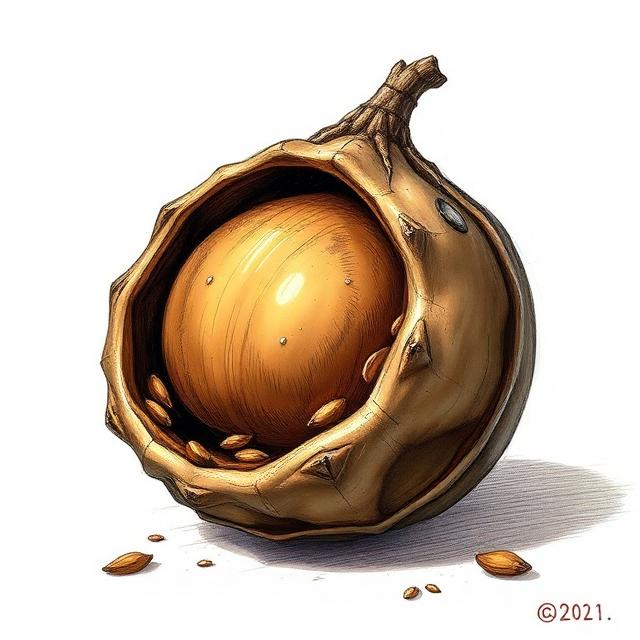
- About the size of a pumpkin
- Dense, resin-sealed
- Harder than ironwood
- Encased in a nutrient-rich shell
- Incredibly slow to germinate
- deep fungal soil
- a specific moss layer
- in the shade of older Grothulthi̊r
~1 seed per 10,000 becomes a tree. Life is brutally selective.
Early Solmiri believed each seed contains a “star soul” waiting for the right earth to open it.
2. Sapling Stage (“The Candle”)
Age: 0–150 yearsHeight: 1–20 meters
This stage is SO slow that most people don’t even realize they’re looking at a baby Grothulthi̊r.
- Looks like a dark, thick-trunked pine at first
- Incredibly shade-hungry
- Sap glows faintly at night (tiny luminescent channels)
- Sends down deep taproots immediately — up to 20 meters deep by year 30
Frost, wind, root-boar digging, fungus imbalance — everything kills them.
Only the most perfectly aligned ecological conditions allow survival.
This early fragility is why Grothulthi̊r are sacred.
3. Adolescent Stage (“The Spearwood”)
Age: 150–3,000 yearsHeight: 20–300 meters
Growth accelerates. This is when:
The ferro-lignin bands develop
- They twist up the trunk like massive living steel cables.
- Thick, overlapping armor plates appear.
- The first true canopy emerges at ~150m height.
This stage produces the most fruit of the tree’s entire lifespan.
4. Early Maturity (“The Pillar Age”)
Age: 3,000–9,000 yearsHeight: 300–700 meters
This is the age of:
- Major canopy colonies
- Inter-tree Sölmiri sky routes
- City habitation
- Glider species specialization
- Peak oxygen output
- Pulling moisture inland
- Moderating winter temperature
- Reducing storms
- Feeding fungal and moss networks
The tree is stable, reliable, and safe — though Solmiri still treat it with deep reverence.
5. Full Maturity (“The Mother Age”)
Age: 9,000–14,000+ yearsHeight: 700–900 meters
Only ~15% of all Grothulthi̊r reach this stage.
Characteristics:
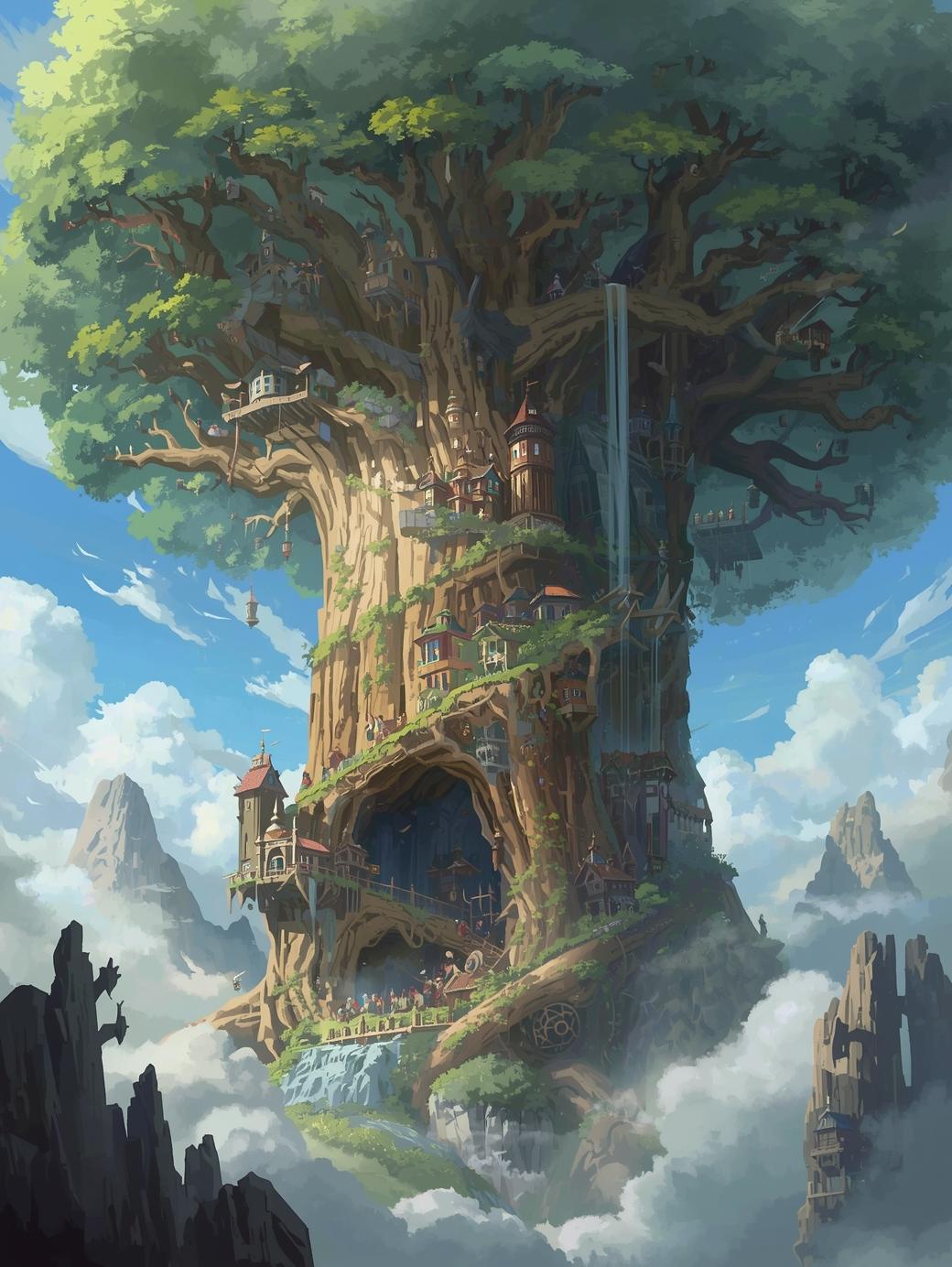
- Immense hollow trunk chambers form naturally
- The canopy becomes a self-contained world
- The tree’s internal fungal symbiotes are fully established
- Roots have fused into bedrock
- Fruits become rarer but incredibly potent
- Sap thickens, forming amber nodules (currency-grade)
- Tree produces the strongest Grothwood
6. Senescence (“The Waning”)
Age: 14,000–20,000 yearsThe decline is not sudden.
It is… sad, majestic, and eerie.
Symptoms:
- Canopy thins, letting more light to forest floor
- Bark plates shed more frequently
- Roots begin to retract slightly
- Sap channels slow
- Internal fungal symbiosis becomes unbalanced
- Fruit production ceases
- Moss turns brown around trunk base
- Songhorn drakes abandon the tree
The Solmiri treat these trees like dying elders:
- Ceremonies are held
- People move out of trunk cities
- Hunters and scouts monitor cracks
- Surrounding wildlife migrates away
7. Death (“The Fall”)
Age: 15,000–22,000 yearsThe death of a Grothulthi̊r is one of the most significant natural events on the continent.
What causes death?
- Fungal takeover (“Blight Rot”)
- Internal cavity collapse
- Lightning strike to the ferro-lignin core
- Root damage from earthquakes
- Old age (rare but possible)
- The ground trembles LIKE AN EARTHQUAKE
- Winds rush outward for miles
- Shockwaves break branches of nearby trees
- The canopy collapses first
- Then the trunk shears and falls in massive segments
- A shock of oxygen-rich dust fills the air
8. Aftermath (“The Shattered Years”)
Affects 3–10 km around the tree.Immediate Effects
- Enormous crater of roots exposed
- Light floods in for the first time in millennia
- Steam rises from sap-soaked earth
- Mosswolf packs move in
- Fire risk increases briefly
- Massive fungal blooms
- Huge influx of herbivores
- Burrow serpents dominate
- Moss and shelf fungi cover the fallen wood
- The fallen canopy becomes a multi-level habitat
- The fallen trunk becomes a forest ridge
- Soil builds up around it
- New species colonize high-light zones
- Smaller trees grow (birch, bluepine, alder)
- Fallen Grothulthi̊r fully becomes:
hills, ridges, moss-covered “tree mountains”, fungal kingdoms
- Young Grothulthi̊r may sprout in the light gap
It is a geological event.
Ecology and Habitats
GEOLOGY — WHY THE EARTH DOESN’T HATE THIS
A tree that big reshapes the land around it.Root System (The Underweb)
- Reaches 50–70 km outward
- Descends 4–7 km deep
- Interweaves with bedrock
- Functions like geological rebar
Grothulthi̊r roots actually stabilize tectonic stress. Regions with Mother Trees have fewer earthquakes.
Soil Formation
The fallen leaves and bark produce:- incredibly rich humus
- nitrogen super-cycles
- fungal networks the size of small countries
The land around a Mother Tree becomes one of the most fertile ecosystems on the continent.
Biological Cycle
These trees are ancient.
Sapling: first 200 years
Adulthood: 2,000–3,000 years
Prime: 4,000–9,000 years
Elderhood: 12,000+ years
They grow upward for the first few millennia, then outward, then internally hollow out on purpose — creating chambers, stabilizing arches, and load-distribution cavities.
They’re basically natural megastructures.
Sapling: first 200 years
Adulthood: 2,000–3,000 years
Prime: 4,000–9,000 years
Elderhood: 12,000+ years
They grow upward for the first few millennia, then outward, then internally hollow out on purpose — creating chambers, stabilizing arches, and load-distribution cavities.
They’re basically natural megastructures.
Additional Information
Uses, Products & Exploitation
NATURAL GROTHULTHIR RESOURCES
Structural & construction materials
- Bast fibers from outer layers — long, rope-grade fibers for cordage, sails, hammocks, lashing, and woven mats. These are harvestable with simple retting/soaking and spinning.
- Branch timber (secondary limbs, aerial roots, scaffold wood) — large branches can be harvested and worked for beams, planks, and masts. Because the trunk itself is composite and spiritually guarded, people tend to use coppiced limbs, scaffoldings and grafted living beams rather than hacking core wood. Early iron tools (chisels, adzes) can shape this material.
- Root-wrought boards — surface roots and buttress plates yield curved, strong planks useful for hulls or curved architecture.
- Resin/“living wood” composites — soaking and lamination with sap/resin lets craftsmen make weatherproofing panels and small boat hulls.
Fuel & lighting
- Resin and sap oils — excellent lamp oil when clarified and mixed with tallow; burning resin produces bright, long-lasting flame. Sap can be fermented into lower-grade fuels. Because the tree is ecologically central, fuel use is controlled and often ritualized.
- Charcoal from coppiced branches — for metallurgy and cooking; but limited because overharvest threatens the tree’s health.
Adhesives, sealants, and household materials
- Resin = glue and sealant for boats, roofs, and pottery repairs. Mixed with mineral ashes or lime it becomes a waterproof mortar.
- Tannins and saps used in leather tanning and wood finishing.
- Amber (crystallized resin) — used as jewellery, traded, and as proto-currency (expanded below).
Food & food systems
Fruits and seeds: many Mother Trees bear fruit — but fruiting varies by genotype and tree age. Varieties include:- Oil-drupe “grothnuts” — large, oily drupes (4–12 cm) packed with calorie-dense kernels; can be pressed for oil, eaten roasted, or ground into paste. High value; some trees produce them annually in heavy mast years.
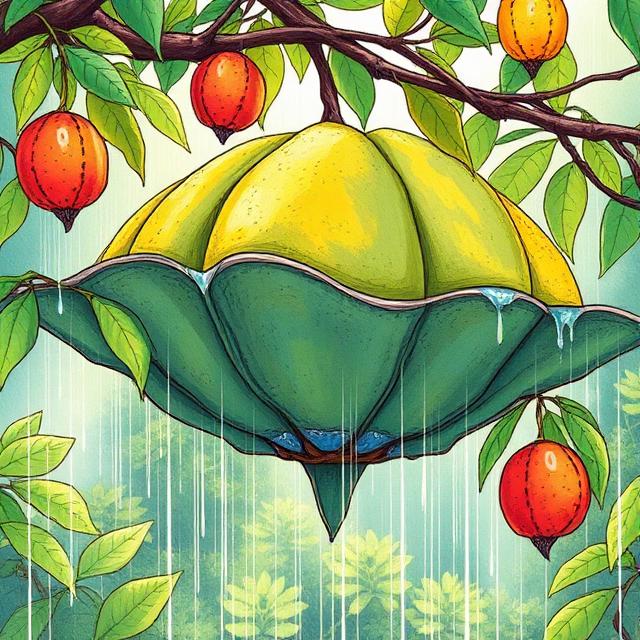
- Fleshy umbrella-fruits — broad, plate-like fruits that collect fog and rain; pulp is mildly sweet and starchy, used fresh or fermented.
- Small tart berries — abundant but low-calorie, used for preserves and flavoring.
- Inedible/medicinal fruits — some trees’ fruits are bitter/toxic but yield dyes, medicines, or insect repellents.
People domesticate and guard fruiting mothers.
Leaf and epiphyte crops
- Broad leaves are used as durable plates/coverings and sometimes processed into starch; epiphytic gardens (moss beds, bracket-fungi, and cultivated lichens) provide greens, mushrooms, and protein sources.
Fungal agriculture
- The mycorrhizal web supports edible truffles and tubers in the root zone; humans cultivate or encourage these fungi in root caverns. Those fungi can be a major protein source.
Animal husbandry in canopy
- Small poultry, tree goats, or tethered browser mammals can be kept on platforms and leaf-farms; gliding livestock (smaller ungulates adapted to ledges) are plausible fantasy elements.
Medicine & craft
- Medicinal saps and barks — antiseptics, poultices, fever reducers; resin with antiseptic qualities helps preserve wounds and mummify valuables.
- Dyes & perfumes — aromatic resins and leaf oils used in ritual perfumes, insect repellents, and to stain textiles.
- Fiber and woven goods — bast fiber yields cloth, nets, and sails. Early looms make coarse cloth; refined spinning yields finer fabrics for trade.
Mechanical / technological roles
- Sap as varnish and electrical insulator — in an early tech world, sap is used to waterproof cords and insulate delicate wiring in ritual electrified devices (if your world has primitive electrostatic or piezoelectric tech).
- Stone + sap mortars — resin mixed with ash and crushed minerals gives workable mortars and plasters faster than lime alone.
Sap & resin: quantities and uses (realistic ranges)
We’re dealing with monsters of trees, so the absolute quantities are enormous — but sustainable harvest must be a small fraction.- Sap reservoir (internal cavities + vascular matrix): huge, but sustainable annual extraction should be small to avoid stressing the tree.
- Sustainable sap harvest (per mature Grothulthi̊r): tens of thousands → low millions of liters per year, depending on tree size and health.
Practical early-tech harvest: ~50,000 – 500,000 liters/year per large, healthy tree is a plausible working range for communities that collect sap without killing the tree. (If you allow more intensive tapping with advanced arborist techniques that evolved over centuries, numbers can rise into the low millions.)
- Resin (sticky, polymerizable fraction of sap): only a small percentage of sap becomes resin. Sustainable resin yield might be hundreds → low thousands of liters/year per tree in good years.
- Amber formation (crystallized resin suitable for currency): forms over long periods (centuries) through polymerization and mineral infusion. Annual natural production of usable amber chunks is very limited — perhaps tens to hundreds of kilograms per tree per century, concentrated in trees with particular chemistry or injury history.
Uses of sap/resin
- Lamp oil, glue, waterproofing, varnish, medicinal washes, fermentation substrate (for low-proof drinks), and after refinement, a source of sugar or syrup in some genotypes (think of very concentrated, sweet heartwood saps).
Amber Currency
How it forms and how it functions culturally/economicallyHow amber forms on Grothulthi̊r
- Resin exudation occurs where bark is damaged, during stress or as a byproduct of normal metabolism. The resin contains terpenoids, sugars, and captured airborne minerals.
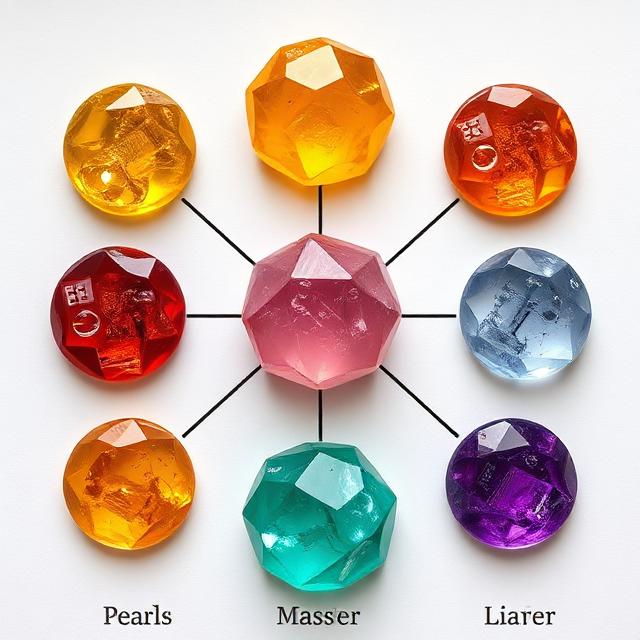
- Over centuries, polymerization and partial mineral replacement harden resin into translucent ambers with different hues depending on mineral load (golden, deep red, green-tinged if copper/mineralized, near-black if charred).
- Rare conditions (proximity to mineral springs, specific fungal action, low oxygen burial in resin pockets) make “gem amber” — very clear, hard, and lustrous.
Economic properties & valuation
- Rarity: gem amber is slow to form and concentrated in some trees → high value.
- Grades: color, clarity, size, and the presence of inclusions (insect, plant fragment) determine grade.
- Divisibility: amber can be carved into standardized beads or ingots; smaller beads for day trade, larger ingots for major transactions.
- Durability: resistant to rot and water, keeps symbolic value (ritual uses).
- Intrinsic uses: beyond currency, amber is used for ritual objects, high-status inlays, and sometimes in medicinal preparations (small quantities). That keeps demand strong.
- Control & politics: control of amber-producing trees (or the refinement workshops) becomes a major political lever — kings and guilds will protect, tax, or monopolize access.
Formation & supply constraints
- Slow formation makes amber a store of value (inflation-resistant), but not too rare: major markets can form around the few hundred to thousand high-grade pieces produced per century on Solmir. That scarcity underpins its use as currency and wealth store for elites.
- Everyday trade still uses other media (grain, traded metal, woven cloth), but amber serves for higher-value and cross-region transactions.
Circa 927 AL (Second Age)
Scientific Name
Arbora titana matrilucens
Lifespan
12,000+ Years
Average Height
500-900 meters tall (1640-2952 feet tall)
Average Physique
200-400 meters in diameter (656-1312 feet)
- Clade A — Olea-matrices (Oil-Mothers) — Fat-rich fruiters (grothnuts, oil drupes).
- Clade B — Resinifera (Resin-Mothers / Amber-Mothers) — High-resin producers prized for amber.
- Clade C — Folia-archaea (Leaf- and Fiber-Mothers) — Giant-leaf and bast-fiber specialists.
- Clade D — Lignoferra (Structural / Ferro-lignin-heavy Mothers) — Dense, ferro-lignin-rich trees; architectural timber.
- Clade E — Mycofructus (Fungal-symbiosis / Truffle-Mothers) — Root-fungal mutualists that produce truffles and tubers.
- Clade F — Umbellaria (Umbrella-Fruit / Water-Catch Mothers) — Huge plate-like fruits, fog-harvest specialists.
- Clade G — Cryomatri (Frost / Polar Dwarfs) — Cold-adapted, stunted but resin-rich types in the north.
- Clade H — Lithomantle (Mineralized / Lake-Mothers) — Trees that absorb minerals from springs and yield mineralized resins/wood.
“Day 19. By the mercy of the Deepwind, I have seen it with my own eyes — a forest that is no forest at all but a nation of pillars so vast they swallow the sky. The locals call them Grothulthír, but that word is too small. Each trunk is a world unto itself, with cities clinging to their sides like barnacles on a god’s spine.”
“The Sölmiri… they move like ghosts between shadow and lantern, pale-eyed and solemn. Kind enough — but wary, as though the trees themselves are listening. They laugh rarely, but when they do it echoes strangely, carried upward like an offering to the canopy.”
“Today I witnessed one of their hunters fell a beast they named ‘zöltharak’ — a shadow-thing with too many joints and not enough eyes. They slew it with a spear that glowed with some resin-born fire. I will not sleep tonight.”
“If ever the kings of Vheros knew what wealth rests in those branches — fruits the size of helmets, leaves that shine like lanterns, entire villages dangling in the mist — they would crawl across the sea to claim it. But they would die here. All of them.”
“Sölmir is not a place men conquer. It is a place that permits them to live.”
Excerpt from The Journals of Eskar Thuline, Explorer of Vheros (Year 854)
Published posthumously. Often retold in taverns as “The Green Wall Account.”

Comments