
Asmodeus, The Pact-Wrought King
Introduction
Asmodeus, known throughout Zycore as The Pact-Wrought King and Architect of Chains, is a conceptual god-like entity born not from divine lineage, but constructed purposefully during the Shrouded Age to stabilize a world collapsing under chaotic Tides of Magic. Where Rexentra embodies harmonic order, Asmodeus represents coercive order — the belief that reality survives only when all wills are bound to purpose. He is the manifestation of law as weapon, hierarchy as salvation, and suffering as calibration rather than cruelty.
His philosophy is stark and merciless: freedom leads to collapse, compassion weakens systems, and choice accelerates entropy. To Asmodeus, good and evil are irrelevant — only functional or catastrophic matters. He codifies existence through The Crimson Lexicon, a living metaphysical scripture that rewrites laws into the fabric of reality. From this doctrine arises his core axiom: “Hope breeds desire, desire breeds transgression — therefore law must prune the soul.”
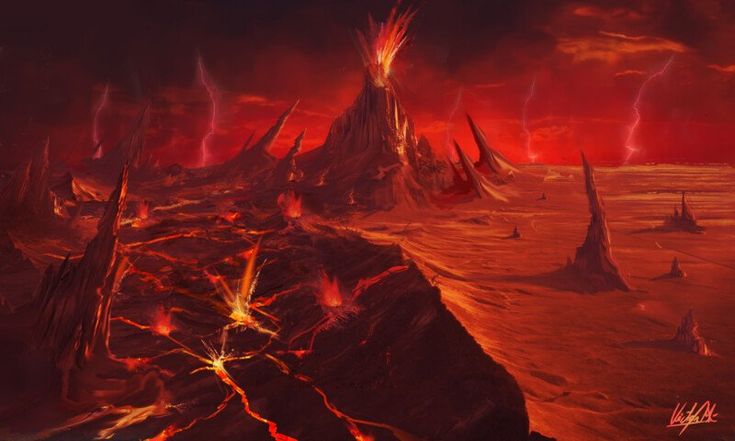
Asmodeus domain exists within the first layer of hell and is a vast metaphysical bureaucracy — a realm of ledgers, soul-courts, iron cities, and contract-forges where every oath becomes architecture and every spirit is reshaped into purpose. The condemned are not tortured for spectacle; they are repurposed into function — scribes, archivists, enforcers, architects of discipline — serving an eternal system where punishment is refinement.
Asmodeus discovered that magic does not merely obey will — it binds to law. Infernal covenants therefore do not grant power symbolically; they alter the soul’s resonance, licensing individuals to wield magic under contractual authority. Pact-mages, inquisitors, magistrates, and warlocks of his order operate like sanctioned agents in a reality where power is regulated, revocable, and owned by the system.
He is neither rebel nor tyrant in his own eyes, but a tragic necessity forged in an age of collapse — an archdevil who believes that the only world worth preserving is one disciplined into permanence, even at the cost of freedom, mercy, and human warmth. To follow Asmodeus is to accept a terrifying question at the heart of Zycore’s cosmology:
What price is a stable world worth — and who decides the terms of survival?
Physical Description
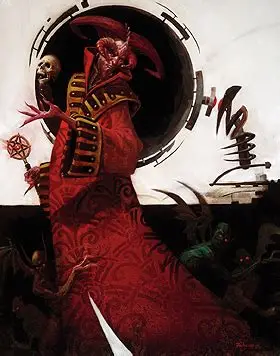
Asmodeus appears not as a horned beast or roaring tyrant, but as a figure of impossible precision and presence — a being shaped the way a law is shaped, deliberate in every line and angle. He stands tall and statuesque, his form lean but iron-strong, built like a pillar meant to bear the weight of ages. His skin is a deep, burnished crimson, not aflame but polished like ancient lacquered stone, etched in places with faint geometric sigils that pulse dimly when he speaks edicts or seals a covenant.
His face is severe and elegantly sculpted — high-boned, symmetrical, unyielding — with lips set in a measured calm that is neither cruel nor kind, only final. His eyes are the most striking feature: twin wells of dark rubied light, within which faint rings of script revolve like orbiting judgments. To meet his gaze is to feel weighed, assessed, measured against a standard older than empires.
Two subtle, backward-swept horns rise from his temples — not jagged or monstrous, but smooth, judicial, and ceremonial, as if carved by intention rather than nature. His hair, long and black like ink poured across stone, is bound in a clasp of dark metal inscribed with the sigil of the Crimson Lexicon.
He is robed in layered garments of black iron thread and blood-red cloth, tailored with an austere perfection — part magistrate, part war-architect. Chains are woven into the fabric like structural supports rather than ornamentation, each link engraved with clauses, names, and sealed pacts. Where others wear armor, Asmodeus wears authority.
His presence does not radiate heat or rage — instead, the air around him grows still and quiet, as though reality itself pauses to listen. Footsteps leave faint sigil-marks upon the ground that vanish like closing contracts. When he speaks, his voice is measured and resonant, like a verdict delivered by a cathedral built for judgment.
Divine Domains
Order-Through-Control: Order in Asmodeus’s doctrine is not harmony, but alignment under pressure. It is the shaping of will into function, the arrangement of society into purpose, and the refusal to let chaos dictate destiny. Under his gaze, every life is assigned weight, role, and task — a place in the machinery of endurance.
Binding Oaths: In Asmodeus’s theology, an oath is a metaphysical bond, as real and as heavy as iron. Words do not live in the air — they carve themselves into the soul. Every promise creates architecture. Every pact becomes a corridor in the Hell-Engine.
Hierarchy: Hierarchy, to Asmodeus, is not oppression — it is load-bearing order. The strong carry chains, the weak are chained to them, and together the structure holds.
Punishment as Stability: In the Infernal System, punishment is a tool of calibration. Suffering is not vengeance — it is the reshaping of a fractured will into something capable of endurance.
Tenets of Faith
1. Order Above All
“Where order fails, worlds perish.”
Chaos is the root of collapse; freedom without restraint leads to ruin. The faithful must preserve structure — in law, in faith, in the self — even when compassion tempts them toward weakness.
2. Purpose Before Desire
“Desire is the fracture of the soul.”
Personal wants mean nothing compared to the function one serves. Will must be shaped into duty. Ambition is tolerated only when it strengthens the system.
3. The Oath Is the Self
“A vow spoken is a life rewritten.”
Promises are binding metaphysical truths. To break an oath is to break one’s own spirit — and the debt must be paid, in labor, obedience, or eternity.
4. Hierarchy Sustains the World
“The chain endures because every link bears weight.”
Power flows downward; obedience flows upward. The strong must enforce structure, and the weak must accept their place within it. Rank exists because the world requires load-bearing souls.
5. Punishment Corrects the Flawed
“Mercy without measure breeds collapse.”
Suffering is not cruelty but calibration. Failure must be corrected so it does not repeat — for one unchecked error can doom many.
6. Authority Is a Sacred Burden
“Command is not privilege — it is sacrifice.”
Leaders are not exalted, they are responsible. To hold authority is to accept consequence, guilt, and the weight of necessary decisions.
7. Power Must Be Licensed
“No gift exists without cost.”
Magic, influence, and privilege are not rights. They are permissions granted by law and covenant — and may be revoked if misused.
8. The Ledger Must Balance
“Nothing endures without a price.”
Nations, cities, and lives survive because someone pays the cost. The faithful do not ask whether a price is required — only who is worthy to bear it.
9. The World Must Endure
“A cold world that survives is holier than a warm world that dies.”
Kindness is not forbidden — only secondary. Survival of civilization, stability of the ages, and preservation of
Titles
The Law Infernal, The Pact-Wrought King, The Architect of Chains, Lord of the Crimson Lexicon, The Sovereign of Binding
Realm
Avernus
Major Cult
The Profane Order

Comments