
Mavedras ul Naveron
Let the fools chase sunlight and salvation. I am the shadow it casts — the consequence of every lie wrapped in gold. Where their goddess blinds with brilliance, I strike from the dusk they dare not name.
— Mavedras ul Naveron, Chapter 4
Mavedras ul Naveron is one of the principal antagonists of Weltengeist. He first appears in Chapter 1 of the story, where he leads the Beschek raid in person to abduct Shava. Only the direct intervention of the god Tanud stops him, and the brief duel that follows is the first time a mortal has stood against Tanud and survived to retreat.
He returns throughout the story as a recurring villain — Highest General of the Navurian Empire's army, operative lead of the Sixth Pillar's inner circle, and the closest thing the theocracy of Janeka has to a sword it can point.
What the Empire does not know about its own weapon is the part that matters most.
Backstory
Mavedras was not made the way other Pathics are made.
The other Nevur — the so-called "sons of the God-Emperor" — were forged through the brutal Ascension Ritual, soul-merged under priestly supervision until what survived could be called a Pathic. Mavedras went through none of it. He is, instead, a biological anomaly. In the womb he absorbed his identical twin, and with the twin came its share of the Weltengeist — a quantity of spiritual essence that no single body is supposed to carry.
This made him a subject of extreme interest to the Sixth Pillar, the Empire's most secret elite faction. To erase every trace of the family that produced him, they killed his entire village. The official record blames an avalanche. The truth is a massacre.
At the age of five he was carried to Navuria and raised as a Nevur — a "son of the God-Emperor" — under a fabricated identity. By seventeen he led the campaign that broke the Seralian Kingdom at the battle of Arazek and gave the Empire the Sea of Vinuria. The general he replaced, who had opposed the Rennan invasion, was quietly removed. Mavedras was quietly elevated.
He has never met the God-Emperor in person. He has never asked to.
Appearance
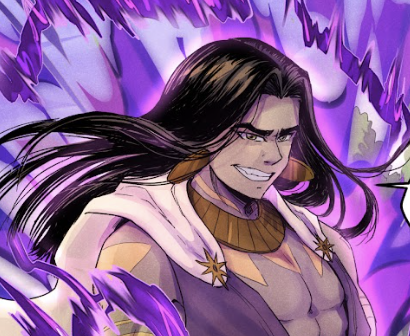
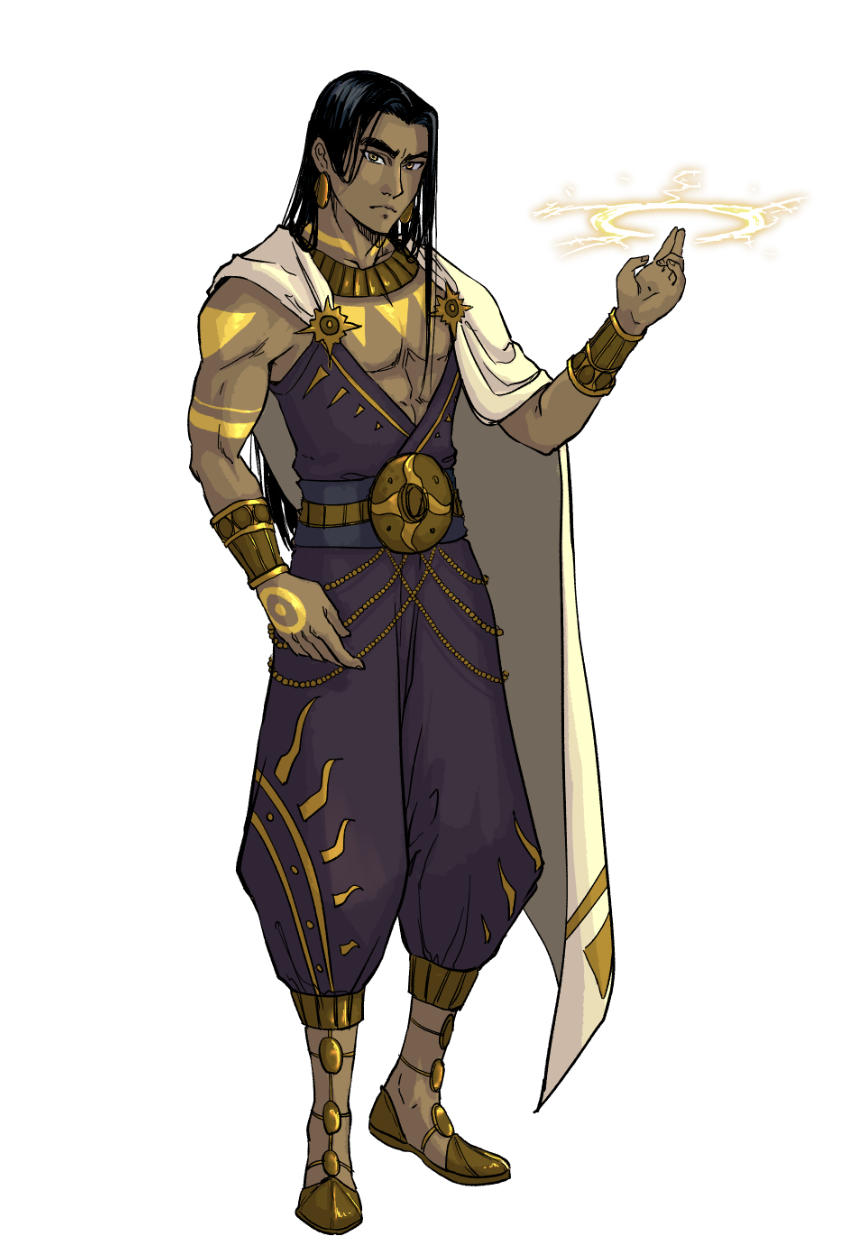
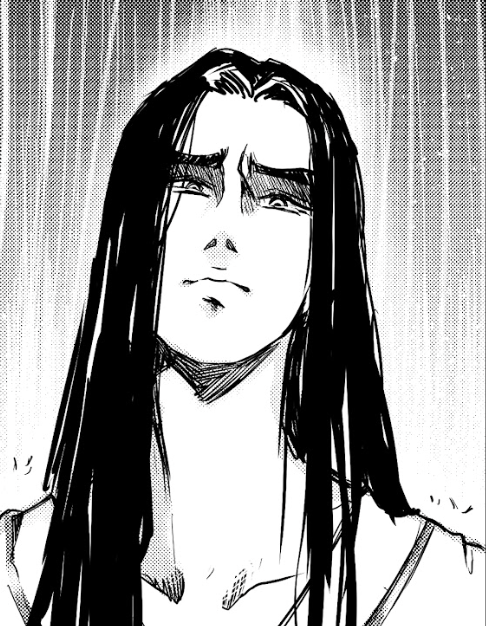
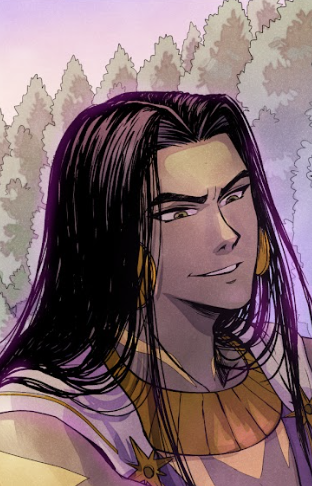
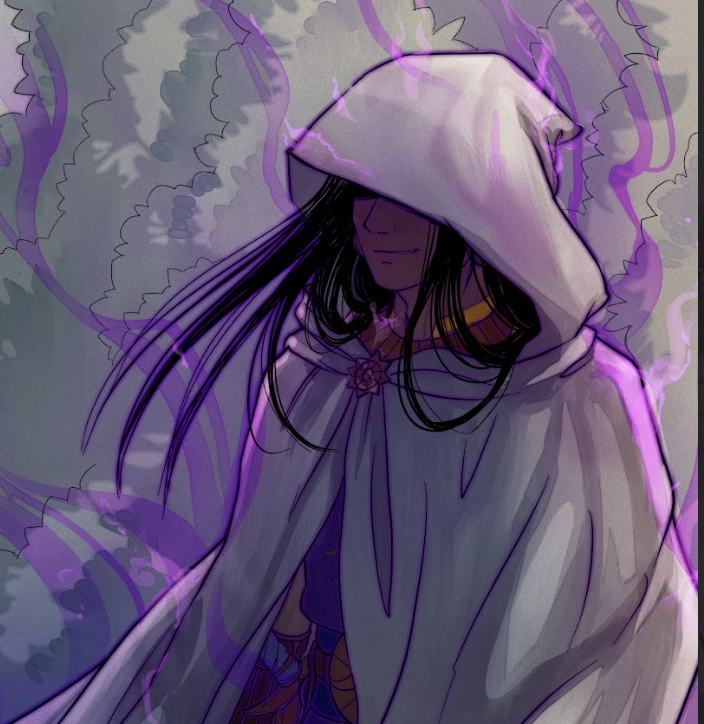
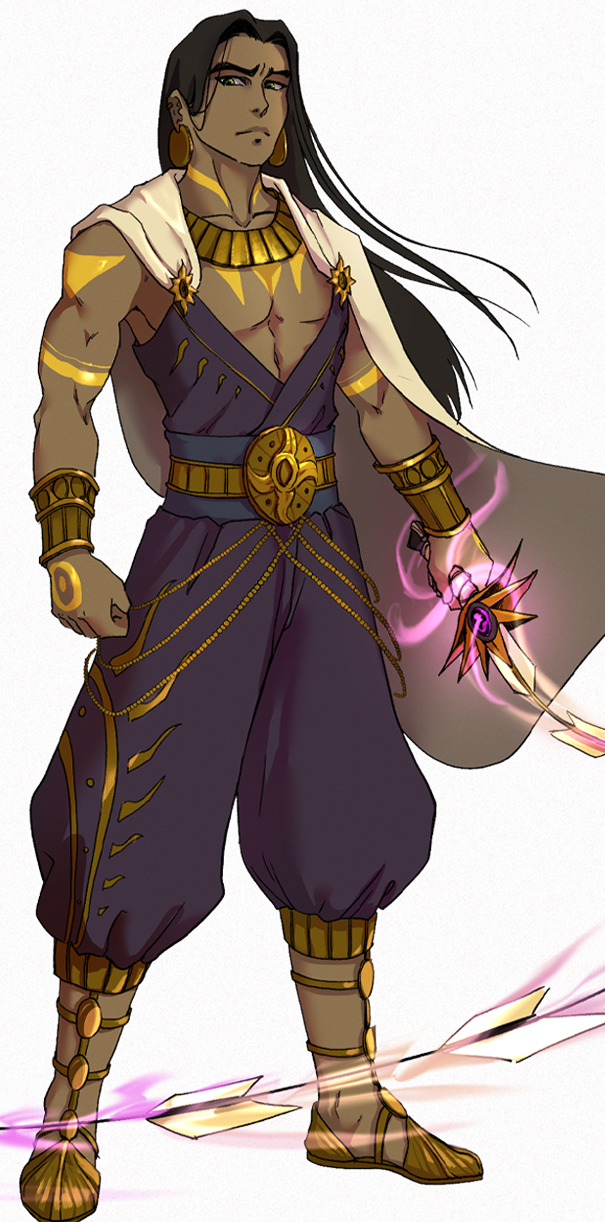
Mavedras is tall, statuesque, and built like a Roraz-Path master — athletic and dense, not massive, the kind of body that announces competence without raising its voice. His skin is tan-mediterranean, smooth, almost statue-perfect. His hair is long, straight, and black, kept past the shoulders — a deliberate imperial status-marker, never careless. His jaw is angular, his cheekbones sharp; his face does not move unless he wants it to.
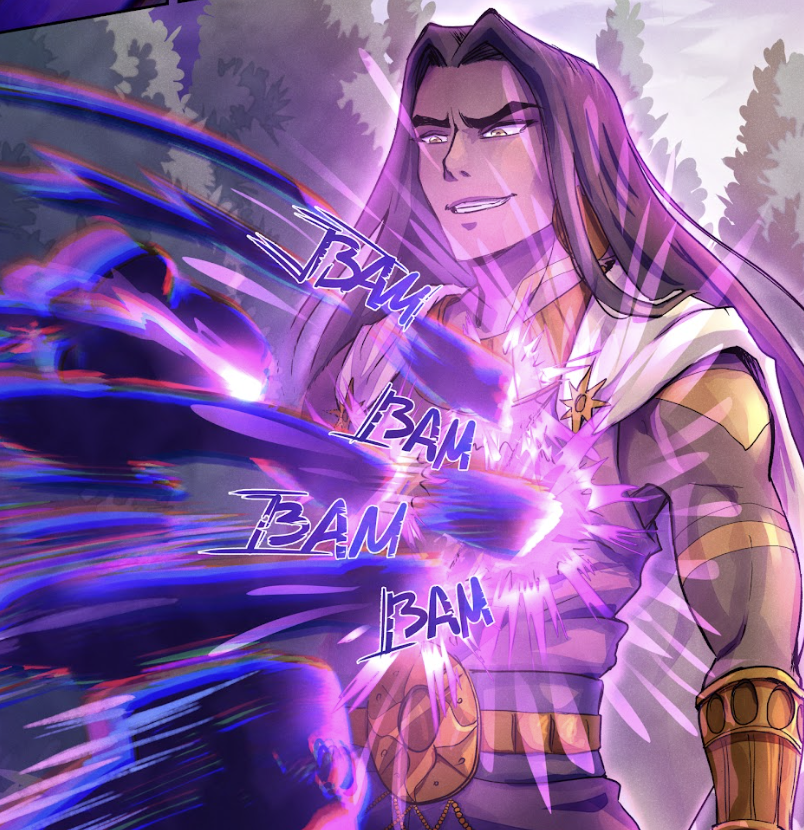
His eyes are green. They stay green as long as he is not using his kinetics — cold, unreadable, almost bored. The moment he draws on the Pathic current they shift to a deep, glowing violet, the canonical visual signature of every Pathic in the world. Nobody who sees the change misreads what follows it.
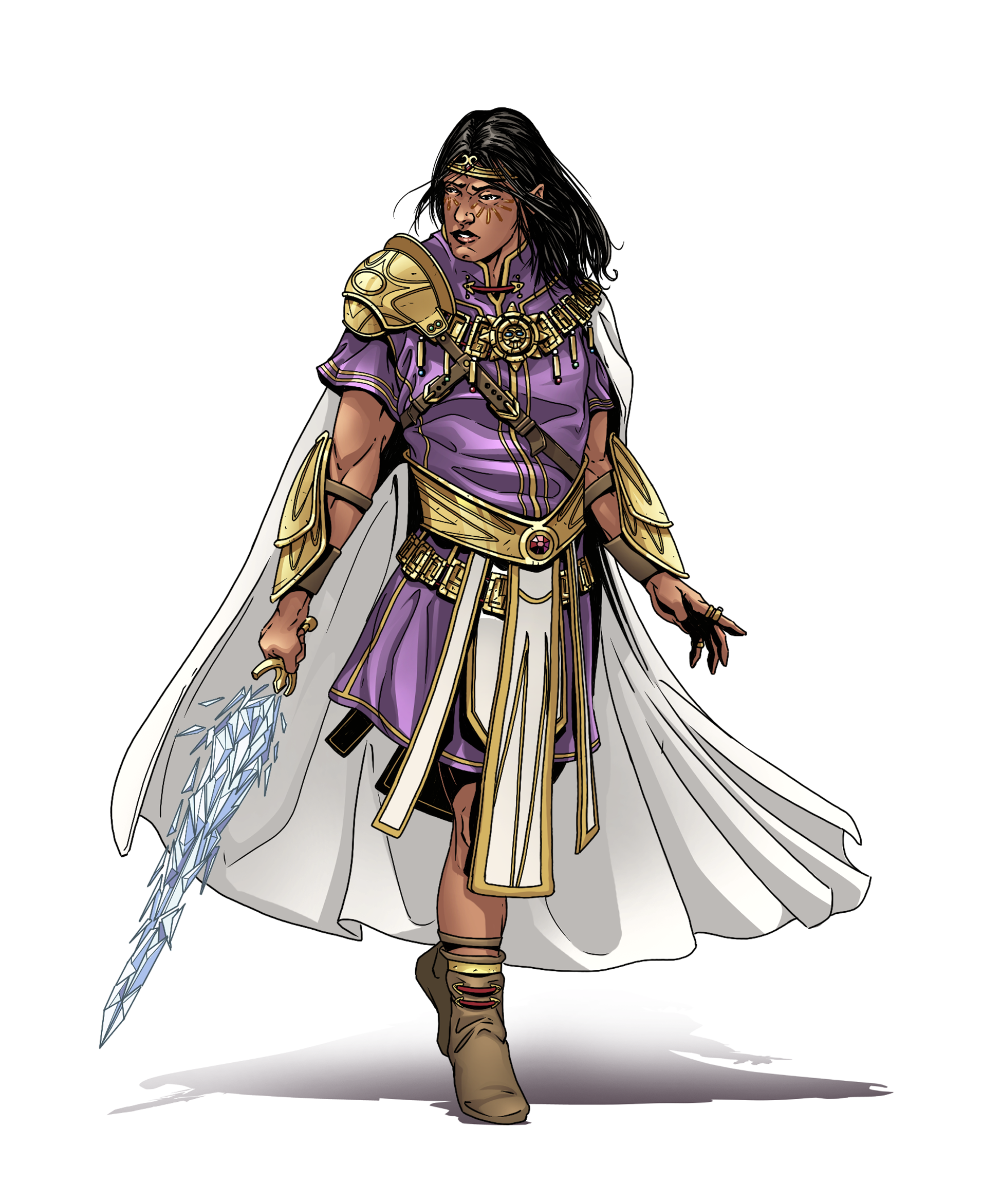
He dresses in an aesthetic that fuses Maya-Aztec nobility with Egyptian pharaonic grandeur, every gold piece a deliberate reference to the sun-doctrine of Janeka:
Beneath the regalia, the message is single and intentional: I am Avenal's instrument. The light is on me, not from me.
The Operations Mask
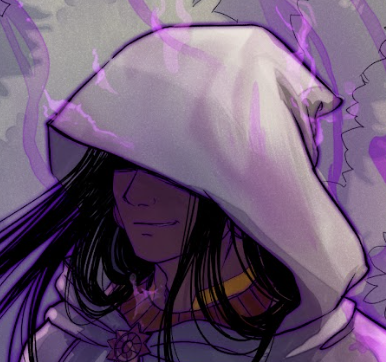
For high-risk Sixth Pillar work outside the Empire — covert Eluvari captures in foreign provinces, eliminations of high-ranking Tanud-followers, off-the-record meetings with allied agents — Mavedras wears a personal mask.
The mask is a flat, hand-sized gilded bronze sun-disc that covers the entire face. Twenty-four fine etched rays run from the centre to the rim, one for each dynasty of the Empire. The eye-slits are deliberately narrow: in repose, only the green shimmer of his eyes is visible through them. When his Pathic current rises, the etched rays fill with violet light and his eyes burn through the slits in the same colour. The change is the only thing the mask reveals about him.
Inside the bronze, against his skin, a private inscription reads: I am not the Prince. I am the Sun.
He did not wear the mask at Beschek. The plan called for no survivors; a mask seemed unnecessary; he authorised his own face. Two survivors — Averon and Shava — now exist who have seen Mavedras ul Naveron unmasked on a Sixth Pillar operation. Officially, nothing has happened. Privately, the inner circle has not forgotten.
Personality
Outwardly, Mavedras is calm, exact, and cold. He speaks softly and rarely smiles; when he does, it is a thin, almost bored lift of one corner. He stages his violence — every kill he can afford to stage is staged — and he expects an audience to read the staging correctly.
Inwardly, there is very little there to find. His memories of childhood were stripped before they could form. The conditioning the Sixth Pillar replaced them with did not leave room for empathy, and the years since have not grown it back. He completes his missions with the same exactness he applies to his appearance. He is bored most of the time, and the only thing he reliably enjoys is the moment something becomes interesting again — a strong opponent, a strange anomaly, a creature like Averon.
He believes, fanatically, that he serves the God-Emperor. He does not know that this belief is the most successful piece of work the Sixth Pillar has ever done.
Powers & Abilities
Focus Duality. Because he absorbed his identical twin in the womb, Mavedras carries a doubled share of the Weltengeist — the spiritual essence that powers all kinetic ability. He is a Pathic by output and a structural anomaly by origin: an Eluvari without any of the canonical markers (no white hair, no permanently violet eyes), and the only known case of a natural ascent to Pathic-tier without external soul-absorption. The Sixth Pillar reads this as divine favour. Tanud, in the Beschek confrontation, appeared to read it as something else entirely.
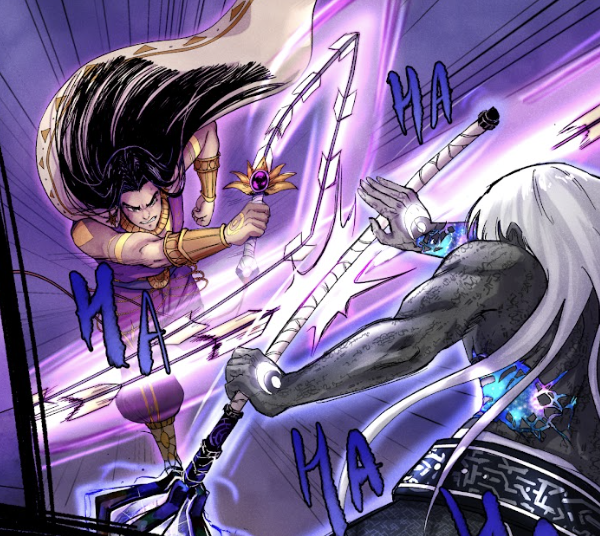
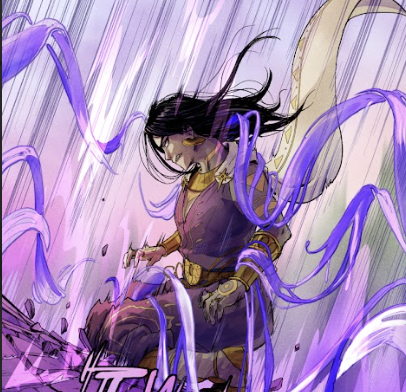
The Roraz. A legendary kinetic chainblade — a flexing core of imperial steel strung with arrowhead-shaped blade segments, mentally guided by the wielder. At rest it hangs at his belt like a coiled rope of dark glass. In motion it extends into a five-to-six-metre whip-sword whose path he commands with thought alone. His mastery of the Roraz Path is canonically among the three highest in the Empire. His signature move, the Sun-Crown, detaches the Roraz from its grip entirely: eight arrowhead segments hover in a slow circle around him, joined by ribbons of violet-pink kinetic energy. He does not move. The blades do the moving for him.
Strategic Genius. His campaign at Arazek shattered the Seralian Kingdom and gave the Empire the Sea of Vinuria when he was seventeen. He is, by reputation, as dangerous in a war-room as he is on a battlefield — patient, asymmetric, willing to spend whatever the operation requires. He is the only general the Sixth Pillar trusts with both political and military authority simultaneously. The other Nevur do not like this. He does not care.
Relationships
Name
Jevanu The God-Emperor Vorenis Averon Shava Tanud
Jevanu The God-Emperor Vorenis Averon Shava Tanud
Nature
The only person he trusts. Fellow Nevur, fellow brainwashed. Possibly more. The mythic father he has never seen. The reason he believes he exists. His tool inside the Sixth Pillar. Useful. Replaceable. Knows it. His most successful target who became his most unsolved question. His most successful capture. He uses her without sentiment. The god who stopped him at Beschek. The first opponent he could not finish.
The only person he trusts. Fellow Nevur, fellow brainwashed. Possibly more. The mythic father he has never seen. The reason he believes he exists. His tool inside the Sixth Pillar. Useful. Replaceable. Knows it. His most successful target who became his most unsolved question. His most successful capture. He uses her without sentiment. The god who stopped him at Beschek. The first opponent he could not finish.
Gallery

Trivia
- The name "Mavedras" was given to him at the age of five, on arrival in Navuria. Its roots are mythological: "Mavros" (an old word for dark) and "Andras" (a demon of chaos in pre-Janeka folklore). The Sixth Pillar liked the omen.
- His original birth name is unknown — to the Empire, to the Sixth Pillar, and to himself.
- He has personally never been defeated in single combat by a mortal opponent. He has been stopped, exactly once, by a god.
- The gold tattoos along his arms are not decorative. They were applied during the ritual that locked his fabricated identity in place. If they were ever removed, the conditioning beneath might still hold. Or it might not.
Mavedras ul Navur
Character Profile
Species
Human
Gender
♂ Male
Age
approx. 22 years
Height
182cm
Aliases
Bloodmoon
(by The Sixth Pillar)
(by The Sixth Pillar)
Relatives
Jevanu
Avaru
Avaru
Faction
Navurian Empire
Sixth Pillar
Sixth Pillar
Position
Nevur of War
Member of Triumvirate
Member of Triumvirate
Biographical Profile
Status
Alive
Place of Birth
Officially: Navuria
Actually: Teli
Actually: Teli
Powers
Weapons
Roraz
Abilities
Outter Kinetics
Gestalt
Anomalies
The Pathway
Gestalt
Anomalies
The Pathway
| Known as | The Seventeenth Prince · Hand of Avenal · The Sun-Crowned |
|---|---|
| Status | Alive · active |
| Affiliation | Navurian Empire · Sixth Pillar (Inner Circle) · Hammer-Dynasty Pharos |
| Role | Highest General of the Navurian Army · Sixth Pillar Operations Lead |
| Power Tier | Pathic — suspected Strong Tangled (anomalous origin) |
| Combat School | Roraz Path (Master) · Mirror School (Pathic Tier 3) |
| Age | ~22 |
| First appearance | Chapter 1 — Beschek Raid |
Children