
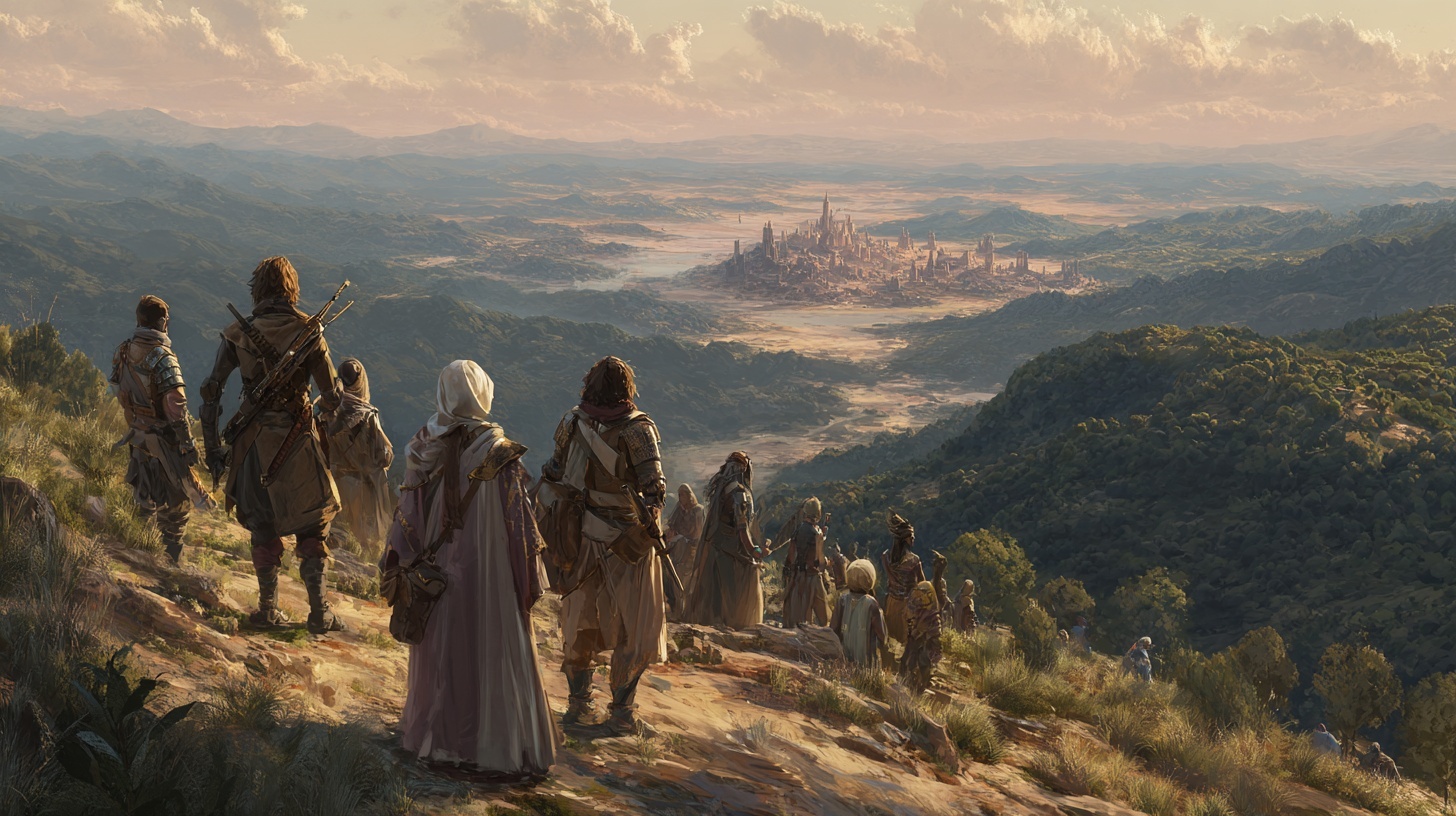
Human
Humans of Wakodia
Overview
Humans are one of the younger mortal races of Wakodia, emerging long after the arrival of the gods and the elder peoples. Despite this late beginning, humanity has become one of the most widespread and influential races in the world. Human societies are defined not by a single culture or belief, but by adaptability, ambition, and resilience.Where other races endure through longevity, tradition, or divine favor, humans endure through change. They build quickly, expand readily, and adapt their customs to new lands with remarkable speed. This flexibility has allowed humans to thrive across nearly every continent, forming empires, trade networks, and philosophies that continue to shape Wakodia’s history.
Physical Traits
Humans exhibit the greatest physical diversity of any major race. Skin tones, facial features, hair textures, and eye colors vary widely depending on ancestry, region, and cultural lineage. This diversity reflects humanity’s broad geographic spread and long history of migration.Most humans stand between 5 and 6½ feet tall, with builds ranging from slender to robust. Their bodies tend to reflect their environment and lifestyle more strongly than innate racial traits.
Lifespan: Humans typically live between 70 and 100 years, though magic, exceptional health, or rare circumstances can extend this range.
Culture and Society
Human cultures are extraordinarily varied, shaped by geography, history, and interaction with other races. Some human societies emphasize discipline and hierarchy, others value trade and diplomacy, while still others prioritize endurance, artistry, or communal survival.What unites most human cultures is a shared emphasis on personal agency. Humans tend to believe that status, success, and legacy are earned rather than predetermined. This outlook fuels innovation, ambition, and—at times—conflict.
Human settlements range from isolated villages and nomadic caravans to sprawling cities and world-spanning civilizations.
Religion and Belief
Human belief systems are as diverse as their cultures. Many humans revere the Twin Luminaries—Soldeus and Lunara—as guiding forces of balance, ambition, and reflection, but this reverence is far from universal.In the Heilig Empire, Alexandros Bloodflame holds a central and uniquely exalted place in human faith, worshiped as a divine figure and spiritual cornerstone. Elsewhere, humans may follow regional gods, ancestral spirits, philosophical traditions, or pragmatic belief systems rooted in survival, trade, or self-mastery.
Human spirituality tends to be adaptive rather than rigid, often absorbing new ideas without fully abandoning old ones.
History and Role in the World
Humans rose to prominence during periods of decline, stagnation, or isolation among older races. Their rapid population growth, willingness to cooperate across cultures, and drive to expand allowed them to fill power vacuums and establish lasting influence.The founding of the Heilig Empire, the spread of human trade networks across Ramaal and Zerokai, and humanity’s central role in many post-Cataclysm developments have cemented humans as a dominant force in Wakodia—not through inherent superiority, but through persistence and ambition.
Relationships with Other Races
Human relationships with other races are shaped largely by proximity and necessity.Elves are often admired for their wisdom and artistry, though humans may find their pace frustrating. Dwarves are respected for craftsmanship and tradition, but disagreements arise over innovation and change. Other races encounter humans as traders, settlers, rivals, or allies—often all at once.
Human adaptability allows them to integrate into foreign societies more readily than most races, for better or worse.
Human Cultural Lineages
While all humans share a common origin, centuries of migration and adaptation have given rise to distinct cultural lineages and ethnic identities. These include, but are not limited to:Albionites — The agricultural and civic backbone of Stonefell
Heiligen — The disciplined and imperial people of the Heilig Empire
Nordravans — The hardy northern clans of Stonefell and the Ruska regions
Ramaalians — Desert travelers and endurance-focused peoples of Ramaal
Yoakejin — Disciplined artisans and philosophers of Yoake and the Silken Dynasty
Zafirians — Traders, brokers, and cultural leaders of the Golden Concord
These lineages reflect how humanity expresses itself differently across environments, rather than rigid biological divisions.
Playing as a Human
Humans are defined by versatility and adaptability, making them suitable for nearly any role or path.
Age: Humans reach adulthood in their late teens and rarely live beyond a century. Alignment: Humans tend toward no particular alignment; the best and worst of Wakodia are both found among them. Size: Humans vary widely in height and build. Your size is Medium. Speed: Your base walking speed is 30 feet. Languages: You can speak, read, and write Common and one other language of your choice.
Versatile Talent: You gain proficiency in one skill or one tool of your choice.
Related Organizations

Comments