


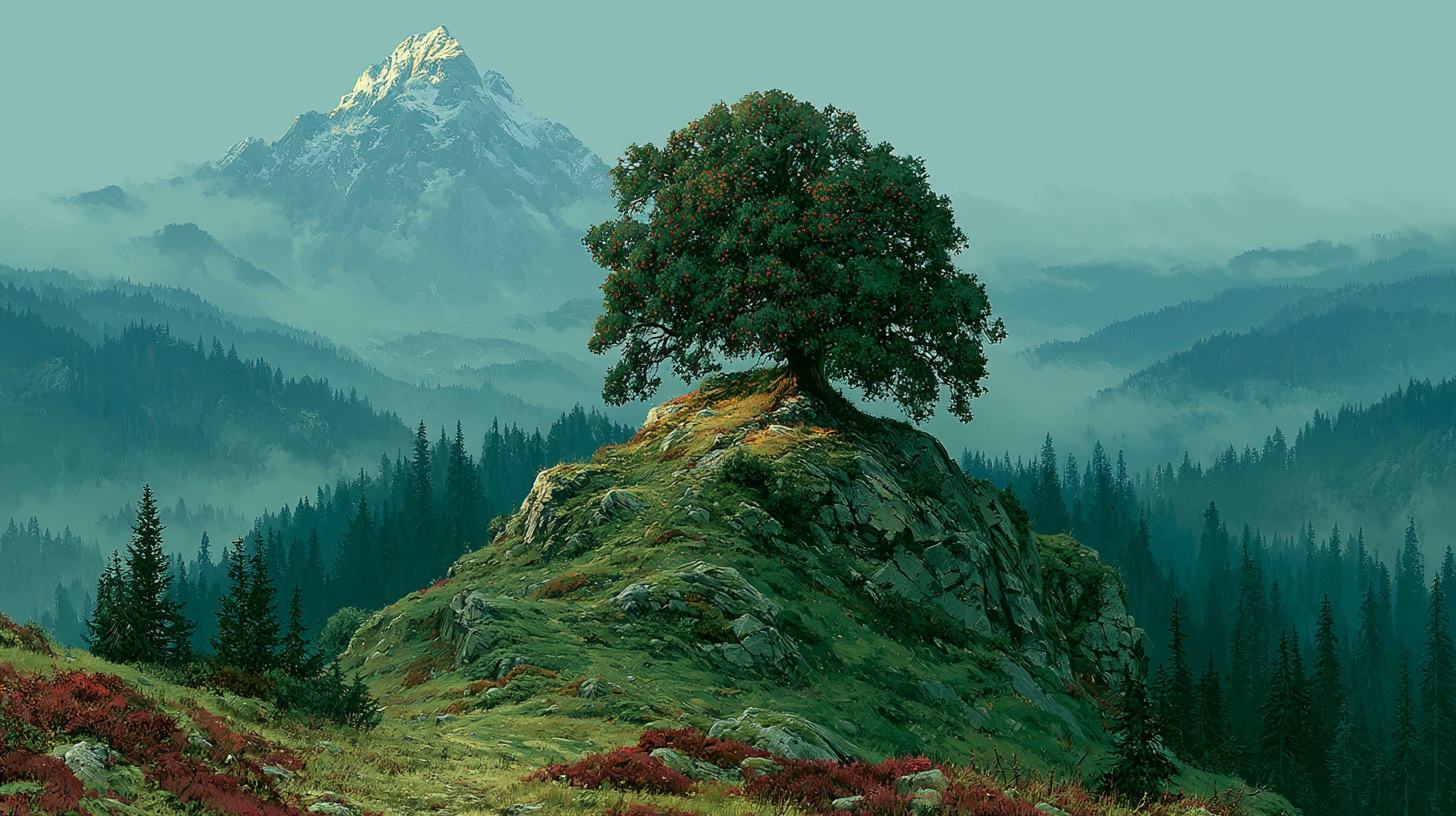
The Wytch Tree
What You Need
Little crow, mind what you're told,
Not all gifts are bought with gold.
If a tree should call to thee,
Shut your eyes and let it be.
Take the lantern, take the ring,
Take whatever branches bring.
Need will smile and call it grace,
While sorrow learns your name and face.
Little crow, if hunger stays,
Walk the long and harder ways.
Many gifts look good at first,
But every blessing hides a curse.
There was once a cooper named Bastajin de Brujin who lived in a narrow village beneath the western slopes of the canton of Rinlin, where the houses leaned into one another as if sharing warmth and the mountain winds came down hard enough in winter to make doors groan like old men in their sleep. Bastajin was not a wicked man, and that is where the tale begins its trouble, for the Arin have little use for stories in which only monsters are punished. He was careful, sober, and hardworking, the sort of man who kept his tools oiled, his accounts honest, and his children fed whenever there was food enough to divide. His wife, Anra, was gentle by nature but sickly after the birth of their third child, and the village physician told him in the dry voice of one who has delivered too much bad news that she would not live to see the thaw unless stronger medicine could be found.
Bastajin did what desperate husbands do. He borrowed from men he disliked, promised work he had no hours left to perform, and walked from house to house with his cap in his hands until pity had been spent as thoroughly as coin. The medicine Anra needed came from beyond the pass, and the pass had already begun to close beneath early snow. No trader would risk the road for a cooper’s wife, and no prayer Bastajin spoke seemed to rise higher than the rafters of his own poor house. On the seventh night of Anra’s fever, when her breath had become thin and her hand no longer tightened around his own, Bastajin took a lantern and went into the woods to gather deadfall, because there are moments when a man continues working not because work can help him, but because stillness would make him understand too much.
He wandered farther than he intended. Snow had softened the old paths, and the trees appeared unfamiliar under the moonless sky. Near midnight he came to a hollow where no hollow had ever been, a bowl of black earth ringed by roots like fingers curled around a secret. At its center stood a tree unlike any that grew in those mountains. Its trunk was pale and smooth, its branches bare despite the season, and from one low limb hung a small leather pouch tied with red thread. Bastajin knew before he touched it what lay inside. Desperation has its own intelligence. A starving man does not need to be told the meaning of bread, and a husband with a dying wife needs little instruction in the shape of mercy.
Inside the pouch was a vial of amber medicine, sealed with wax and still warm from some unknown keeping. The tree gave no sound. Its branches did not move. No bargain was spoken, no spirit stepped from the bark, and no price was named. Bastajin took the vial and ran home through snow that seemed suddenly easy beneath his feet. By morning Anra’s fever had broken. By the following evening she sat upright and drank broth. Within a week she laughed at something their youngest child said, and Bastajin wept so hard that he had to leave the room, ashamed of being seen so grateful.
For a time, no darkness followed. That is why the old people say the Wytch Tree is more dangerous than a demon, for a demon hurries toward ruin, while the tree allows gratitude to ripen first. Anra regained her strength, the children grew rosy again, and Bastajin’s work prospered. Those who had pitied him now called him blessed. When asked how the medicine had been found, he said only that the mountain had provided, which was not exactly a lie and therefore sat more comfortably in his mouth than truth.
Years passed before Bastajin saw the tree again. By then his eldest son, Corren, had become a restless youth with his father’s hands and none of his caution. He wished to leave Rinlin, to take work in Venlin or beyond, and he spoke often of a life larger than barrels, winter stores, and village debts. Bastajin feared the world would swallow the boy, as the world often does with sons who mistake distance for destiny. On the night before Corren meant to depart, Bastajin walked alone into the woods to think, and there, in a hollow where no hollow should have been, stood the pale tree. From its branch hung a folded passmark, properly sealed, bearing Corren’s name and granting safe passage through every checkpoint between Rinlin and the lowland roads.
Bastajin did not take it at first. He circled the tree until dawn grayed the snow and told himself that a father must not meddle with the road placed before his child. Yet fear speaks with the voice of wisdom when it wants to be obeyed. At last he took the passmark home and placed it beneath Corren’s pack, where the boy found it with astonishment and joy. The document proved flawless. Corren reached the cities safely, found work under a respected builder, and sent letters full of gratitude. Bastajin read those letters aloud beside the fire, proud enough to forget the hollow in the woods and the silent branch waiting above him.
The third gift came when Bastajin’s daughter Kristien fell in love with a miller’s son from a neighboring village. The match was good in affection but poor in fortune. Bastajin had no dowry to offer, and the miller’s family, though not cruel, refused to bind their son to hardship. Anra told Bastajin that young people must bear disappointment as others had before them, but Bastajin had already learned a secret most men should never learn. He had learned that need could be answered. That winter he sought the hollow deliberately. He told himself he was not asking for wealth, only fairness. He told himself many things before he found the tree standing beneath a sky full of cold stars, with a purse of silver hanging from its lowest branch.
Kristien married in spring. The wedding was merry, the tables full, and Bastajin danced with his daughter beneath lanterns strung from the mill beams. No one asked too closely where the silver had come from. People rarely question a blessing when it arrives in a form they can spend. Yet from that day forward the miller’s family looked at Bastajin differently, with a respect that contained suspicion. The young couple began their life surrounded by gifts bought with money that had no history, and money without history breeds stories faster than mold in damp grain. Within two years the neighboring village had turned against itself over accusations of hidden debts, stolen coin, and false prosperity. Kristien remained married, but joy fled her house early and did not return.
Bastajin began to notice then that every gift the tree had given had indeed answered the need before him, while opening some farther door he had not thought to guard. Anra had lived, but the years after her recovery had bound Bastajin to fear with a chain no gratitude could break. Corren had left safely, but he never came home again except as a guest who spoke of the mountains with polite distance. Kristien had married the man she loved, but the silver that made the match possible had seeded distrust in the soil around them. Still, Bastajin did what most people do when conscience begins counting aloud. He argued with it.
The last time he found the tree, he was an old man. Anra had died peacefully the previous autumn, and his children were scattered across the world in the ordinary way that feels like betrayal only to the parent left behind. Bastajin went into the woods not because he needed anything, but because he wanted to know whether the tree would still appear. It stood waiting in the hollow, pale and patient, with one final object hanging from its branch. It was a child’s wooden cup, the very one his youngest had used during the winter of Anra’s sickness. Bastajin reached for it and stopped, because at last he understood the cruelty of the thing before him. The tree had not cursed him, deceived him, or taken payment in any form a judge could name. It had merely given him what he needed each time he was too frightened to ask what his need might cost.
He left the cup hanging there. Some versions say he walked home and never spoke of the tree again. Others claim he cut off his own hand so he could never take another gift, though the Arin usually dismiss that ending as lowland foolishness added by people who prefer blood to truth. The oldest tellers say only that Bastajin returned to his empty house before dawn, extinguished every lamp, and sat in the cold until morning, listening to the wind move through the eaves like branches shifting overhead.
The Wytch Tree is still said to stand somewhere in the high places of Rinlin, though no map records it and no wise traveler seeks it. The Arin do not say its gifts are false. That would make the warning too easy. They say instead that the tree gives exactly what is needed, and that this is why one must fear it. For a man may survive hunger, grief, sickness, and poverty, yet be undone by the thing that saves him from them when he mistakes rescue for mercy and relief for wisdom.
“Misfortune announces itself with drums. Ruin arrives dressed as an answered prayer.”
Date of First Recording
Once Upon A Time...
Related Species
Related Locations
Related Organizations



#Love it
<3