


Structural Memory
Nice Bones
"Stand long enough among the ruins, and you will understand that we are not the inheritors of greatness, but its latecomers. These stones were set with a certainty we have yet to recover, and though they lie broken, the intent behind them still towers over anything we dare to build."
There is a quiet arrogance in the way people look at ruins.
They walk through broken halls and collapsed chambers and assume they are seeing the end of something. A final state. A corpse of stone and timber that has already told its story and has nothing left to offer beyond speculation. Walls are measured, debris is catalogued, and conclusions are drawn from what remains visible, as though absence were not itself a form of evidence.
Structural Memory exists to correct that mistake.
It does not restore what was lost. It does not rebuild, repair, or grant the structure any return to function. The ruin remains a ruin. The broken stones remain broken. The gaps remain gaps. What the spell does instead is far more unsettling, because it does not change the world. It changes how much of it you are forced to acknowledge.
When the casting is complete, the structure reveals itself, not as it stands, but as it was when it last held together as a whole. The effect is not a vision in the conventional sense. There is no separation between present and past. No shifting of the environment into some distant moment. The ruin does not vanish.
It is simply no longer alone.
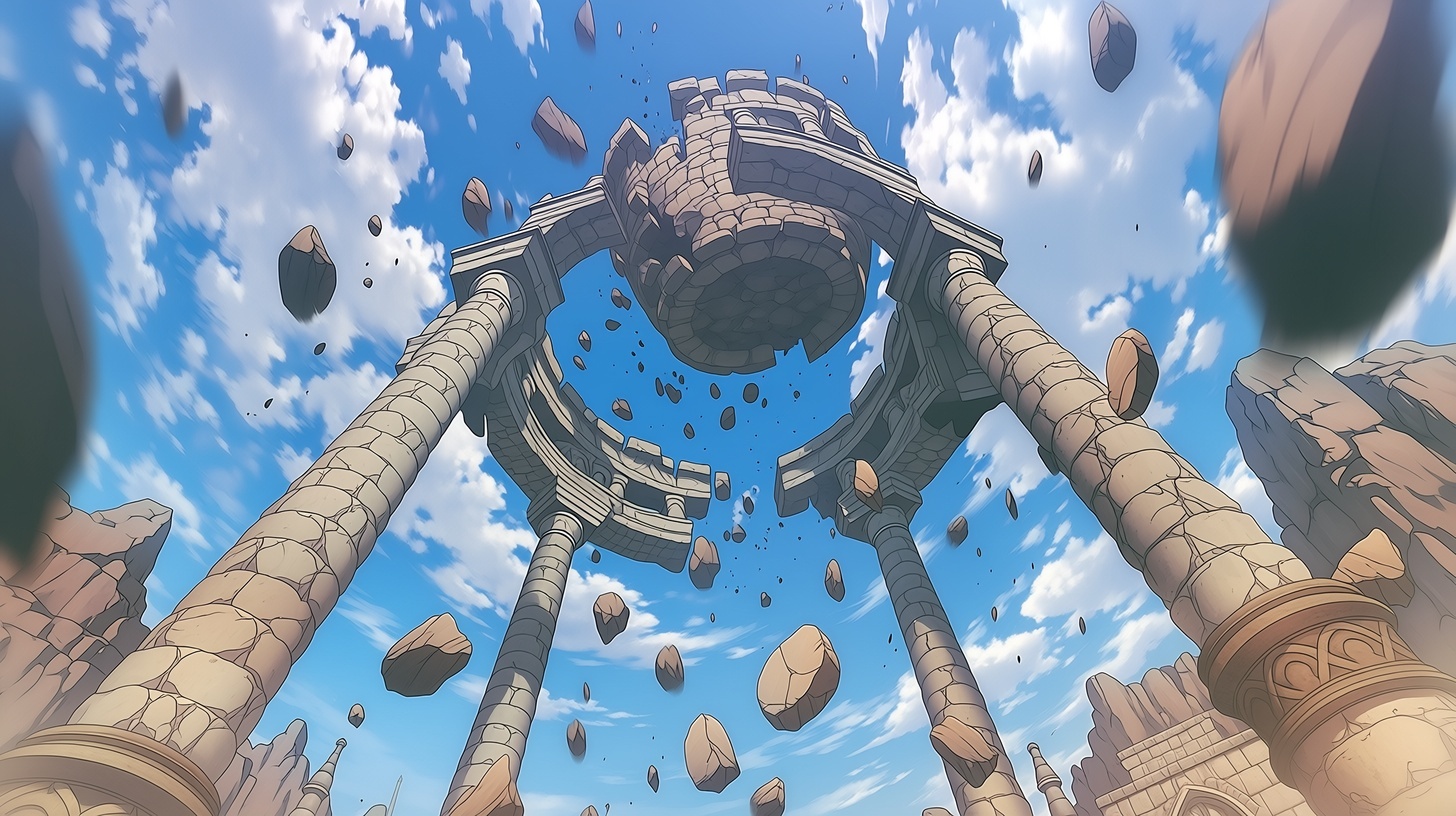
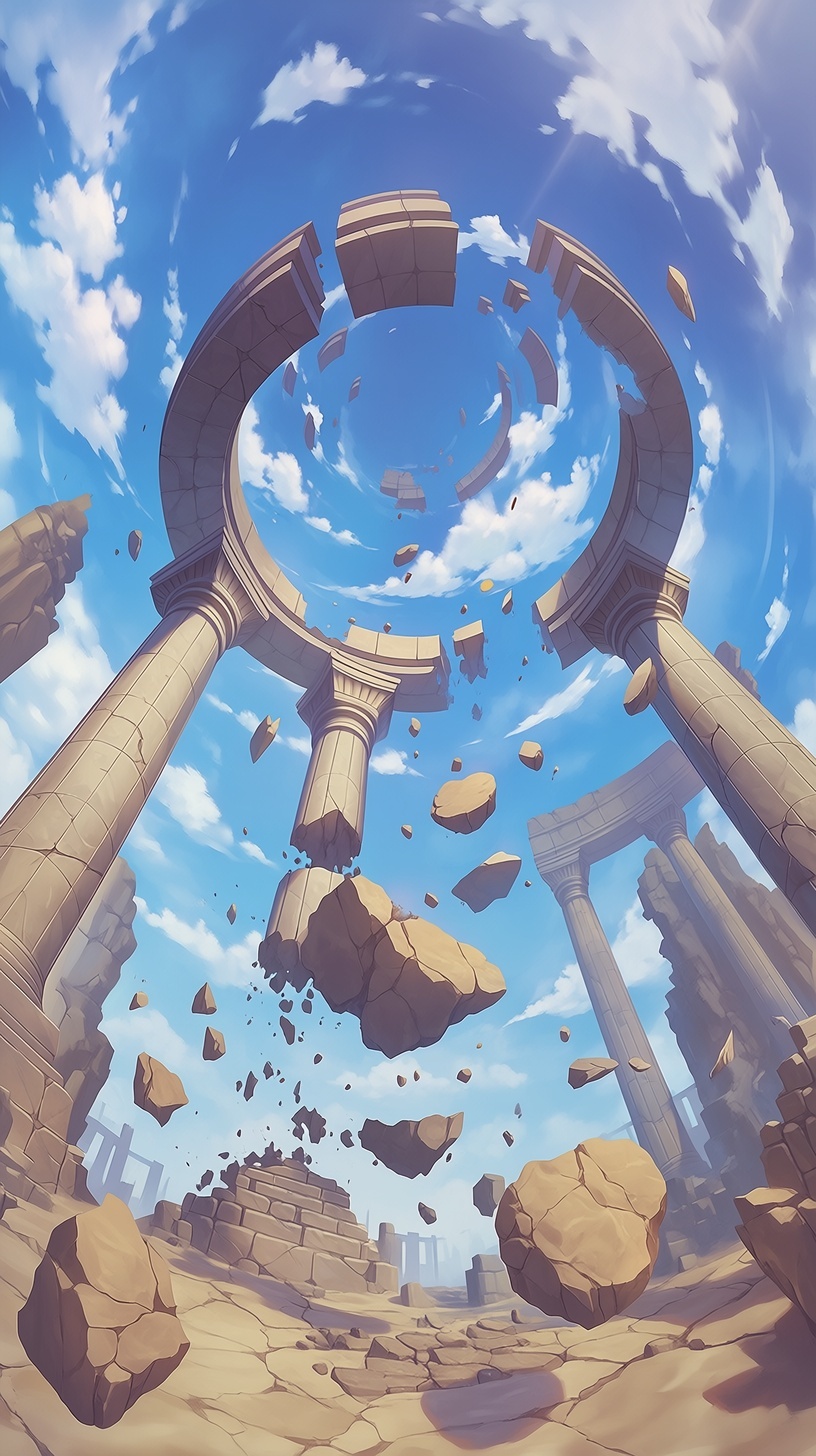
The intact structure overlays the remains with a precision that leaves little room for comfort. Walls rise where only foundations linger. Ceilings stretch overhead where the sky once intruded. Doorways stand complete, their frames aligned perfectly with the fragments that survived. The present and the past occupy the same space, and the mind is left to reconcile them without the courtesy of distance.
This reconstruction is not a perfect illusion. It does not pretend to certainty where none exists. Missing sections do not fill themselves in with confident fabrication. They remain incomplete, rendered in faint, translucent forms that suggest shape without claiming accuracy. The spell does not lie. It admits what it does not know.
That honesty makes the rest of it far more difficult to dismiss.
The caster perceives the structure as it was in its final intact state, but even that definition carries its own complications. Buildings are not static things. They are altered, repaired, expanded, damaged, and repurposed over the course of their existence. Structural Memory does not select a single moment of perfection. It settles on the last version of the structure that could reasonably be called whole, and even then, it does not smooth over the contradictions.
Layers appear where layers once existed. A wall may carry the outline of an earlier doorway that was sealed long before the final collapse. A chamber may show signs of reinforcement added after some forgotten failure. Repairs that were never fully integrated stand out in subtle misalignments, their presence recorded in the geometry of the reconstruction. The structure remembers what was done to it, even if it does not explain why.
This is where the spell becomes invaluable to those who know how to read it.
Treasure hunters, for all their reputation, are not merely seekers of wealth. The successful ones understand that the true value of a ruin lies not in what is immediately visible, but in what can be inferred from the relationship between what remains and what is missing. Structural Memory provides that relationship in a form that can be studied, questioned, and, with enough patience, understood.
Hidden spaces reveal themselves not by opening, but by contradiction. A wall that appears solid in the present may, in the reconstruction, show a hollow where a chamber once existed. A collapsed corridor may reappear in alignment with passages that no longer connect. These are not revelations in the sense of secrets being handed freely to the observer. They are opportunities to notice that something does not match.
The spell does not solve the puzzle. It shows you the shape of it.
Archaeomancers, perhaps more than any other group, have developed a particular respect for this kind of magic. Their work depends on understanding structures that were built under conditions no longer fully understood, by hands guided by principles that may have been lost or altered by the passage of time. To them, a ruin is not merely a site of interest. It is a record, incomplete but persistent, of decisions made long ago.
Structural Memory allows them to read that record more clearly, but it also introduces a complication they are uniquely equipped to appreciate.
The past, when seen in this way, is not stable.
The reconstruction reflects the structure’s final intact state, but that state itself may be the result of multiple conflicting alterations. A tower that was expanded, partially destroyed, and rebuilt may present a form that carries all of those histories at once. A temple repurposed by successive faiths may show architectural elements that were never intended to coexist. The spell does not choose a single narrative. It preserves the contradictions.
For the untrained, this can be disorienting.
A corridor appears to lead somewhere that no longer exists. A staircase rises into open air. A door opens onto a chamber that was sealed generations before the structure fell. These are not errors in the magic. They are accurate reflections of a structure that did not live a simple life.
The mind, accustomed to clean continuity, resists this at first. It seeks a single, correct version of the building. It tries to decide which elements are real and which are not. Structural Memory offers no such comfort. Everything shown was real, at some point. The question is not whether it existed, but when, and in relation to what else.
There is a particular stillness that settles over those who spend time within the effect of this spell. It is not the stillness of peace, but of attention. The structure, in its layered state, demands to be read carefully. Every inconsistency is a clue. Every alignment, every misalignment, carries information that was invisible before.
With enough time and focus, patterns begin to emerge.
A hidden chamber becomes apparent not because it is revealed outright, but because the surrounding structure makes more sense with its existence than without it. A structural weakness presents itself in the way a load-bearing wall was reinforced, suggesting a point of failure that may still be exploited. The original purpose of a space becomes clearer as the accumulated alterations are mentally stripped away, revealing the intent beneath the modifications.
This is the true strength of the spell. Not revelation, but context.
And yet, there is an aspect of Structural Memory that is rarely discussed outside of quiet conversations and private notes.
The structure remembers.
Not in the sense of consciousness or intent, but in the persistence of its form. What was built leaves an impression that does not fully vanish when the material is lost. The spell does not reach into time to retrieve the past. It draws upon something that remains embedded in the present, something that allows the past to be reconstructed with this level of fidelity.
That implication is not a comfortable one.
If a building can retain the memory of its form, then the world is not as transient as it appears. The act of construction leaves a mark that endures beyond the destruction of the materials involved. Every wall raised, every chamber carved, every alteration made becomes part of a pattern that can be recalled under the right conditions.
This raises questions that most prefer not to follow to their conclusion.
What else retains such memory?
What other structures, natural or otherwise, carry the imprint of what they once were, waiting for the right method to reveal it? The spell is limited, deliberately so, to physical structures that can be defined and contained. It does not extend to landscapes, to cities as a whole, or to more abstract constructs.
It does not need to.
It demonstrates the principle clearly enough.
For the duration of the spell, the caster stands in two versions of the same place. One broken, one whole. One defined by absence, the other by what once filled it. Neither replaces the other. Both are true.
And in that overlap, there is a moment, brief but undeniable, where the ruin ceases to be a mystery of what was lost and becomes something far more precise.
A record of what refuses to be entirely gone.
"We do not study antiquity to learn what was. We study it to confront what we are not. For every fallen arch and buried hall speaks of a world that knew its shape, its purpose, and its place in the greater order. We walk among fragments of that certainty, and call it history."
Related School
Level



Comments