


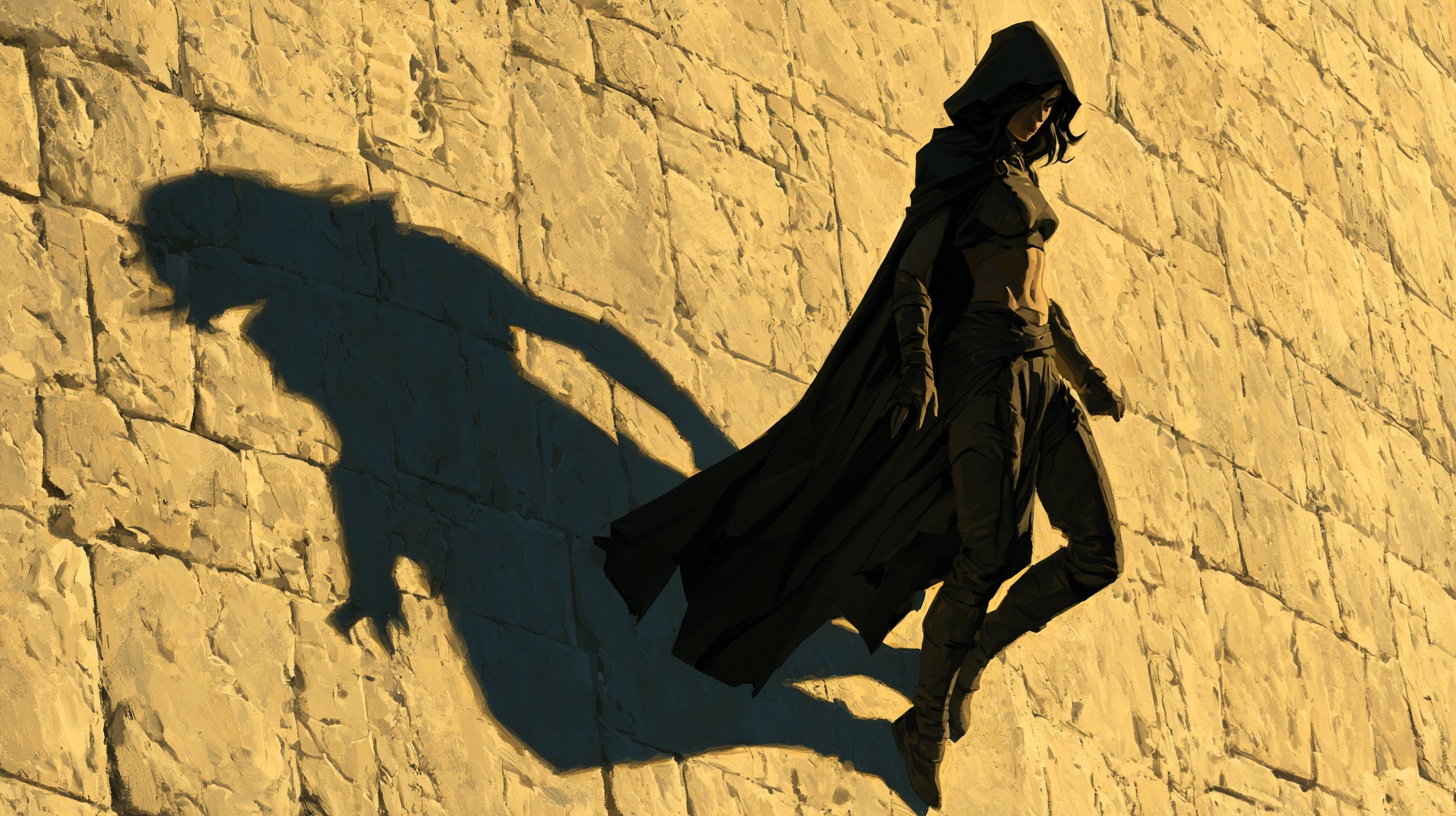
Shadow Step
Darkness Calls
“I looked away for only a breath, yet somehow his shadow remained where he stood after the man himself had already vanished.”
Shadows touch long before people do.
Across crowded streets, torchlit corridors, moonlit rooftops, and cathedral halls, darkness stretches between living things constantly, overlapping and reconnecting in ways most creatures never notice. Certain spellcasters eventually learn those connections are more than visual absence.
They are pathways.
Shadow Step allows the caster to slip briefly into one substantial shadow and emerge from another nearby as though darkness itself forms a hidden network beneath ordinary space. The transition happens almost too quickly for the eye to follow properly. One moment the caster stands beside a looming silhouette. The next, they unfold silently from another shadow elsewhere.
Witnesses often struggle to describe the movement afterward.
Some insist the caster vanished entirely. Others swear the shadow itself moved unnaturally first. A few claim they briefly saw a shape traveling beneath the darkness like something swimming under black water.
Most prefer not to think about it too carefully.
The spell requires meaningful shadows cast by creatures or objects large enough to create genuine darkness. Small flickering silhouettes or weak ambient dimness cannot sustain the transition. The caster must step into a shadow capable of briefly concealing human shape before emerging from another substantial darkness nearby.
This limitation gives the spell unusual tactical character.
Battlefields at noon become difficult terrain for shadow mages. Torchlit ruins become ideal hunting grounds. Moonlight creates opportunities constantly. Clever casters manipulate positioning deliberately to maintain access to useful shadows during combat.
Warlocks favor the spell heavily, particularly those tied to entities associated with darkness, secrecy, or liminal spaces. Their transitions often appear especially disturbing. Some melt downward unnaturally before emerging elsewhere. Others leave lingering silhouettes behind for half a heartbeat too long. A few cause nearby shadows to twitch independently during passage.
Sorcerers tend to manifest more instinctive variations shaped by emotional tone or bloodline influence. Fear sharpens the spell into frantic disappearance. Confidence produces smooth theatrical movement. Certain lineages leave drifting smoke, cold air, or distorted reflections near entry points.
Wizards approach the magic differently.
To them, Shadow Step represents practical manipulation of negative spatial illumination and sympathetic dimensional overlap. Most non wizards hearing this explanation immediately regret asking.
Assassins and spies made the spell infamous long before battlefield mages adopted it widely. Palace guards learned quickly that locked doors matter considerably less once darkness itself becomes traversable. Entire noble houses redesigned interiors specifically to minimize uninterrupted shadows after several high profile murders involving shadow stepping infiltrators.
Naturally, this created architectural trends nearly as paranoid as they were expensive.
Bright halls. Reflective floors. Distributed lighting. Constant lantern placement. Some fortresses even employed rotating mirrored surfaces specifically to disrupt stable shadows entirely.
Experienced infiltrators simply learned to wait for sunset.
The spell’s protection against opportunity attacks when emerging beside the shadow’s owner reflects profound instinctive disorientation. Creatures sense movement nearby but struggle briefly to understand that someone has emerged directly from their own darkness. The momentary hesitation often proves enough for escape or repositioning.
Scholars debate constantly whether the caster physically travels through some shadow dimension during transit or merely uses darkness as sympathetic anchors for instantaneous relocation. Certain occult texts claim shadows are not absence of light at all but thin places where reality becomes less firmly attached to itself.
No reputable magical institution officially endorses this theory.
Several secretly investigate it anyway.
The emotional atmosphere surrounding the spell remains deeply tied to primal fear. Intelligent creatures instinctively distrust movement occurring inside darkness incorrectly. Children fear things beneath beds for similar reasons. Predators hide in shadow naturally. Shadow Step weaponizes that ancient instinct with elegant efficiency.
Among thieves, occultists, and paranoid nobles alike, one saying survives consistently.
If the room contains shadows large enough to hide in, assume someone already is.

“The assassin emerged from the duke’s own shadow like a secret the candlelight had been concealing all evening.”
Related Discipline
Level



Comments