



Scrounger

Got A Spare Here Somewhere

"According to the owner, this wagon was beyond repair. According to me, it was a wagon, a shed, two ladders, a bridge, and most of a tavern extension. Looks like we were both right."
— Luther Greenstone, junkyard owner
Not every artificer works from a pristine workshop filled with carefully organized tools and rare materials.   Some work from wreckage.   Scroungers are masters of reclamation, adaptation, and practical ingenuity. They understand that every object is merely a collection of parts arranged for a purpose. When that purpose ends, the parts remain. To a Scrounger, a shattered wagon is not a failure. It is lumber, hardware, wheels, rope, leverage, and opportunity. A collapsed bridge is not an obstacle. It is the beginning of a new bridge. A ruined construct is not scrap. It is a cache of useful components waiting for a second life.   This philosophy emerged naturally throughout Aerith in the centuries following the Shattering. Entire civilizations were forced to rebuild themselves from whatever survived the collapse. Communities scavenged stone from ruined fortresses, salvaged timber from abandoned settlements, and repurposed machinery whose original creators had long since vanished from history. Necessity taught a generation of survivors that usefulness rarely disappears. More often, it simply changes shape.   While many artificers devote themselves to innovation, Scroungers specialize in transformation. They are not primarily inventors, though many are highly creative. They are not traditional craftsmen, though most possess considerable technical skill. Their true talent lies in recognizing hidden potential. They excel at looking at an object and understanding not only what it is, but what it could become.   This perspective often places them at odds with more conventional artificers. An academy trained engineer may spend weeks designing an elegant solution to a problem. A Scrounger is more likely to solve the same problem before lunch using debris, spare parts, and an alarming disregard for conventional procedure. Their work is rarely beautiful. It is frequently temporary. Yet it functions, and in many situations functionality matters far more than perfection.   For this reason, Scroungers are common wherever conditions are difficult and resources are scarce. Frontier settlements rely upon them to keep essential infrastructure functioning. Explorers value their ability to repair equipment far from civilization. Military expeditions employ them to construct fortifications, overcome obstacles, and keep damaged machinery operational under impossible conditions. Salvage crews, archaeomancers, merchants, and adventurers frequently seek their expertise.   Many develop an almost instinctive understanding of structures, mechanisms, and materials. Given enough time to study an object, a skilled Scrounger can often determine how it was built, how it failed, and how its remains might be repurposed into something entirely different. This ability stems from experience as much as training. Years spent dismantling, repairing, rebuilding, and improvising cultivate an intuitive grasp of engineering principles that few formal educations can replicate.   The greatest Scroungers eventually develop a reputation for accomplishing the impossible. They build bridges from wreckage. They restore function to machines long believed irreparable. They transform battlefields into fortifications and ruins into workshops. Their creations often appear crude to outside observers, assembled from mismatched materials and held together by methods that seem questionable at best. Yet these same creations have a frustrating tendency to continue working long after more sophisticated alternatives have failed.   Among artificers, there is an old saying.   Any fool can build something from perfect materials.   True mastery begins when nothing is available except broken pieces.   Scroungers embody that principle more completely than any other artificer tradition. They do not fear scarcity because scarcity is their natural environment. They do not fear ruin because ruin is where they find their resources. Where others see debris, they see inventory. Where others see failure, they see possibility.   In a world still marked by the scars of the Shattering, that perspective remains as valuable as ever.   Because civilization is not built from perfection.   It is built by people willing to pick through the wreckage and start again.
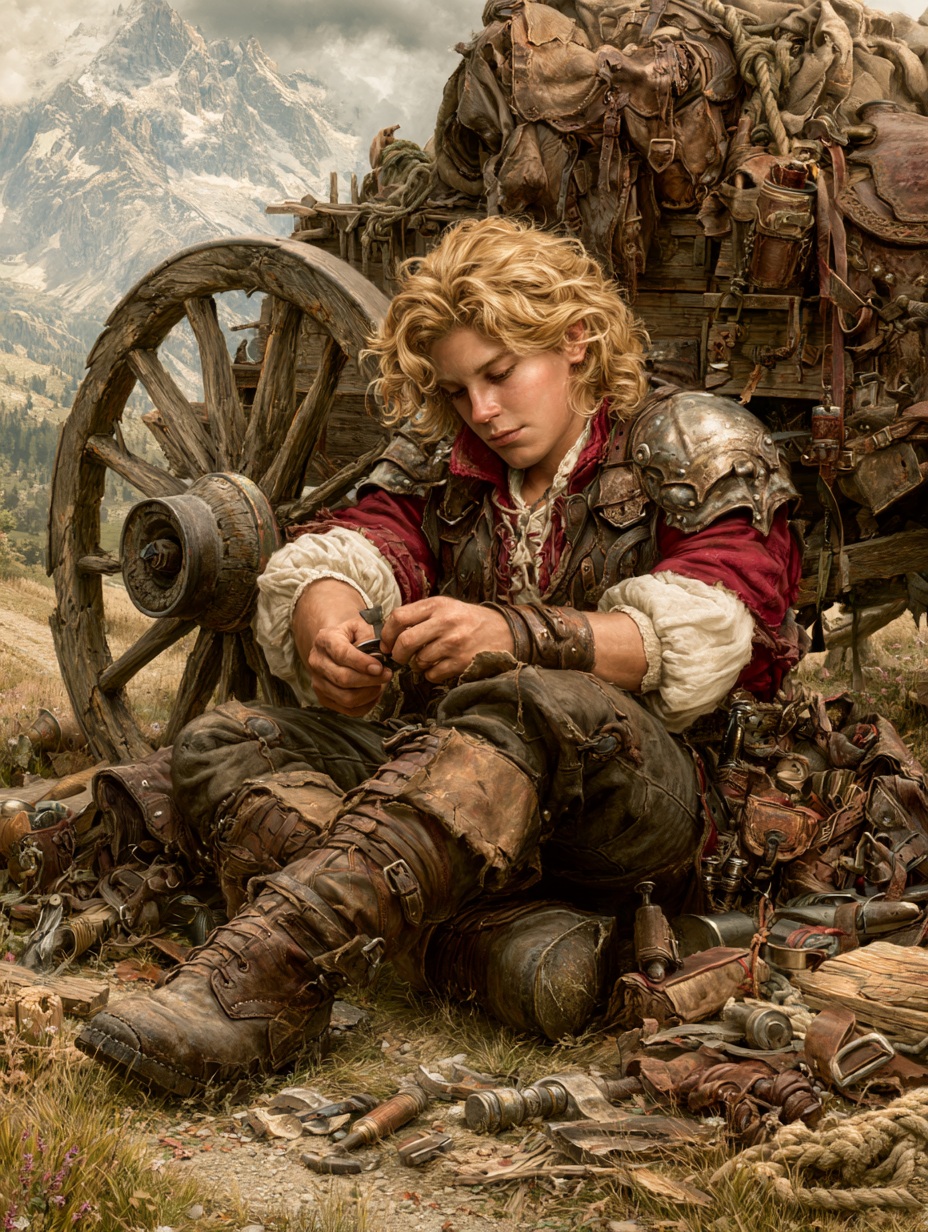
"Nothing is broken until I've looked at it. After I've looked at it, it might become three different things, but it won't stay broken."
— Kri'ka Mishu, Rashada Industrial Ambassador
Type
Industrial

Unknown Shores

Scrounger

Scroungers see value where others see waste. To them, a broken cart is lumber, wheels, and leverage. A collapsed bridge is a future scaffold. A shattered construct is a collection of useful components waiting to be repurposed.   While other artificers create wonders through careful planning and meticulous craftsmanship, Scroungers thrive on improvisation. They excel at transforming wreckage, debris, and discarded materials into practical solutions, often accomplishing in moments what others would require a workshop to build.
Features
Artificer LevelFeature
3rdTool Proficiency, Repurpose, Junkyard Genius
5thExpedient Construction
9thSalvage Mastery
15thReclaim the Ruined
 

Tool Proficiency

3rd-Level Scrounger Feature
You gain proficiency with tinker's tools. If you already have proficiency with them, you gain proficiency with one other set of artisan's tools of your choice.  

Repurpose

3rd-Level Scrounger Feature
You can rapidly transform mundane materials and salvage into useful tools, structures, devices, and mechanisms.   Given access to sufficient nonmagical materials or salvage, you can spend 1 minute creating one of the following:
  • A ladder up to 20 feet long.
  • A bridge spanning up to 10 feet.
  • A barricade that provides Half Cover and occupies up to three contiguous 5-foot spaces.
  • A platform occupying a 10-foot square.
  • A winch, pulley system, crane, or similar mechanical aid.
  • A battering ram, sled, or similar utility device.
  • A complete set of artisan's tools or thieves' tools.
  • Another nonmagical structure, device, or mechanism of comparable complexity, at the DM's discretion.

Unless otherwise specified, a creation must fit entirely within a 10-foot Cube.   A creation appears in an unoccupied space you can see within 30 feet of yourself.   A creation must appear on, attached to, or supported by a suitable surface capable of bearing its weight.   A creation remains functional for 1 hour or until it is destroyed.   If creating a new Repurpose creation would cause you to exceed your maximum number of active creations, choose one of your existing Repurpose creations. That creation immediately falls apart into unusable scrap.   Creations produced by this feature are obviously improvised, have no meaningful resale value, and fall apart into unusable scrap when the feature ends.   You can have a number of creations from this feature active at one time equal to your Intelligence modifier (minimum of one).   A battlefield creation is a Repurpose creation that occupies one or more spaces and is capable of providing cover, obstructing movement, or otherwise influencing creature positioning.  

Junkyard Genius

3rd-Level Scrounger Feature
You instinctively recognize useful materials and hidden potential in ordinary objects.   Whenever you spend at least 1 minute examining a nonmagical object, structure, vehicle, construct, or similar creation, you learn one of the following details of your choice:
  • How it can be safely dismantled.
  • Its most vulnerable structural point.
  • What useful materials can be salvaged from it.
  • Whether it contains hidden compartments, mechanisms, or structural weaknesses.
  • How it could be repurposed into another practical use.

The DM provides truthful information.  

Expedient Construction

5th-Level Scrounger Feature
Your improvisations become remarkably efficient.   The time required to use your Repurpose feature becomes 1 action.   In addition, whenever you create a battlefield creation using your Repurpose feature, choose one of the following functions for that creation:
Obstruction
The first creature that moves within 5 feet of the creation before the start of your next turn has its speed reduced by 10 feet until the end of its turn.
Interference
The first creature that moves within 5 feet of the creation before the start of your next turn can't take reactions until the start of its next turn.
Opportunity
Choose a hostile creature within 5 feet of the creation when the creation is made. The first attack roll made against that creature before the start of your next turn has advantage. Once this benefit is used, it ends.   A creature can be affected by each function only once per turn.   Finally, when a creature gains cover from one of your Repurpose creations, that cover improves by one category, to a maximum of Three-Quarters Cover.  

Salvage Mastery

9th-Level Scrounger Feature
You always keep useful materials close at hand.   When you finish a short or long rest, you prepare a cache of salvage.   Until you finish your next long rest, you are considered to have sufficient nonmagical materials and salvage to use your Repurpose feature regardless of your surroundings.   If a Repurpose creation doesn't already have hit points determined by the DM, it has hit points equal to five times your Artificer level.   Whenever you create a battlefield creation using your Repurpose feature, you can choose two different functions from Expedient Construction instead of one.  

Reclaim the Ruined

15th-Level Scrounger Feature
Nothing stays useless for long in your hands.   As an action, you touch a damaged, ruined, or destroyed nonmagical object no larger than Huge.   The object must be a discrete object rather than a building, terrain feature, or portion of a larger structure.   For 1 hour, the object functions as though it were intact and fully operational.   The object can't regain expended charges, magical properties, or consumable contents.   Once you use this feature, you can't use it again until you finish a short or long rest.   In addition, whenever you create a structure, device, or mechanism using your Repurpose feature, choose one of the following benefits:
  • The creation's dimensions are doubled.
  • The creation gains resistance to all damage.
  • The creation remains functional for 24 hours.

Comments

Please Login in order to comment!
Jun 3, 2026 03:17 by Jacq

Scavenging is a core part of being human. I love that you have made it into a subclass and an Artificer was the perfect choice. They give me a wonderful MacGyver feel.

Piggie
Jun 3, 2026 03:58

Another one that needed more table time in our playtest game but oh man did the gnome get up to nonsesne with this :)

Powered by World Anvil