


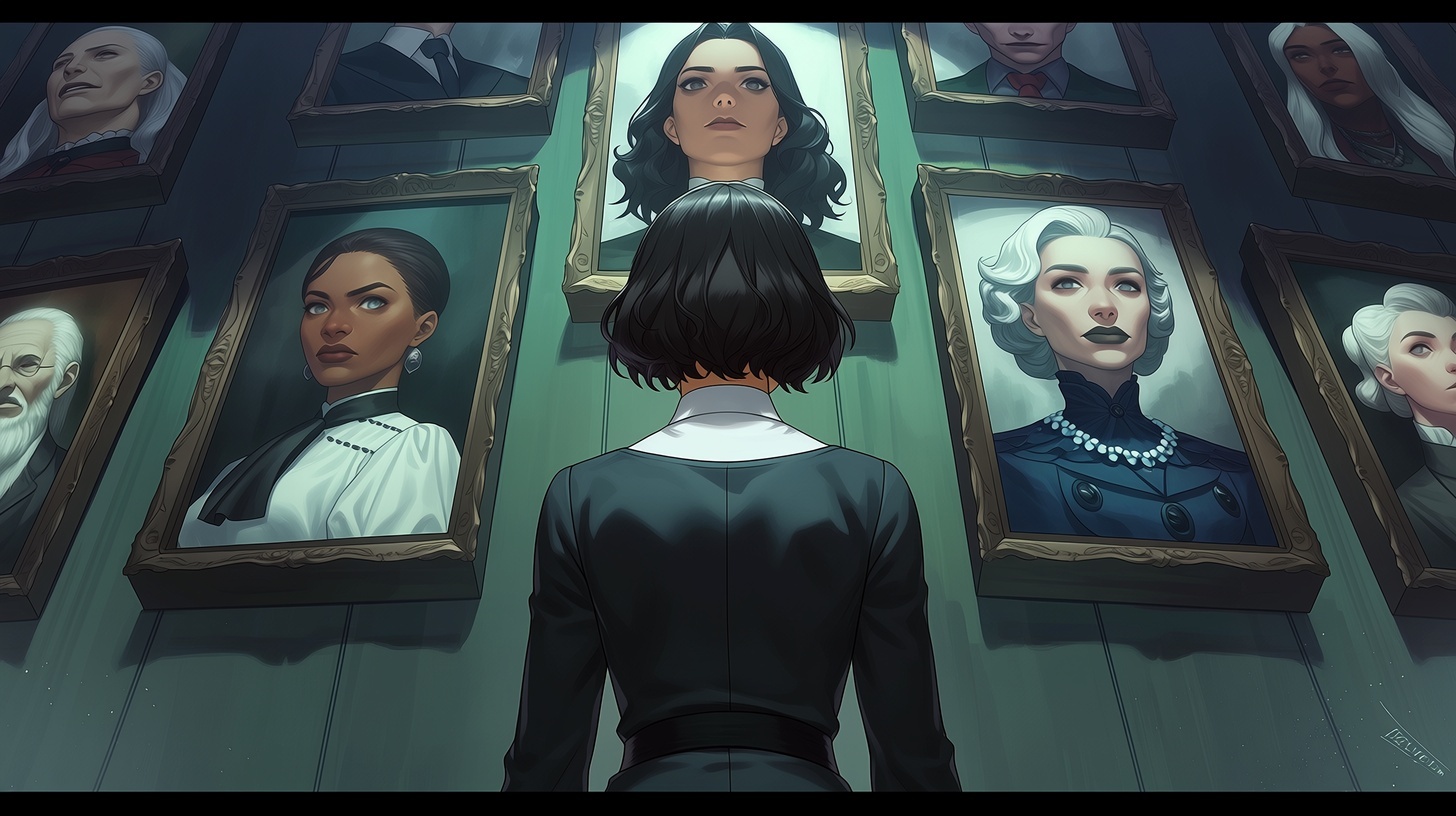
Render Image
Do You Have A Picture?
“A witness will forget a face within days. Fear makes sure of that. This spell remembers the fear just as clearly as the face.”
There are spells that reveal truth, spells that uncover lies, and spells that force the world to answer questions it would rather leave buried. Render Image does none of these. It does something quieter, and in many ways, more dangerous. It records what a person believes they saw.
The spell allows a caster to reproduce a memory as a physical image, fixing it onto a surface with rough, sketch-like clarity. The result is not a perfect depiction, nor is it an objective one. It is a reflection of perception, shaped as much by the mind as by the moment itself.
In practice, the spell is most often used for identification. A witness describes a face, a creature glimpsed in the dark, or an object seen only once, and the caster renders it into something tangible. Guards use it to circulate likenesses of suspects. Investigators rely on it to preserve fleeting details before memory fades. Scholars employ it to record artifacts or inscriptions they cannot remove from their place of discovery.
Yet its limitations are well understood by those who rely on it.
The spell does not correct memory. It does not filter illusion from reality. If a face was seen through disguise, the disguise is what appears. If a monster was glimpsed in fear and confusion, the resulting image may exaggerate or distort what was truly there. Even without interference, memory itself is an unreliable foundation. Distance, stress, and time all leave their mark on what is recalled, and the spell faithfully preserves those imperfections.
Because of this, renderings are rarely treated as definitive proof. They are tools, not answers. A skilled investigator knows to compare multiple accounts, looking for patterns rather than trusting a single image. A careless one may chase a false lead drawn from a flawed recollection.
The spell is also notably unsuited for structural or navigational use. It cannot produce accurate maps or layouts, and attempts to reconstruct spaces from repeated castings quickly reveal inconsistencies. Each image is bound to a single perspective, and the mind is poor at maintaining exact spatial relationships without deliberate training.
Despite these constraints, the spell has become a quiet staple in civilized regions where law, trade, and scholarship intersect. Its value lies not in precision, but in preservation. A moment seen once can be captured, shared, and examined long after it would otherwise have been lost.

“You think it shows you what happened. It doesn’t. It shows you what someone thinks happened. Learn the difference before you trust it.”



Excellent! Could its use be linked to thought detection magic?
Thought Detection? No, not directly, only because thought/thinking is an active and present activity on the part of the target and you the caste and the spell specificallys says it has to be from your memory. What you could do, assuming time wasn't a huge factor in this scenario, is use whatever flavor of thought detection magic you have available, read what ever thought based information from your target that the thought detection magic would allow, and if per that spell's rules, you are able to retain a memory from what you picked up on after that initial spell effect ended, then, yes, you could then use Render Image to get a hard copy. Keep in mind that this depends entirely on what flavor of Detect Thoughts you use in the first place. If it's just you get superficial surface thoughts, or just their current emotional disposition or abstract? No. So, if the target is just standing there, picking his nose and solving logirithims over and over in his head, Render Image fails. If he's picking his nose and thinking about the sandwich he brought for lunch? Oh yeah, Render Image will work great.