



Read the Table
Know When To Fold 'Em
"You can lie to your opponent. You can bluff, posture, mislead, and bait. That’s the game. But the moment you start lying to the rules themselves, you’re no longer playing. You’re stealing."
There are few environments where deception is not only tolerated but expected as part of the experience. At a gaming table, players conceal information, mislead their opponents, and attempt to manipulate perception to gain an advantage. Bluffing, feinting, and calculated misdirection are not violations of the contest. They are fundamental to it. The structure of many games relies on the assumption that participants will attempt to influence one another without revealing their true intentions.
Despite this, every contest is defined by a shared agreement. Rules establish the boundaries within which the game operates. They determine what forms of deception are permitted and what actions fall outside the intended structure of play. When those rules are knowingly broken, the nature of the contest changes. It is no longer a matter of skill, strategy, or nerve. It becomes an act of manipulation that undermines the agreement itself.
Read the Table is a divination spell designed to recognize that distinction without interfering in the contest. It does not alter the outcome of a game, nor does it expose the mechanics of deceit. Instead, it attunes the caster’s perception to deliberate violations of the agreed structure governing a game or contest.
When the spell is cast, there is no visible manifestation of magic. The environment does not shift, and no outward sign marks the caster as being under its effect. The change occurs entirely within the caster’s awareness. Their perception sharpens in a subtle but focused way, allowing them to interpret intent within the boundaries of structured play.
For the duration of the spell, the caster becomes aware whenever a creature within range deliberately breaks the rules of a game or contest in order to gain an advantage. This awareness is immediate and unambiguous. It does not present itself as a sound, image, or external signal. It is understood directly, as a certainty rather than a sensation.
The spell does not provide any further detail beyond that certainty. It does not reveal how the rules are being broken, what method is being used, or when the violation occurred within the sequence of play. It does not identify the specific rule that has been violated. The caster receives no information about whether the cheating is subtle or overt, minor or severe. The spell does not differentiate between a concealed card, a manipulated die, or a hidden agreement between participants. It conveys only that a deliberate breach of the rules has taken place.
This limitation defines the spell’s role. It is not a tool for investigation or exposure. It does not replace observation, deduction, or enforcement. Instead, it provides clarity in situations where uncertainty would otherwise dominate. The caster knows that a boundary has been crossed, but must rely on their own judgment to determine how to respond.
Equally important are the conditions under which the spell does not function. A creature that breaks the rules unknowingly does not register. Misunderstanding the rules, making an honest mistake, or acting under incorrect assumptions produces no result. The spell recognizes intent, not outcome. A player who believes they are acting within the rules, even if they are objectively incorrect, remains undetected.
The spell also does not reveal outcomes that have been altered without a creature’s knowledge. If a contest is influenced by external forces that the participants are unaware of, the spell remains silent. This includes situations where objects have been tampered with beforehand, where magic alters results without the user’s understanding, or where another party interferes indirectly. The spell does not identify unfair conditions. It identifies deliberate actions taken by participants who knowingly violate the rules.
Because of these constraints, Read the Table occupies a narrow but clearly defined role. It is not a universal solution to dishonesty. It does not guarantee fairness. Instead, it isolates a specific category of behavior, conscious rule-breaking within a structured contest.
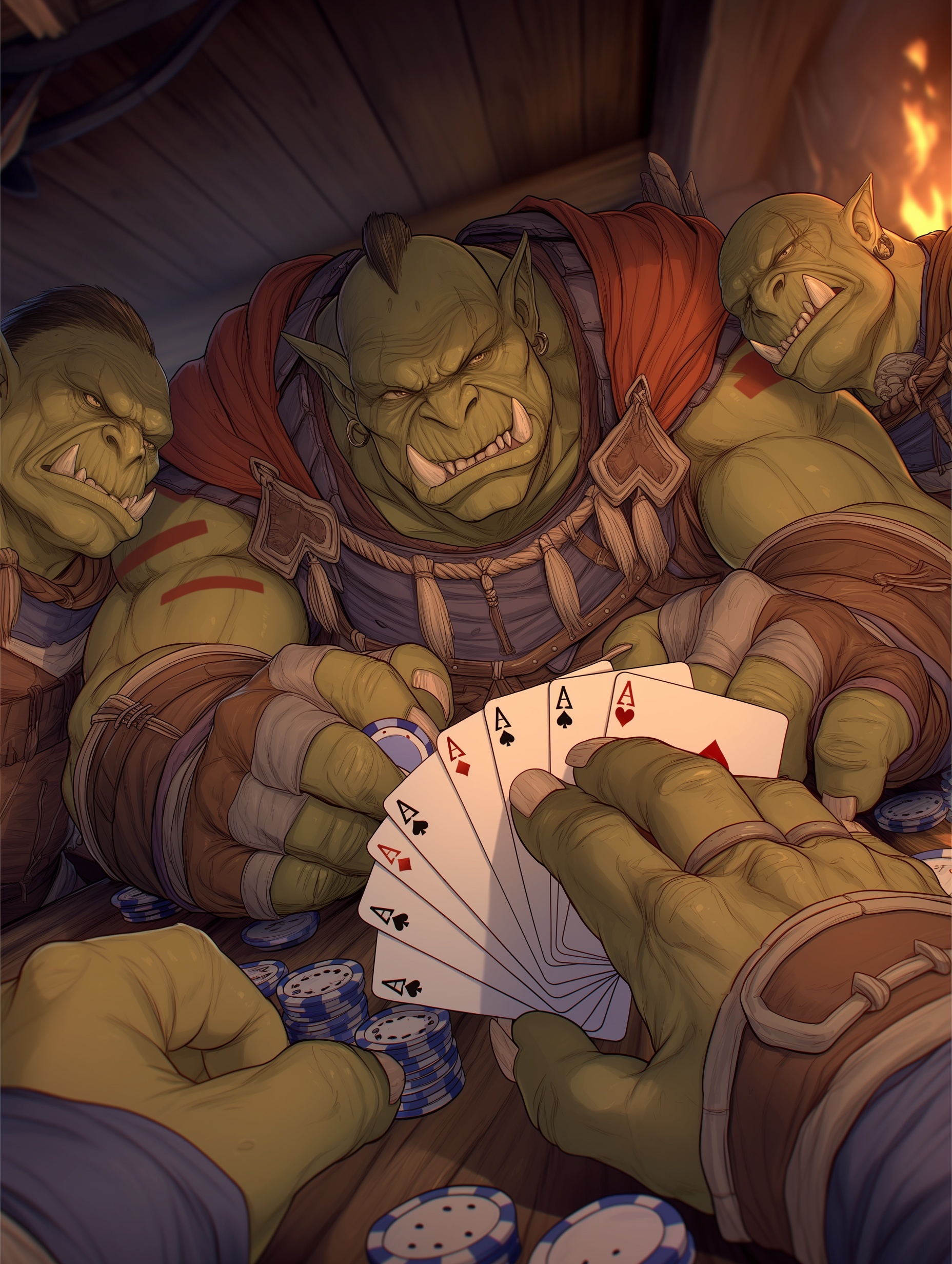
In practice, the spell is most commonly employed in environments where the integrity of a game must be preserved but cannot be easily verified. Gambling halls are the most obvious example. Games of chance and skill attract individuals willing to test the limits of what they can get away with. The presence of a caster using Read the Table can act as a deterrent, discouraging attempts to cheat simply by introducing the possibility of detection.
Merchant houses and trade guilds also make use of the spell during negotiations that take the form of structured contests or games. In these contexts, wagers and agreements may be tied to outcomes determined by cards, dice, or other formalized systems. Ensuring that all participants adhere to the rules maintains trust in the process and reduces the likelihood of disputes escalating into conflict.
Military organizations have found more limited but still relevant applications. Contests used to assess skill, discipline, or decision-making can be compromised if participants attempt to gain advantage through prohibited means. The spell allows officers or adjudicators to confirm that such evaluations remain within the intended framework.
The spell is also used in more informal settings, though its presence can alter the tone of a gathering. Casting it openly signals distrust and can disrupt the social dynamics of a game. Participants may feel scrutinized or accused, even if no violation occurs. As a result, some casters prefer to use the spell discreetly, observing without announcing its presence.
This introduces a secondary consideration. The spell provides information, but not authority. Knowing that a participant is cheating does not automatically resolve the situation. The caster must decide whether to confront the individual, inform others, or allow the game to continue. In some cases, acting on that knowledge may carry social or political consequences greater than the act of cheating itself.
There is also the question of interpretation. The spell detects deliberate rule-breaking, but it does not define the rules of the contest. In environments where rules are loosely defined, poorly communicated, or intentionally ambiguous, determining what constitutes a violation may not be straightforward. The caster must rely on their understanding of the contest’s structure and the intent of its participants.
Because of this, Read the Table is most effective in situations where the rules are clearly established and mutually understood. Formal games, regulated contests, and structured competitions provide the clarity necessary for the spell to function as intended. In less defined environments, its usefulness depends on the caster’s ability to interpret the context accurately.
At its core, the spell reinforces a simple principle. A game is only meaningful if its participants agree to its structure. Bluffing, deception, and strategy exist within that structure and give it depth. Deliberate violations exist outside of it and undermine its purpose. Read the Table does not enforce fairness, but it ensures that the boundary between those two states can be recognized with certainty.
"A fair game doesn’t mean an honest player. It means the rules hold, whether the players do or not."



Comments