


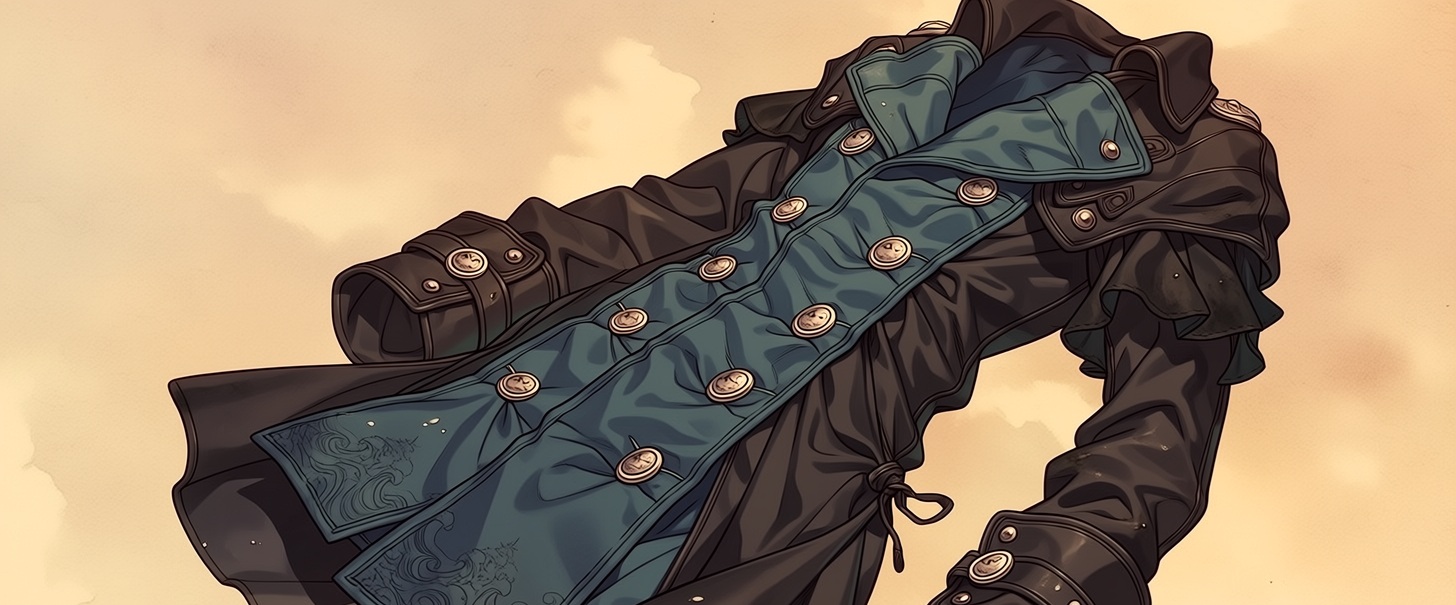
Perfectly Normal Overcoat
A Little Snug
“Early attempts at reconstructing pre-Shattering spatial theory produced a number of results that were, by all available definitions, functional. Whether they were sensible is a separate discussion entirely.”
The Perfectly Normal Overcoat is the result of incomplete understanding applied with complete confidence.
Created during the early efforts to reverse engineer ancient magical principles, the coat represents an attempt to replicate spatial compression techniques observed in recovered relics and partially intact enchantments. The original goal was straightforward. Reduce the space required for multiple individuals to occupy a given area without compromising mobility or awareness. The outcome, while technically successful, reflects a number of practical oversights.
At a glance, the coat appears unremarkable, if slightly oversized. Its construction is deliberate, with reinforced seams and subtle stitching that suggests careful craftsmanship. Closer inspection reveals that these seams are thicker than necessary, layered in a way that implies structural function rather than simple tailoring. The shape itself is just slightly incorrect, as though designed to accommodate more than a single wearer without explicitly stating so.
When used, the coat behaves according to its intended function.
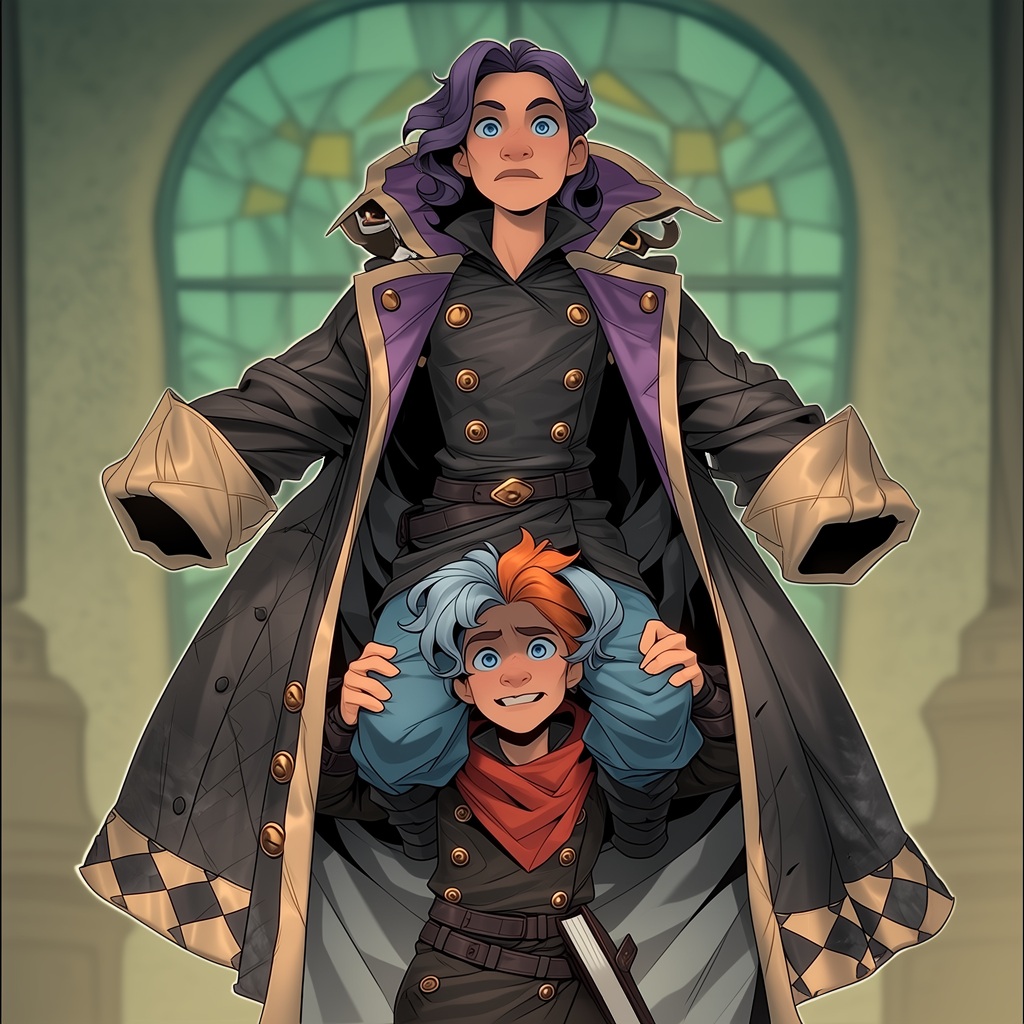
Multiple creatures can occupy the same physical space within it, compressing their positions into a single outward form. From an external perspective, the result is a single humanoid figure of appropriate size, moving and acting as though it were alone. This effect is not an illusion. It is a localized manipulation of space, allowing those within to coexist without immediate physical conflict.
Internally, the experience is less refined.
Creatures inside the coat remain aware of their surroundings, but their ability to act independently is removed. Movement, balance, and direction are determined entirely by a designated lead individual, whose actions dictate the behavior of the combined form. This arrangement requires a degree of coordination that the enchantment itself does not provide. The coat enables the configuration, but it does not manage it.
This is where the design begins to show strain.
The combined form functions as a single entity for most purposes, relying on the lead creature’s abilities and responses. This simplifies interaction with the environment, but it also introduces a significant limitation. If the lead creature falters, the entire structure fails. Loss of balance, incapacitation, or external disruption causes the enchantment to collapse immediately, forcing all occupants out of the coat in a manner that is rarely controlled.
The results are predictable.
Coordination breaks. Movement becomes uneven. Situations requiring precision, particularly those involving stealth or agility, become difficult to manage. The coat does not conceal its limitations. It compresses space effectively, but it does not compensate for the realities of multiple individuals attempting to act as one.
From a distance, the effect is convincing enough to pass casual inspection.
The combined figure appears normal at a glance, though something about it may seem slightly off to those who observe carefully. Movements may lack fluidity. Posture may shift in ways that do not align cleanly with natural motion. Those who take the time to study it closely can recognize the inconsistency, though doing so requires attention and experience.
Despite its flaws, the coat remains in use.
It provides a practical, if imperfect, solution to specific problems. Concealment in controlled environments. Transport of multiple individuals through restricted spaces. Situations where presenting a single presence is preferable to revealing several. It is not elegant, but it is functional, and in many cases, that is sufficient.
The item is often regarded with a mix of appreciation and quiet skepticism.
It demonstrates that the underlying principles it was built upon are sound, even if the execution is incomplete. It also serves as a reminder that understanding ancient magic is not simply a matter of replication. Without full comprehension, even successful results can produce outcomes that are technically correct and practically questionable.
The coat does exactly what it was designed to do.
It simply does not do it gracefully.
“Why does my shadow have too many legs? …Loose stitching. Very common in this climate. Pay it no mind.”
Item type
Magical
Rarity
Common
Weight
6lb
Base Price
75gp



Comments