



Oversleep
Long Night
"O gentle sleep, thou silent, kindly thief,
That steals the weight of sorrow from the mind,
And lays the weary soul in borrowed peace.
If this be death’s rehearsal, soft and brief,
Then life itself is but a troubled waking."
There are few states more vulnerable than sleep, and fewer still that people trust as completely. To sleep is to surrender awareness, to set aside caution, and to assume, if only for a handful of hours, that the world will remain as it was when your eyes closed. It is a small act of faith repeated every night by every thinking creature, and like all acts of faith, it rests on the quiet assumption that nothing is waiting to take advantage of it.
Oversleep exists to test that assumption.
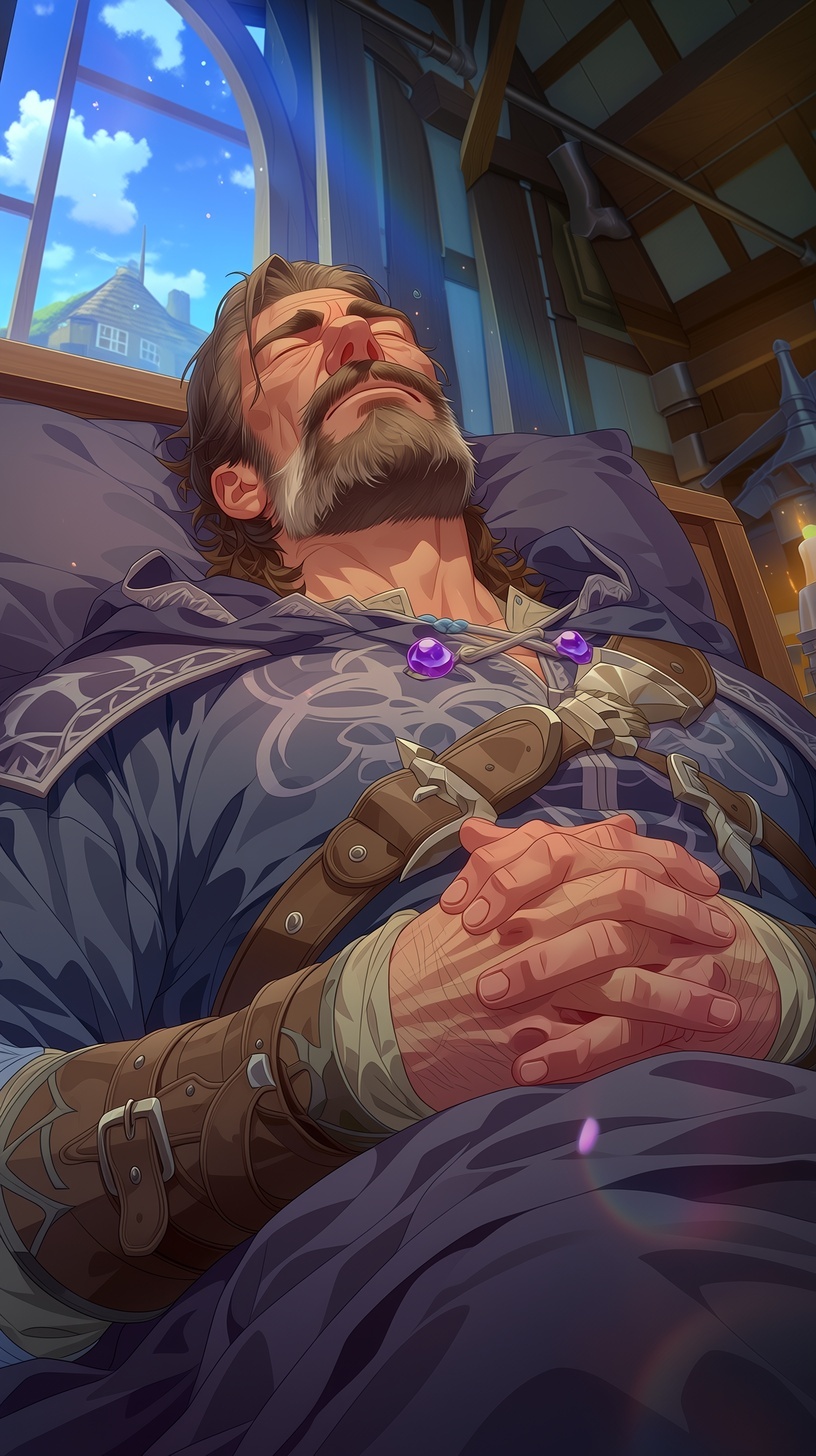
The spell does not create sleep. It does not impose unconsciousness where there is none, nor does it reach into a waking mind and force it into stillness. Instead, it waits for a moment that has already been given freely. A creature must first fall asleep on its own terms, guided by exhaustion, comfort, routine, or simple necessity. Only then can the spell take hold, slipping into the natural rhythm of rest like a hand closing over an already turning wheel.
What it does, once present, is not violent. It does not shock the body or overwhelm the mind. It deepens. It extends. It takes the fragile boundary between sleep and waking and presses it further away, stretching it into a distance the sleeper cannot easily cross. The effect is subtle in its beginning and absolute in its result. A sleeper who might have stirred at a passing noise does not. A dream that should have loosened its hold lingers. The slow climb back toward waking thought never quite begins.
To an outside observer, nothing appears unusual. The sleeper breathes steadily. Their posture does not shift into distress. There are no signs of struggle or discomfort. If anything, they appear to rest more completely than before, as though they have simply found a deeper, more restorative state of sleep. This is part of what makes the spell so effective. It offers no visible warning that anything has changed.
The mind, however, tells a different story.
Dreams under the influence of Oversleep do not behave as ordinary dreams do. They do not drift, fragment, or dissolve into the formless impressions that usually accompany natural rest. Instead, they persist. They hold their shape. They repeat with a clarity that suggests something has fixed them in place. Moments stretch longer than they should. Scenes recur with subtle variations, each iteration carrying a faint sense that something is being observed, measured, or simply allowed to continue.
There is no evidence that the spell introduces new imagery into the sleeper’s mind. It does not create nightmares, nor does it impose visions or foreign thoughts. Everything experienced within the dream originates from the sleeper themselves. Memory, fear, desire, and unfinished thought all provide the material. What the spell changes is the structure. It prevents the mind from moving on. It denies the natural conclusion that would otherwise release the sleeper back into waking.
This distinction has unsettled more than one scholar who has studied the spell in controlled conditions. The mind is not being invaded. It is being held in place, left to circle its own contents without resolution. In most cases, the sleeper experiences nothing more than an unusually long and uninterrupted rest. In others, particularly when the sleeper’s thoughts are already troubled, the effect can be more difficult to dismiss.
There are recorded accounts of individuals who, upon waking, described the experience as “complete,” as though they had lived through something that reached a conclusion they could not quite articulate. There are others who could not recall the dream at all, only the lingering sense that time had passed in a way that did not align with the world outside. Neither response is consistent enough to draw firm conclusions, but both have contributed to the spell’s quiet reputation among those who know of it.
From a practical standpoint, Oversleep is a tool of control rather than harm. It allows a caster to delay, to remove a presence from a situation without confrontation, and to ensure that a sleeping individual remains exactly where they are for longer than they intended. It is used by those who require time more than force, by individuals who understand that sometimes the simplest way to resolve a problem is to prevent it from waking up.
Its limitations are as important as its function. The spell cannot create the opportunity it relies on. If a creature is not already asleep by natural means, there is nothing for the magic to take hold of. This constraint reflects the philosophy behind many spells developed in the centuries following the Shattering, where manipulation of existing conditions often proved more reliable than attempts to impose entirely new ones.
There is, however, a deeper discomfort tied to the spell that has never been fully resolved.
Sleep is one of the few states in which a creature exists without defense, without intention, and without awareness of the world around it. It is a pause in the continuous act of being present. Oversleep extends that pause. It lengthens the moment in which a person is absent from the world while still physically within it. They remain where they are, unchanged in body, but delayed in mind, held just beyond the threshold of waking.
For most, this is nothing more than an inconvenience, a lost span of time that passes unnoticed until it has already gone. For others, particularly those who concern themselves with the boundaries between mind and reality, the implications are harder to ignore. If a thought can be delayed, if a waking moment can be postponed, then the line between being present and being absent becomes less certain than it appears.
And in a world still relearning what magic is capable of, uncertainty is rarely a comfortable thing to leave unexplored.
"When sleep doth take me, I am not myself, But some dim echo wandering without name."



Comments