



Myconic Cloud
The Forest Is Melting
“I swear to you, I meant to move. I saw him. I knew where he stood. And then something… shifted. Not the room. Not him. Just the part of me that decides. Like my thoughts slipped their grip and wouldn’t hold long enough to matter.”
Myconic Cloud is a spell that does not overwhelm the battlefield with force or spectacle. It changes the terms of perception itself, turning certainty into suggestion and intention into something unreliable. Where it settles, the world does not vanish or distort beyond recognition. It remains intact, visible, and deceptively normal. The danger lies in what the mind begins to do with what it sees.
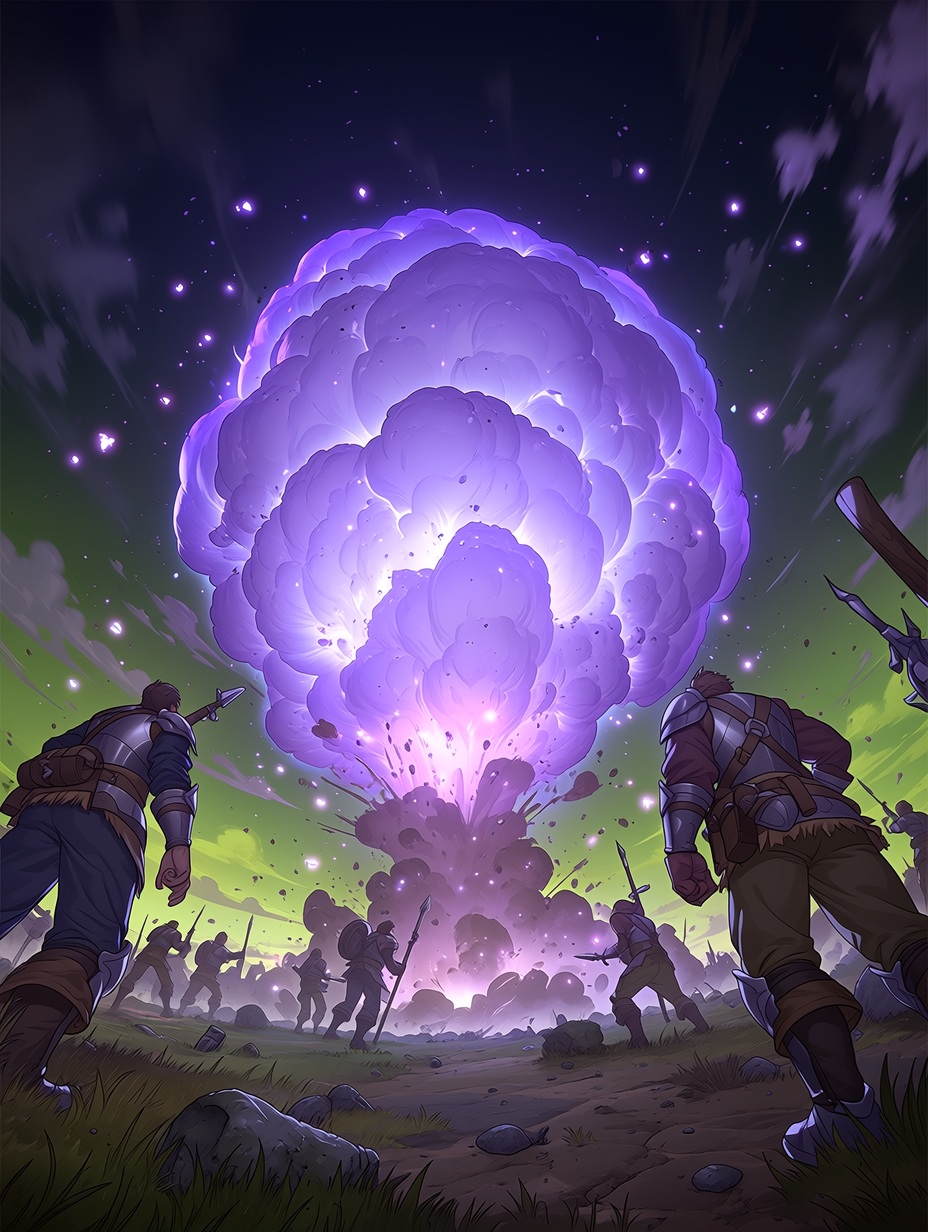
When the cloud forms, it arrives as a slow bloom rather than an explosion. A faint shimmer gathers in the air, almost beautiful at first glance, as though fine dust has caught the light in a way that feels deliberate. The spores drift outward in a quiet expansion, curling around obstacles, filling space with a patient inevitability that gives little warning of what is to follow. They do not darken the field or conceal movement. If anything, they seem to clarify it, outlining shapes and motion with subtle precision.
That clarity is a lie.
Those who breathe the spores do not immediately recognize what has changed. There is no sudden blindness, no ringing in the ears, no obvious intrusion. Instead, the shift begins in thought. Decisions hesitate. Intentions falter. The mind reaches for a simple course of action and finds it slipping just out of reach, replaced by alternatives that feel equally valid and increasingly difficult to prioritize.
Movement follows this uncertainty. A step taken with purpose becomes a step redirected without clear reason. A hand raised to strike pauses, shifts, or lowers entirely as doubt seeps into the space between thought and action. The afflicted are not rendered senseless. They are rendered inconsistent. Their behavior fractures into a series of impulses that fail to align, each one competing for control in a way that prevents any from fully taking hold.
To those watching from outside the cloud, the effect can appear erratic or even absurd. A warrior may turn away from an obvious threat to address something unseen. A spellcaster might begin an incantation only to abandon it midway, distracted by a thought that dissolves as quickly as it formed. Conversations break into fragments. Commands lose coherence. It is not chaos born of panic, but of misfiring intention, as though the mind itself has lost the ability to settle on a single path forward.
There is a subtle cruelty in the way the cloud operates. It does not impose the same experience on every creature at once. Some resist its influence, maintaining their clarity while others falter beside them. This uneven effect fractures coordination, breaking lines of communication and trust. Allies begin to doubt one another’s actions. Plans unravel not because they are opposed, but because they can no longer be executed with consistency.
The spores themselves seem almost indifferent to the disruption they cause. They drift, settle, and disperse with a natural rhythm, as though following patterns older than the creatures caught within them. There is no malice in their movement, no deliberate targeting or escalation. The spell does not seek to harm directly. It allows confusion to do the work in its place.
Those who endure the cloud for more than a fleeting moment often describe a lingering unease even after its influence fades. Thoughts feel slower to align. Decisions carry a faint hesitation that was not there before. The memory of having lost control, not through force but through subtle interference, leaves an impression that does not fade immediately. It is not fear of the cloud itself that remains, but distrust in one’s own certainty.
Myconic Cloud is favored by those who understand that control of a battlefield does not always require dominance. It can be enough to disrupt, to introduce just enough uncertainty that precision becomes impossible. Where others rely on strength or speed, this spell relies on doubt, turning even the most disciplined minds into unreliable instruments.
In a world where survival often depends on acting quickly and decisively, that kind of interference can be more devastating than any direct assault. The cloud does not need to strike. It simply needs to linger long enough for intention to unravel on its own.
“It wasn’t madness. I’ve seen madness. This was worse. Everything stayed clear. Every face, every voice. Only the meaning kept changing, like the world wouldn’t agree with itself long enough for me to act.”
Related Discipline
Level



Comments