


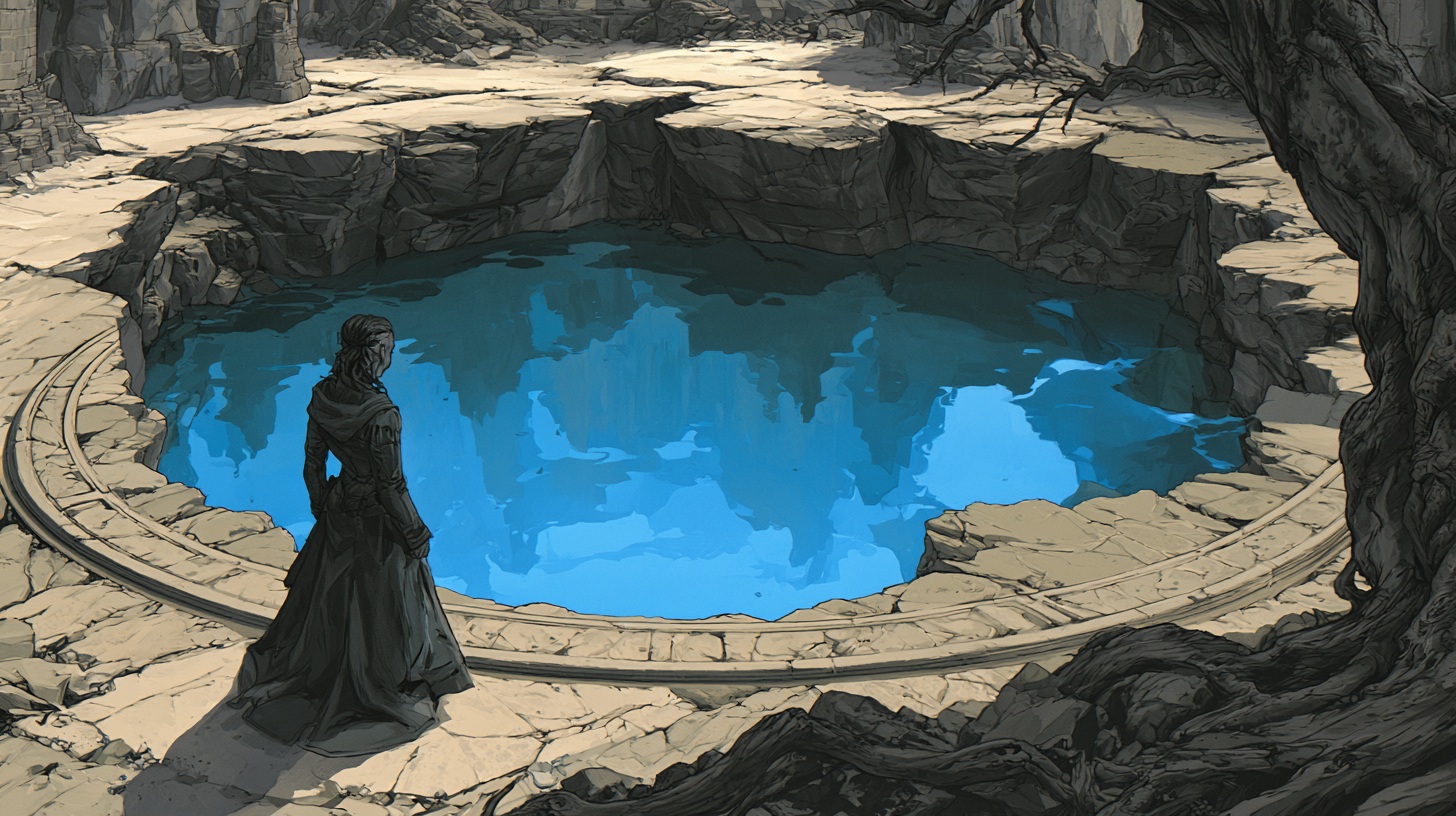
Locate Water
Not A Drop To Drink
“Gold may purchase kingdoms, but a single clean well persuadeth men to build one.”
Civilization begins wherever clean water survives long enough for people to trust staying nearby.
Roads, kingdoms, shrines, farms, trade routes, battlefields, and graveyards all eventually answer to the same quiet truth. A person can survive hunger longer than thirst. Armies collapse without rivers. Entire cities vanish when wells fail.
Because of this, Locate Water became one of the oldest and most respected practical divinations ever developed.
The spell grants the caster an instinctive awareness of nearby potable water sources, revealing direction, approximate distance, and the broad nature of the water itself. The sensation differs between practitioners. Some describe faint pulling pressure behind the eyes. Others experience taste impressions, distant sound, emotional certainty, or invisible downward tension guiding them toward hidden springs and underground streams.
Experienced rangers often claim the spell feels less like finding water and more like suddenly remembering where it always was.
Unlike more aggressive divinations, Locate Water feels calm.
Quietly essential.
The magic distinguishes important qualities immediately. Freshwater carries different emotional texture than saltwater. Flowing rivers feel active and directional, while still pools seem heavy and settled. Subterranean sources often produce deep muted sensations, as though awareness passes downward through layers of stone and earth.
Magical or extraplanar water feels unmistakably wrong.
Priests describe holy water sources as radiant or harmonious. Fey touched springs often feel emotionally vibrant or dreamlike. Extraplanar water tends to provoke discomfort ranging from subtle unease to outright nausea depending upon origin.
Several explorers survived specifically because they recognized water that should not have been consumed.
Druids and rangers rely heavily upon the spell during overland travel. Wilderness survival becomes dramatically safer once reliable hydration can be identified quickly. Hidden springs beneath dry valleys, buried rivers beneath desert stone, and concealed forest pools all become accessible to travelers who would otherwise die nearby without realizing salvation sat beneath their feet.
Nomadic cultures often treat practitioners of Locate Water with enormous respect regardless of broader magical suspicion.
A mage capable of finding water during drought becomes more valuable than gold.
Clerics frequently employ the spell during disaster relief and famine response. Wells contaminated by floodwater, plague, or salt intrusion can be bypassed rapidly in favor of safer sources. Entire refugee caravans have survived hostile terrain because one exhausted priest kept walking toward faint impressions only they could feel.
Naturally, armies weaponized the spell eventually.
Sieges became harder once defenders could identify hidden groundwater beneath fortifications. Invading forces tracked rivers beneath sand dunes and mountain stone previously believed impassable. Several desert kingdoms reportedly collapsed after enemies discovered concealed oasis networks once considered impossible to locate without local guides.
The spell’s inability to detect water hidden inside creatures or sealed containers prevents certain absurd exploitations, though apprentices still attempt them constantly.
“Yes, technically humans contain water.”
“No, the spell does not count blood.”
This conversation has occurred in magical academies for centuries.
The enchantment’s preference toward the largest nearby source occasionally creates problems in certain environments. A massive underground lake may overwhelm awareness of smaller nearby springs more practically accessible. Coastal casters often become immediately aware of nearby oceans unless specifically seeking freshwater sources farther inland.
Experienced practitioners learn quickly to interpret the sensation carefully rather than blindly following it.
The spell holds deep symbolic importance in many religions associated with survival, renewal, healing, and pilgrimage. Water represents mercy in countless traditions because nature distributes it unfairly. Entire peoples flourish beside rivers while others cross wastelands praying for clouds.
Locate Water narrows that cruelty slightly.
Among explorers and travelers, old superstitions surround the spell heavily. Some claim repeated use causes strange dreams of drowned places or hidden rivers beneath the world. Others believe the magic slowly teaches the caster to hear water naturally even without enchantment.
Most druids hearing this simply smile without answering directly.
Among caravans, sailors, and frontier settlements alike, one saying regarding the spell remains nearly universal.
Treasure matters less once the canteens run dry.

“The desert had hidden the spring beneath twenty feet of stone, yet the old priest walked toward it without hesitation.”
Related Discipline
Level



Comments