


Identity Crisis
Fractured
“I have reviewed every account that survived the Shattering. The violence is excessive, but not uncontrolled. The strikes land where they must. The damage beyond that is… indulgent. That is not rage. That is habit. Whoever did this knew exactly when the victim was dead and chose to continue anyway.”
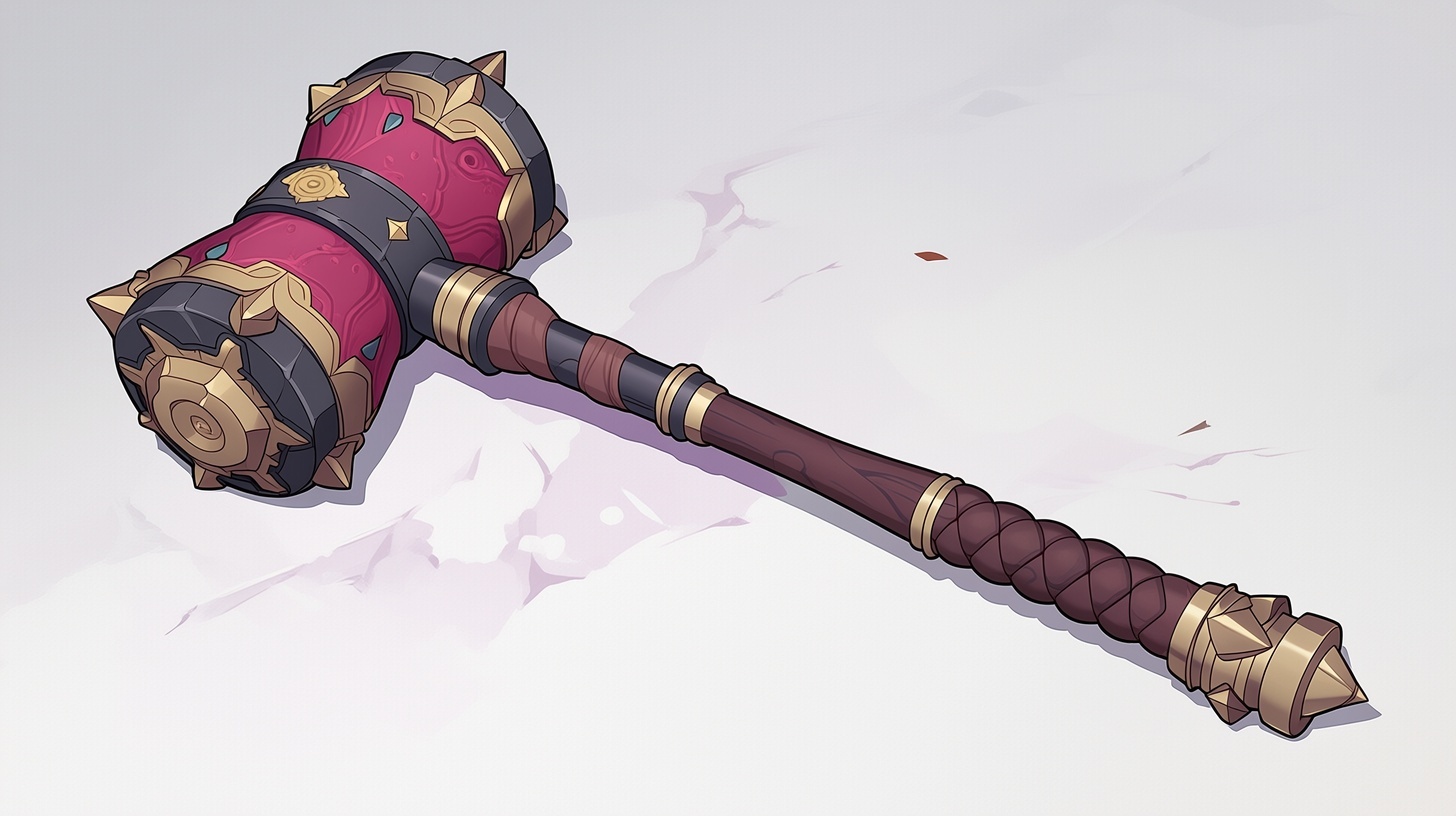
The weapon known as Identity Crisis does not present itself as something to be feared. That is, in all likelihood, part of the problem.
At a glance, it appears almost absurd. A large wooden hammer with an oversized head, exaggerated proportions, and a construction that suggests novelty rather than function. Its weight does not match its size. It feels lighter than it should be, as if some part of it refuses to fully exist in the way ordinary matter does. When swung, it emits a faint squeak, the kind associated with cheap toys or stage props. On impact, it produces an echoing, hollow “bonk” that sounds more comedic than violent.
None of this aligns with what the weapon actually does.
The surface of the hammer bears shifting sigils that do not remain fixed long enough to be cataloged. They move slowly, almost lazily, across the grain of the wood, rearranging themselves in patterns that have resisted meaningful interpretation. Attempts to transcribe them have produced inconsistent results, even when observed by multiple witnesses at the same time. Some claim the symbols resemble fragmented arcane notation. Others insist they are not symbols at all, but impressions of something trying to resolve into a form it cannot maintain.
Despite its appearance, the hammer strikes with real force. The enchantment embedded within it enhances the wielder’s ability to land a blow, lending both weight and precision where neither should logically exist. That much is straightforward. It is the secondary effect that has drawn sustained concern.
On contact, the weapon does not merely injure the body. It interferes with the mind.
Those struck by the hammer have, on occasion, exhibited sudden and extreme disruptions in identity. The affected individual retains their skills, their physical capabilities, and their capacity for action, but their sense of self becomes unstable. Behavior shifts rapidly, sometimes from one moment to the next, as if the victim is cycling through different versions of themselves without warning or control. These episodes are brief, typically resolving within seconds or minutes, but the consequences during that window can be significant. Allies are treated as strangers. Enemies are ignored or protected. Actions are taken that bear no relation to the individual’s established personality or intent.
Reports from controlled observation suggest that these shifts follow recurring patterns. Subjects may adopt the demeanor of a heroic protector, a panicked civilian, a loyal subordinate, or a domineering antagonist, among others. In rarer instances, the subject appears to manifest an exaggerated or darker reflection of their own personality, acting with increased aggression and diminished restraint. The transitions between these states occur without visible cause and without memory continuity once the effect ends.
It is not domination. It is not possession. It is fragmentation.
The weapon does not replace the target’s identity. It disrupts the cohesion that allows that identity to function as a single, continuous whole.
This behavior is consistent enough to be documented, but not consistent enough to be predicted. Not every strike produces the effect. Not every subject responds the same way. The lack of reliability has led some to dismiss the phenomenon as a secondary curiosity rather than a defining feature. Others have reached the opposite conclusion, arguing that the unpredictability is itself the intended function.
What remains uncontested is the weapon’s origin.
Identity Crisis was recovered from Castle Witherbloom during the years following the Shattering, when magic across Aerith had failed and only the most anomalous artifacts retained any function at all. Witherbloom, even by the standards of that era, was considered unstable. It was one of the few locations where objects of power could still be found, though rarely in forms that aligned with established arcane principles. Expeditions into its depths were undertaken out of necessity rather than confidence, and many ended in complete loss of life.
In this case, they did not.
A small adventuring party entered Castle Witherbloom and returned with a collection of functioning artifacts. The circumstances of that expedition are poorly recorded, and what documentation survives offers little clarity. Accounts differ on the layout encountered, the resistance faced, and even the number of individuals involved. What is consistently noted is that the group exited with their findings intact, an outcome rare enough to draw attention even in a period defined by desperation.
Among the items recovered was the hammer.
There is no reliable record describing where within the structure it was found, how it was obtained, or whether it was in use prior to its recovery. No inscriptions tie it to a maker. No surviving text links it to a known tradition of craftsmanship or enchantment. It appears in the historical record fully formed, already functioning, and already anomalous.
The adventurers themselves did not remain unified long enough to provide a consistent account. Their later histories diverge sharply, and in some cases contradict one another outright. A number of scholars have noted that the timeline of the Identity Crisis murders overlaps with the period immediately following that expedition. This has led to a long standing theory that one of the individuals involved in the recovery later became associated with the killings.
That theory has never been proven.
It persists because it explains just enough to remain plausible and leaves enough unanswered to resist confirmation.
Beyond that, nothing about the weapon’s origin can be stated with certainty. It was found in a place where magic behaves incorrectly, during a time when magic did not behave at all, by a group that should not have survived the attempt.
Everything else has been inferred, argued, or assumed.
The hammer itself offers no clarification.
History
“The weapon was left behind. That is not arrogance. It is either a conclusion or a dismissal. The note offers nothing. No demand, no instruction, no continuation. ‘Get it?’ is not a message. It is a question asked by someone who already believes the answer is obvious. I do not share that confidence.”
The history of Identity Crisis does not begin with the weapon. It begins with a series of murders that should have been simple to understand and never were.
The first killings took place in the early years of the of the Post-Shattering world, when magic had failed and the world was still learning how to function without it. That absence mattered. There were no reliable divinations, no speak with dead that could be trusted, no wards that could preserve a scene or expose a lie. Investigators worked with what they could see and what little testimony survived fear, rumor, and time. In that environment, the case should have been difficult. It was something worse. It was incoherent.
Victims were found in enclosed spaces, most often their own homes, with no sign of forced entry and no consistent pattern of approach. The cause of death was always the same. Massive blunt force trauma to the head. The wounds were excessive, often to the point that identification relied on clothing or personal effects rather than the body itself. Whatever struck them did not stop when the victim fell. It continued until there was nothing left to mistake for survival.
Witness accounts did not help. They never do in cases like this, but here they actively made things worse. Some claimed to have heard laughter before the attacks. Others insisted there had been no sound at all. A few described a figure, but no two descriptions aligned. Height, build, even the number of attackers varied from one account to the next. Several survivors, those rare few who encountered the killer and lived, later gave statements that contradicted themselves within the same telling. Names were forgotten mid sentence. Allegiances shifted. People who had known each other for years failed to recognize one another when recounting the event. At the time, these inconsistencies were attributed to shock. In retrospect, they read differently.
The killings continued long enough to establish a pattern without ever becoming predictable. There was no clear social class targeted, no geographic logic, no cycle investigators could anticipate. A dockworker and a magistrate might die in the same week. A healer in a quiet district might be followed by a caravan guard in a crowded quarter. The only constant was the brutality and the absence of a clear motive.
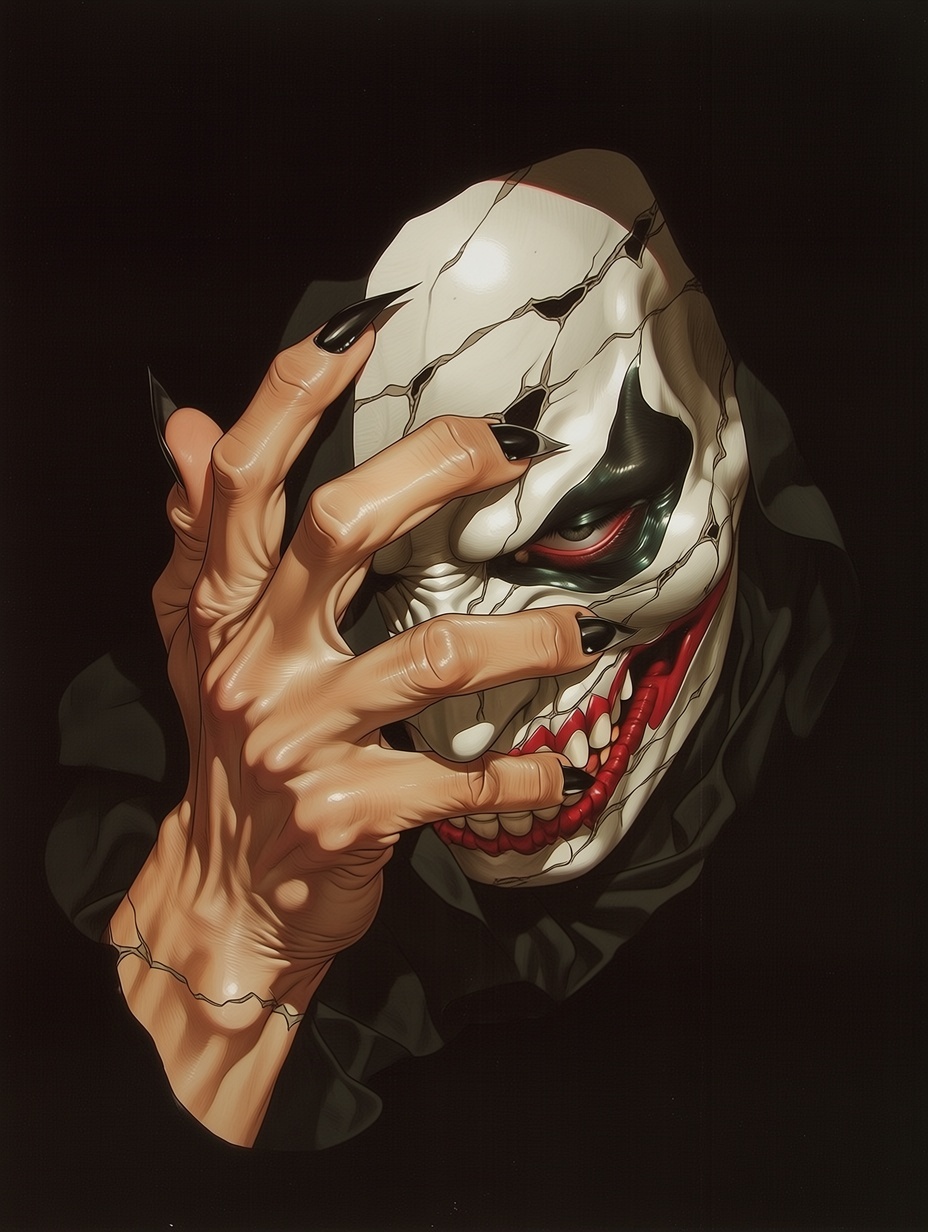
The name “Giggles the Clown” did not come from any official record. It emerged from repetition. Enough witnesses, independent of one another, described some form of laughter or a distorted attempt at humor that the label took hold. It was not a description. It was a placeholder, a way to speak about something no one could properly define. The name stuck because nothing else did.
The final confirmed murder of that original series ended the way the entire case had been building toward. With something that made no sense.
The victim was found in a private residence, killed in the same manner as the others. The weapon was left at the scene. A large, oversized hammer of carved wood, its proportions exaggerated, its surface marked with shifting sigils no one at the time could properly interpret. Beside it, written in the victim’s own blood, was a single phrase.
“Get it?”
There was no follow up. No additional message. No escalation. The killings stopped immediately after.
For reasons that remain debated, the weapon was cataloged and transferred to the custody of the Kestenvale Ministry of Justice. It was secured within Grimm Reach Keep, stored in a locked evidence vault alongside records, artifacts, and materials deemed too unusual or too dangerous to discard. Without magic to study it properly, it was treated as a curiosity tied to an unsolved case. Over time, the investigation stalled. Witnesses died. Records degraded. Interest faded. What had once been a matter of public fear became an academic argument, then a footnote, then a cold case no one expected to move again.
For nearly five centuries, it did not.
The fire changed that.
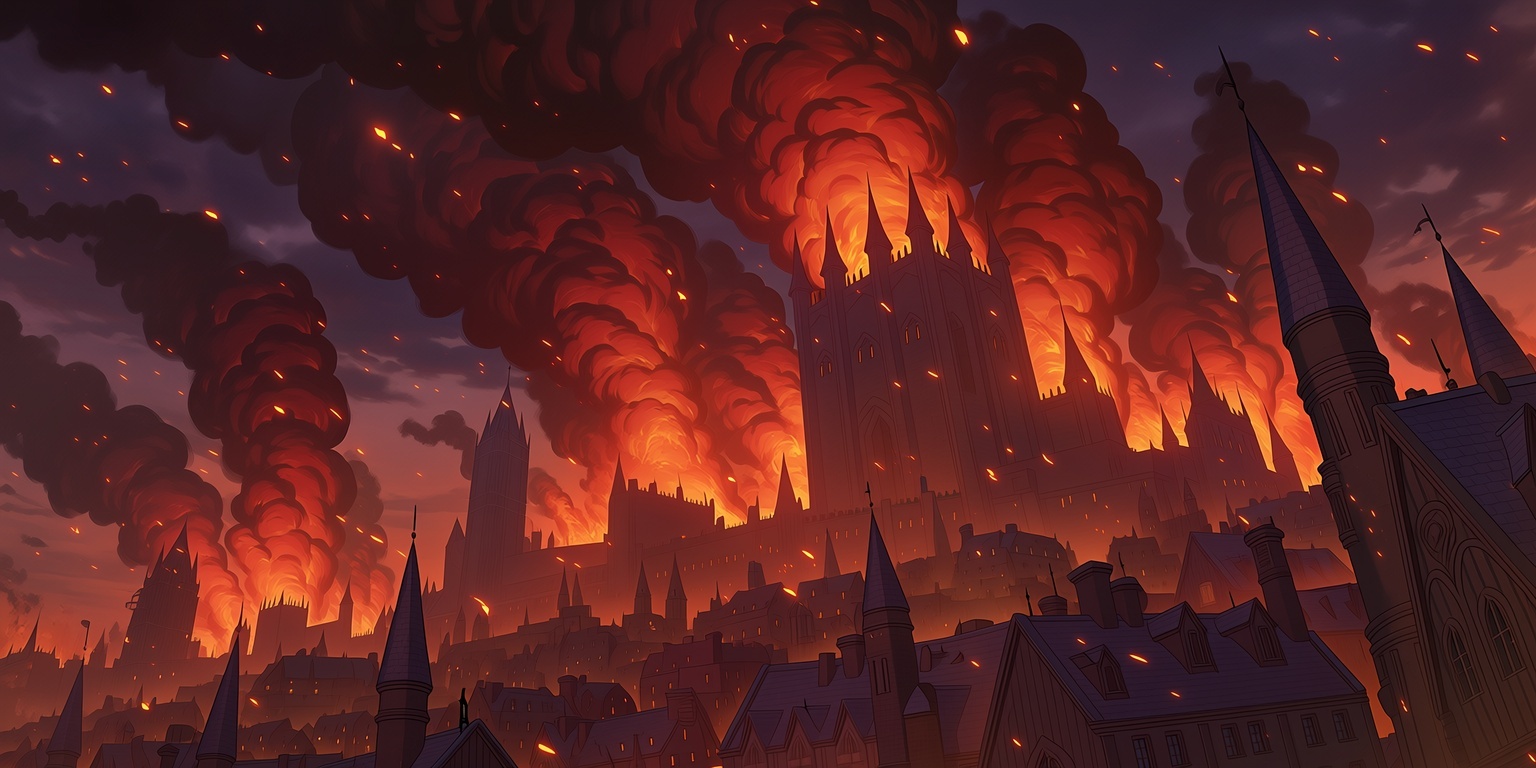
The archival vault beneath Grimm Reach Keep was not meant to burn. Even in the absence of magic, its construction was designed to resist the kind of destruction that would threaten the Ministry’s records. When the fire began, it spread in ways that defied those expectations. Sections of the vault were compromised faster than they should have been. Access routes collapsed. Entire collections were lost before they could be recovered or even properly inventoried.
In the aftermath, the official report listed extensive damage. Documents destroyed. Objects rendered unusable. Evidence lost beyond reconstruction. Among those losses was the lockbox containing the hammer.
Closer examination of the scene complicated that conclusion. The lockbox had not been consumed by the fire. It had been forced open. The locking mechanism showed signs of tampering consistent with a failed attempt at picking, followed by blunt force sufficient to break the housing. The surrounding materials bore similar marks. The damage was localized, deliberate, and occurred during the fire, not before it.
Nothing else of comparable value was taken from that section of the vault.
Whoever entered that space did so while it was actively burning. They navigated a collapsing archive, bypassed other materials, located a specific secured container, attempted to open it quietly, failed, destroyed it, and removed a single item. Then they left.
There are no confirmed witnesses to the theft. No record of entry or exit. No indication that the individual or individuals involved were present for any other purpose. The hammer was the target.
The case did not reopen immediately. It took time for the significance of what had been taken to surface. By then, the damage was done. Records that might have provided context were gone. The chain of custody was broken. The one physical link between the original murders and any future investigation had been removed.
Roughly one year after the fire, a new murder was recorded.
The victim was not a figure of public prominence, but one of quiet importance. A teacher. A caretaker. Someone known, respected, and largely invisible outside their immediate community. They were found in their home. No sign of forced entry. Cause of death consistent with the earlier killings. Severe blunt force trauma to the head.
At the scene, there was a message.
It did not match the brevity of the original note. It did not match the tone of any known correspondence tied to the case. It was longer. Rhythmic. Structured in the cadence of something meant for children. Bright language. Simple phrases. Repetition. On its surface, it read as harmless.
It was not.
The letter made no direct claims. It issued no demands. It did not negotiate or threaten in the conventional sense. It performed. It introduced itself. It invited. It promised that the “game” would continue.
Most who encountered the report dismissed the connection. One murder does not make a pattern. The tone of the message differed too sharply from the original to be considered reliable. Without the weapon, without surviving records, without corroborating evidence, the case remained closed in all but name.
A small number of investigators disagreed.
They pointed to the method of the killing. The condition of the body. The absence of forced entry. The presence of a message where none was necessary. They argued that the differences in tone were not a contradiction, but a development. That whatever had ended the original series had not been resolved, only interrupted.
No official conclusion was reached.
As it stands, the Identity Crisis murders are recorded as an unsolved case spanning five centuries, marked by a series of killings that defy consistent explanation, a weapon of uncertain origin recovered from Castle Witherbloom during the Shattering, and a theft carried out under conditions that should have made it impossible.
The only point on which all surviving records agree is the simplest.
The killings stopped once.
They did not end.
“They have taken the hammer from a burning vault and killed again within the year. That is not coincidence. That is sequence. Five centuries, and the method has not changed. The tone has. It has… deteriorated. Whatever this was, it did not end. It simply waited for the world to become capable of noticing it again.”
Hi Kids!
Those Gloomy Gus’ tried oh so hard to spoil our fun, didn’t they?
But Giggles says now it’s time for us to play!
Remember boys and girls, Giggles is your bestest pal in the whole wide world!
Those mopey Mary’s say we can’t play, but who doesn’t love a giggle every now and then?
We’re going to have the most super bestest time ever, kids!
We’ll play all day and laugh all night!
We just have to keep an eye out for those grumpy dumps who want to spoil our fun when our party’s only just begun!
Now don’t you worry one bit, kids.
It’s not their fault they don’t know how to have fun. Not like we do, right?
You and me, we’re pals.
We know how to have all sorts of fun!
Maybe we ought to show them a thing or two…
But those lumpy bumps never learn!
They say such silly things.
They call it nasty names.
But we just want to laugh and sing!
I want to play every single day!
I get so excited, I just want to make everyone my special friend and make them smile extra big!
That’s me! Your old buddy, Giggles!
It’s time for me to go now, kids…
But don’t you worry.
We’ll see each other again.
Real soon."
“The witnesses are the problem. Not because they are unreliable, but because they are consistently unreliable in different ways. They forget names they should know. They misidentify people they have lived beside for years. One man described himself in the third person for the duration of his statement. That is not fear. That is interference.”
Item type
Magical
Creation Date
1299
Current Holder
Rarity
Rare
Weight
10lbs
Base Price
2,200 gp



Comments