

Gelatinous Form
Ooey Gooey
“Steel bars, locked doors, chained wrists. All of it means something to a body that keeps its shape. Change the shape, and the rest becomes a suggestion.”
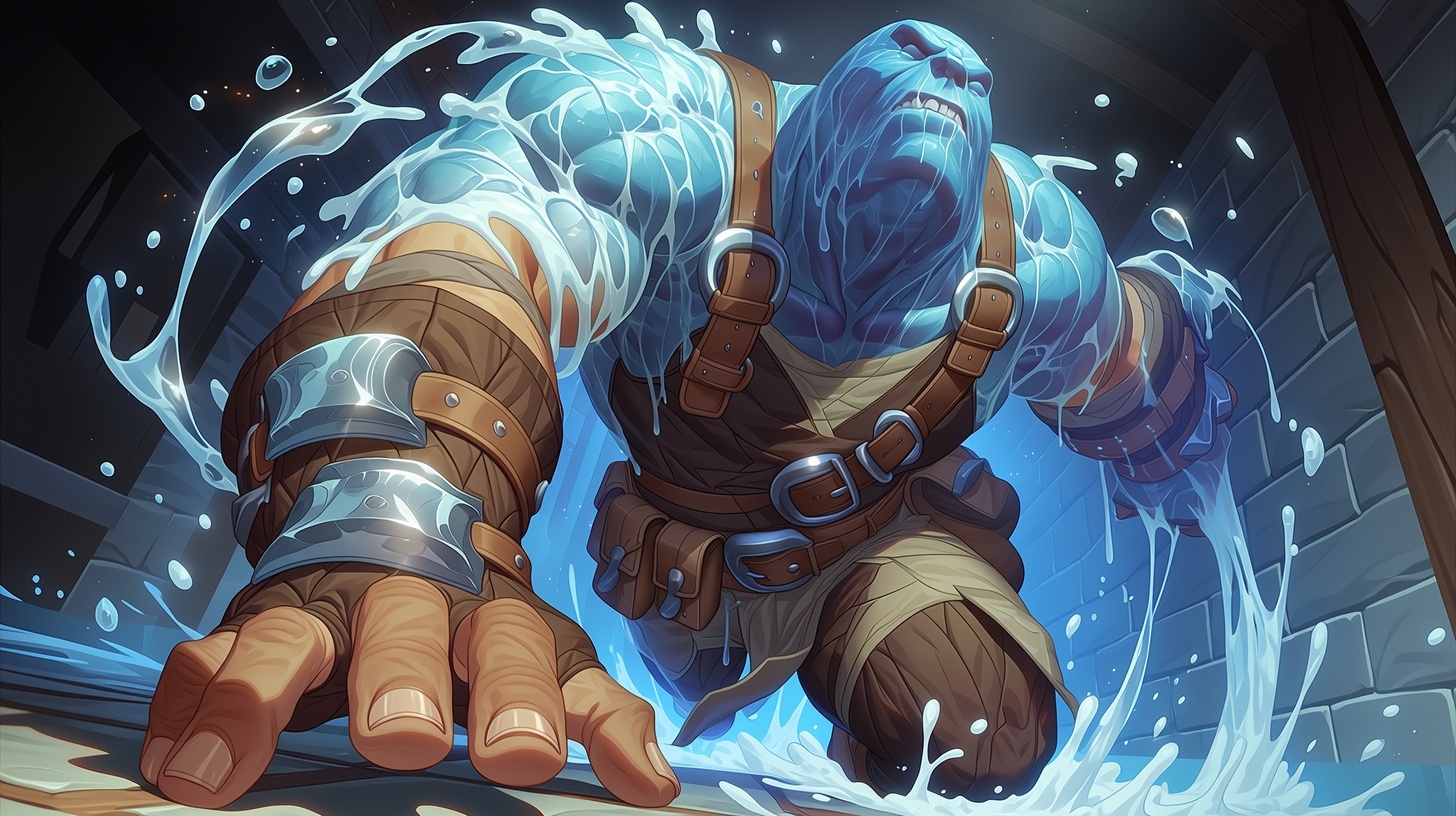
Gelatinous Form is a controlled transmutation that abandons the structure of the humanoid body in favor of something far more adaptable. Rather than enhancing strength or hardening the flesh against harm, the spell dissolves the rigid boundaries that define physical form. Bone, muscle, and skin lose their distinct roles and are reconstituted into a unified, viscous mass that moves as a single, cohesive whole. The caster does not become incorporeal or immaterial, but instead adopts a state that exists between solid and fluid, retaining presence while shedding constraint.
The transformation is immediate and unmistakable. Limbs lose their articulation, features soften and collapse, and the body settles into a shape that responds more to intent than anatomy. Movement in this state is not achieved through steps or strides, but through controlled shifting and flow. The caster presses forward, spreads, and gathers themselves with deliberate control, navigating terrain in ways that would be impossible in a fixed form. Narrow gaps, cracks in stone, and tightly sealed passages become viable routes, allowing access to spaces that would otherwise remain unreachable.
Despite its advantages, Gelatinous Form is not without significant tradeoffs. The loss of defined structure removes the caster’s ability to perform actions that require precision or force. Attacks become impractical, as there are no longer limbs capable of delivering a controlled strike, and the manipulation of arcane gestures required for spellcasting is similarly disrupted. This limitation is not a flaw in the spell’s design but a consequence of its purpose. It is not meant for direct confrontation. It is meant for movement, escape, and survival in situations where rigidity would mean failure.
The spell’s effect on equipment reinforces this focus. Items worn or carried by the caster are drawn into the transformed body, suspended within the gelatinous mass and rendered inert for the duration. Weapons cannot be wielded, tools cannot be manipulated, and protective gear offers no benefit while merged. This merging is stable and reversible, ensuring that nothing is lost or damaged, but it serves as a clear boundary. A caster in Gelatinous Form must rely entirely on the properties of the transformation itself, rather than on external implements.
Defensively, the spell offers a distinct kind of resilience. The amorphous nature of the body disperses the force of blunt impacts, allowing the caster to absorb blows that would otherwise cause significant harm. This resistance reflects the way energy is distributed through the gelatinous mass rather than concentrated at a single point. However, this same lack of structure makes rapid, reactive movement more difficult. Fine control over balance and positioning is diminished, leaving the caster more vulnerable to effects that demand precise physical responses.
One of the most valuable aspects of Gelatinous Form is its ability to negate physical restraint. Grapples, bindings, and other forms of confinement rely on holding a defined shape in place. When that shape ceases to exist, the effectiveness of such restraints is dramatically reduced. The caster can slip free of holds that would bind a normal body, reshaping themselves to escape through whatever space is available. This capability has made the spell particularly favored among those who operate in environments where capture is a constant risk.
From a theoretical perspective, Gelatinous Form represents a shift in how transmutation is applied to the living body. Rather than reinforcing or augmenting existing traits, it replaces them entirely with a new physical paradigm. The caster’s identity remains intact, but their method of interacting with the world is fundamentally altered. This approach requires a degree of mental discipline, as the caster must adapt to a form that lacks familiar points of reference. Balance, orientation, and movement all function differently, and those unprepared for the transition may find the experience disorienting.
The spell’s duration reflects the strain of maintaining such a state. While it can be sustained for several minutes, doing so requires continuous focus. The body does not naturally hold this configuration, and the caster must actively preserve it through concentration. Disruption of that focus causes the form to collapse, returning the caster to their original state. This reversion is immediate and governed by the same practical constraints as the transformation itself. If the surrounding space cannot accommodate the caster’s normal form, the magic resolves the conflict by displacing them to the nearest suitable location, ensuring that the transition does not result in harm.
In practical use, Gelatinous Form is rarely chosen for its spectacle. It is a spell of necessity, employed when conventional movement is insufficient or when escape requires abandoning the advantages of a solid body. It excels in confined environments, complex structures, and situations where flexibility outweighs strength. Those who master it learn to think of space not as a barrier, but as something that can be navigated through adaptation.
Culturally, reactions to the spell vary widely. In some regions, it is regarded as a clever and efficient tool, a mark of ingenuity in the face of physical limitation. In others, the transformation is seen as unsettling, even unnatural, as it strips away the familiar shape of the body and replaces it with something that defies easy understanding. The sight of a person reduced to a shifting mass challenges instinct and expectation, often leaving a lasting impression on those who witness it.
Gelatinous Form stands as a reminder that power in magic is not always expressed through force. Sometimes it lies in the willingness to relinquish strength, to abandon the structures that define the self, and to adopt a form better suited to the demands of the moment. In doing so, the caster gains access to possibilities that rigid bodies cannot achieve, navigating the world not by overcoming its constraints, but by flowing through them.
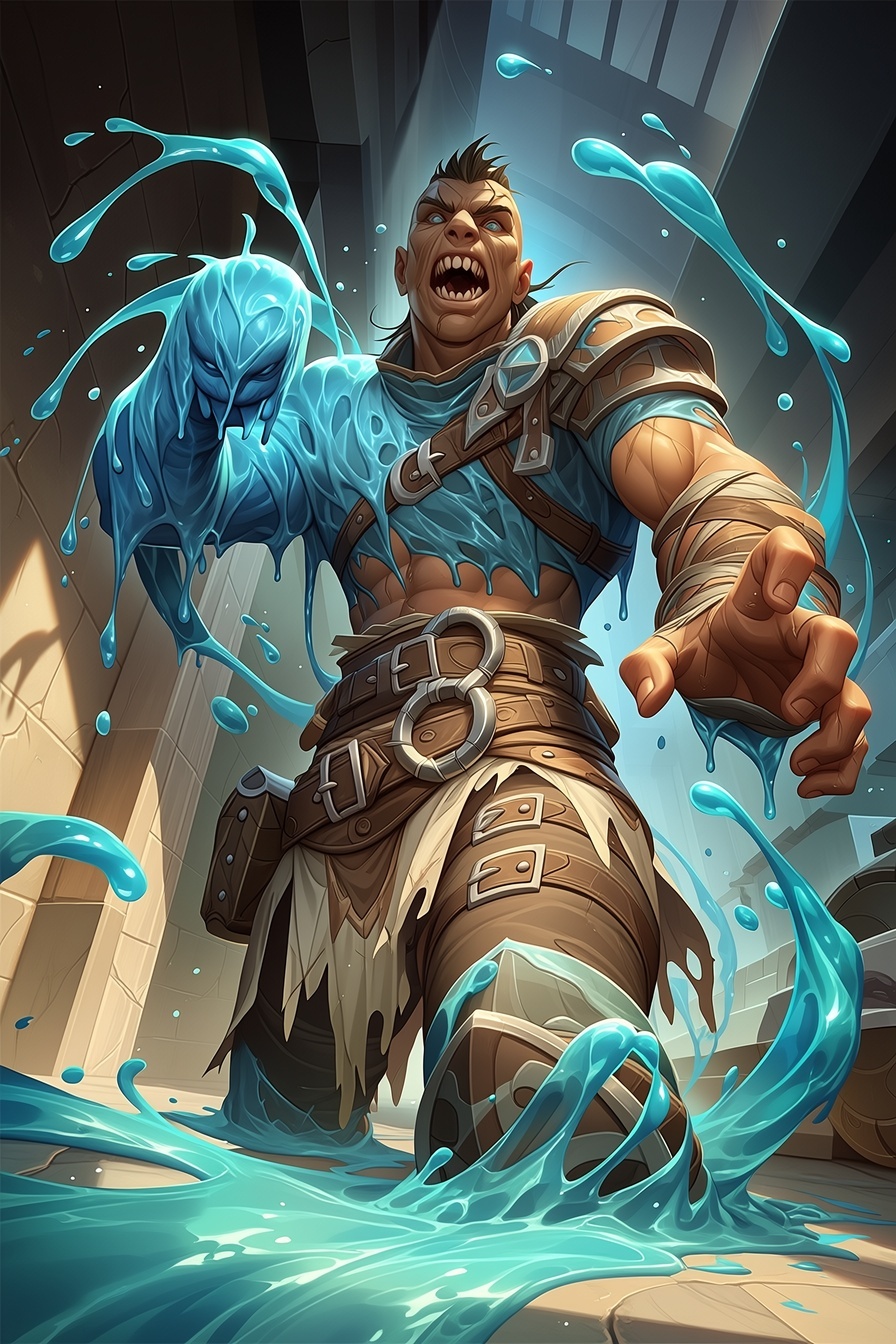
“I reached for him and found nothing to hold, only a trembling mass that slipped between my fingers like fear given form. Gods forgive me, I did not know where the man ended and the magic began.”



Wild! Nice work. : D
thank you! this one led to some hijinks in our playtest game :)