

Forecast
Better Than The Almanac
“I trust a bad forecast more than a clear one. At least the bad ones admit something is wrong.”
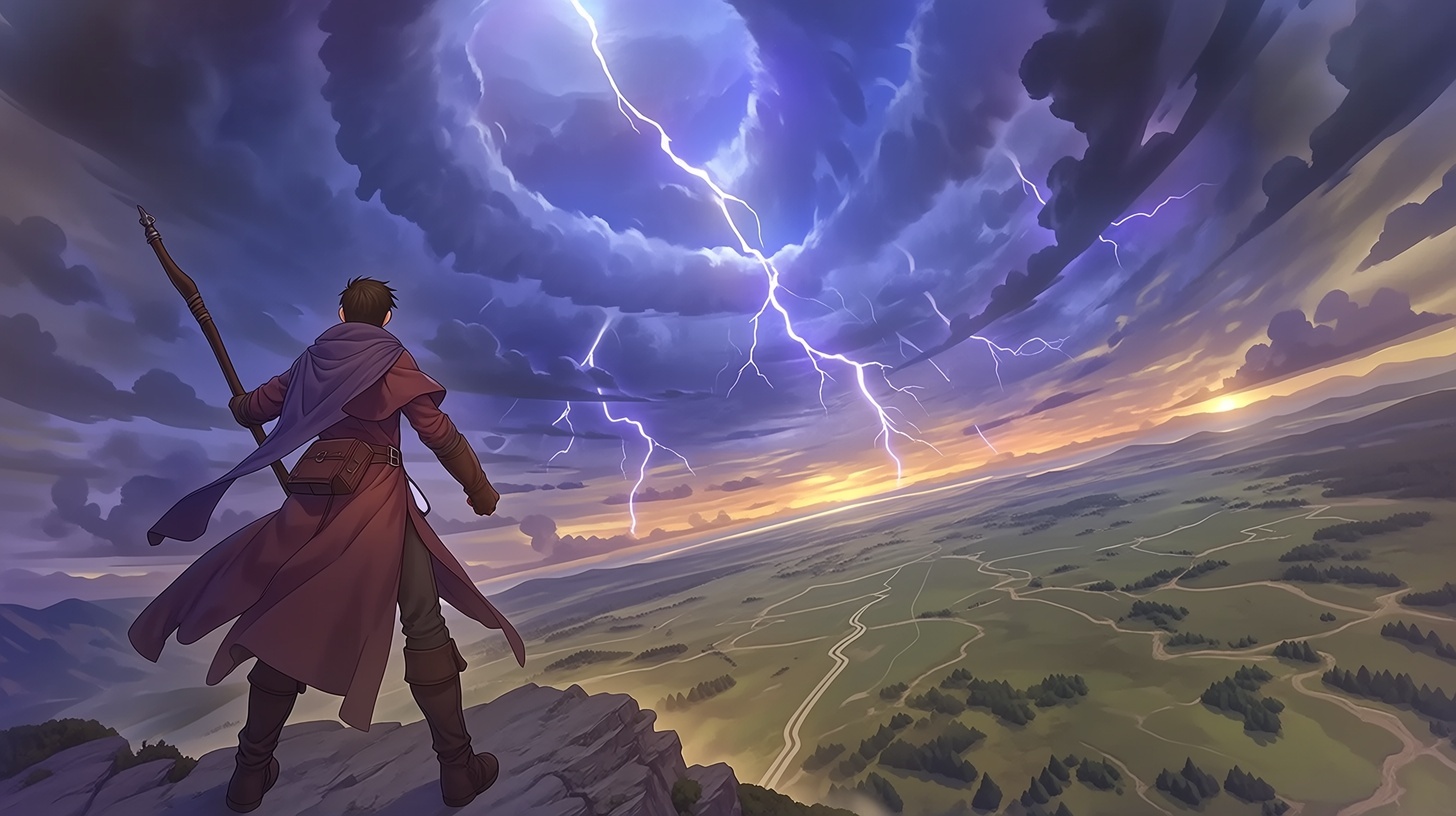
Not all divination reaches into fate. Some of it remains anchored in the physical world, concerned with processes that are already underway rather than outcomes that have yet to be shaped. Forecast belongs to this category. It does not attempt to reveal distant futures or interpret symbolic meaning. It focuses on immediate, observable systems and extends their trajectory forward with clarity.
The spell operates by refining the caster’s awareness of atmospheric conditions. It does not create new phenomena or impose artificial order. Instead, it gathers and organizes information that is already present in the environment. Variations in pressure, moisture, temperature, and wind are perceived not as isolated details, but as interconnected elements of a larger system. The spell allows the caster to interpret these elements with a level of precision that would be difficult to achieve through ordinary observation alone.
This interpretation produces a projection of how current conditions are likely to develop over a short period of time. The result is not a prediction in the abstract sense. It is an extrapolation based on existing motion. The spell identifies patterns that are already forming and follows them to their most probable outcome under present conditions.
In this way, Forecast differs from more speculative forms of divination. It does not attempt to account for all possible variables or anticipate unforeseen changes. It works within the limits of what can be observed and understood at the moment of casting. Its reliability depends on the stability of the systems it examines.
The Shattering disrupted those systems in significant ways.
Before that event, seasonal cycles and weather patterns followed relatively consistent structures. While variation existed, it occurred within predictable bounds. Knowledge accumulated over time could be applied with confidence. Farmers, sailors, and travelers relied on established patterns to guide their decisions.
After the Shattering, those patterns became unreliable. Seasonal transitions shifted or failed to occur. Storm systems developed without precedent or did not form when expected. Regions that had once been stable experienced abrupt and inconsistent changes, while others entered periods of prolonged stagnation. The underlying structure of atmospheric behavior was altered, introducing uncertainty into processes that had previously been dependable.
In this environment, the ability to interpret immediate conditions became more valuable than reliance on historical patterns.
Forecast emerged as a response to this shift. Rather than attempting to restore lost predictability, it focuses on the present state of the environment and projects forward from that point. It does not assume that the past will repeat. It evaluates what is currently happening and determines where it is likely to lead. Different traditions approach the spell in different ways.
Some practitioners develop it through refined observation. They train themselves to recognize subtle indicators of atmospheric change, such as shifts in wind direction, variations in humidity, and changes in temperature gradients. The spell enhances their ability to process these indicators, allowing them to form a coherent understanding of the system as a whole. For these practitioners, the experience of casting the spell feels like an extension of their existing skill rather than a separate act of magic.
Others approach Forecast as a structured arcane procedure. Through deliberate casting techniques, they isolate environmental variables and trace their interactions forward. This method is more formalized and can be taught within academic or institutional settings. It provides a consistent framework for applying the spell, making it accessible to those who may not have extensive experience with natural observation. Both approaches produce similar results, though the process by which those results are reached differs. The spell’s applications are broad but grounded in practicality.
Navigators use it to anticipate changes in wind and weather that may affect travel. Even a short term projection can influence decisions about route, timing, and speed. In maritime contexts, where conditions can change rapidly, the ability to identify developing systems provides a significant advantage.
Agricultural planning also benefits from the spell. Farmers and land managers use it to assess near term conditions that may affect planting, harvesting, or maintenance. While it does not provide long term forecasts, its ability to clarify immediate trends supports more informed decision making.
Military and logistical operations rely on Forecast to coordinate movement and supply. Weather conditions can influence visibility, terrain stability, and the effectiveness of equipment. By anticipating changes, planners can adjust their strategies to account for environmental factors that would otherwise introduce uncertainty. Despite its usefulness, the spell is defined by its limitations.
Forecast is bound to the natural order of the environment it observes. Where that order remains consistent, the projections it produces are reliable. Where it has been disrupted, the results become less certain. Areas affected by lingering magical interference, planar instability, or other unnatural influences do not follow predictable patterns. In such regions, the spell may produce incomplete or contradictory projections. These inconsistencies are not considered errors. They are indicators of underlying instability.
Experienced practitioners learn to recognize when the information provided by the spell does not align with expected patterns. Rather than attempting to force a coherent interpretation, they treat these discrepancies as warnings. The inability to produce a clear projection suggests that the environment is influenced by factors beyond the scope of the spell. This secondary function has become an important aspect of its use.
Forecast does not only provide information about what is likely to occur. It also reveals whether the conditions necessary for reliable prediction are present. A clear and consistent projection indicates that the system is functioning within expected parameters. A fragmented or unstable projection suggests that external forces are affecting the outcome.
In regions where the effects of the Shattering persist, this distinction can be critical. The presence of unpredictable or anomalous weather patterns may signal deeper issues within the environment. By identifying these conditions early, practitioners can avoid areas that may pose additional risks.
The spell does not offer control over the elements. It does not alter weather or mitigate its effects. Its value lies entirely in preparation. It allows those who use it to align their actions with the developing state of the environment rather than reacting to it after the fact. This emphasis on preparation reflects a broader approach to survival in a world shaped by uncertainty.
Forecast does not restore the predictability that was lost. It provides a method of working within that loss. By focusing on what is already in motion, it allows individuals to make informed decisions without relying on assumptions that may no longer hold true.
The result is a form of knowledge that is both limited and practical. The spell does not answer what will happen in every case. It clarifies what is most likely to happen based on the conditions that exist at the moment of casting.

“You don’t need magic to know a storm is coming. You need it to know exactly when it decides to break.”



Comments