


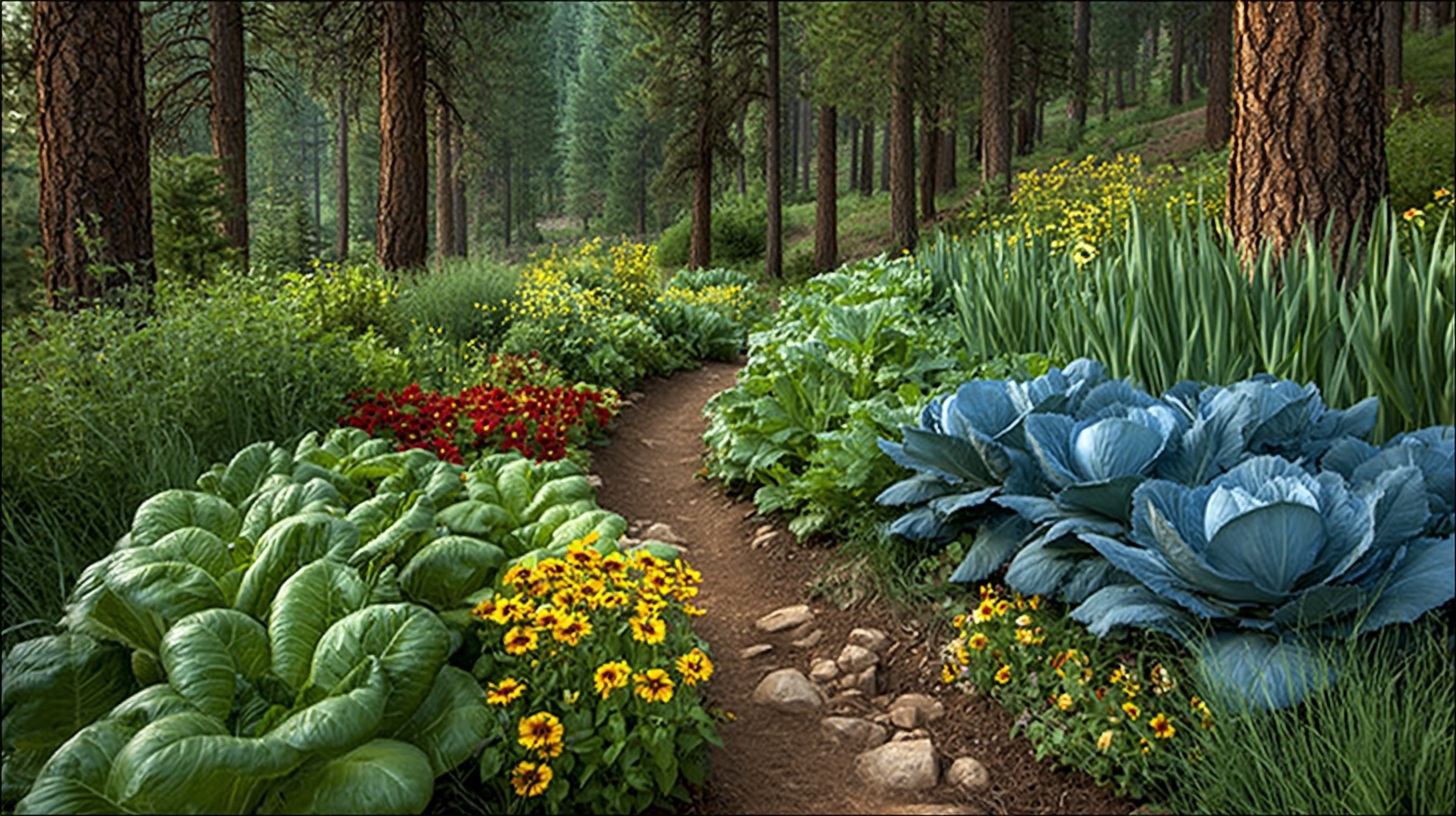
Forage
Living Off the Land
“A smart family learns the land before the pantry runs empty.”
There are spells born from conquest, from scholarship, from war, and from ambition. Forage was born from hunger.
The spell first appeared not in great arcane academies but among travelers, herbalists, frontier scouts, and isolated communities who depended on the land’s generosity to survive another season. Long before kings commissioned royal botanists and wizards cataloged magical flora in towering libraries, ordinary people needed a way to find food, medicine, and safe shelter in landscapes that could turn lethal without warning. Forage emerged from that practical desperation. It remains one of the most widely respected low circle divinations ever developed because it solves a problem every civilization eventually faces. Finding what the land is willing to give before starvation, illness, or exposure claims the unprepared.
At its core, the spell is deceptively simple. The caster names a plant or fungus familiar to them and opens their awareness to the living traces of that species nearby. The magic does not reveal exact distance or provide a clear image. Instead, it creates a directional instinct that settles behind the eyes and somewhere deep in the chest, pulling the caster toward the nearest viable specimen within range. Experienced users often compare the sensation to catching the smell of rain before clouds appear or recognizing the direction of smoke on the wind.
The forked twig required by the spell is not symbolic decoration. Traditional practitioners insist the branch acts as a sympathetic guide, mirroring the branching structures of roots and fungal networks beneath the earth. Different cultures favor different woods. Willow remains common among marsh dwellers, while mountain communities often prefer ash or pine. Some druids carefully carve notches into their twigs to mark successful harvests, years traveled, or dangerous encounters tied to the spell’s use.
Unlike more aggressive forms of magical detection, Forage operates through subtle communion rather than domination. The spell does not force nature to reveal itself. It listens for living presence. Because of this, the magic fails entirely on dead or harvested material. Dried herbs hanging in a pantry, mushrooms stored in crates, preserved roots packed in wax paper, or flowers pressed between pages remain invisible to the spell. Many scholars believe this limitation is intentional, a consequence of the spell recognizing vitality rather than substance.
This distinction has shaped centuries of folklore and practical survival wisdom. Rangers warn apprentices never to trust the spell blindly during famine because desperate people often strip landscapes bare while hidden stores remain magically silent. Herbalists tell stories of apprentices freezing to death beside abandoned cabins full of dried medicinal plants because they followed the spell’s silence rather than their instincts. The lesson appears consistently across cultures. Forage helps the living find the living. Nothing more.
The spell’s ability to estimate abundance is often more valuable than the directional sense itself. Skilled foragers learn quickly that finding a single specimen rarely solves a problem. A lone healing herb cannot support an army infirmary. One truffle does not feed a village. The magic’s vague impressions of sparse, moderate, or plentiful growth allow travelers to judge whether pursuit is worthwhile before wasting daylight or supplies.
Veteran wilderness guides frequently combine Forage with practical ecological knowledge. If the spell reveals plentiful growth in terrain where the target species should not thrive, something unusual is often occurring nearby. Entire expeditions have uncovered hidden springs, forgotten ruins, magical contamination, or ancient burial grounds because plants clustered where logic said they should not exist. In some frontier regions, investigators even use the spell to locate dangerous supernatural activity by searching for fungi known to flourish near death magic or corrupted soil.
The spell’s failures are just as important as its successes.
Rare magical plants are notoriously difficult to detect. Some resist divination naturally, while others exist partially outside ordinary reality. Extraplanar flora often confuses the spell entirely because their biological patterns do not properly belong to the world around them. Scholars continue to debate whether the failure stems from the spell’s limitations or from the plants themselves refusing recognition.
This uncertainty has made Forage strangely controversial among professional botanists and treasure hunters. Every generation produces stories of ambitious adventurers searching for extinct flowers, mythical fungi, or legendary alchemical ingredients only for the spell to reveal nothing at all. Some accept this as proof the target no longer exists. Others argue the spell merely cannot comprehend species too alien, ancient, or magically unstable to register properly.
The resulting arguments have ruined more than one academic partnership.
Despite its humble reputation, Forage has influenced history in quiet but profound ways. Armies have survived winter campaigns because scouts located edible mosses and medicinal roots before disease spread through encampments. Refugees crossing hostile terrain have endured because wandering druids guided them toward hidden fungal groves and wild grain patches. Entire trade routes developed around regions repeatedly identified through magical foraging as rich in rare herbs or valuable alchemical ingredients.
In coastal settlements and isolated mountain villages, the spell often became associated with caretakers rather than warriors. Midwives, herbal healers, shepherds, and village elders frequently learned basic forms of the spell long before formal magical education reached their communities. In many places, a local forager held nearly as much importance as a blacksmith or physician because survival depended upon understanding what the surrounding wilderness could safely provide.
Wizards remain divided in their opinions of the spell. Some dismiss it as rustic hedge magic beneath serious arcane study. Others consider it one of the purest examples of practical divination ever devised. Unlike grand prophetic rituals obsessed with destiny or cosmic truth, Forage addresses immediate material reality. Something either lives nearby or it does not. The spell succeeds because it asks a narrow question and accepts a narrow answer.
Druids and rangers typically approach the magic with greater reverence. Many traditions teach that repeated use of Forage encourages awareness of natural rhythms over time. Casters begin noticing seasonal shifts, soil conditions, migration patterns, and ecological imbalance more intuitively. Whether this represents mystical attunement or simple experience remains debated, though most wilderness folk see little reason to separate the two.
At higher levels of casting, the spell’s range expands dramatically. What begins as a localized survival tool can become an instrument for regional exploration. Veteran casters searching broad forests or isolated valleys describe the sensation as standing within an invisible web of living signals stretching across the landscape. The increased range can become overwhelming without discipline. Some apprentices report phantom impressions, confusion between overlapping growth regions, or exhaustion from maintaining concentration too long in biologically dense environments.
Yet for all its utility, Forage carries an old warning repeated by experienced wanderers everywhere.
The land always gives something. The danger lies in assuming it gives freely.
“The remarkable thing about the Embercap is not that it survives poor soil. It is that the soil improves after it leaves.”
Related Discipline
Level



Comments