


Direct Bearing
Where The Hell Are We?
“Distance is honest. It tells you exactly how far away something is. The problem is that it never tells you what stands in between.”
There are many ways to lose your way in the world. Most are obvious. A wrong turn on a mountain path. A river crossed too late in the season. A map drawn by a man who had never walked the land he claimed to chart. Others are quieter. A road that bends where it should not. A valley that seems farther than it was the last time you passed through. A destination that feels closer or farther depending on who is asking the question.
Direct Bearing was not developed to solve all of these problems. It was created to answer a single, stubborn question with absolute clarity. Where is it, in relation to me, right now.
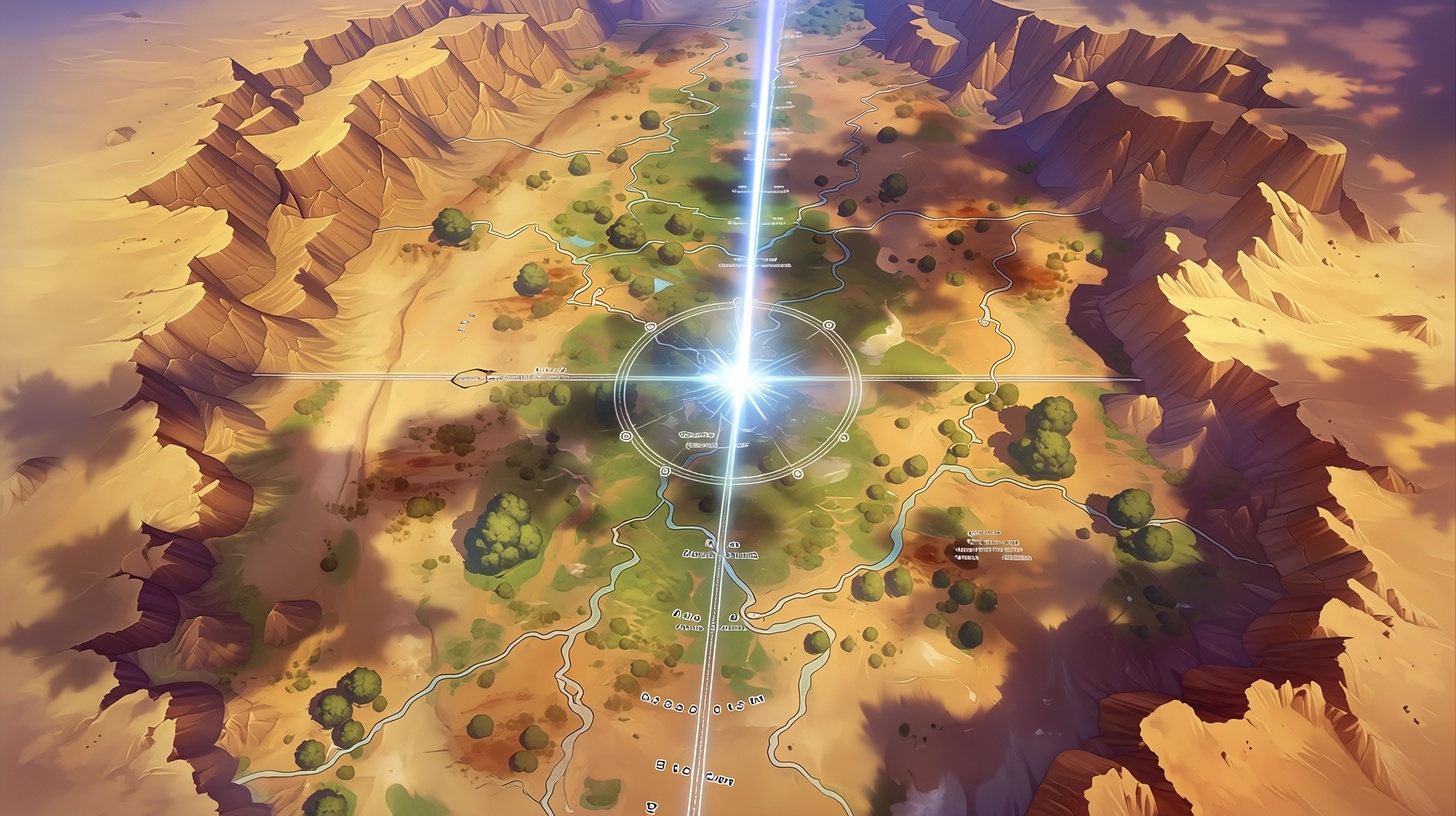
The spell does not guide the caster. It does not reveal a path, nor does it account for the realities that make travel difficult or dangerous. It offers no warning about storms, shifting ground, hostile borders, or the countless small decisions that determine whether a journey succeeds or fails. It does something simpler and far more exact. It reduces the world to distance and time, stripped of everything that complicates both.
Those who rely on it understand the distinction quickly. The answer it provides is always correct, but rarely sufficient. A traveler standing at the edge of the Agriss Mountains may learn precisely how far they are from their destination, yet still face a journey that stretches far beyond that number in effort and risk. The land does not care for straight lines, and those who try to walk them often do not arrive.
Because of this, the spell has found its place among those who plan rather than those who wander. Couriers use it to measure urgency against distance. Surveyors use it to confirm what their instruments suggest. Scholars and field researchers rely on it to orient themselves when working far from established routes. It is valued not for what it reveals, but for what it removes. Guesswork, assumption, and the quiet lies people tell themselves about how far they still have to go.
The requirement of familiarity is not a limitation imposed by tradition but by necessity. The spell cannot resolve a place that exists only as rumor or description. It requires a point of reference grounded in experience. A place seen, stood in, or known with certainty. Without that anchor, the question has no meaning, and the magic has nothing to answer.
In the years following the Shattering, when maps failed and distances shifted with unsettling inconsistency, spells like Direct Bearing became essential tools for those trying to rebuild reliable knowledge of the world. While it cannot account for the lingering distortions that still plague certain regions, it provides a fixed relationship between two known points. In a world where much remains uncertain, that alone is often enough.
Even now, it is taught not as a spell of discovery, but as a discipline of perspective. It reminds the caster that knowing where something lies is not the same as knowing how to reach it. The difference between those two truths has stranded more travelers than any storm or blade.

“I have seen men comfort themselves with numbers. Fifty miles, they say, as if the land will oblige them by being simple. Then they step forward and learn what those miles cost.”



Comments