


Celestial Reference
Catography Of The Heavens
“I trusted maps once. Then I trusted roads. Now I trust the sky, even when I can't see it."
There was a time when looking to the sky was enough.
Before the Shattering, the heavens were not simply a source of wonder or philosophical inquiry. They functioned as a reliable system. Sailors plotted courses across open water using fixed stars. Travelers marked distance and direction by the movement of constellations. Scholars tracked celestial patterns with the expectation that their observations would remain valid across seasons and generations. The sky provided a framework that could be trusted when other measures failed.
This reliability extended beyond navigation. The consistency of the heavens offered a point of stability in a world shaped by forces that were otherwise difficult to predict. Even as magic fluctuated and political boundaries shifted, the sky remained constant. That constancy allowed knowledge to accumulate without needing constant revision. It served as a reference against which other uncertainties could be measured.
The Shattering disrupted that relationship.
When the arcane structures that supported the world collapsed, the effects extended beyond the obvious loss of magical function. Instruments that depended on stable forces lost their accuracy. Measurements that had once been reliable began to vary without explanation. Distances that had been mapped precisely no longer corresponded to experience. Entire regions found themselves isolated not through physical barriers, but through the breakdown of shared reference points.
In this environment, the loss of reliable navigation was not an inconvenience. It was a structural problem. Without consistent orientation, movement became uncertain. Trade routes became difficult to maintain. Exploration slowed, not because paths were blocked, but because their endpoints could no longer be confirmed with confidence. Celestial Reference emerged as a response to that problem.
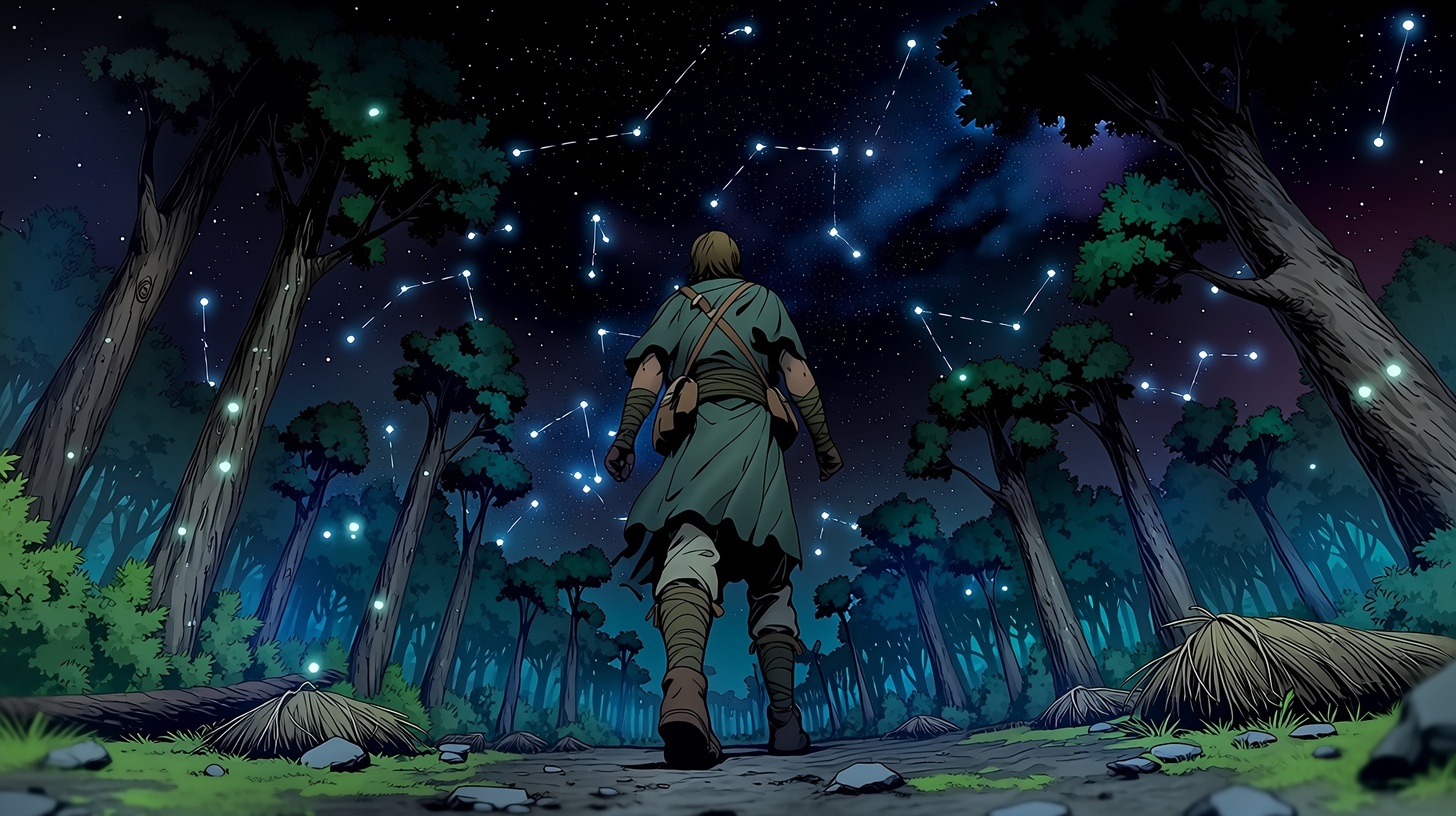
The spell does not attempt to restore the heavens to their former state, nor does it correct the distortions introduced by the Shattering. It does not stabilize the world or impose order on the environment. Instead, it provides the caster with a consistent frame of reference by overlaying the true positions of celestial bodies onto their perception.
This overlay functions independently of local conditions. It is not limited by line of sight, terrain, or physical obstruction. The stars appear as they exist in relation to the caster’s position, regardless of whether the sky is visible. Underground, indoors, or beneath layers of stone, the celestial framework remains present within the caster’s awareness.
The experience of this effect is often described as disorienting at first. The mind is conditioned to interpret the sky as something distant and positioned above. When the same patterns appear beneath the feet or through solid structures, that expectation is disrupted. Constellations extend through walls and ground without regard for physical boundaries. The horizon loses its significance as a defining line. With continued exposure, this disorientation diminishes.
The caster begins to integrate the overlay into their perception of space. The presence of the celestial framework becomes less intrusive and more functional. Instead of conflicting with the environment, it provides a consistent reference that can be used to interpret position and orientation.
The spell does not provide directions or identify destinations. It does not indicate where a path leads or how to reach a specific location. Its function is limited to establishing the caster’s position relative to the broader structure of the world. This information can then be used in conjunction with other knowledge to determine movement and direction. In practical use, Celestial Reference has become a standard tool among those who operate in environments where conventional navigation is unreliable.
Couriers traveling between regions disrupted by shifting terrain rely on it to maintain consistent routes. Explorers moving through unmapped or unstable areas use it to track their position without depending on landmarks that may change or disappear. Investigators working beneath cities or within enclosed structures use it to orient themselves in spaces where external reference points are absent.
The spell is particularly valuable in environments where disorientation is a significant risk. Complex underground systems, dense urban structures, and regions affected by lingering arcane instability all present challenges that cannot be resolved through ordinary means. By providing a fixed point of comparison, the spell allows the caster to maintain awareness of their position even when other indicators are unreliable. There are limitations to its effectiveness.
The spell depends on the existence of a stable celestial framework. In regions where the sky itself is distorted, whether through natural phenomena or deliberate magical interference, the reference it provides may be incomplete or inaccurate. If the positions of celestial bodies cannot be determined with consistency, the overlay reflects that instability.
Additionally, the spell is subject to interference from effects that disrupt divination. In areas where such interference is present, the connection between the caster and the celestial framework may be weakened or severed entirely. In these cases, the spell provides no benefit, and the caster must rely on conventional methods of navigation. Despite these limitations, the spell remains widely used.
Its value lies not in perfection, but in reliability under conditions where other methods fail. It does not require preparation beyond casting, and it does not depend on external tools or environmental features. As long as the underlying celestial structure remains accessible, the spell provides a consistent reference. Regular use of Celestial Reference can influence how individuals perceive space and position.
Those who rely on it frequently begin to think in terms of relative alignment rather than fixed orientation. The ground is no longer treated as an absolute reference. Instead, it becomes one of many surfaces through which position is interpreted. The distinction between above and below becomes less significant when both are defined relative to the same external framework. This shift in perspective does not alter the physical world, but it changes how the caster interacts with it.
Movement becomes less dependent on immediate surroundings and more anchored to a broader structure. The environment is understood as a variable layer over a stable system, rather than as a self contained space. This approach can improve consistency in navigation, but it may also create a sense of detachment from local features that others rely on. In a broader sense, the spell reflects the adaptation of arcane practice to a world where certainty has been reduced.
Rather than attempting to restore what was lost, Celestial Reference accepts the instability of the present and provides a means of working within it. It does not correct the world. It allows the caster to orient themselves despite its inconsistencies. The result is a form of knowledge that is both limited and dependable. The spell does not answer where to go. It establishes where the caster is.

“People think it shows you where to go. It does not. It shows you where you are. The difference matters more than they realize.”



Very useful, especially underground!
One of our writers made this one. Her Druid/Bard found it incredibly useful and they were (well, still are) underground for some time. We're really happy with it. Thanks for checking it out! <3