


Canopy
Roughing It
“It’s not shelter. It’s enough to pretend you have shelter.”
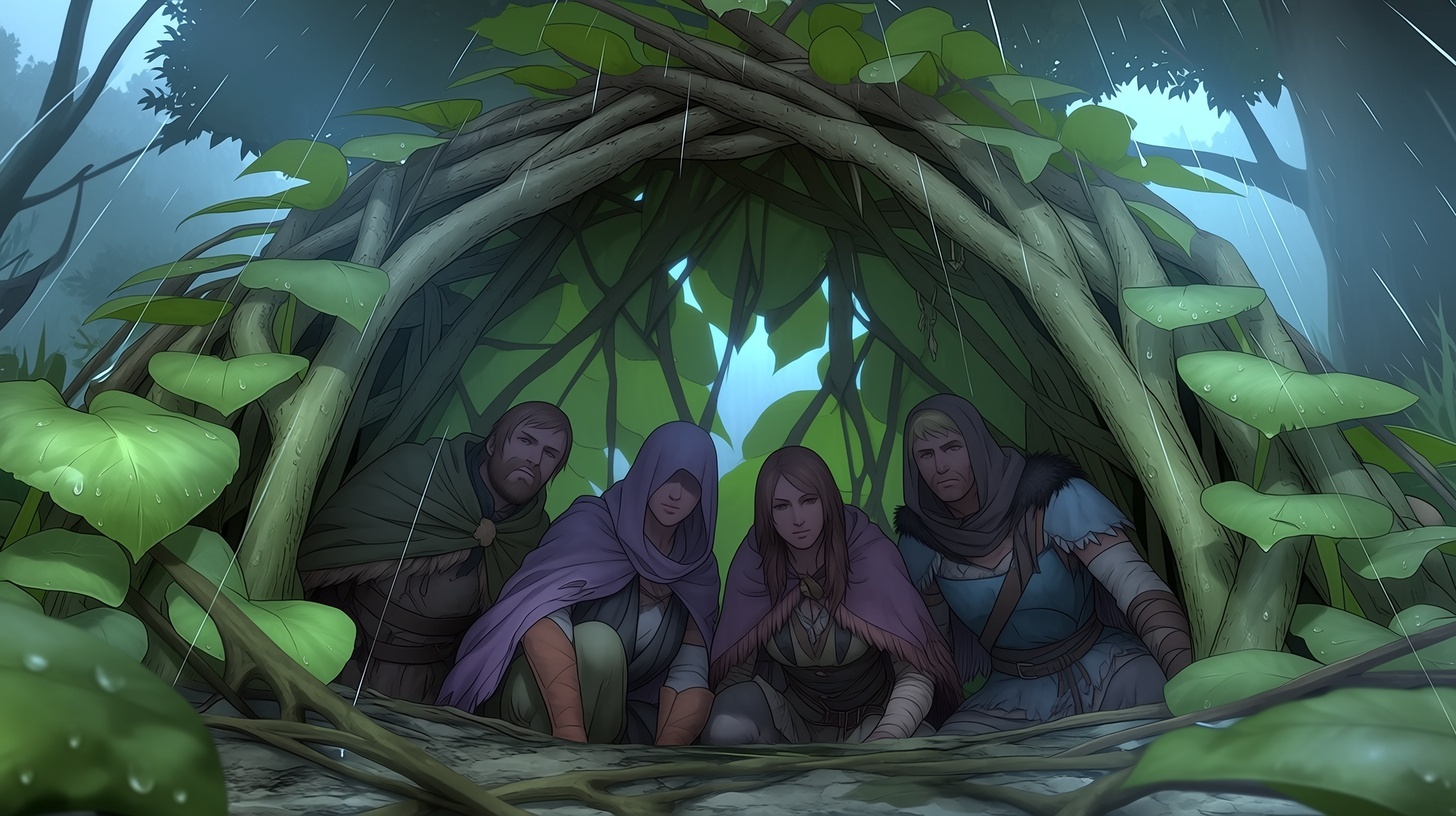
Canopy is a simple spell in both function and intent. It reshapes existing plant life to provide immediate, temporary shelter. It does not create vegetation, strengthen it beyond its natural limits, or alter the surrounding environment in any lasting way. Instead, it gathers what is already present and compels it into a more useful form.
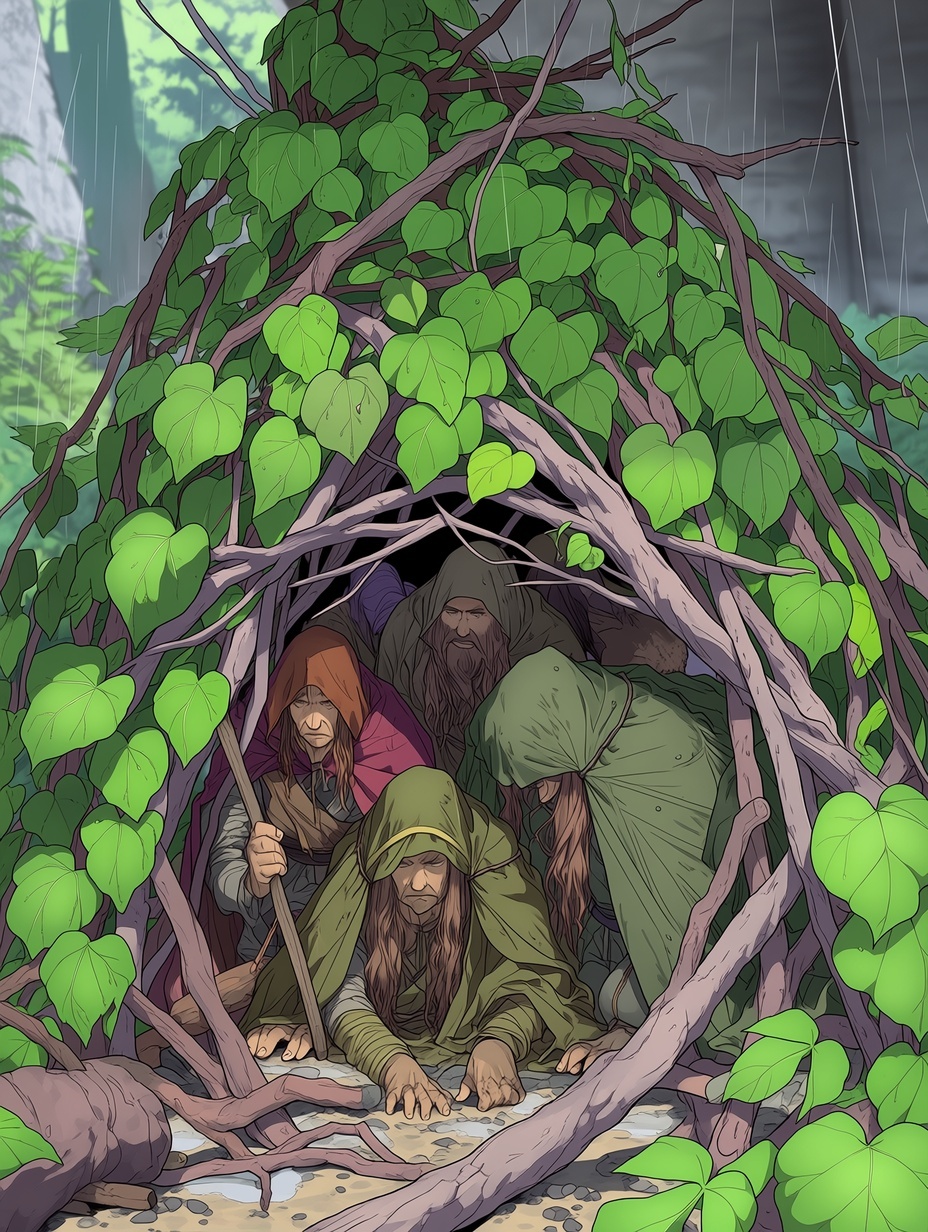
When the spell is cast, nearby vegetation bends inward and interlaces, forming a low, protective covering over a defined area. Branches, vines, and broad leaves are drawn together and held in place by the magic sustaining the effect. The resulting structure is crude but stable, resembling a natural shelter that might otherwise take time and effort to construct by hand.
The effectiveness of the spell depends entirely on the presence of suitable plant life. Sparse or insufficient vegetation cannot be forced into a functional canopy. The magic does not compensate for a lack of material. Where there are no trees, vines, or large foliage, the spell has no effect.
Within its area, the canopy provides basic protection from environmental exposure. Rain is diverted, and normal wind is reduced to a level that allows for relative comfort. The ground beneath remains dry under ordinary conditions, making the space suitable for rest, preparation, or temporary refuge.
This protection is limited and clearly defined.
The structure is not reinforced beyond the natural strength of the plants that form it. It does not resist force, block attacks, or withstand extreme conditions. Strong winds can disrupt it. Heavy snowfall or accumulated debris may collapse it. Fire, whether natural or magical, can destroy it as easily as it would any other vegetation.
The spell does not insulate against temperature. Heat and cold remain factors within the space it creates. While it can shield against rain and light wind, it offers no meaningful protection against harsh climates. Those who rely on it for shelter must still account for the broader environment.
One notable effect of the spell is its influence on small nonmagical creatures. Insects and vermin tend to avoid the area beneath the canopy. The exact reason for this behavior is not fully understood, but it appears to be a byproduct of the magic’s interaction with the vegetation. The space created by the spell is treated as unnatural by such creatures, despite being formed from natural materials. As a result, the area remains relatively free of minor pests.
This aspect of the spell is often valued as much as its protective qualities. In environments where insects or small animals are a persistent problem, the ability to create a clear, dry space can significantly improve conditions for rest and recovery.
The duration of the spell reflects its intended use. Canopy is not meant to create permanent structures or long-term shelter. It is a temporary measure, sustained only as long as the caster maintains concentration and the vegetation remains intact. If the plants forming the canopy are cut, burned, or otherwise destroyed, the structure collapses and the spell ends.
Because of this, the spell is most commonly used in situations where speed and convenience are more important than durability.
Travelers use it to establish short-term camps without the need to construct shelter manually. Scouts and messengers rely on it to create brief refuges during extended movement through wilderness areas. Small groups may use it to maintain equipment, prepare food, or rest without exposure to rain or wind.
In more organized contexts, the spell is sometimes used to create temporary working spaces in natural environments. Field operations that require a stable, dry area can benefit from the immediate shelter it provides. The simplicity of the spell makes it reliable, provided the necessary conditions are met.
There are also limitations in how the spell interacts with terrain and space.
The canopy forms around a fixed point and does not move once established. Creatures beneath it must remain within its area to benefit from its protection. Expanding or relocating the shelter requires recasting the spell. This reinforces its role as a static, localized solution rather than a mobile one.
The structure itself is shaped by the available vegetation, and as a result, its form can vary. In areas with dense foliage, the canopy may be thick and low, providing a more enclosed space. In regions with taller or more rigid plant life, the shelter may be higher and more open. The spell does not impose a uniform shape, only a functional one.
This variability does not affect its primary purpose, but it does influence how it is used. Some forms may offer better coverage or more usable space than others, depending on the environment.
From a practical standpoint, Canopy occupies a clear position among low-level transmutation spells. It addresses a common need without introducing complexity or risk. It does not alter the course of events in a dramatic way, but it provides a consistent and reliable benefit in situations where exposure would otherwise be a problem.
Its value lies in its predictability.
The spell does not require specialized knowledge to use effectively. Its limitations are straightforward, and its outcomes are easy to anticipate. As long as the caster understands the environment and the conditions required, the result is consistent.
This makes it particularly useful for those who spend extended time in natural settings. The ability to create shelter quickly, without tools or preparation, reduces the burden of travel and allows for greater flexibility in movement and planning.
At the same time, the spell does not replace traditional methods of survival. It cannot substitute for proper equipment, preparation, or awareness of environmental hazards. It provides a measure of comfort and convenience, not security.
Those who rely on it exclusively may find themselves unprepared when conditions exceed what the spell can handle.
In this way, Canopy serves as a supplement rather than a solution.
It offers a simple answer to a specific problem. It does not attempt to solve anything beyond that.
“You can spend an hour building something better, or you can spend a minute making something that works.”



Comments