


Bloodwake
The Medium of Crime
"Once you give the dead a way to speak, you must accept that the living will do everything they can to silence them again."
Bloodwake occupies an uneasy position in the modern understanding of investigation and applied alchemy. It is neither a miracle solution nor a simple tool, but a substance that reshaped how truth is pursued in a world still recovering from the Shattering. Its continued relevance lies not in what it guarantees, but in what it demands from those who use it. Bloodwake does not replace testimony, reasoning, or judgment. It complicates them by introducing evidence that cannot be ignored once revealed.
In Estania, the reagent became emblematic of the Second Alchemical Renaissance’s shift toward practical, civic application. Where earlier discoveries were celebrated simply for functioning at all, Bloodwake represented intent. It existed to answer specific human questions about harm, concealment, and accountability. This purpose driven design distinguished it from many contemporaneous breakthroughs and ensured its adoption by institutions concerned with law, medicine, and governance rather than private experimentation.
The reagent’s reliance on darkvision introduced an unexpected social dimension. Investigations involving Bloodwake often required the presence of individuals capable of perceiving its reaction, elevating certain races and professions into roles of forensic authority. This reliance subtly altered investigative hierarchies, creating situations where interpretation rested in fewer hands. In some regions, this concentration of perception was welcomed as specialization. In others, it fostered distrust and accusations of selective truth.
Beyond law enforcement, Bloodwake found controlled use in medical settings. Surgeons and physicians employed it to identify internal trauma, concealed wounds, and complications masked by superficial healing. While invaluable in emergencies, its application raised ethical concerns about consent and the boundary between diagnosis and accusation. As with all uses of the reagent, its presence carried implications beyond its immediate function.
The darker applications of Bloodwake were slower to emerge but no less significant. Necromancers, anatomists, and mortuary specialists recognized its value in maintaining precision and cleanliness in their work. This association further complicated the reagent’s reputation, binding it to disciplines already viewed with suspicion. Although its use in these contexts was often practical rather than malicious, public perception rarely drew such distinctions.
Over time, Bloodwake became as much a symbol as a substance. Its deployment at a scene altered behavior immediately. Witnesses grew guarded. Officials intervened. Silence often followed. The reagent’s very presence suggested scrutiny and consequence, sometimes provoking cooperation and sometimes provoking violence. In this way, Bloodwake influenced outcomes even before it revealed anything at all.
Today, Bloodwake remains tightly regulated wherever it is officially recognized. Its production is monitored, its distribution recorded, and its use scrutinized. These controls exist not because the reagent is unreliable, but because it is effective enough to threaten established narratives. Bloodwake endures as a reminder that in a world where magic faltered, truth did not disappear. It simply became harder to face, and far more dangerous to uncover.

Mechanics & Inner Workings
"Light was never the answer. The answer was learning who could already see in the dark."
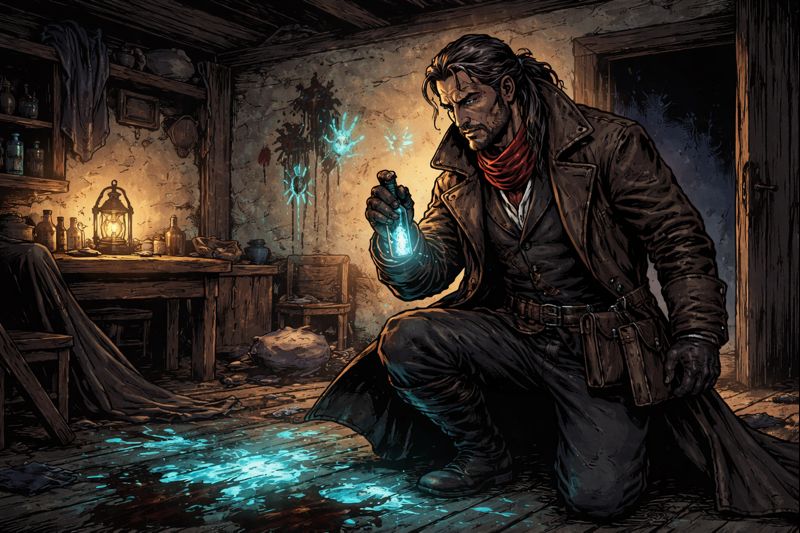
Bloodwake functions through a delayed reactive process rather than an immediate visible effect, a design choice that emerged through repeated failure rather than intention. When applied to a surface, the solution first penetrates porous material and settles into microscopic irregularities rather than reacting at once. During this initial phase the reagent appears inert, leading early observers to assume it had failed. Only after several minutes does the reaction fully develop, once the solution has bonded to trace residues left behind by biological trauma.
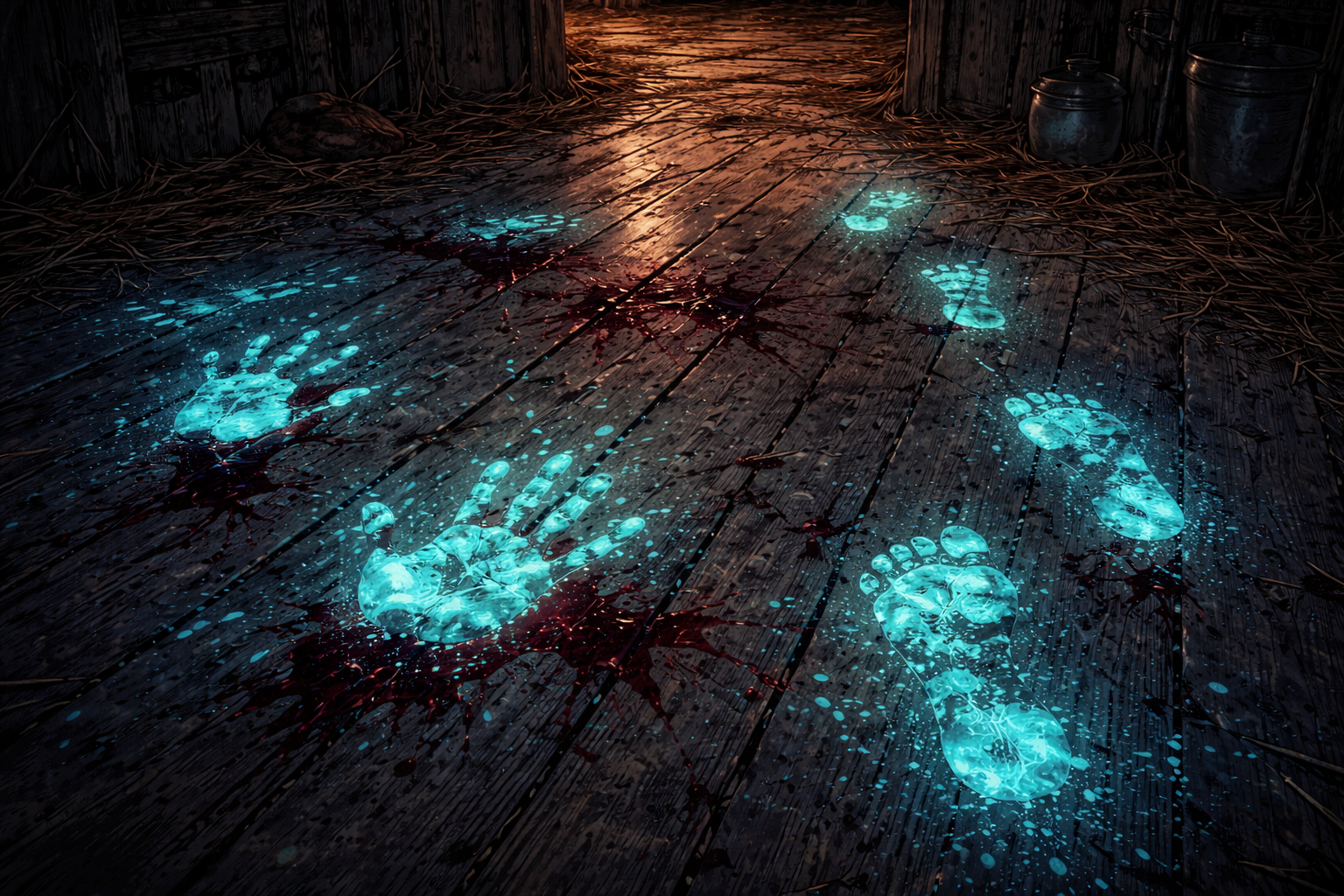
The reaction itself does not generate light in the conventional sense. Instead, Bloodwake produces a subtle alchemical luminescence that exists primarily within the lower visual spectrum. This glow is invisible to creatures reliant on ordinary sight, regardless of ambient lighting conditions. Those possessing darkvision perceive the reaction clearly, as the altered residue reflects within the same range their vision is adapted to interpret. This property was not originally planned and was only recognized after repeated field testing involving non human watch officers.
The glow produced by Bloodwake is not uniform. It varies in intensity and pattern depending on the nature of the original event. Spatter, drag marks, and attempts at cleaning create distinct visual signatures that trained observers can learn to read over time. However, the solution does not interpret meaning on its own. It reveals presence and movement, not intent. Misreading patterns remains a persistent risk, particularly among those eager to see guilt where none exists.
Once fully active, the reaction persists for approximately thirty minutes before fading naturally. This limitation is inherent to the chemical stability of the solution and cannot be extended without rendering it dangerously volatile. The finite window was initially viewed as a flaw, but later recognized as a safeguard. Evidence revealed by Bloodwake demands immediate attention and careful documentation, discouraging prolonged manipulation or theatrical reconstruction of events.
Bloodwake does not discriminate between recent and old traces beyond the clarity of the reaction. Older residue produces weaker, fragmented patterns that can be mistaken for environmental noise. This degradation places a natural emphasis on timely investigation and prevents the solution from functioning as a universal answer to historical crimes. It also ensures that scenes heavily trafficked after an incident become increasingly difficult to interpret with confidence.
Despite its precision, Bloodwake is not foolproof. Certain materials absorb or disrupt the reaction entirely, while others distort the resulting patterns. Extensive fire damage, prolonged exposure to running water, and deliberate chemical countermeasures can all reduce its effectiveness. These limitations are well known among Estanian authorities and quietly acknowledged by those who rely on the reagent. Bloodwake reveals what remains. It does not restore what has been deliberately erased, nor does it absolve investigators of judgment or restraint.

Manufacturing process
"Every substance has a memory. Some remember heat. Some remember pressure. This one remembers violence."
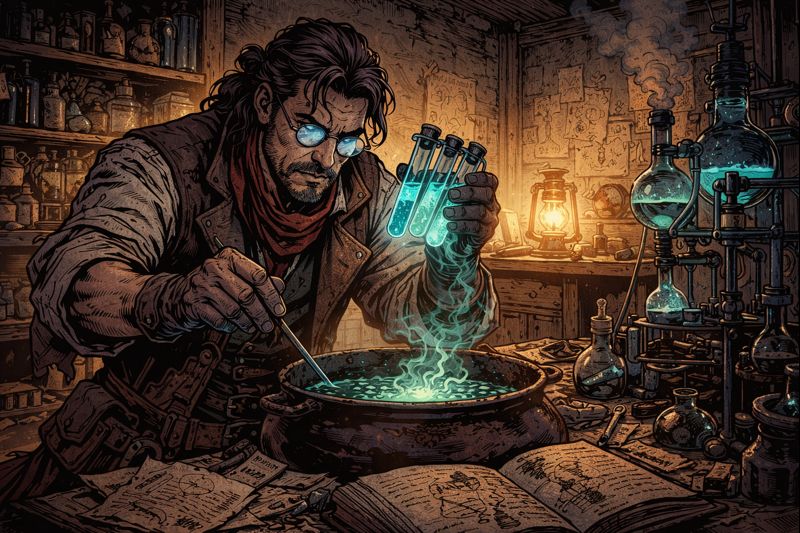
The materials used in the preparation of Bloodwake reflect the unusual intersection of alchemy and mundane chemistry that defined the Second Alchemical Renaissance. None of its components are inherently magical, a fact that initially made the reagent easier to justify in a post Shattering world wary of arcane dependency. Instead, its foundation relies on carefully purified mineral salts, distilled solvents, and binding agents refined to a level of consistency uncommon outside Estanian laboratories of the period. These base substances were already in use among physicians, dye makers, and metallurgists, which allowed Bloodwake to exist without immediately attracting religious or political suspicion.
Central to the solution is a class of reactive compounds derived from iron rich minerals and treated organic residues. These materials were selected not for rarity, but for their predictable behavior under controlled conditions. Estanian chemists favored sources from coastal quarries and inland riverbeds where mineral composition could be reliably cataloged. This emphasis on repeatability marked a clear departure from earlier alchemical traditions that prized symbolism or planetary alignment over material consistency.
Organic components play a quieter but equally important role. Bloodwake requires trace extracts derived from animal proteins that have undergone specific processes of decay and stabilization. These were originally sourced from slaughterhouses and apothecaries rather than arcane suppliers, reinforcing the reagent’s grounding in the physical world. Such materials demanded careful handling, as improperly prepared samples degraded quickly and rendered entire batches unstable or inert. This fragility contributed to the reagent’s cost and limited shelf life.
To prevent unwanted reactions during storage and transport, Bloodwake is suspended in a neutral carrier solution distilled to exceptional purity. Estanian records note that even minor contamination from untreated water or impure glassware could compromise a batch. As a result, production required facilities capable of maintaining clean environments and standardized vessels, something beyond the reach of most independent alchemists. This infrastructural requirement became one of the primary barriers to unsanctioned manufacture.
Taken together, the materials of Bloodwake reveal why its creation was never a casual endeavor. None of its components are forbidden on their own, yet their combination demands expertise, discipline, and access to regulated resources. This balance allowed the reagent to exist within civil institutions while remaining inaccessible to casual misuse, ensuring that every vial carried not only chemical weight, but administrative and social consequence as well.
History
"Truth does not vanish when magic fails. It only learns to hide better."

Bloodwake was conceived in the turbulent decades following the Shattering, when the failure of spellcraft forced Estania to confront which disciplines still functioned in a broken world. Among the civil institutions that endured was the city watch, stripped of magical certainty and left to rely on testimony, physical evidence, and flawed memory. Inspector Mateo de Alvarín served in the coastal city of Calbrava during this period, a jurisdiction plagued by unrest, displacement, and a rising tide of unsolved violent crime. Unlike many of his peers, de Alvarín had long maintained a private interest in chemistry and practical alchemy, believing that reproducible reactions hinted at deeper laws that the Shattering had not erased.
The catalyst for Bloodwake’s creation was a prolonged and deeply unsettling murder investigation that gripped Calbrava for nearly two years. Victims were discovered in sealed rooms, guardhouses, and private residences, their surroundings meticulously cleaned and arranged to suggest accidents or self inflicted deaths. Magical inquiry proved unreliable or entirely inert, producing no consistent results. Witness statements contradicted one another, and official conclusions shifted with political pressure. The killer, never seen and never credibly identified, became known among the watch as El Silente, a name reflecting not absence of evidence but the city’s inability to speak plainly about what had occurred.
De Alvarín’s frustration with the case drove him away from official methods and into personal experimentation. His initial goal was not to invent a new investigative tool, but to determine whether violence left behind any non magical residue that could not be erased through mundane cleaning. Working alone and without sanction, he tested reagents on discarded materials from closed cases, cellars, and condemned buildings. Many early trials failed outright or produced dangerous side effects, nearly costing him his post when an experiment damaged municipal property.
The critical breakthrough occurred only after the investigation into El Silente had effectively stalled. De Alvarín identified a reaction that did not respond to blood itself, but to traces left behind where blood had once been present. When tested in an old cellar tied to an unrelated death ruled natural, the reaction revealed patterns that contradicted months of sworn testimony. The case was quietly reclassified, but the implications disturbed de Alvarín more than the result. The reagent could expose truth, but only if someone was willing to look, and only before fear or convenience intervened.
By the time de Alvarín recognized the broader significance of his discovery, interest from civic and judicial authorities had already begun to grow. Estania was entering the latter phase of the Second Alchemical Renaissance, a period marked by the deliberate application of post Shattering chemical knowledge to governance, medicine, and civil order. Officials questioned de Alvarín repeatedly, not about the killer he failed to catch, but about how his work might be standardized, regulated, and controlled. He resisted formal adoption, insisting his findings were incomplete and dangerous if misused.
Inspector Mateo de Alvarín died several years later under unremarkable circumstances, his personal notes seized and archived by the Calbravan magistracy. El Silente was never identified, and the original investigation faded into rumor. The reagent survived him, refined by others and eventually named Bloodwake by those who used it in the field. In Estania it became both a symbol of post Shattering ingenuity and a quiet reminder that the most important discoveries are often born not from triumph, but from failure that refuses to stay buried.
Significance
“Truth does not care about alibis. It waits patiently in the dark until someone gives it permission to be seen.”

The significance of Bloodwake lies not in its novelty but in how decisively it altered the balance between rumor and evidence in criminal investigation. Prior to its adoption, Estanian courts relied heavily on witness testimony, confessions extracted under pressure, and circumstantial reconstructions that were often shaped as much by politics as by fact. Bloodwake introduced a quiet but profound shift by allowing investigators to demonstrate that violence had occurred even when every visible trace had been scrubbed away. In doing so, it reduced the space in which plausible deniability could operate and forced crimes to be argued on material grounds rather than reputation or influence.
Its earliest documented uses were cautious and unofficial, employed by city inspectors willing to risk professional ruin if the substance proved fraudulent or dangerous. When it worked, however, it worked with unsettling clarity. Hidden stains in rented rooms, washed courtyards, and public bathhouses reappeared as undeniable proof of wrongdoing. This capability did not merely solve individual cases. It changed investigative behavior. Crime scenes were preserved rather than hurriedly cleared. Locations previously dismissed as irrelevant were reexamined. Patterns began to emerge across cases that had once seemed isolated, allowing magistrates to connect crimes separated by time, distance, or social class.
Bloodwake also played a critical role in protecting the innocent. False accusations, particularly against the poor, the foreign, and the socially expendable, had long been a convenient tool for closing difficult cases. The ability to demonstrate the absence of blood where violence was alleged gave defenders a material counterweight to rumor. While not eliminating corruption or bias, the substance raised the cost of fabrication. A charge unsupported by Bloodwake findings increasingly appeared suspect, especially in urban courts where its reliability became known.
Over time, its influence extended beyond Estania’s borders. Neighboring polities took note of the sudden increase in solved violent crimes and the corresponding decline in unresolved disappearances. Requests for sanctioned production followed, often framed as public safety initiatives but just as often motivated by a desire to maintain parity with Estanian investigative methods. In this way, Bloodwake became not only a tool of justice but a symbol of institutional legitimacy. A city that possessed it signaled an intention, genuine or otherwise, to pursue truth through evidence rather than decree.
Perhaps most importantly, Bloodwake reshaped how violence itself was perceived. The knowledge that blood could no longer be fully erased altered criminal behavior, encouraging either greater brutality or greater restraint depending on temperament. For law enforcement, it reinforced the idea that actions leave echoes whether one wishes them to or not. In the long aftermath of the Shattering, when certainty was scarce and trust fragile, Bloodwake stood as one of the few developments that made the world feel briefly more legible. It did not bring justice on its own, but it made lying to justice far more difficult.


"I did not make this to accuse the living. I made it because the dead were being ignored."



If there's Blood Wake, is there a Bile Sleep?
Coming soon ;)