

Behold Convergence
Beauty of the Infinite
"Behold the veil, how thin it lies between
What is, what was, and all that yet may be.
A thousand worlds lean close against our own,
Each whispering truths we scarcely dare to name.
What we call real is but a single note
In some vast chorus without end or form."
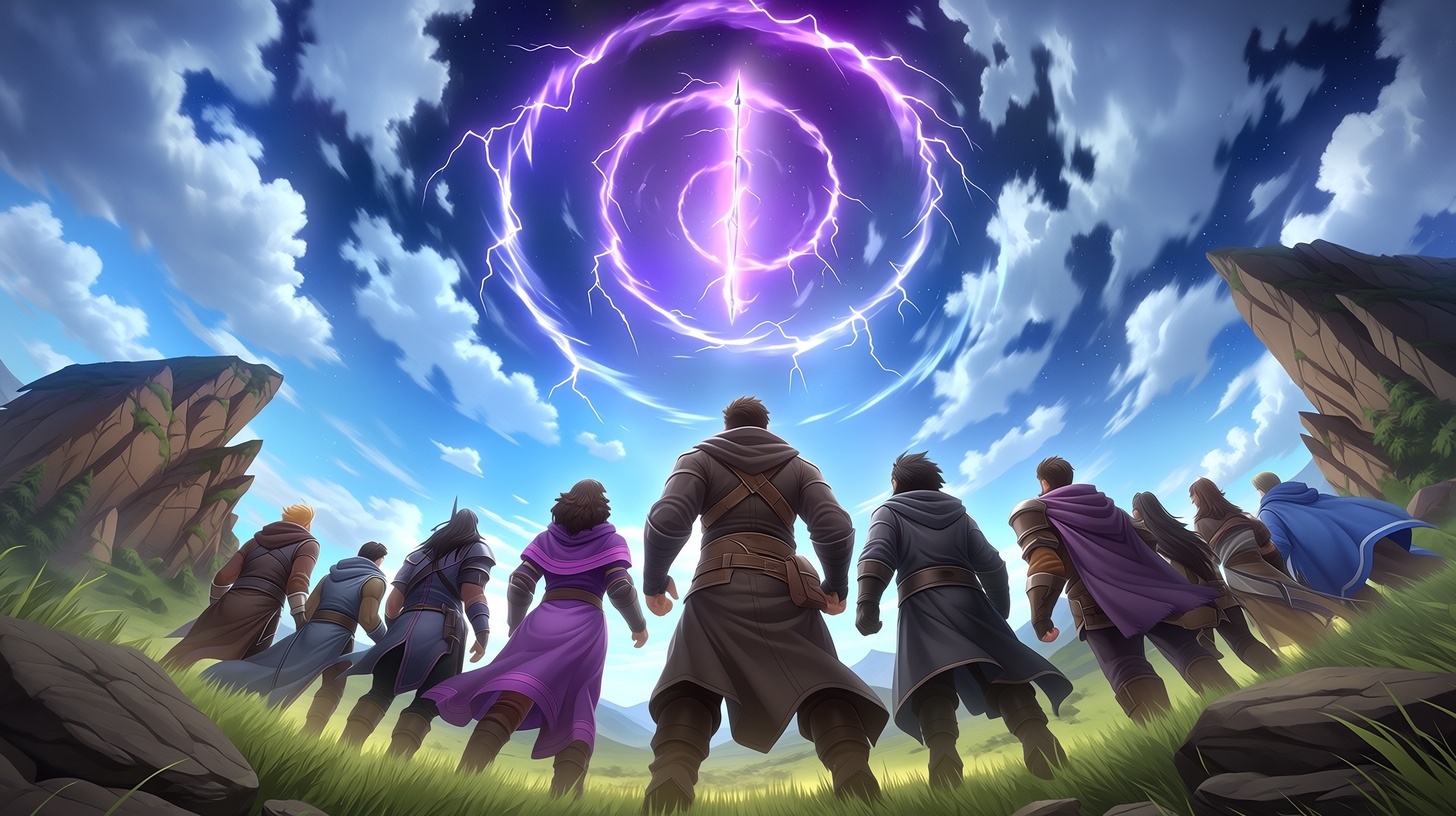
There are spells that reveal the hidden structure of the world, and then there are spells that reveal the more troubling fact that the world has never been singular to begin with. Behold Convergence belongs to the latter category. It is not merely a working of perception, nor a refined means of detecting portals, boundaries, and arcane anomalies. It is an invitation to witness the uneasy truth that reality is less a sealed chamber than a house whose walls were never finished, a place of drafts, thin plaster, and doors that open inward from places no mason ever planned.
In simpler terms, this spell allows the caster to perceive the pressure points where planes lean too close to one another. That is the practical function, and it is useful enough on its own. For explorers, wardens, ritualists, and anyone whose business takes them into old ruins, dead sanctums, corrupted battlefields, or the damaged places of the world, such a spell is of obvious value. To know whether a portal lies dormant beneath stone, whether a region has been touched by foreign planar force, whether the air itself has begun to wear thin between worlds, is to possess knowledge that may preserve not only life, but reason.
But practical descriptions, however necessary, do not quite capture what this spell actually does to the mind that bears it.
When Behold Convergence is cast, the caster does not simply notice arcane signatures or glowing traces. The spell does not reduce the impossible to tidy symbols and comfortable abstractions. Instead, it fractures perception just enough that the eye begins to understand what it was never designed to understand. The familiar world remains present, but it no longer enjoys the courtesy of exclusivity. Space becomes layered. Light acquires additional meanings. Corners deepen. Surfaces hesitate. The empty air within sixty feet of the caster is revealed to be full of negotiations already in progress.
Each planar disturbance appears as a translucent interference in reality, but not in any uniform or convenient manner. The spell grants recognition, not simplification. Every plane announces itself through a language of geometry, color, motion, and pressure unique to its own nature. A disturbance tied to the Hells may appear as thin, precise layers of bruised crimson and blackened gold, like stained glass submerged in oil, while a boundary weakened by the Feywild might shimmer in impossible greens and soft iridescent curves that seem to move just after one has stopped looking. The Astral may present itself as silver fractures suspended in thought rather than air. The Shadowfell may not darken the world so much as drain the conviction from its colors, leaving the caster with the terrible impression that the room has become uncertain of its own existence.
It is one thing to know, academically, that such planes exist. It is another to stand in a silent crypt and watch the wall behind an altar breathe with a geometry that does not belong to stone.
The spell’s greatest strength lies in the clarity of its distinctions. It does not merely reveal that a disturbance is present. It tells the caster which plane or planes are involved, whether the condition is stable, fluctuating, or near rupture, and whether the anomaly is natural or the result of a spell, creature, or magical object. That last detail matters more than many assume. There is a profound difference between a place where the world has worn thin on its own and a place where some deliberate will has pressed a foreign reality into the local one. One suggests cosmic erosion. The other suggests intent. Between those two possibilities lies the difference between caution and dread.
The spell, wisely, does not identify specific sources. It will not tell the caster which creature opened the boundary, which relic poisoned the chamber, or which ritual bruised the veil. It identifies origin in broader, more unsettling terms. Natural. Spell. Creature. Object. That is enough. More than enough, in fact, because such knowledge tends to awaken the mind in unpleasant directions. A fluctuating overlap tied to a magical object may be reasoned with. A stable boundary caused by ancient ritual architecture may be studied. But a near rupture whose origin is simply creature presents a more unpleasant set of possibilities, and the imagination is never at its healthiest when given room to speculate about what sort of being can wound reality merely by being near it.
There is also the matter of the weakest point, which the spell senses with unnerving precision. This feature of the magic is perhaps its most quietly dreadful one. The caster becomes aware, at every moment, of the direction in which reality is least secure. That awareness updates as one moves, shifting like the pull of a compass needle that has learned fear. In ordinary hands, this is a navigational advantage of extraordinary value. A ritualist can find where a boundary may be reinforced. An explorer can locate the dormant seam beneath a ruin. A hunter of planar intrusions can follow the line of least resistance to the source of contamination. Yet it is difficult to ignore the psychological effect of walking through the world while always knowing where it is weakest.
Most people pass through a room assuming its walls are walls, its floor is floor, and its air is merely air. Behold Convergence deprives the caster of that innocence for as long as the spell endures. Somewhere within range, there is always a point where the world is thinner than it should be. Somewhere near your left shoulder or beneath your feet or behind the old wooden cabinet is a place where existence holds less firmly to itself. And when you come within five feet of such a point, the spell grants immediate recognition. Not suspicion. Not inference. Recognition. You know it as surely as one knows the edge of a cliff in darkness, even before the body fully understands why it has gone still.
The ritual use of the spell deserves particular note. There is something deeply appropriate about taking ten full minutes to prepare one’s senses for this kind of vision. The quicker form of casting is practical in the field, but the ritual version feels truer to the spirit of the thing. The crystal lens etched with planar sigils is not a mere focus in the decorative sense. It is a tool of forced translation, a piece of shaped certainty interposed between the mortal eye and realities that have no obligation to present themselves in mortal terms. One peers through the lens not because it makes the impossible safe, but because it narrows the impossible into a form that can be survived.
Even so, survival is an interesting word here. The spell does not damage the caster. It does not intoxicate, blind, or overwhelm. But it leaves residue of a more subtle kind. To behold overlapping extradimensional spaces where planar effects have caused such overlap is to experience an assault not upon health, but upon assumption. A chamber may contain more chamber than its dimensions allow. A corridor may possess an angle that exists only when viewed through the lens of a nearby bleed. A simple traveler's pack resting near a compromised threshold may briefly suggest an interior larger than architecture should tolerate, not because the pack itself is magical, but because the local world has forgotten where it ends.
That is where the voice of older, more frightened scholarship tends to rise. Not the modern language of clean classifications and confident categories, but the older tone preserved in condemned margins and cracked observatory journals. Those writers understood something that later academies often prefer to polish into respectability. The planes are not neighboring countries. They are not merely destinations. They are conditions of existence so alien in principle that even limited overlap should be treated with reverence and suspicion. Where they touch, the world does not simply become more magical. It becomes less certain.
Behold Convergence is therefore not a spell for the incurious, nor for those who believe that seeing a thing necessarily grants mastery over it. The spell is not a lantern carried into darkness. It is the moment one realizes the darkness has shape, color, architecture, and intention. It is the discovery that what seemed like empty space has been occupied all along by pressures too subtle for ordinary senses and too significant to ignore once revealed.
There are stories of seasoned casters who used the spell for years and came to rely upon it, speaking of planar seams with the same practical tone a mason uses for cracks in old stone. There are also stories, less often told aloud, of those who cast it once in some abandoned shrine, sea cave, crater, or ancestral vault and never again cared to know what else might be standing just to the side of the visible world. Neither response is unreasonable.
Because this spell does not show monsters, though monsters may be involved. It does not show gods, though the trace of divinity may bruise the veil. It does not even show other planes in their fullness, which is a mercy. What it shows is far more intimate and therefore far more disturbing. It shows that the world around you is not sealed. It shows the stitches. It shows where the cloth has worn thin. It shows, with unbearable usefulness, the nearest place where one reality ends its argument and another begins.
"Think not this realm the measure of all things.
For every step we take upon this ground,
A thousand paths unfold beyond our sight.
The stars themselves are but a scattered map
Of doors uncounted, waiting still unopened.
Infinity does not stretch, it surrounds."



Comments