


Summer Night
The Last Summer
“I have spent my life cataloging movements, schools, and masters, and I tell you plainly that none of them taught me how to look the way Alaric Vandelune did. Others painted what the world claimed to be. He painted what it felt like to stand inside it when no one was watching. That alone would have been enough.”
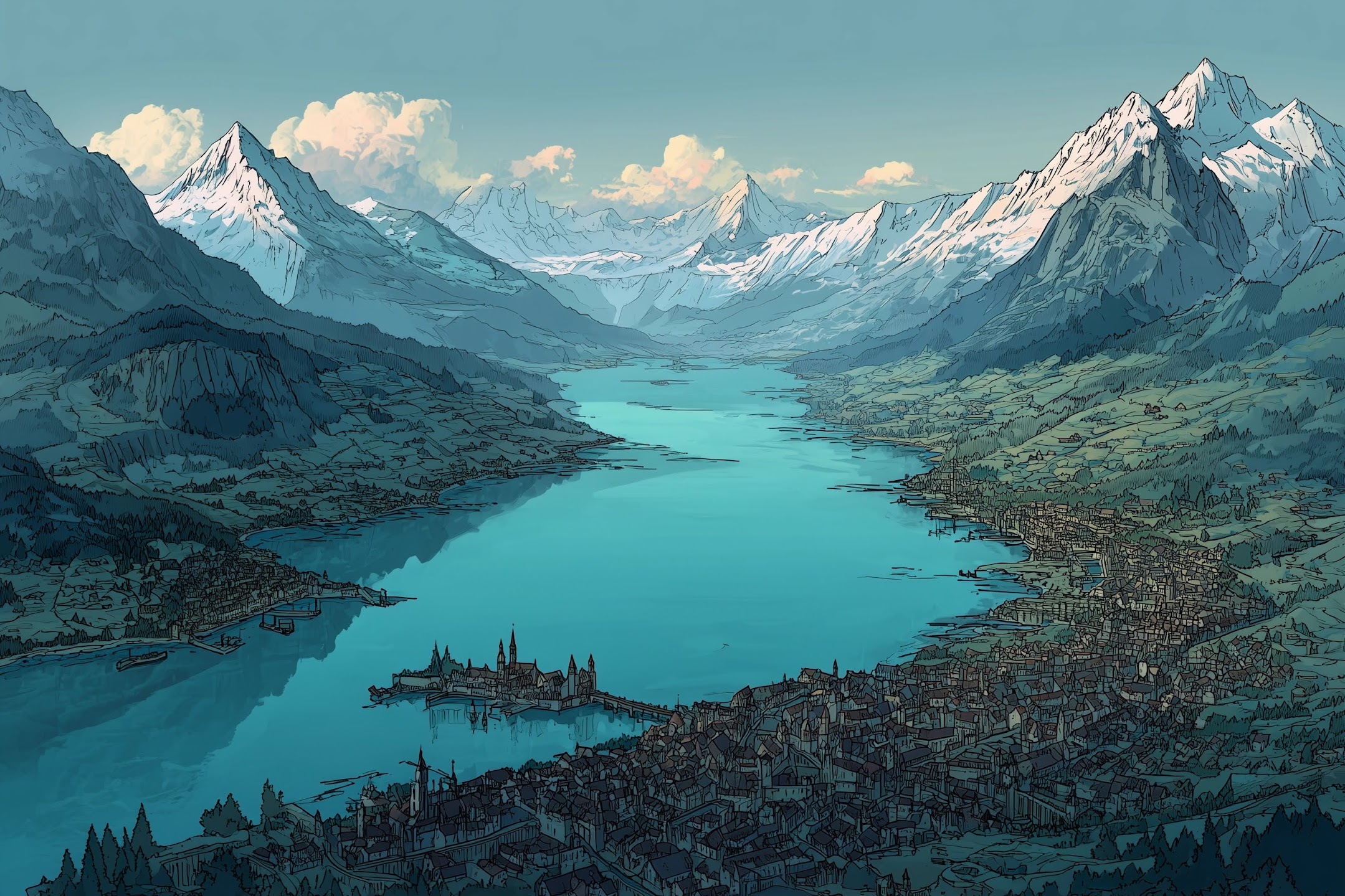
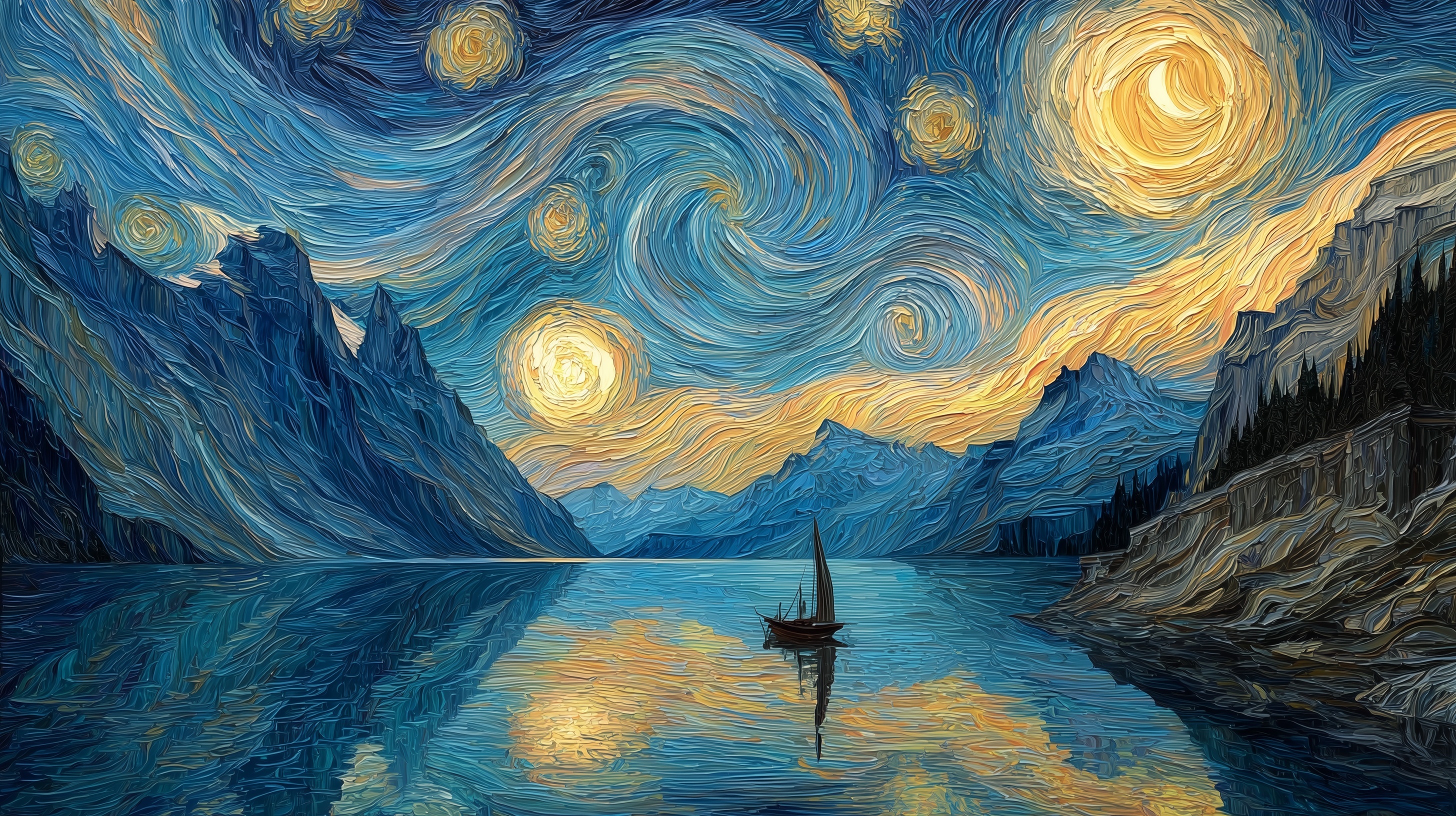
Summer Night occupies a central position in the later reassessment of Alaric Vandelune’s body of work, largely because it exemplifies the characteristics that once alienated him from his contemporaries. The painting is neither technically conservative nor overtly experimental. Instead, it demonstrates a deliberate rejection of compositional calm in favor of emotional immediacy. Vandelune was not attempting to document Lake Shan as a geographic feature. He treated it as a dynamic surface upon which light, motion, and perception could be distorted to convey internal experience.
From a formal perspective, the composition is deceptively simple. A low horizon divides the canvas between water and sky, while a single small vessel anchors the foreground. This simplicity, however, serves to amplify instability rather than order. The lake is rendered with heavy, rhythmic strokes that pull the eye laterally, while the sky presses downward through layered motion that refuses stillness. The boat appears structurally sound yet visually overwhelmed, its scale intentionally diminished against the surrounding elements.
Vandelune’s use of color departs sharply from the naturalistic palettes favored in Lyan and Arin landscape traditions of the period. Blues and yellows are heightened to the point of tension, while darker tones are used not to create depth, but to suggest movement within shadow. Light behaves inconsistently across the surface, bending rather than illuminating. This treatment was widely interpreted during his lifetime as technical failure, but is now understood as a controlled manipulation of visual rhythm.
One of the most striking aspects of Summer Night is its refusal to locate the viewer. The implied presence of Venlin is suggested only through faint reflections, denying the reassurance of recognizable landmarks. This ambiguity removes the painting from civic or commemorative function. The viewer is not invited to admire the city or the lake as symbols of stability or prosperity. Instead, they are placed within an unresolved space that resists interpretation as either peaceful or threatening.
Contemporary criticism of Vandelune often centered on accusations of emotional excess, and Summer Night was frequently cited as evidence. His detractors argued that the painting imposed personal turmoil onto an otherwise unremarkable scene. Modern scholarship has largely inverted this assessment. Rather than projecting instability, Vandelune is now seen as exposing the instability already present in perception itself. The lake does not change. The viewer does.
In comparative analysis, Summer Night stands apart from other nocturnal landscapes of its era by avoiding romanticization. There is no moon rendered as a focal point, no dramatic contrast between darkness and illumination. The painting does not guide emotional response through symbolism. Its power lies in accumulation. Stroke upon stroke, color upon color, motion builds without release. This quality has led many historians to identify the work as an early articulation of emotional realism rather than expressionism proper.
Within Vandelune’s oeuvre, Summer Night is now regarded as a culmination rather than an anomaly. It synthesizes his recurring interest in water, night, and solitude into a single, cohesive statement. While his life ended without recognition, the painting endures because it articulates something that formal records cannot. Not a moment, not a place, but a way of seeing that continues to resonate long after its context has faded.
Historical Details
History
“Vandelune lived his entire life just out of step with the world around him. He was not ignored because he lacked talent, but because he would not soften what he saw. Patrons want affirmation. Alaric offered honesty. That choice cost him everything while he lived and gave us everything afterward.”
Alaric Vandelune was born in Lucenva during a period of political calm that masked deep cultural stagnation. Lyanmar prized tradition, precision, and restraint, and artistic training followed strict guild formulas that rewarded technical competence over vision. Vandelune showed early talent but struggled under instruction, not because he lacked skill, but because he could not accept the idea that art existed to preserve the past rather than interrogate it. His tutors recorded him as difficult, unstable, and overly emotional, yet they also noted an intensity of perception that none of them could replicate.
After failing to secure permanent patronage within Lucenva, Vandelune drifted through smaller cities and rural cantons of Lyanmar. During this period he produced a large number of sketches, studies, and experimental works that ignored accepted composition and color theory. He painted fields, workers, taverns, riverbanks, and border fortifications with exaggerated motion and unnatural color, claiming he was attempting to capture how the world felt rather than how it appeared. These works were routinely rejected by guild juries as crude or unfinished.
Vandelune returned to Lucenva repeatedly, each time poorer and more isolated. His mental health deteriorated alongside his reputation. Letters from this period describe auditory disturbances, religious fixations, and violent swings between fervor and despair. Despite this, his work grew more confident and more extreme. He abandoned commissioned pieces entirely and focused on a series of paintings depicting ordinary Lyan life rendered with unsettling intensity, thick application of pigment, and distorted perspective that unsettled viewers.
The most infamous episode of his life occurred during his final stay in Lucenva, when he suffered a public breakdown following a failed exhibition. Contemporary accounts vary, but all agree that the incident ended his remaining social credibility. He was briefly confined and later released into the care of a charitable order outside the city of Valenbruck. During this confinement he produced what are now considered his most significant works, painting obsessively despite limited materials and worsening physical health.
Vandelune died in obscurity, leaving behind a disordered collection of canvases, sketches, and journals that were initially cataloged as curiosities rather than achievements. For decades his work circulated only among minor collectors, eccentric scholars, and fringe artists who found something unsettling but compelling in his vision. Mainstream Lyan institutions dismissed him as a cautionary example of unregulated creativity and personal excess.
It was only generations later, after shifts in artistic philosophy and political upheaval within Lyanmar, that Vandelune’s work was reevaluated. Scholars began to see his paintings not as failures of discipline but as deliberate confrontations with stagnation, suffering, and perception. Today his work is regarded as a turning point in Lyan art, not because it founded a school or movement, but because it demonstrated that sincerity and obsession could fracture tradition in ways refinement never could.
Public Reaction
“When Summer Night was finally shown, years after its creator had already been buried, the reaction was not celebration but recognition. People stood before it with the uneasy awareness that something important had been missed. That silence was not confusion. It was grief arriving late.”
The initial public reaction to Alaric Vandelune’s work in Lucenva was confusion followed quickly by dismissal. Viewers accustomed to clean lines, balanced composition, and reverent subject matter found his paintings abrasive and improper. Many complained that his use of color was aggressive rather than expressive and that his figures appeared strained or malformed. The prevailing opinion was that his work reflected personal instability rather than artistic intention.
Guild authorities were openly hostile. Exhibition juries rejected his submissions with unusual bluntness, describing them as undisciplined and socially irresponsible. Some critics argued that his paintings undermined public taste and threatened the reputation of Lyan art abroad. The fact that his subjects were often laborers, tavern interiors, and neglected outskirts of cities further reinforced the belief that he lacked refinement and ambition.
Among the general population, reaction ranged from mockery to discomfort. A small number of viewers reported feeling unsettled by his work without being able to articulate why. Others reacted defensively, accusing Vandelune of exaggeration or deliberate ugliness. His name became associated with instability, and rumors about his behavior spread more widely than discussion of the paintings themselves.
After his public breakdown, sentiment hardened. Any remaining curiosity about his work was eclipsed by fascination with his decline. His paintings were retroactively interpreted as evidence of madness rather than creative struggle. Even sympathetic observers framed him as a tragic failure rather than a serious artist, reinforcing the consensus that his work was not worth sustained engagement.
Only long after his death did public reaction shift. When later generations encountered his work without the burden of his reputation, responses were more measured and often more visceral. Viewers reported unease, empathy, and a sense of recognition rather than confusion. What had once been dismissed as incoherent began to provoke sustained attention, marking the first genuine public engagement with his art rather than with the man who made it.
Legacy
“If you ask who the greatest painter of our age was, many names will be offered eagerly. Mine is spoken more quietly. Alaric Vandelune changed no laws and crowned no kings, yet his work outlived empires because it altered how we recognize ourselves in the world. That is the kind of legacy history never learns to value on time.”
In the years following its public rediscovery, Summer Night came to be regarded as more than a remarkable painting. It became a reference point. Artists, critics, and historians alike began to speak of it as a work that quietly altered expectations of what landscape art could accomplish. Where earlier traditions emphasized accuracy, symbolism, or grandeur, Summer Night legitimized emotional truth as sufficient purpose. It demonstrated that a place did not need to be idealized, mythologized, or explained in order to matter.
The influence of the painting spread unevenly but persistently. Younger painters in both Lyanmar, Areeott and Kestenvale cited Vandelune’s handling of motion and light as permission to abandon restraint in favor of expression. Lake Shan itself became a frequent subject, not because artists sought to imitate Summer Night, but because they wished to confront the same challenge. To paint a place already shaped by memory rather than novelty. Over time, this led to a recognizable shift in regional artistic schools, where mood and internal response were valued alongside technical mastery.
For the public, Summer Night reshaped how familiarity was perceived. The lake outside Venlin was no longer spoken of only as infrastructure, trade route, or scenic boundary. It became something inward facing, a place associated with reflection and unease as much as beauty. People visited the shoreline not to see what Vandelune saw, but to feel what the painting suggested. In this way, the artwork altered the cultural identity of a real location without ever depicting it directly.
Institutionally, the painting’s legacy forced curators and scholars to reconsider how artistic importance is identified. Summer Night had no documented commission, no contemporary acclaim, and no connection to power or prestige during its creation. Its later elevation challenged the assumption that cultural value is reliably recognized at the time of origin. As a result, numerous neglected works from the same period were reexamined, leading to a broader reassessment of overlooked artists whose lives mirrored Vandelune’s quiet failure.
Today, Summer Night is regarded as a cultural treasure rather than a curiosity or cautionary tale. It is neither a national embarrassment nor a triumph claimed by any single place. Its endurance rests in its honesty and its refusal to resolve itself. The precedent it set was simple but lasting. That a single, ordinary moment, rendered with sincerity, could outlive declarations, movements, and reputations. That legacy has ensured the painting’s place not only in galleries, but in the shared imagination of those who continue to stand before it in silence.
Summer Night
“They called his skies unstable and his waters excessive. They were right and still failed to understand him. Alaric did not paint the world as it appears when it behaves. He painted it as it feels when you are alone inside it. That is not exaggeration. That is accuracy of a rarer kind.”



Before I started writing, I was an artist who didn't think I was good with words, and this article took me back to all the art history classes of my college days. Painting the world, not as it appears, but as it feels when you're standing inside of it is something that the artist in me would love to be able to do. Thank you for your wonderful description and analysis of Alaric Vanderlune's work, as well as, illustrating how society's perception of an artist's work can change drastically over time. I've included your article in my inspirations list for NYR 2026 and I'd love to have you come over and see what I wrote: https://www.worldanvil.com/w/kantostara-alexthecreatrix/a/2026-for-kantostara-article
Thank you!!!!!! <3