
The Divinities
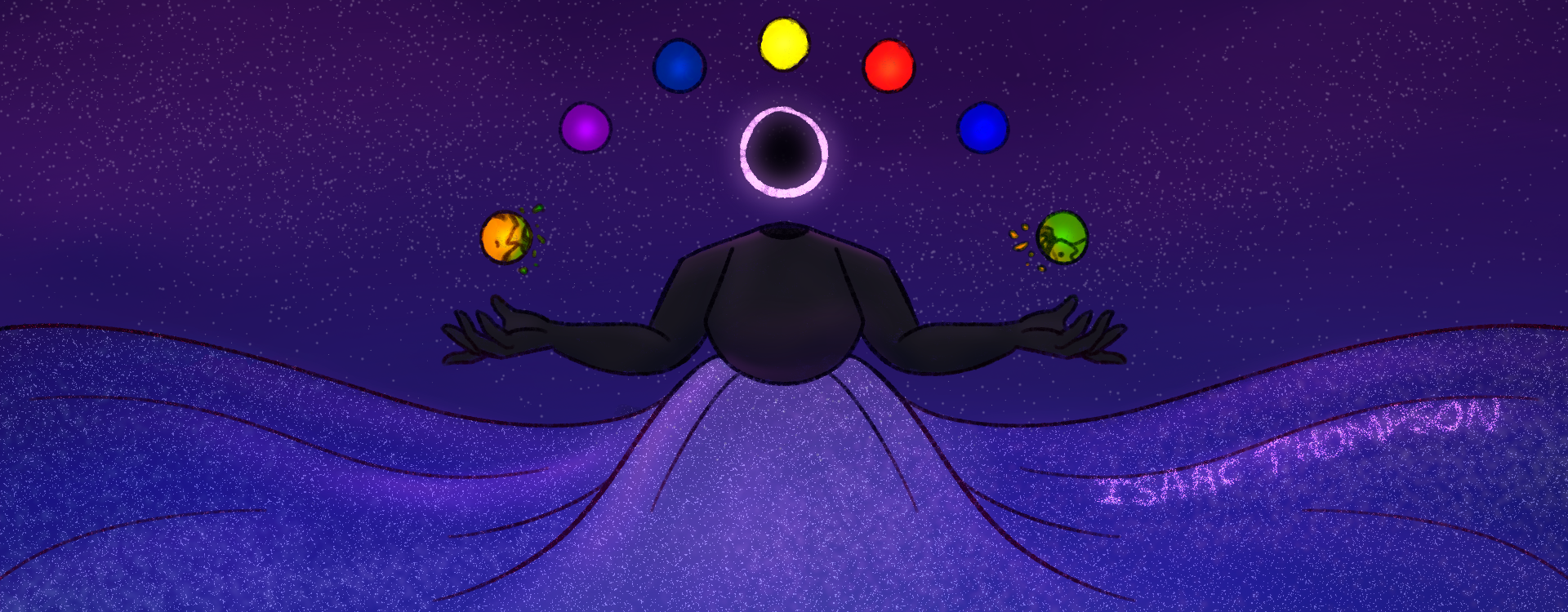
If one thing unites us across worlds, it is the existence of the Divinities, whose light shines on us all. We may call them different things, but the essence remains true from the highest peaks to the deepest oceans.The Divinities are the primary pantheon of gods, worshipped across the worlds of Tiyu Amara, Tiyu Noha, and Tiyu Shòbá. Revered by humans, elves and merfolk, they are responsible for shaping the worlds and guiding their inhabitants.
History
The common story says that The Mother is the first and most supreme being, arising from the infinite Planar Sea at the dawn of time. With her immense power, she created the many worlds of mortals, as well as the mortals themselves to inhabit them.To see that her creation would be maintained, she divided herself into multiple components with different divine domains. When they found themselves overworked, they subdivided further, creating the modern form of the Divinities as they are known today.
For much of mortal history, The Mother is said to be asleep, exhausted from the creation of all things. As a result, most worship of the Divinities centre upon her many aspects, who have been known to intervene visibly with events across time. Such worship varies wildly across the worlds, ranging from animal sacrifice to ritual prayer, and their interventions have been just as diverse.
Structure
The Pantheon is split into three "tiers", loosely defined by their power, the scale of their interventions, and the ways in which they are honoured.The Mother
As the supreme being, The Mother occupies a tier unto herself. Her power is considered vast and limitless, with a command of reality unrivalled. Despite or even because of this, she intervenes in mortal affairs rarely - her work is limited to the natural functioning of the world, such as the cycle of rebirth and the setting of the sun.Due to her absent nature, she is not often worshipped directly, but forms part of many prayers. She is often invoked when they would otherwise involve multiple lesser gods, since she contains their multitudes. Some festivals are also held in her honour, often around the change of year or era, as a representation of her role in the many cycles of life.
The Dualities
The Dualities are the first aspects of The Mother, created directly from her after she formed the worlds. They govern broad domains, which grants them significant power to change things. As a result, the Dualities typically intervene at large scales, such as in the drought of a region or the aversion of widespread disaster.Because of their varying domains, the extent to which the Dualities are worshipped varies significantly. Their broad focus means most have a reason to worship them somewhat, even if only in throw-away prayers. Many countries also devote themselves to specific dualities, such as Ozäxa-Lavüdh to Balance or Zhrayqarnyu to Wisdom.
The Dualities are Balance, Charity, Justice, and Wisdom.
The Spirits
Subdivisions of the Dualities, the Spirits are lesser gods with more narrowly defined domains. Though they possess less world-altering power, they are still divine, and can enact significant change to small areas. The Spirits typically intervene at an individual level, aiding in personal crises and local affairs.As the most "personal" of the Divinities, the Spirits have wide purchase and diverse worship. While most people will honour every Dualities, they will often pick singular Spirits they prefer based on what part of the greater whole they embody. An individual's patron divinity is more likely to be a Spirit, though not always.
The Spirits of Balance are Structure and Change.
The Spirits of Charity are Independence and Solidarity.
The Spirits of Justice are Vengeance and Mercy.
The Spirits of Wisdom are Experience and Wisdom.
Intervention
While the Divinities are known to impact the world in multiple ways, such as commanding the natural facts of the universe, an "intervention" by the divine usually refers to a direct act by a given entity. These usually take the form of Divine Contracts or pacts, wherein a given mortal channels the powers of the divine to shape events.There is no singular structure of a pact, but they usually take the form of the mortal making an offering or pledging to complete some task in exchange for magic at a level no mortal can naturally obtain. These are usually temporary arrangements, and either party can revoke the agreement.
However, there are notable instances of a different kind of divine intervention. These are possessions, which occur without divine contract and usually with little prior warning. Almost always performed by the Dualities, these interventions are made in the course of disasters, either to forestall their happening or rectify them before thousands are harmed. These have always been very significant events, and an omen not taken lightly.
Notable Interventions
Jrinta
When the dragon Jrinta threatened to arise from their slumber to seek vengeance against Dyiiladuun, the Dualities of Justice and Balance both made efforts to persuade the leader of Dyiiladuun to cease his destructive actions.When this was unsuccessful, efforts were made by the Divinities to protect the people of Dyiiladuun, enabling some to flee across the ocean, and empowering others to fight Jrinta once they awoke.
Annqyun Ulijwa
An elf from Qariy, Annqyun was executed by the occupying Xiy Kiiquldamii forces for some minor crime. However, they were able to form a pact with the Spirit of Solidarity, sacrificing an arm in order to be saved from death to fight against tyranny.Though Annqyun would be captured and executed again less than a year later, their efforts galvanised the Qarimii independence movement.
The Oracle
A priest on the island of Xörrodha, the Oracle of Experience has formed a consistent pact with the titular Spirit since approximately 13 Collision (412 Years Ago), enabling them to predict the potentially deadly Porriha Coral blooms on the island.Despite the role being held by several different people over the centuries, the power granted as been the same, and there has supposedly never been a gap in Experience's protection of Xörrodha.
Zhrayqarnyu
Considering themselves divinely appointed, the Ro'aqlens of Zhrayqarnyu owe their authority to the Duality of Wisdom. Unusually, this does not seem to take the form of a pact or mere worship, with Wisdom making themselves available for the Ro'aqlen's consultation consistently over the centuries.Wisdom has also intervened more traditionally, during the ousting of Uyntteyl III from the throne over his dictatorial rule and suppression of dissent, with Wisdom forming pacts with his priests and aunt to push him into exile.
The Separation
When the worlds of Tiyu Amara and Tiyu Noha were forcibly separated, some efforts were made to forewarn the people of Abravost of the approaching danger. These were fairly limited, with known interventions by the Dualities of Wisdom and Charity.It's widely speculated that the Divinities themselves were caught off guard by the event, preventing them from informing people like the Vosti Empress before she was lost to the other side of the destroyed portals.
Koshi Varmand
A farmer from Telziad, Koshi was kidnapped by a group of mages and necromancers hoping to contact the Spirit of Change, hoping to use her soul as a bargaining chip to ask for a portal to Tiyu Noha. Koshi instead formed a pact with the Duality of Justice, destroying their lair and leaving a trail of destruction before she was stopped.She allegedly remains in this pact to this day, though has been out of the public eye since her involvement in thwarting the assassination of Crown Larusion of Telziad.
Type
Religious, Pantheon
Leader
Permeated Organizations
Controlled Territories

The Dragon Krenar by Isaac Thompson
Draconic Agents
In additional to mortals, the Divinities also created dragons, who at the beginning of the world took on the role of shaping the mountains and rivers. Some are still worshipped for this, or for other foundational events.Unusually, dragons only inhabit the continent of Thurásin. Myths on Abravost suggest their dragon populace were driven away by a singular dragon who was later killed with the aid of the Duality of Justice. Sporadic sightings of the so-called Abravost Dragon also suggest the continent has been declared "off-limits" by the serpent.

Tiyu Amaran Cosmology by Isaac Thompson
Collide
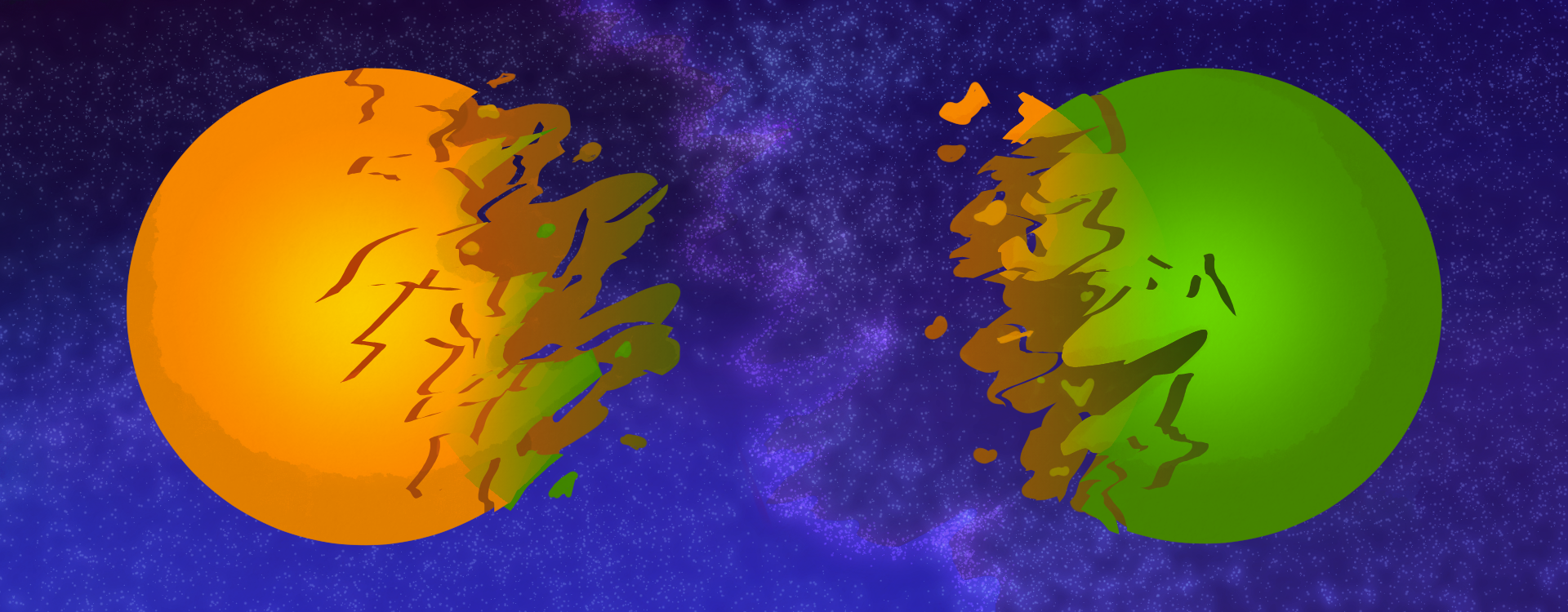
425 years ago, the human world of Tiyu Amara and elven world of Tiyu Noha collided with each other, exchanging people and places between them in the chaos.It is still unknown how or why this occurred. While many attribute it to the actions of the Spirit of Change due to their nature, Spirits do not seem to possess enough power to do such action on their own. While the categories are hazy, such an action would require the power of the Mother herself.
Given the complete lack of warning from the Divinities, especially compared to the later Separation, some suspect there may be an external force involved, which kept the Divinities occupied until it was too late. It is possible we will never know, because the gods do not say.
The Separation by Isaac Thompson
Separate
Counterpart to the Collision, the Separation saw the two worlds torn apart, destroying all the portals between them that had been created in Abravost.Though the Divinities only provided warnings in Abravost, due to their complex enmeshing with the elven world, those in Thurásin noticed it as well, labelling it a disturbance in the Planar Sea.
While the cause of the Collision is contested, most in Abravost agree on what caused the Separation - the Mother, arising from her slumber to see her creation twisted, sought to restore the worlds to their "proper" place. Though the lesser Divinities seem to have objected, the Mother went through with the act, forever parting the worlds.

Gothic Angel by darksouls1
Compete
Though the most widely worshipped and best documented gods, the Divinities are not the sole powers in Tiyu Amara. The two best known are Ibraos, god of magic, and Qiliind, god of the sun.Both are highly regional in their worship - Ibraos is honoured in parts of Abravost, and Qiliind only in the frozen north of Thurásin. Their existence is sometimes considered heretical, requiring some adherents to describe them as creations of the Mother to avoid persecution.
Unlike the Divinities, neither Ibraos or Qiliind have formed pacts with adherents, and little explicit evidence exists for either. Some Ibraosi claim their presence can be felt in the casting of spells, only detectable by the faithful, while Qiliindamii offer as evidence the continued existence of the sun.


Great pantheon. I love how it is structured, in particular how they are all named after concepts/qualities (except the Mother).
Explore Etrea | Summer Camp 2026