
Blade Singers
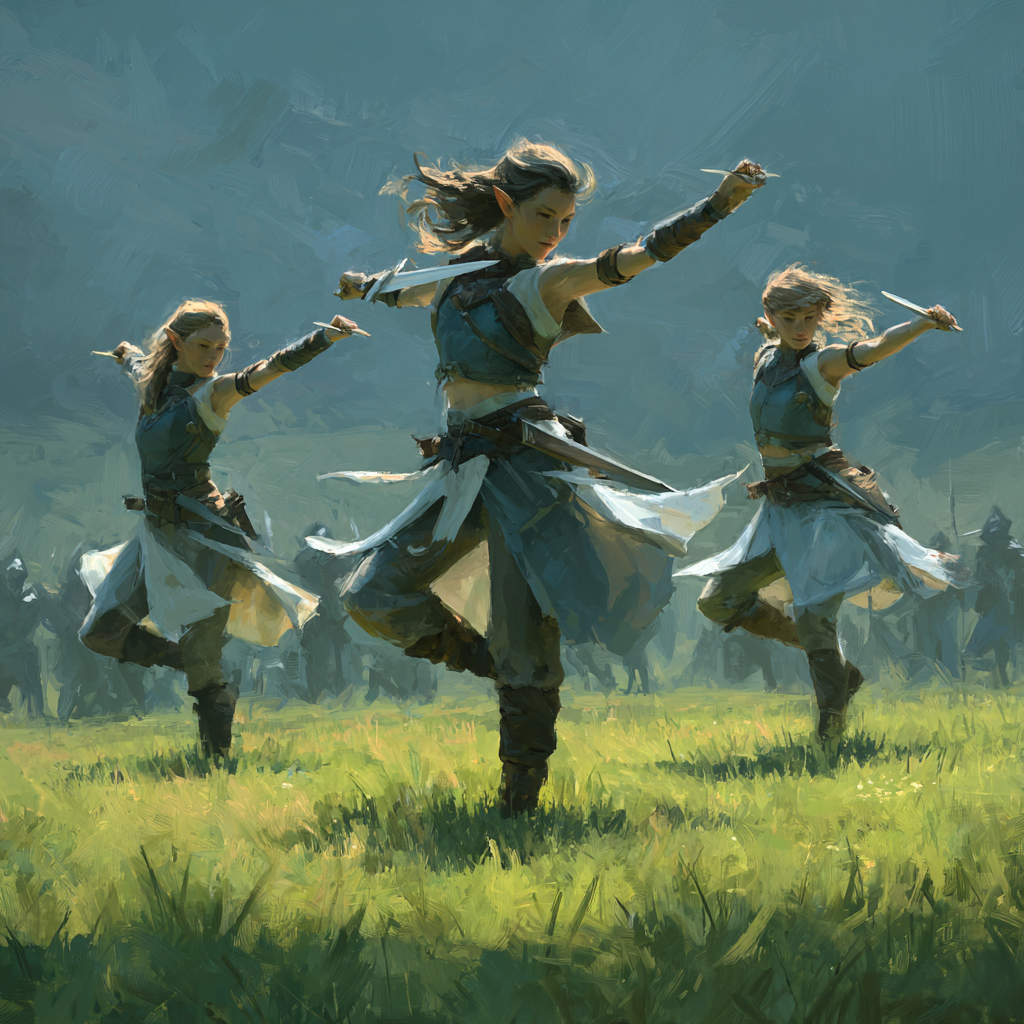
Let's put on a good show, shall we, though I doubt the lads won't mind a bit of blood in the performance. - Blade SingerThe Blade Singers are unique Elven assault formations renowned for blending martial mastery with arcane rhythm. To outsiders, their battles appear as deadly dances, whirling steel, resonant chants, and flashes of magic woven into a single flowing performance. Among the Elven nations, Blade Singers are deployed as shock troops, champions, and dueling specialists. Unlike defensive orders such as the Glade Wardens, Blade Singers are instruments of decisive force, meant to break enemy morale and lines through precision and spectacle.
Composition
Manpower
Twelve to sixty warriors placed into choirs
Equipment
Enchanted Light Armor: A set of Armor that is infused with magic to grant protection and still feel light in it to maintain agility in it with being hindered.
Spellwoven Robes: infused with magic glyphs that are woven into its fabric the wearer can be used to enhance a magic user's power and capabilities.
Focus Crystal: A crystal that allows the user to channel their magic into a more refined state when cast.
Charm Belts: Magic items that allow the wear to have have spells at the ready when they need them.
Union Anklets: Special Anklets that are covered in bells that allow multiple people to synchronize their movements by listening to just the sound.
Weaponry
Rapier: Fine blade used for thrusting and speed that some consider an elegant weapon in battle.
Elven Curved Blade: A elven sword with a curve in it to use for slashed with great speed in mind.
Elven Longswords: A finely crafted blade that is well-balanced and used by skilled hands to fight any foe up close.
Elven Dagger: Elven Daggers have always been made to be light and sturdy to get in close without anyone noticing it.
Elven Short Blade: A shorter Elven blade meaning for much closer encounters and maneuver without a longer blade causing problems.
Structure
Choirmaster: Overall commander and master of tempo in battle.
Verse Captain: Veterans leading individual verses in squads of eight to twelve.
Cantors: Arcane specialists responsible for maintaining magical harmony.
Tactics
Blade Singers fight in coordinated motion, maintaining rhythm to sustain magic.
Rapid advances with overlapping spell-strikes
Synchronized Switch: Rotating duelists to exhaust enemy champions and multiple fighters.
Spell Sling: Arcane ripostes that deflect or unravel attacks with a sharp tongue and an even sharper mind.
Swift Dance: Sudden tempo shifts to disorient foes while attacking them with finesse.
Lunge Soiree: Focused breaches followed by immediate withdrawal
Disruption of rhythm through loud noise, uneven terrain, or heavy bombardment can significantly weaken a Choir.
Training
Training is divided into progressive movements rather than years, each known as a Verse. Advancement occurs only when the Choir deems the recruit’s rhythm flawless.
The Empty Measure
Recruits train without blades or magic, focusing solely on movement, balance, and breath. They learn to fight unarmed while maintaining tempo and spatial awareness, often sparring blindfolded or amid deliberate distractions. As they continue in their dance they are able to pick up new ways up ways to apply it in their fighting. Soon the idea of combat and dancing start to blur as it all seems the same to them at some point. After all that they are finally ready to use weapons into their training with their footing prepared for it.Steel Introduction
Blades are introduced, but spellcasting remains forbidden. Recruits master precise cuts, ripostes, and footwork synchronized to internal rhythm rather than audible song. In doing so they they are not dependent on magic to help in a fight should be unable to use it or they deplete their own reserve. Each one learns to fight in their own style to match their rhyme for their performance in battle. Then they all spare with each other to show how well they are with the weapons they bind themselves to.Arcane Weaving
Magic is slowly layered into motion. Recruits practice sustaining minor enchantments while dueling, learning how emotion, fatigue, and injury affect magical flow. Each one learns their limits and what spells best suits them with the style they fight with. Doing them makes them more lethal in a fight than an average one. This makes each one of them to be forced to reckon with in battle.Choral Discipline
Recruits are formed into provisional Choirs. Which is dedicated to shared tempo and adaptive formations in the field of battle. Each one of them are taught rotational dueling roles and recovering harmony after disruption. Soon enough each one of them learns how to move with their Choir as if they were preforming on a stage. So much so that they can tell what's going to happening next by simply looking at the stance they are in.The Living Performance
The final phase requires recruits to fight in real combat alongside veteran Blade Singers under controlled conditions, proving they can maintain the song amid chaos. The chaos alone often place most on edge as they are not use to the danger that surrounds them. But they soon learn to follow the lead of the veterans who remain in control. In a short amount of time they are able to overcome the unpredictable of battle with grace and discipline in their dance. Once they do so they are ready to achieve victory with all the skills they have learned into one final performance of serenity in the flow of their dance.Final Ascension
Graduation is marked by the Naming of the Blade, where the recruit’s weapon is bound to their rhythm through an ancient arcane rite. From that moment, the Blade Singer is considered complete though mastery is believed to take a lifetime. Training often spans many years to reach this final stage to become what they are. Those who fail are sent back and find other jobs that suit their tasks such as instructors, arcane guards, or ceremonial champions, preserving their knowledge rather than discarding it.Logistics
Recruitment
Recruitment into the Blade Singers is as exacting as it is rare. Candidates are not drawn from conventional military ranks alone, but from across elven society, dancers of sacred rites, fencing prodigies, magic acolytes, and even court performers whose movements reveal unnatural precision. Raw talent alone is insufficient; a candidate must demonstrate the ability to think, breathe, and fight in rhythm.
Potential recruits are evaluated on physical grace and balance under stress. Having an innate arcane talent and control over themselves. Mental discipline and emotional restraint under pressure in certain situations. Along with the ability to synchronize instinctively with others. Those who pass initial observation are summoned to the Calling of the First Note, a ritual duel-performance before a hidden Choir. Failure carries no shame; only those who disrupt the harmony are dismissed.
History
The Blade Singers trace their lineage to the War-Dancers of the pre awakening era, when elven houses settled disputes through ritualized combat rather than open war. These contests were fought to music, chant, and spell, believed to please ancestral spirits and prevent conflicts from escalating into ruinous bloodshed. Over time, these ritual champions discovered that rhythm enhanced spellcasting and sharpened focus. Blades moved more cleanly, magic flowed more predictably, and fear took hold of onlookers. What began as ceremony slowly became doctrine.
Codification under the United Kingdom
During the rise of the Elven Kingdom, these traditions were gathered and formalized by royal arcanists and swordmasters. The first true Blade Singer Choirs were established as elite royal formations, trained to serve as champions, bodyguards of nobilty, and symbols of elven superiority. It was in this era that the principles of tempo, harmony, and verse were codified, and the title of Choirmaster was first recorded. Blade Singers became living embodiments of the Kingdom’s ideal beauty, discipline, and lethal mastery united.Wars of Expansion and Decline
As the Elven Kingdom expanded, Blade Singers were increasingly used not as ritual champions, but as instruments of conquest. Choirs were dispatched to break fortified lines, duel foreign heroes, and shatter morale through spectacle and terror. This shift strained the order. Some Singers argued that the Song was never meant for slaughter without meaning, while others embraced their role as living weapons. Several Choirs were destroyed entirely when forced into prolonged or chaotic warfare where harmony could not be maintained.The Secession and Shattered Choirs
When the Elven Kingdom fractured, the Blade Singers did not remain unified. Some Choirs stayed loyal to royal remnants, others pledged themselves to emerging Free States, and a few dissolved entirely, refusing to fight elves for political ambition. This era saw the birth of independent blade-schools and wandering Choirs, each interpreting the Song differently. The shared tradition survived, but uniformity was lost.Dance of Battle
Blade Singers exist as rare and highly valued formations. Some are formally bound to a single state, others operate as honored mercenaries, and a few remain secretive orders answering only to ancestral blade-spirits. Though divided, all Blade Singers believe that the Song must be preserved. Legends speak of a Final Chorus, a moment of existential threat when all surviving Choirs will reunite and perform as one either to save elven kind, or to mark its end.
Type
Infantry
Overall training Level
Professional
Assumed Veterancy
Veteran
Used by


Comments