
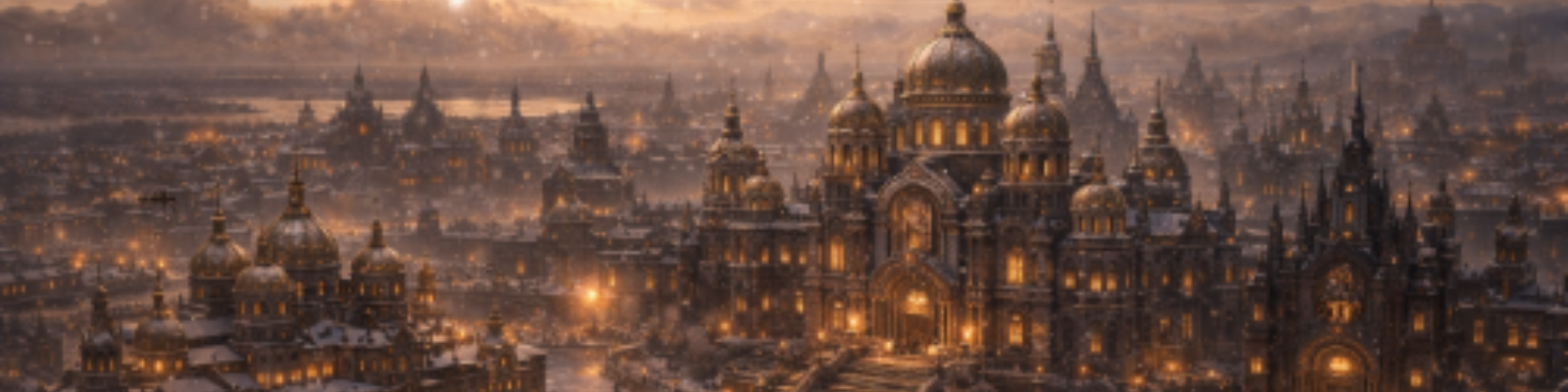
The Kozemos
24-3-683
The Kozemos is a world built in defiance of its own foundations
Across its vast continents and bitter seas, empires rise not because the land welcomes them, but because power insists. Rivers are straightened, borders are drawn, and names are fixed into ledgers long before the people who live there are asked what they call themselves. Stone cities bloom from marsh and frost. Palaces gleam above floodwaters. The world is measured, catalogued, and illuminated in silver and gold; while beneath the surface, rot spreads quietly, patiently.
This is a neobaroque age: an era of excess and anxiety, of monumental beauty and institutional violence. Art flourishes alongside repression. Music spills from candlelit salons even as secret police compile dossiers by gaslight. Faith is ornate, ritualized, and deeply entwined with the legitimacy of rule. Science advances not to liberate, but to classify. Maps are instruments of law. Ink is power.
At the heart of this world stands Serebraya Zorya, the Argent Kingdom: an autocratic, outward-facing empire that believes itself chosen not by divinity alone, but by destiny and discipline. Its capital, Veliky Serebrinsk, is a city wrested from water and weather by imperial will, a jewel of canals and embankments meant to awe both subjects and rivals alike. From its palaces and ministries radiate decrees that reshape distant lands, turning forests into parcels, peoples into statistics, and horizons into obligations.
Colonial expansion is framed as stewardship. Conquest is renamed “survey.” Erasure becomes “harmonization.” Institutions such as the Grand Surveyorate of the Crown claim neutrality while quietly deciding which lives will be recognized, which languages will survive, and which histories will be archived... or discarded. The empire’s reach extends far beyond its borders, not always through armies, but through charters, concessions, and carefully worded laws.
Yet the Kozemos is not a world without resistance. Dissidents gather in salons and cellars. Artists paint truths that cannot be spoken. Revolutionaries circulate forbidden texts that question whether measurement is morality, whether order is justice, and whether an empire so obsessed with permanence can survive its own contradictions. Even within the imperial family, fractures form; between duty and desire, obedience and excess, control and joy.
This is a world of silken gowns and steel rails, of incense and ink, of snow-drowned streets and gilded halls. It is a place where beauty is weaponized, where decadence is political, and where history is not merely written; it is enforced.
Welcome to the Kozemos.
The silver dawn is radiant.
And it is watching the horizon.
Across its vast continents and bitter seas, empires rise not because the land welcomes them, but because power insists. Rivers are straightened, borders are drawn, and names are fixed into ledgers long before the people who live there are asked what they call themselves. Stone cities bloom from marsh and frost. Palaces gleam above floodwaters. The world is measured, catalogued, and illuminated in silver and gold; while beneath the surface, rot spreads quietly, patiently.
This is a neobaroque age: an era of excess and anxiety, of monumental beauty and institutional violence. Art flourishes alongside repression. Music spills from candlelit salons even as secret police compile dossiers by gaslight. Faith is ornate, ritualized, and deeply entwined with the legitimacy of rule. Science advances not to liberate, but to classify. Maps are instruments of law. Ink is power.
At the heart of this world stands Serebraya Zorya, the Argent Kingdom: an autocratic, outward-facing empire that believes itself chosen not by divinity alone, but by destiny and discipline. Its capital, Veliky Serebrinsk, is a city wrested from water and weather by imperial will, a jewel of canals and embankments meant to awe both subjects and rivals alike. From its palaces and ministries radiate decrees that reshape distant lands, turning forests into parcels, peoples into statistics, and horizons into obligations.
Colonial expansion is framed as stewardship. Conquest is renamed “survey.” Erasure becomes “harmonization.” Institutions such as the Grand Surveyorate of the Crown claim neutrality while quietly deciding which lives will be recognized, which languages will survive, and which histories will be archived... or discarded. The empire’s reach extends far beyond its borders, not always through armies, but through charters, concessions, and carefully worded laws.
Yet the Kozemos is not a world without resistance. Dissidents gather in salons and cellars. Artists paint truths that cannot be spoken. Revolutionaries circulate forbidden texts that question whether measurement is morality, whether order is justice, and whether an empire so obsessed with permanence can survive its own contradictions. Even within the imperial family, fractures form; between duty and desire, obedience and excess, control and joy.
This is a world of silken gowns and steel rails, of incense and ink, of snow-drowned streets and gilded halls. It is a place where beauty is weaponized, where decadence is political, and where history is not merely written; it is enforced.
Welcome to the Kozemos.
The silver dawn is radiant.
And it is watching the horizon.