
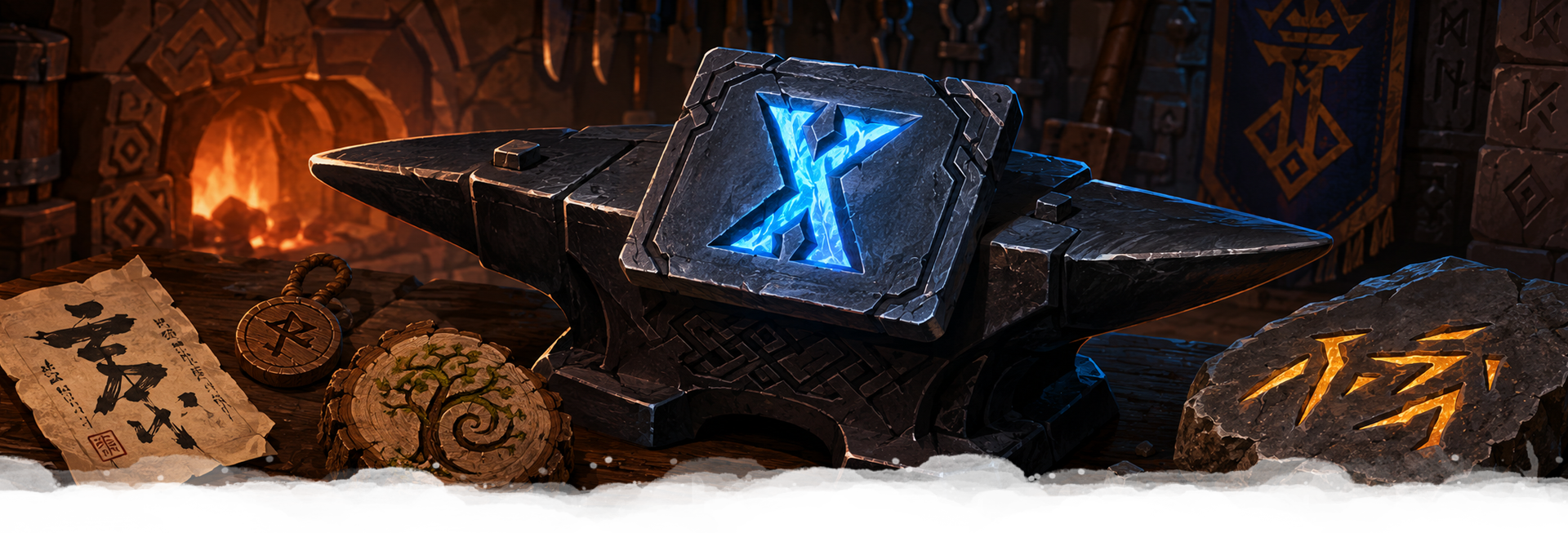
Runes
A rune is a magical instruction given a physical body. The shape gives the instruction form. The material gives it endurance. The maker gives it purpose.
Simple runes hold brief effects. A brewer may mark a cellar stone to keep ale cool. A mason may carve a stabilizing sign into a cracked arch. A Hunter may burn a scent-ward into the haft of a spear before entering a Troll den.
Greater runes demand stronger materials, exact geometry, and a reliable source of power. These can reinforce fortress gates, guide lifts through deep shafts, awaken guardian statues, seal tombs, or turn a masterwork weapon into a thing of legend.
Runecrafting
Runecrafting is the art of binding Magic into written, carved, painted, branded, or engraved symbols. A spell is spoken and spent. A rune remains. It holds a command in stone, metal, paper, bark, bone, cloth, flesh, or glass until the proper hand, word, oath, blood, flame, breath, or celestial hour wakes it.
Every culture with a long magical tradition has some form of runecraft. Orcs paint talismans in careful calligraphy. Dwarves carve deep marks into metal and stone. Northern humans cut old runes into wood, shield-rims, grave posts, and standing stones. Druids shape sigils into living bark. Demon-kind draw wards and planar symbols closer to spell circles than craft marks, though the working principle is much the same.
The undisputed masters of the art are the dwarves. Their methods are old, exact, and stubbornly preserved. Dwarven runecrafting values stability, permanence, restraint, and continuity. A true dwarven rune is expected to outlast the maker, the tool, the hall around it, and sometimes the kingdom that commissioned it.
History of Runes
Runecrafting began before mortal civilization gave it a name. Its earliest form was the dragon mark.Ancient Dragons carved precise claw marks into stone, metal, and cavern walls, then filled those cuts with their own innate elemental magic. These marks were neither ordinary writing nor formal spellcraft. They were impressions of Draconic will, pressed into the world by scale, claw, breath, and blood.
A Red Dragon’s mark could hold heat in basalt. A Blue Dragon’s mark could call a charge through buried ore. A White Dragon’s mark could keep frost locked in a vault wall through summer. The earliest dragon marks were crude by later scholarly standards, but they proved that magic could be made to wait inside a physical sign.
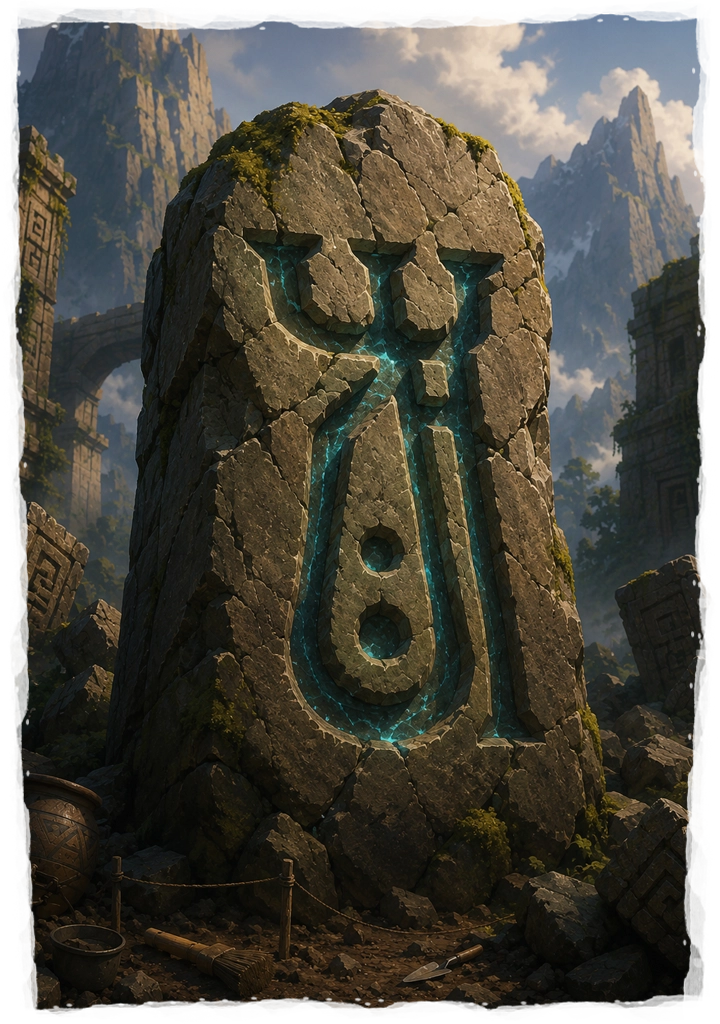
The Ak'teshi Transmission
During the height of the Ak'teshi Empire, the chromatic dragonflight traded fragments of this knowledge to the empire’s Giant rulers. The bargain was practical and ugly. The dragons gained access to the empire’s vast wealth, tribute, hoards, and enslaved labor. The Giants gained a method for sealing raw elemental force into the bones of their empire.
Fire giants and stone giants were the first great mortal imitators of dragon marks. Fire giants adapted them to furnaces, weapons, engines, chains, crucibles, and siege works. Stone giants shaped them into roads, walls, vaults, lifts, boundary stones, and the foundations of imperial architecture. Under giant hands, dragon marks became repeatable symbols. Those symbols became proto-runes.
The giants spread the craft wherever the empire reached. Runic gates, furnace marks, slave brands, fortress seals, labor engines, and war machines became part of Ak'teshi magical technology. To later ages, giant rune-work looks enormous, forceful, and blunt. It was built for command. It was built for scale. It was built by masters who had little reason to care what the work cost.
The Dwarven Inheritance
The prismatic dragonflight passed the art to the enslaved dwarves in secret. Some accounts say this was done by ruby dragons in disguise. Others claim several prismatic dragons acted through false names, hidden forges, and carefully chosen mortal agents. Their reasons remain debated. Dwarven histories usually remember the act as one of the few outside gifts that helped make freedom possible.
The dwarves also learned by watching their Fire Giant and Stone Giant masters. They repaired giant furnaces, hauled marked stone, polished rune-cut tools, and carried weapons covered in symbols they were forbidden to understand. Piece by piece, they learned the old shapes. Piece by piece, they changed them.
In dwarven hands, runecrafting became smaller, cleaner, and more disciplined. The giants had used runes to dominate matter. The dwarves used them to make matter keep faith. A dwarven rune had to hold, remember, endure, and answer only to the purpose given to it.
By the time of the War of Broken Chains, rune-carved weapons, hidden wards, sealed forges, and oath-bound strongholds had become central to dwarven survival. The art that had once served the empire became one of the tools that helped break it.
The Four Parts of the Craft
Most trained runecrafters speak of four parts, though the names vary between cultures.
The Line. The visible mark. Every cut, curve, brushstroke, notch, and break matters. A weak line gives a weak command. A misplaced angle can cause power to bleed into the surrounding material.
The Medium. The substance that receives the mark. Granite holds long memory. Iron grips force. Silver carries purity and command. Paper accepts breath, ink, and intention. Living wood carries growth and spirit. Bone holds death close.
The Charge. The power placed into the mark. This may come from a spell, a ritual, a forge-fire, a holy blessing, a shard of magical material, a storm, a sacrifice of wealth, or years of patient work.
The Binding. The final act that tells the rune when to wake, what to obey, and when to sleep again. In dwarven practice, this is often framed as an oath. The rune is made to keep faith with its purpose.
Cultural Forms of Runecraft
The word runecraft is used broadly by scholars, but each people gives the art its own materials, habits, taboos, and names. The same principle can appear as a chisel-cut rune in a fortress gate, a brush-painted talisman drying above a shrine, a charm carved into a ship beam, a sigil pressed into living bark, or a warding circle drawn in ash and blood.
These traditions share an older root in dragon marks and giant rune-work, yet most have changed over centuries of use. Local faith, climate, available materials, and cultural memory all shape the final form. Dwarves remain the clearest inheritors of the old structured craft, while other peoples adapted runecraft into forms better suited to their own homes, gods, spirits, tools, and fears.
Dwarven Runecrafting
Dwarven runecrafting is the oldest structured mortal form of the art still practiced in a recognizable way. Its tools, rites, teaching methods, and core principles have changed little compared to other traditions.
Among dwarves, runes began as memory before they became magic. Clan halls, tomb walls, drinking stones, shields, and gatehouses carry old marks that record bloodlines, debts, grudges, victories, marriages, disasters, and names that must never be forgotten.
A Dwarf can walk through a stronghold and read its history from carvings that outsiders mistake for decoration. A curling line around a door lintel may mark the year a plague was held outside. A band of square glyphs at ankle height may name every mason who died raising the lower vaults. A repeating hammer-mark may honor a smith whose descendants still work three levels below.
The greatest dwarven masters are known as Runelords. They are custodians of the old methods, judges of dangerous rune-work, and keepers of private records that trace great works, lost techniques, and the succession of master artisans.
Orcish Talismans
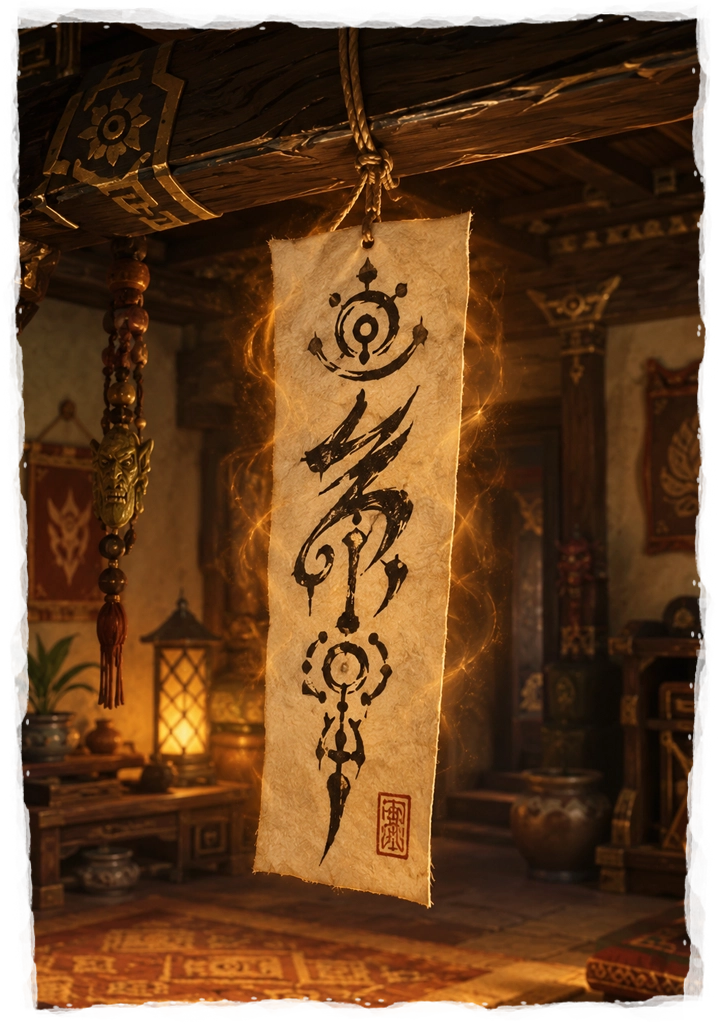
Orcish runecraft most often takes the form of painted calligraphy. These works are commonly called talismans, especially when written on paper, silk, thin wood, or hanging strips of treated cloth.
An Orcish talisman is made through brush control, ink preparation, breath, posture, and spiritual intent. The brushstroke matters as much as the symbol. A rushed charm may hold for a day. A properly made ward can guard a home, shrine, weapon, cradle, or grave for years if treated with respect.
Orcish talismans often draw on the sacred balance of Yin and Yang, ancestral reverence, celestial signs, and protective charm-work. They are carried against curses, hung above doors to ward evil spirits, burned during rituals, folded into armor, pressed beneath bowls, tied to weapons, or placed in temples.
To dwarven eyes, orcish talismans can seem fragile. To orcish Inkweavers, that fragility is part of the form. Paper breathes. Ink flows. A charm can be renewed, replaced, burned, or released when its purpose is complete.
Northern Human Runes
Among the Human tribes of the far north, especially those in and around Djora and Vaskyr, runecraft is usually carved into stone and wood. Their methods resemble dwarven and giant traditions more closely than the painted charms of Khitang or the spell-wards of Demon-kind.
Northern human runes are found on standing stones, burial markers, ship beams, spear shafts, hall doors, drinking horns, sledges, boundary posts, oath rings, and the inner faces of shields. Many are protective. Others mark ownership, lineage, victory, warning, season, exile, or oath.
Their strongest rune traditions are often tied to place. A stone beside a fjord may hold a family’s drowned dead in memory. A winter road marker may keep travelers from losing the path in white weather. A war-band may carve the same sign into every shield before a raid, binding them to one purpose until they return.
Druidic Sigils
Druids carve, press, grow, or burn sigils into living wood, deadwood, roots, stones, antlers, and old trees. Their runecraft is usually less concerned with permanence than balance. A druidic sigil may be meant to last one season, one storm, one migration, one moon, or one life of the tree.
These marks can guide growth, ward groves, calm beasts, warn against corruption, seal old paths, strengthen sacred circles, or mark the boundary between mortal settlement and spirit-haunted wilds. Many are hard to read because they change as bark thickens and branches turn. A druid may see meaning in a split of bark, a ring of fungus, or a root curling through old stone.
The best druidic sigils do not fight the material. They persuade it.
Demonic Sigilwork
Demon-kind use magical symbols, wards, binding circles, and planar geometries that resemble traditional spellcraft more than mortal runecarving. Their marks are often drawn in ash, blood, powdered metals, smoke, chalk, shadow, or light. Some are cut into skin, horn, bone, or the walls of places where reality has grown thin.
Demonic sigilwork is less tied to craft tradition and more tied to will, bargain, direction, and planar law. A Demonic ward may name a boundary. A sigil may call a lesser spirit, bar a threshold, focus torment, conceal a passage, or bind a promise into painful consequence.
Many scholars treat demonic sigilwork as a parallel branch of runecraft. Dwarven Runelords usually speak of it with caution. A dwarven rune is meant to hold a stable purpose. A demonic sigil often hungers for interpretation.
Tools and Materials
A working runesmith’s bench is part scriptorium, part forge, and part shrine. The common tools include chisels, burins, acid needles, wax masks, measuring wires, powdered gems, clamps, engraving frames, oath-ink, polishing stones, and small hammers balanced for different metals.
Other traditions use different tools. Orcish calligraphers rely on brushes, inkstones, papers, silks, seals, and prepared pigments. Northern rune-cutters favor knives, awls, chisels, charcoal, ochre, and bone-handled carving tools. Druids use antler points, thorn knives, shaped stones, fire, sap, and living growth. Demon-kind may use crystals or focusing gemstones.
The strongest runes are usually built into an object from the start. A sword carved after forging may hold a charm. A sword designed around its rune from the first billet can hold a legacy.
Risks and Failures
A failed rune can be quiet for years before it shows its flaw. Wards may weaken. A bridge stone may begin to hum. A weapon may grow hot in the hand when no battle is near. Names may vanish from an oath tablet. A paper talisman may curl and blacken without flame. A tomb seal may start answering to voices that were never meant to be heard.
Common failures include cracked lines, mismatched materials, overcharged seals, careless trigger phrases, poor ink, false names, unstable planar angles, and old bindings left without maintenance.
The worst failures happen when the rune’s command remains intact after its purpose has rotted away. A guardian rune may keep guarding a ruin whose masters are dead. A curse rune may keep punishing the descendants of a forgiven enemy. A soul-rune may keep holding a spirit long after every living person has forgotten why.
Modern Practice
In the present age, runecraft survives in many forms. Dwarven holds preserve the oldest structured tradition. Orcish temples and households maintain talismans through calligraphy and ritual renewal. Northern humans still carve old signs into stone and wood. Druids mark living groves with sigils that change over time. Demon-kind keep their own systems of wards, symbols, and planar bindings.
Dwarven runecrafting remains the measure by which most others are judged. Dwarven kings value Runelords for fortification and legacy. Adventurers seek runesmiths for arms, armor, seals, and strange repairs. Temples request grave marks and consecrated tablets. Scholars study ancient dragon marks and giant proto-runes for lost history. Criminals search for shortcuts, stolen signs, and unlicensed curse-work.
A good rune is patient. It waits in the dark, under dust, under blood, under stone, beneath paper, or under bark. When the right hand touches it, when the right word is spoken, when the old condition is met, it remembers what it was made to do.
Runes & Magic Items
Runes are one of the quiet foundations of magic item crafting. Even when an enchanted item shows no visible marks, a trained runecrafter may find tiny signs hidden beneath a sword’s grip, inside a shield boss, along the seam of a ring, under a gemstone setting, or between plates of armor.In most permanent magic items, runes serve as anchors. They tell the magic where to rest, how to move through the object, what conditions wake it, and what limits keep it from consuming the item or its wielder. A flame-tongue blade may carry heat-runes beneath its fuller. A cloak of protection may have warding stitches worked into its hem. A staff may hold layered sigils beneath the lacquer, each one guiding a different spell through the grain.
This is why master artisans prefer to plan the enchantment before the item is finished. A rune carved into completed steel can hold power. A rune built into the steel while it is forged can become part of the item’s nature. Dwarven runesmiths are especially prized for this work, since their tradition treats the object and the enchantment as one craft rather than two separate labors.
Poor rune-work is one of the common causes of unstable magic items. The item may leak power, demand more attunement than it should, flare under stress, reject repairs, or break when exposed to another enchantment. Good rune-work is quiet. The item feels balanced in the hand, its magic answers cleanly, and its purpose remains clear even after centuries of use.

Comments