

Scene 5: First Reconnaissance Tour
GM Information
Once the recruits are familiar with their daily routine, confident with commands, and the first traces of monotony begin to settle in, the moment has come to break that rhythm. The players should feel that something significant is approaching — not through loud announcements, but through subtle tension. Let Beron appear in the evening with a serious expression. He seems unusually reserved, almost worried, as he asks the group to gather in front of their barracks after dinner. His demeanor should unsettle the players: Has something happened? Is trouble coming?When everyone is assembled, Beron reveals the truth. Tomorrow’s training is cancelled — instead, a journey of at least one week across the plains of Nyrian will begin. The players are to pack their equipment that very evening. The kitchen has already been informed and will prepare ration packs for the next morning. Beron announces that he will personally inspect their gear. Every recruit must be fully equipped: rope, shovel, snowshoes, spike attachment, blanket, tarp, ice saw, spare clothing, climbing gear, fur clothing, as well as provisions and water skins. He then leads the group to the equipment depot, where each receives a pull‑sled — a clear sign that this is no drill, but a real assignment.
This scene marks the transition from training to active responsibility. The players should feel that they are now part of something larger. The mixture of nervousness, anticipation, and underlying danger is essential.
Read‑Aloud Text – Departure
For the first time since the beginning of your training, you stand ready to leave Fortress Virkin for more than just a few hours. The atmosphere is charged — a faint crackle hangs in the air. Excited murmurs pass from one comrade to the next, accompanied by grinning faces and raised, wiggling eyebrows. Feet scrape across the frozen ground, the pull‑sleds creak softly, and everyone waits for the moment to finally set off.
Beron steps forward and instructs you to check the straps of the comrade to your left. He himself inspects the straps of the recruit standing at the far right, pulls them tight, and gives a curt nod. Then he straightens, positions himself before you, and barks: “Form up! Two‑man rows!” By now you’re practiced at it — even if the sleds make everything a bit more complicated. After a brief moment of chaos, you stand neatly lined up behind Beron, ready to depart.
The marching order follows without ceremony. Beron sets off, his stride firm as always. You follow, the sleds dragging behind you, their weight noticeable but not hindering. You pass through the gate of Fortress Virkin. The guards nod to you with solemn respect — no mockery, no smiles, only acknowledgment.
Ahead lies the path between the arena and the barracks, and beyond it the endless white of the Nyrian plain. The horizon blurs into light and ice. A few of you nudge each other with your elbows, glance back over your shoulders — and grin. Adventure calls.
For the first time since the beginning of your training, you stand ready to leave Fortress Virkin for more than just a few hours. The atmosphere is charged — a faint crackle hangs in the air. Excited murmurs pass from one comrade to the next, accompanied by grinning faces and raised, wiggling eyebrows. Feet scrape across the frozen ground, the pull‑sleds creak softly, and everyone waits for the moment to finally set off.
Beron steps forward and instructs you to check the straps of the comrade to your left. He himself inspects the straps of the recruit standing at the far right, pulls them tight, and gives a curt nod. Then he straightens, positions himself before you, and barks: “Form up! Two‑man rows!” By now you’re practiced at it — even if the sleds make everything a bit more complicated. After a brief moment of chaos, you stand neatly lined up behind Beron, ready to depart.
The marching order follows without ceremony. Beron sets off, his stride firm as always. You follow, the sleds dragging behind you, their weight noticeable but not hindering. You pass through the gate of Fortress Virkin. The guards nod to you with solemn respect — no mockery, no smiles, only acknowledgment.
Ahead lies the path between the arena and the barracks, and beyond it the endless white of the Nyrian plain. The horizon blurs into light and ice. A few of you nudge each other with your elbows, glance back over your shoulders — and grin. Adventure calls.
GM Information
Beron leads the recruits into the first outskirts of the Sprakmarka. The journey is long but not difficult — a full day’s march across the open ice plain south of Virkin. The players may play out this first day at a calm pace, with conversations, observations, and small scenes, or skip ahead depending on the group’s tempo and mood. By evening, the squad reaches a cluster of old igloos Beron remembers from earlier missions. Some are damaged, but with a bit of work they can be made usable again. It is the first night outside the fortress since their arrival — a moment that should feel like a small milestone for the players.The igloos provide space for three people each. Some are in good condition, others require attention. At least one player — or several — should be assigned an igloo whose air holes are clogged. All players roll Survival (DC 13) to assess the condition of their igloo. The “chosen” players roll against DC 16. If the roll fails, the problem remains unnoticed at first. Any player who later enters that igloo — for a conversation or out of curiosity — may also roll Survival (16) to notice the blocked air holes.
If no one detects the issue, the occupants of the affected igloo will slowly run out of air during the night. To prevent the scene from becoming lethal, a night watch should be in place. During the shift change, a guard attempts to wake one of the sleepers — and notices the stale air and the groggy state of the person being woken. A rescue effort becomes necessary: the affected recruits must be brought outside into the fresh air to recover. Depending on how coordinated the players act, Beron may praise them the next morning in front of the assembled squad — while also pointing out how dangerous such negligence can be. The players who slept in the clogged igloo gain one level of exhaustion for the day, which they can recover after a full night’s rest.
After breakfast, the group continues their journey. By early morning, they reach the first outskirts of the Sprakmarka — a region that differs noticeably from the smooth ice plain. The fissures are narrow and shallow at first, but grow deeper and more dangerous the further one advances. The players should feel that they are now entering a borderland — between safety and uncertainty.
Read‑Aloud Text – Arrival in the Sprakmarka
The ice plain surrounding Virkin is wide and open — the largest stretch of land around any settlement. While Vintergard, Föndir, and Skipti lie close together, Virkin stands alone in the east. Between it and the next outposts lies nothing but snow, wind, and the occasional solitary homestead. But now, after a long march, you have reached the edge of another region. The Sprakmarka.
Before you lies a transitional zone — the ice is still stable, but crisscrossed with fissures that cut through the surface like scars. It is the forecourt of the Storar Ice Rift, whose fractures carve deep into the land. For now, the fissures are harmless: the one before you is perhaps forty centimeters wide and two meters deep. You can cross it with a single step. But farther ahead you see more — an entire network of cracks running through the ice. They are still narrow, yet Beron has warned you: some fractures reach more than fifty meters down and span several meters across.
You let your gaze wander across the plain.
The ice plain surrounding Virkin is wide and open — the largest stretch of land around any settlement. While Vintergard, Föndir, and Skipti lie close together, Virkin stands alone in the east. Between it and the next outposts lies nothing but snow, wind, and the occasional solitary homestead. But now, after a long march, you have reached the edge of another region. The Sprakmarka.
Before you lies a transitional zone — the ice is still stable, but crisscrossed with fissures that cut through the surface like scars. It is the forecourt of the Storar Ice Rift, whose fractures carve deep into the land. For now, the fissures are harmless: the one before you is perhaps forty centimeters wide and two meters deep. You can cross it with a single step. But farther ahead you see more — an entire network of cracks running through the ice. They are still narrow, yet Beron has warned you: some fractures reach more than fifty meters down and span several meters across.
You let your gaze wander across the plain.
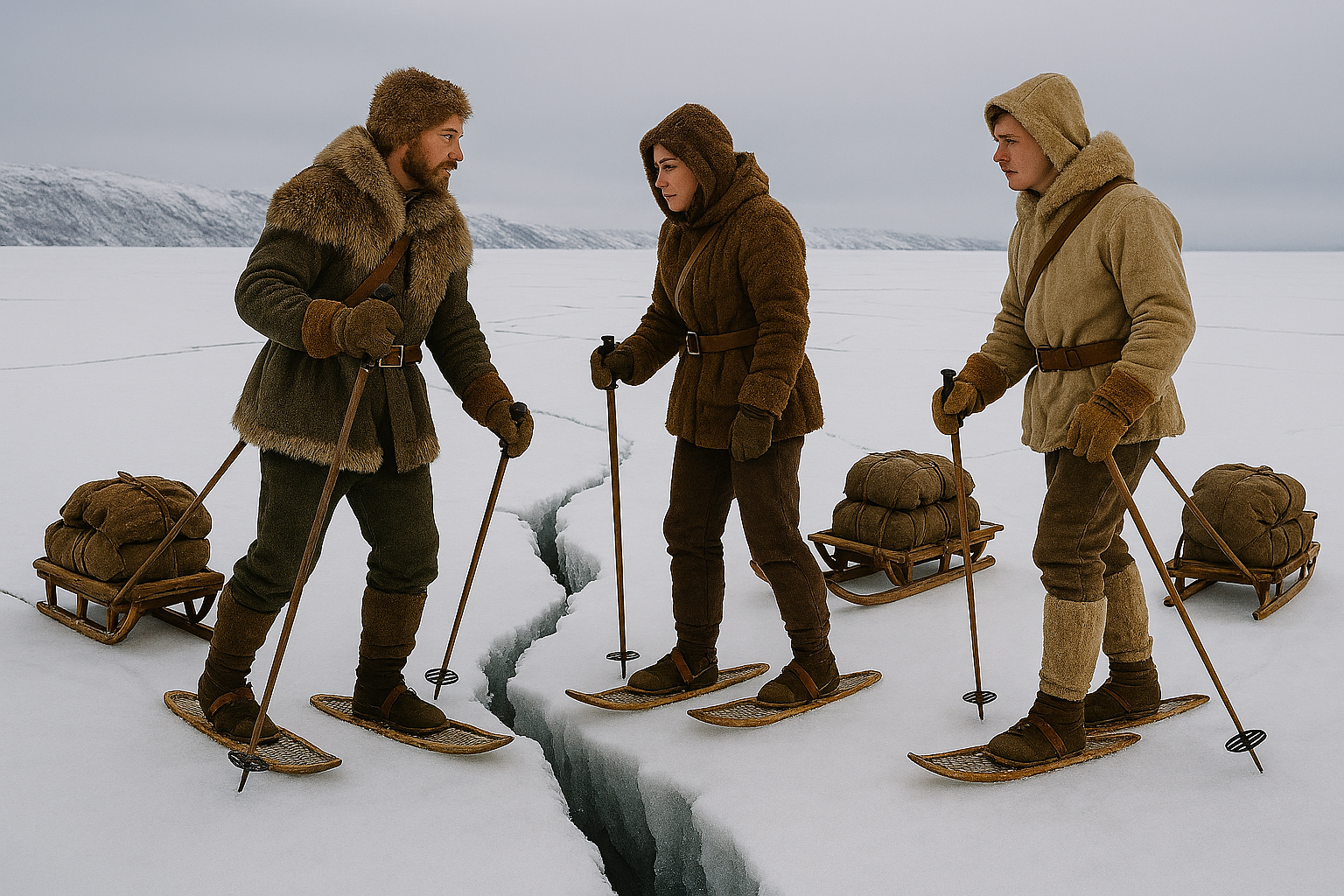
by Microsoft Copilot
GM Information
At first, the Sprakmarka appears to be relatively harmless terrain. The ice surface is only marked by small fissures that can easily be crossed with sleds. Beron will explain the geological and ecological features of the region to the group. The closer one gets to the ice rift known as Storar, the larger and deeper the fissures become. It is rare, but sometimes one can witness the formation of new cracks — a dangerous spectacle, especially near the larger rifts. The Snovingas use these natural formations to raise their young. One of the duties of the rune warriors is to regularly inspect major fissures to search for eggs or newly hatched young.
A fall into an ice fissure is life‑threatening. The fissures are not static; they can widen or close again. Anyone who falls in may slip deeper or become trapped. On the first day in the Sprakmarka, the situation is still safe. Toward evening, however, the group must find a suitable campsite large enough for building igloos and free of major fissures. A successful Perception check (DC 15) allows the discovery of such a place. Building the igloos poses no challenge.
During the night, another Perception check (DC 18) is required. On success, the character notices a faint trembling in the ice. Anyone lying on the ground also hears a distant grinding and cracking, transmitted through the ice. These are the first signs that a large piece of ice will soon break off along the southern coast. Aside from this, the night passes without incident.
The next morning, the group sets out toward the southeast. If someone reports the nighttime sounds to Beron, he will confirm them but cannot name a precise cause. He explains that it may have been the formation of a new fissure nearby and advises everyone to stay alert. The fissures grow larger, forcing the group either to go around them or to jump across and lift the sleds over together.
At the first very large fissure — at least three meters wide and about fifteen meters deep — Beron stops. He takes a bundle from his sled, which turns out to be an oversized dummy, and throws it into the fissure. He explains that someone has fallen in and must be rescued. The players are to propose rescue methods. A sophisticated system or sketches are not required. It is enough if they name basic safety measures: double rope securing, checking the stability of the ice edges, descending in pairs, using experienced climbers, bringing tools and first‑aid equipment, and presenting a practical method for retrieving the person.
Beron will throw the dummy down multiple times and present different scenarios: the person is trapped, unconscious, dead, panicking and aggressive, or there are two people. If a recruit slips during the descent, the exercise becomes a real rescue mission. In that case, all relevant DCs increase by three.
At least two scenarios should be played out. Various skill checks are involved: Finding a suitable descent point requires a Nature check (DC 13). The descent itself succeeds with Athletics (DC 13), with higher DCs for additional weight (15 with dummy, 18 with a real person). A medical examination of the dummy requires Medicine (DC 10). Assessing the situation requires Perception (DC 13). Analyzing the best rescue method uses Investigation (DC 12). Freeing trapped limbs and tying knots for transport requires Survival (DC 14). The ascent also uses Athletics, depending on the load.
While working in the fissure, the heroes may again notice the trembling and cracking from the night. A successful Perception check (DC 16) allows them to determine the direction of the sound. Since the fissure runs west to east and the northern wall does not transmit the sound, it is clear that the noise comes from the south. If Beron is informed, he shows no reaction, but the next day he changes the route and leads the group further south instead of east toward the Storar as originally planned.
Read‑Aloud Text – Tremor
You reach the coastal region in the early afternoon. At first only a distant rumble, then louder and louder, the thunder of the sea reaches your ears. Restlessly, the waves lash against the sheer southern cliffs. The water churns, roars, crashes relentlessly against the icy walls. The current is treacherous — no ship dares to enter this region. The ground beneath your feet trembles softly, steadily, as if the sea itself were pushing against the land.
In the distance — more than ten kilometers away — you see a group of people. Tiny at this distance, yet their dark clothing stands out clearly against the white surroundings. They stand outside the Sprakmarka, at a place often used for the Passing of Souls. There, where bodies are given to the sea, the harsh winds of the southern cliff are said to hasten the soul’s ascent.
Beron’s face is lined with worry. His gaze rests on the ground, yet his thoughts seem far away. Again and again, his eyes flick toward the burial site — as if following an invisible line only he can see.
Then, suddenly — a violent tremor. The ground shudders. You must hold on to one another, plant your feet wide to avoid falling. The astonishment at the force of the quake is written across your comrades’ faces — only Beron’s expression grows even more severe.
You reach the coastal region in the early afternoon. At first only a distant rumble, then louder and louder, the thunder of the sea reaches your ears. Restlessly, the waves lash against the sheer southern cliffs. The water churns, roars, crashes relentlessly against the icy walls. The current is treacherous — no ship dares to enter this region. The ground beneath your feet trembles softly, steadily, as if the sea itself were pushing against the land.
In the distance — more than ten kilometers away — you see a group of people. Tiny at this distance, yet their dark clothing stands out clearly against the white surroundings. They stand outside the Sprakmarka, at a place often used for the Passing of Souls. There, where bodies are given to the sea, the harsh winds of the southern cliff are said to hasten the soul’s ascent.
Beron’s face is lined with worry. His gaze rests on the ground, yet his thoughts seem far away. Again and again, his eyes flick toward the burial site — as if following an invisible line only he can see.
Then, suddenly — a violent tremor. The ground shudders. You must hold on to one another, plant your feet wide to avoid falling. The astonishment at the force of the quake is written across your comrades’ faces — only Beron’s expression grows even more severe.
GM Information
The southern cliff is beginning to calve — a large section of the ice wall will break off and drift into the sea. The collapse will trigger ice avalanches sliding down along the edges. The affected areas will be highly unstable for some time.
The heroes and their squad are in a relatively safe region. The burial site, however, lies closer to the coast and is potentially endangered. At first, Beron assumes only the formation of a new fissure. He sends the recruits out in small groups to search for signs of changes in the ice.
The heroes are to explore the coastal region throughout the afternoon. They may make multiple skill checks — Investigation (DC 17), Survival (DC 16), Perception (DC 15), and similar — to cross fissures, identify fresh cracks, and assess the situation.
Several successful checks — at the GM’s discretion — may reveal the following:
- New fissures have formed, both small and large.
- Most of the new fissures run roughly parallel to the coastline.
- The tremors are noticeably stronger directly at the coast than inland and differ in character. The major tremor has a deeper, duller resonance.
- On an exceptionally good roll: the waves strike the southern cliff in a regular rhythm, causing smaller tremors. The major tremor, however, seems unrelated.
- The cracking in the ice does not sound like normal breaking — more like a sudden shattering or bursting.
In the evening, Beron demands a report from all groups. Most squads describe similar observations. Only one group reports that the ice south of a larger fissure shows a striking milky discoloration — fine cracks like veins running through it.
This information allows a Nature check (DC 20). On success, the character recognizes the connection: a large ice block is about to break off.
Grant your players a level‑up to Level 2. They will need Level 2 for the calving event and the rescue of the burial participants.
Created by Selibaque 2025

Kommentare