

Valorian Occupation Proclamation
The Valorian Occupation Proclamation, also known as "The Proclamation of Stewardship and Order", was a formal decree issued by Valorian authority at the onset of the occupation of Kalros. Framed as a corrective administrative measure rather than an act of conquest, the document declared Kalros a territory under Valorian “stewardship” and stripped its clans of recognized sovereignty.
The proclamation dissolved existing clan governance, outlawed traditional moots and banner councils, and placed all land, labor, and military authority under Valorian administrators. It established new taxation and conscription requirements while severely restricting the bearing of arms among the local population. Resistance was explicitly reclassified as sedition rather than legitimate opposition.
Although presented as a promise of stability and lawful order, the proclamation became a symbol of Valorian domination. Copies were posted in settlements and along major passes, often accompanied by armed enforcement. In later years, surviving originals were defaced, annotated, or ritually destroyed by Kalros clans during the Reclamation.
The language and structure of the document are frequently cited by scholars as an example of imperial rhetoric, employing moral justification and legal terminology to legitimize foreign rule while delegitimizing indigenous authority.
Purpose
The Proclamation of Stewardship and Order was created to provide a legal and moral framework for Valoria’s occupation of Kalros. Its primary purpose was not merely to announce control, but to redefine the political reality of the region in Valorian terms, transforming an act of military dominance into one of administrative necessity.
The document was prompted by Valoria’s inability to fully pacify Kalros through force alone. While Valorian armies had secured major passes and strongholds, persistent clan resistance, decentralized leadership, and difficult terrain made long-term occupation costly and unstable. The proclamation sought to neutralize these challenges by dismantling clan-based authority structures and criminalizing traditional forms of governance.
By labeling the occupation as “stewardship,” the document reframed Valoria’s actions as benevolent intervention rather than annexation. It positioned Kalros as incapable of self-rule, justifying external oversight while delegitimizing clan sovereignty and martial customs. This rhetorical framing allowed Valoria to suppress resistance without acknowledging it as a legitimate political movement.
Practically, the proclamation aimed to achieve several outcomes: the dissolution of clan moots and banner councils, the disarmament of local militias, the establishment of taxation and labor levies, and the redirection of trade and military movement through Valorian-controlled channels. It also served as a warning, explicitly redefining resistance as sedition rather than honorable opposition.
Beyond immediate enforcement, the document was intended to normalize Valorian presence over time. By embedding occupation within legal language and bureaucratic process, Valoria sought to make its rule appear inevitable and permanent, reducing the likelihood of unified rebellion and eroding cultural cohesion among the clans.
In effect, the proclamation functioned as both a tool of governance and a psychological instrument, designed to replace Kalros’s identity as a land of independent banners with that of a managed frontier under imperial order.
Historical Details
Background
The Occupation Proclamation was issued during a period of escalating pressure between Valoria and Kalros, at a time when Kalros remained politically fragmented along clan lines and lacked a single unified authority capable of negotiating or resisting foreign intervention. Valoria leveraged this fragmentation as both justification and opportunity, presenting itself as a stabilizing force amid what it publicly characterized as internal disorder and ineffective governance.
Historically, Kalros had resisted centralized rule, favoring clan autonomy, regional leadership, and traditional systems of mutual obligation. While this structure functioned effectively for internal affairs, it left Kalros diplomatically vulnerable. Valoria, already a dominant arcane power in the region, framed Kalros as strategically important to broader continental stability and claimed that unchecked clan rivalries posed a risk not only to Kalros itself but to neighboring realms.
The proclamation emerged after a series of Valorian “assessments” and diplomatic overtures that were intentionally one-sided. Kalrosian leaders were consulted individually rather than collectively, preventing unified opposition. By the time the proclamation was issued, Valoria had already positioned advisors, surveyors, and arcane specialists within Kalros under provisional authority.
Politically, the document represents Valoria’s transition from influence to occupation without declaring war. It establishes a legal framework that recasts conquest as administration, replacing clan governance with Valorian oversight while maintaining the appearance of lawful stewardship. The proclamation marks the moment Kalros ceased to be treated as a sovereign territory and became, in Valorian law, a managed region under external authority.
Culturally, the document stands in stark opposition to Kalrosian values. Where Kalros emphasized ancestral land rights, oral agreements, and clan consensus, the proclamation imposes written law, centralized power, and distant authority. This clash between traditions would later fuel resentment, resistance, and ultimately the unification of the clans against Valoria.
In hindsight, the Occupation Proclamation is understood as the foundational legal instrument of Valoria’s control over Kalros. It did not merely formalize occupation; it redefined Kalros’ identity in Valorian terms, stripping it of agency while claiming legitimacy through law rather than force.
Public Reaction
The public reaction in Kalros was immediate, divided, and volatile, but it followed clear social fault lines.
Among the common folk, the initial response was cautious rather than openly hostile. Valoria’s proclamation promised order, protection, and continuity of daily life, and for farmers, traders, and town-dwellers exhausted by inter-clan disputes, that message had weight. Taxes were standardized, roads were patrolled, and Valorian officials were careful at first to avoid overt brutality. To many outside the clans’ inner circles, the occupation felt less like conquest and more like an imposed but tolerable administration. Fear outweighed defiance in these early months.
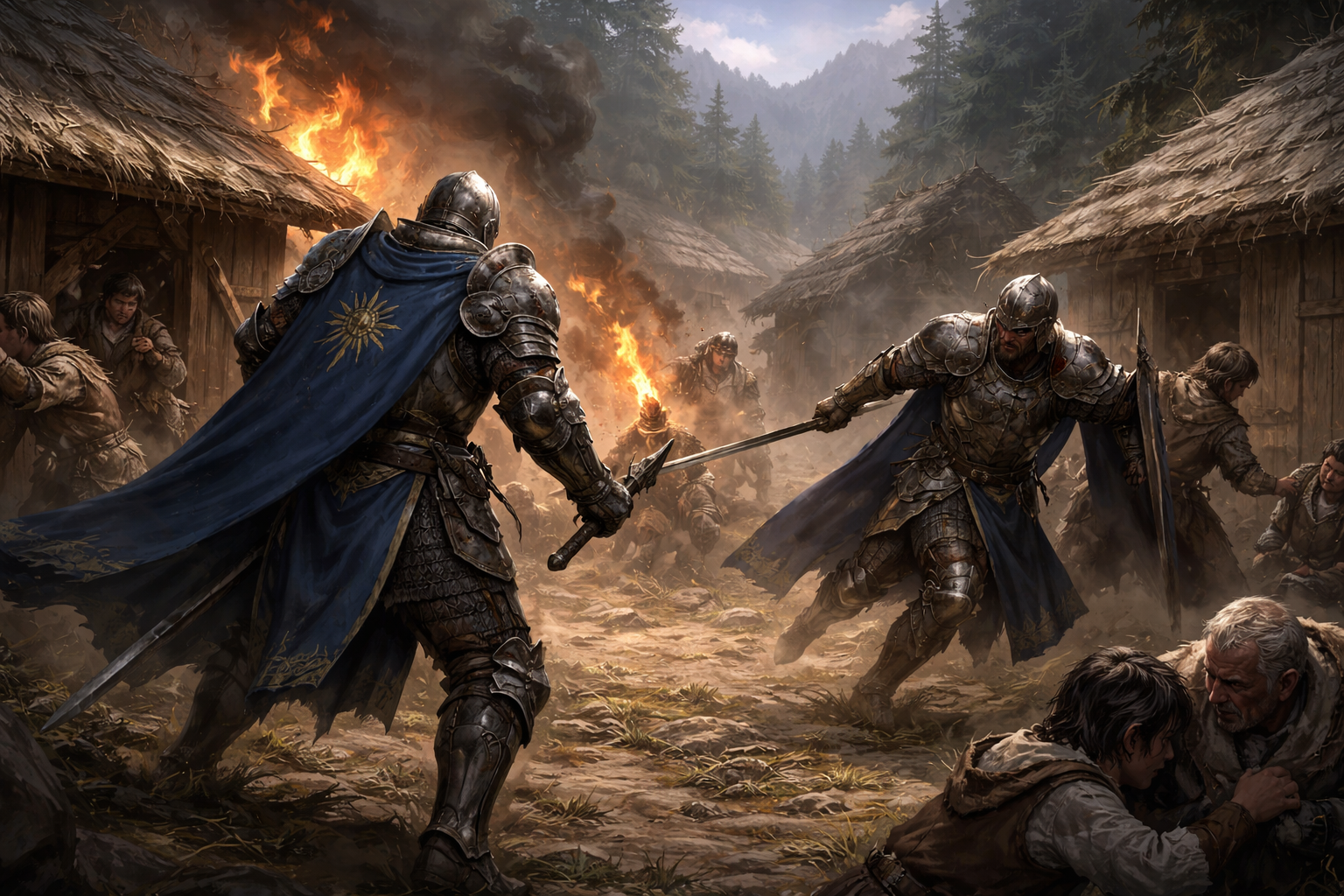
Clan members and rural populations reacted far more negatively. The proclamation was widely understood as an insult to ancestral rights, even by those who could not read its formal language. The idea that land stewardship could be reassigned by foreign decree struck at the core of Kalrosian identity. Elders spoke openly of betrayal, and oral traditions quickly reframed the document as a lie made of ink. While open rebellion was rare at first, compliance was grudging, and passive resistance became common—missed levies, delayed cooperation, and the quiet disappearance of Valorian envoys in remote regions.
 The educated and mercantile classes were sharply split. Some merchants and scholars aligned themselves with Valoria, seeing opportunity in access to arcane infrastructure, new trade routes, and Valorian patronage. Others recognized the long-term implications immediately and became some of the earliest covert organizers against the occupation, using their literacy and access to Valorian systems to undermine them from within.
Public unrest grew steadily rather than explosively. As Valoria’s presence deepened and its oversight became more intrusive, the early promises of stewardship rang hollow. Arcane restrictions, land seizures masked as “reallocation,” and the sidelining of clan authorities eroded any remaining goodwill. By the time resistance coalesced into organized movements, public opinion had largely hardened against the occupation.
In retrospect, the proclamation failed to pacify Kalrosian society. It delayed rebellion, but it also unified public sentiment over time. What began as wary acceptance evolved into shared resentment, laying the social groundwork for the eventual unification of the clans and the rejection of Valorian rule.
The educated and mercantile classes were sharply split. Some merchants and scholars aligned themselves with Valoria, seeing opportunity in access to arcane infrastructure, new trade routes, and Valorian patronage. Others recognized the long-term implications immediately and became some of the earliest covert organizers against the occupation, using their literacy and access to Valorian systems to undermine them from within.
Public unrest grew steadily rather than explosively. As Valoria’s presence deepened and its oversight became more intrusive, the early promises of stewardship rang hollow. Arcane restrictions, land seizures masked as “reallocation,” and the sidelining of clan authorities eroded any remaining goodwill. By the time resistance coalesced into organized movements, public opinion had largely hardened against the occupation.
In retrospect, the proclamation failed to pacify Kalrosian society. It delayed rebellion, but it also unified public sentiment over time. What began as wary acceptance evolved into shared resentment, laying the social groundwork for the eventual unification of the clans and the rejection of Valorian rule.
Type
Decree, Governmental
Medium
Paper
Authoring Date
497 HE
Ratification Date
498 HE
Location
Signatories (Organizations)


Comments