
Thornrest
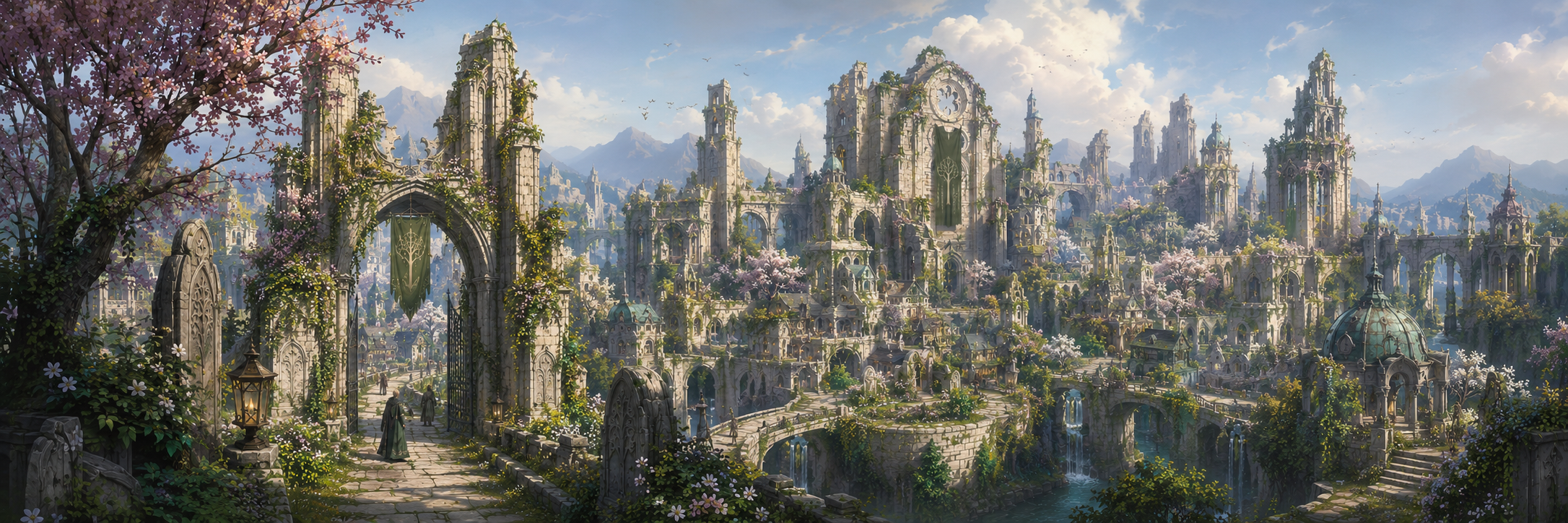
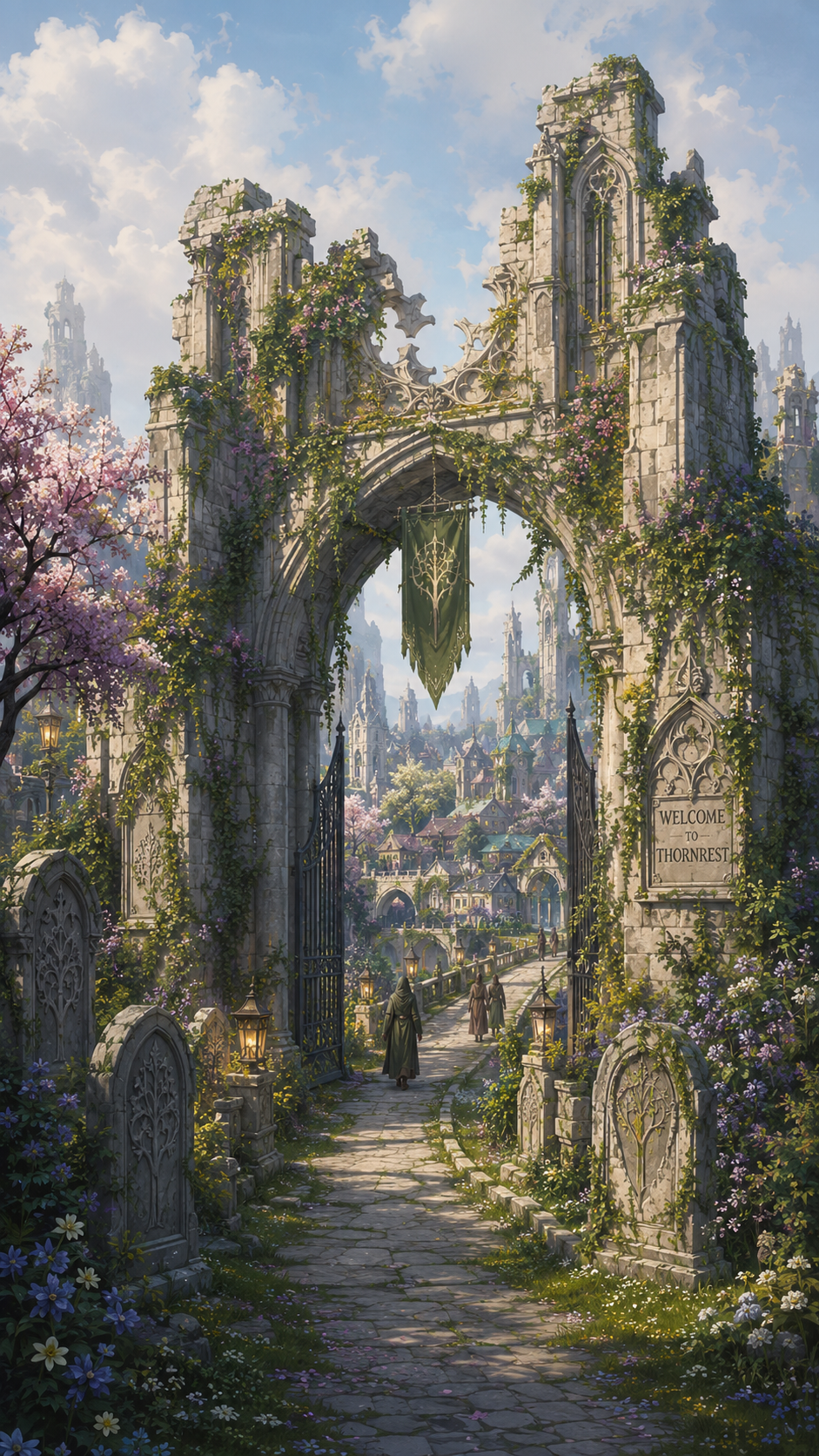
Modern Thornrest is both a city and a memorial. Its residents live closely with the remains of the old ruin, treating broken stone, grave trees, and restored foundations as part of the city’s inheritance. New buildings are rarely allowed to erase old ones completely. Instead, homes are built into surviving walls, gardens are planted inside collapsed halls, and bridges are shaped around ancient foundations.
The city is known for its orchards, thorn gardens, funerary groves, herbal markets, carved memorial stones, and druidic shrines. It is also a place of refuge for those displaced by war, plague, famine, or political ruin. Thornrest has a reputation for accepting people who have nowhere else to go, provided they are willing to contribute to the life of the city.
Thornrest lies in southern Eithwyn, near the old borderlands where Eithwyn, Opos Tyr, and Kharadorn have long pressed against one another through trade, war, pilgrimage, and shifting influence. The city was built among the remains of a destroyed settlement whose original allegiance is still debated by historians. Eithwyn claims it as a restored wound within its own land, while neighboring chroniclers argue that the ruin once belonged to another power before fire, battle, and abandonment erased its certainty.
This uncertain history is part of Thornrest’s identity. The city does not belong cleanly to triumph or conquest, but to what came after: mourning, return, planting, and the slow transformation of a battlefield ruin into a living settlement.
The city is known for its orchards, thorn gardens, funerary groves, herbal markets, carved memorial stones, and druidic shrines. It is also a place of refuge for those displaced by war, plague, famine, or political ruin. Thornrest has a reputation for accepting people who have nowhere else to go, provided they are willing to contribute to the life of the city.
Thornrest lies in southern Eithwyn, near the old borderlands where Eithwyn, Opos Tyr, and Kharadorn have long pressed against one another through trade, war, pilgrimage, and shifting influence. The city was built among the remains of a destroyed settlement whose original allegiance is still debated by historians. Eithwyn claims it as a restored wound within its own land, while neighboring chroniclers argue that the ruin once belonged to another power before fire, battle, and abandonment erased its certainty.
This uncertain history is part of Thornrest’s identity. The city does not belong cleanly to triumph or conquest, but to what came after: mourning, return, planting, and the slow transformation of a battlefield ruin into a living settlement.
Demographics
Thornrest is unusually mixed for a city of its size. Its earliest permanent residents were mourners, druids, grave-tenders, refugees, and laborers from several nearby lands, and that mixed beginning remains visible in the modern population. Eithwyn humans form the largest share of the city, but elves, half-elves, gnomes, firbolg, halflings, and mixed-ancestry families are also common, particularly among the grove-keepers, herbalists, scribes, and restoration guilds.
The city has a notable population of refugees and descendants of refugees. Thornrest has long accepted those displaced by war, famine, plague, and political collapse, provided they are willing to contribute to the care of the city. New arrivals are often assigned work in gardens, rebuilding projects, kitchens, orchards, waterworks, or memorial maintenance before being granted full civic standing.
Druids and nature-aligned priests hold a respected place in the city, though Thornrest is not ruled by a theocracy. Their authority is strongest over grave-groves, sacred roots, funerary orchards, and questions of land use. Builders, merchants, and civic officials frequently complain that no other city in Eithwyn requires so many permissions before moving a wall, cutting a tree, or widening a road.
The poorer districts of Thornrest are mostly found along the outer roads and lower terraces, where newer homes have been built beyond the old ruin. Even there, residents tend to maintain small gardens, shrine niches, and family trees when space allows. Wealthier households live closer to the restored inner districts, often in homes built into ancient stone shells or around private courtyards where memorial trees are carefully tended.
The city has a notable population of refugees and descendants of refugees. Thornrest has long accepted those displaced by war, famine, plague, and political collapse, provided they are willing to contribute to the care of the city. New arrivals are often assigned work in gardens, rebuilding projects, kitchens, orchards, waterworks, or memorial maintenance before being granted full civic standing.
Druids and nature-aligned priests hold a respected place in the city, though Thornrest is not ruled by a theocracy. Their authority is strongest over grave-groves, sacred roots, funerary orchards, and questions of land use. Builders, merchants, and civic officials frequently complain that no other city in Eithwyn requires so many permissions before moving a wall, cutting a tree, or widening a road.
The poorer districts of Thornrest are mostly found along the outer roads and lower terraces, where newer homes have been built beyond the old ruin. Even there, residents tend to maintain small gardens, shrine niches, and family trees when space allows. Wealthier households live closer to the restored inner districts, often in homes built into ancient stone shells or around private courtyards where memorial trees are carefully tended.
- Humans: 55%
- Elves and Half-Elves: 18%
- Halflings and Gnomes: 10%
- Firbolg: 6%
- Dwarves: 4%
- Other ancestries: 7%
History
The city now called Thornrest began as a ruin whose original name is still disputed. Older Eithwyn records refer to it as a fortified border settlement, while fragments from Opos Tyr and Kharadorn suggest that the site changed hands several times before its destruction. Whatever its final allegiance, the settlement was burned during a devastating border conflict that left its towers broken, its wells fouled, and its streets filled with the dead.
For years, the ruin was avoided. Travelers claimed the ground was cursed. Grass grew thinly over ash-black soil, and animals shied away from the old gates. Those who entered in search of salvage often returned with stories of bad dreams, sickness, or voices moving through the broken halls. Whether these tales were caused by grief, poison, lingering magic, or guilt is still debated by Thornrest scholars.
The first people to return with purpose were not settlers, but mourners. Families came searching for bones. Priests came to name the dead. Druids came because the land itself had been wounded. Instead of sealing the ruin away, they began the slow work of return. Bodies were gathered and buried. Ash was mixed into the soil. Broken stones were raised into cairns. Poisoned wells were cleansed. Seeds were pressed into grave earth.
The first thorn trees took root in the burial grounds. Their branches grew dense, their blossoms returned each spring, and their roots held the softened soil where the dead had been laid. These trees gave the place its new name. At first, Thornrest referred only to the grave-grove. Later, it came to mean the mourning camp that formed beside it. Over time, that camp became a refuge for widows, orphans, displaced farmers, wounded soldiers, wandering priests, and those with nowhere safe to return.
As the grove flourished, so did the settlement. Restorers rebuilt portions of the old walls, not to erase the ruin, but to make it livable. Collapsed halls became gardens. Watchtowers became bell towers and dovecotes. Old courtyards became markets. Streets were rerouted around grave trees rather than through them. Thornrest grew slowly, guided by the belief that the dead should remain part of the city’s memory, not hidden beneath it.
By the time Eithwyn formally recognized Thornrest as a city, it had already become something unusual: a living settlement built around protected ruins, sacred groves, and public memory. Its charter granted unusual authority to grove-keepers and memorial wardens, ensuring that certain parts of the old ruin could never be sold, leveled, or built over without ritual consent.
Modern Thornrest remains shaped by this origin. Its people are practical, but rarely casual about land, death, or rebuilding. Every new structure must account for what stood there before. Every orchard has a record. Every grave-grove has keepers. The city’s history is not sealed in archives alone, but grown into roots, walls, blossoms, and the paths people walk each day.
For years, the ruin was avoided. Travelers claimed the ground was cursed. Grass grew thinly over ash-black soil, and animals shied away from the old gates. Those who entered in search of salvage often returned with stories of bad dreams, sickness, or voices moving through the broken halls. Whether these tales were caused by grief, poison, lingering magic, or guilt is still debated by Thornrest scholars.
The first people to return with purpose were not settlers, but mourners. Families came searching for bones. Priests came to name the dead. Druids came because the land itself had been wounded. Instead of sealing the ruin away, they began the slow work of return. Bodies were gathered and buried. Ash was mixed into the soil. Broken stones were raised into cairns. Poisoned wells were cleansed. Seeds were pressed into grave earth.
The first thorn trees took root in the burial grounds. Their branches grew dense, their blossoms returned each spring, and their roots held the softened soil where the dead had been laid. These trees gave the place its new name. At first, Thornrest referred only to the grave-grove. Later, it came to mean the mourning camp that formed beside it. Over time, that camp became a refuge for widows, orphans, displaced farmers, wounded soldiers, wandering priests, and those with nowhere safe to return.
As the grove flourished, so did the settlement. Restorers rebuilt portions of the old walls, not to erase the ruin, but to make it livable. Collapsed halls became gardens. Watchtowers became bell towers and dovecotes. Old courtyards became markets. Streets were rerouted around grave trees rather than through them. Thornrest grew slowly, guided by the belief that the dead should remain part of the city’s memory, not hidden beneath it.
By the time Eithwyn formally recognized Thornrest as a city, it had already become something unusual: a living settlement built around protected ruins, sacred groves, and public memory. Its charter granted unusual authority to grove-keepers and memorial wardens, ensuring that certain parts of the old ruin could never be sold, leveled, or built over without ritual consent.
Modern Thornrest remains shaped by this origin. Its people are practical, but rarely casual about land, death, or rebuilding. Every new structure must account for what stood there before. Every orchard has a record. Every grave-grove has keepers. The city’s history is not sealed in archives alone, but grown into roots, walls, blossoms, and the paths people walk each day.


Comments