
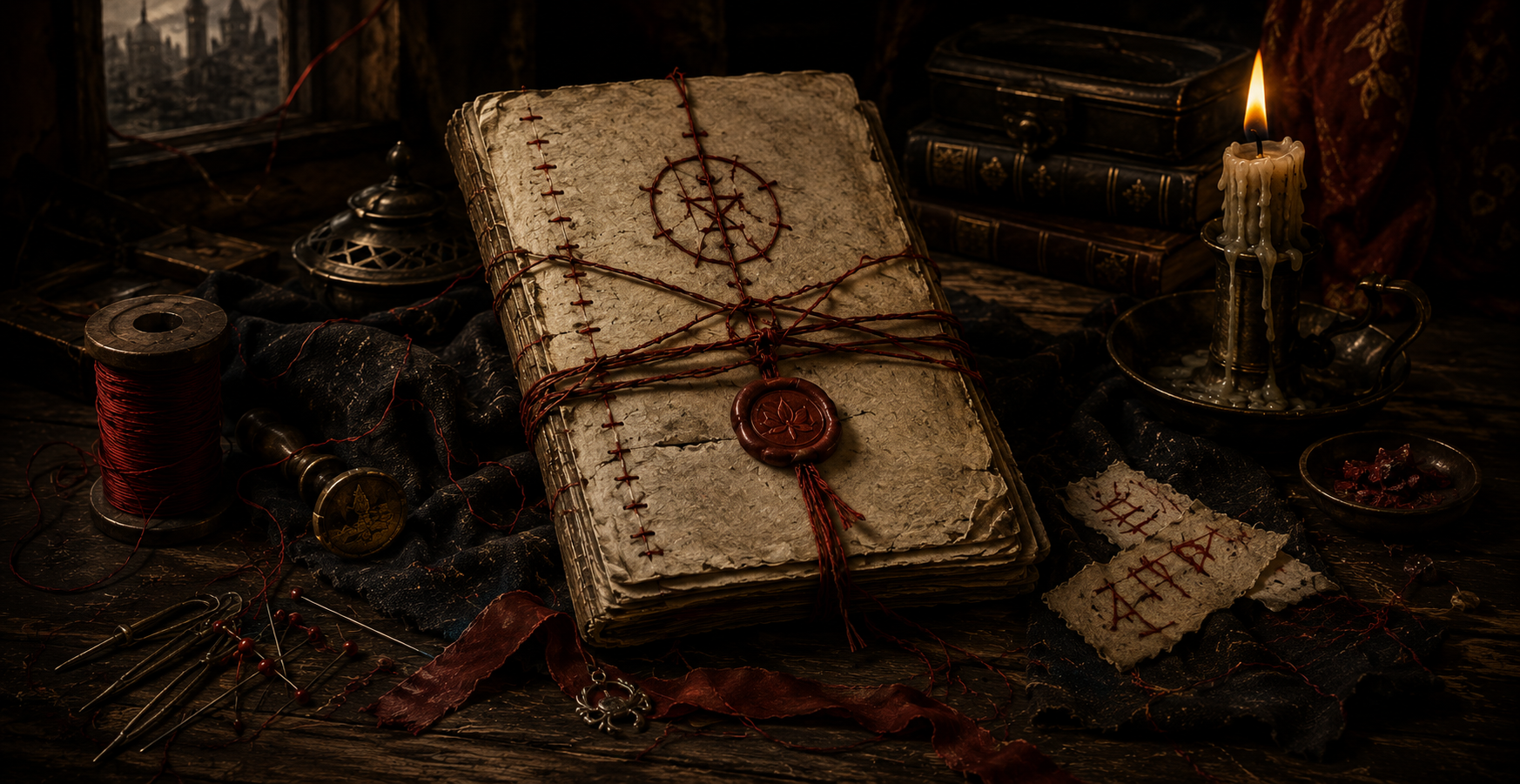
Red Thread Manuscript
The Red Thread Manuscript is a banned work of fiction known for its fragmented romance, strange marginal notes, and alleged connections to the Widow’s Hand. On the surface, it is the story of a woman fleeing an unnamed city after discovering that every woman in her family has been promised, sold, or silenced by the same circle of powerful men. Guided by scraps of red thread, coded household signs, and half-remembered stories from widows, she follows a hidden path through servant corridors, laundries, kitchens, bathhouses, funerary homes, and shrine cellars.
The manuscript is written as fiction, but few readers agree on what kind of fiction it is. Some describe it as a romance, others as a revenge tale, an escape story, a political allegory, or a coded confession. It has no confirmed author, no agreed original title, and no complete first edition. Every surviving copy differs slightly from the others, with altered names, missing pages, rewritten endings, and marginal symbols that may have been added by later readers.
The work is infamous because many believe it contains hidden instructions. Certain passages seem to describe real Valorian streets, Jou’lunni slave routes, old safehouse signals, poison measurements, forged travel phrases, and ways to identify members of the Widow’s Hand. Authorities dismiss these theories as hysteria, but have still banned, burned, or confiscated copies in several cities. This contradiction has only made the manuscript more desirable.
To some, The Red Thread Manuscript is dangerous propaganda disguised as melodrama. To others, it is a survival text wearing the skin of a love story. The most devoted theorists believe the true manuscript is not a book at all, but a changing code passed from woman to woman, rewritten whenever the old routes become unsafe.
The manuscript is written as fiction, but few readers agree on what kind of fiction it is. Some describe it as a romance, others as a revenge tale, an escape story, a political allegory, or a coded confession. It has no confirmed author, no agreed original title, and no complete first edition. Every surviving copy differs slightly from the others, with altered names, missing pages, rewritten endings, and marginal symbols that may have been added by later readers.
The work is infamous because many believe it contains hidden instructions. Certain passages seem to describe real Valorian streets, Jou’lunni slave routes, old safehouse signals, poison measurements, forged travel phrases, and ways to identify members of the Widow’s Hand. Authorities dismiss these theories as hysteria, but have still banned, burned, or confiscated copies in several cities. This contradiction has only made the manuscript more desirable.
To some, The Red Thread Manuscript is dangerous propaganda disguised as melodrama. To others, it is a survival text wearing the skin of a love story. The most devoted theorists believe the true manuscript is not a book at all, but a changing code passed from woman to woman, rewritten whenever the old routes become unsafe.
Document Structure
Publication Status
The Red Thread Manuscript has no single recognized publication status. It is not considered a formally published book in the traditional sense, since no licensed press, printer’s guild, or named author has ever claimed responsibility for it. Most copies exist as hand-copied folios, stitched chapbooks, altered household ledgers, loose serialized pages, or sections hidden inside other texts. In cities where censorship is strict, fragments are sometimes disguised as recipe collections, prayer notes, embroidery patterns, love letters, or domestic accounts.
The manuscript is considered “unpublished” by many scholars because no complete authoritative edition exists. Every surviving copy differs from the others. Some are only a few pages long, while others contain entire narrative arcs, marginal symbols, coded thread marks, or alternate endings. This has led to ongoing debate over whether The Red Thread Manuscript began as one work that was repeatedly altered, or as a body of related fragments gathered under a common name.
Despite this, the manuscript circulates widely in hidden form. In Valoria and Jou'lunn, possession of a copy is dangerous, so readers often memorize sections, copy only selected passages, or destroy pages after passing them on. Outside those regions, less restricted editions sometimes appear as scandalous fiction, though even these versions are often incomplete, sanitized, or deliberately misleading.
The manuscript is considered “unpublished” by many scholars because no complete authoritative edition exists. Every surviving copy differs from the others. Some are only a few pages long, while others contain entire narrative arcs, marginal symbols, coded thread marks, or alternate endings. This has led to ongoing debate over whether The Red Thread Manuscript began as one work that was repeatedly altered, or as a body of related fragments gathered under a common name.
Despite this, the manuscript circulates widely in hidden form. In Valoria and Jou'lunn, possession of a copy is dangerous, so readers often memorize sections, copy only selected passages, or destroy pages after passing them on. Outside those regions, less restricted editions sometimes appear as scandalous fiction, though even these versions are often incomplete, sanitized, or deliberately misleading.
Legal status
The legal status of The Red Thread Manuscript varies by region, but it is banned or restricted in much of Valoria and Jou’lunn. Valorian authorities classify it as seditious literature, immoral fiction, and a threat to household order. Possession of a copy may result in fines, confiscation, imprisonment, or questioning, especially if the owner is a servant, widow, printer, midwife, or woman attached to a noble household.
In Jou’lunn, the manuscript is treated even more harshly. Because some versions are believed to contain escape routes, coded signals, false names, and instructions useful to enslaved women, possession may be charged as conspiracy, theft of property, or aiding flight. Copies found in slave quarters, brothels, dockside lodgings, or caravan houses are usually burned immediately, and anyone connected to them may face severe punishment.
Other regions treat the manuscript with less urgency. In Eithwyn, Miranore, and some independent cities, it is often regarded as banned Valorian scandal literature: dangerous, indecent, politically charged, but not always illegal. Scholars may study confiscated copies under supervision, while collectors prize them for their rarity and controversy. Even where it is technically legal, open sale is uncommon. Few booksellers want the attention that follows the red thread.
In Jou’lunn, the manuscript is treated even more harshly. Because some versions are believed to contain escape routes, coded signals, false names, and instructions useful to enslaved women, possession may be charged as conspiracy, theft of property, or aiding flight. Copies found in slave quarters, brothels, dockside lodgings, or caravan houses are usually burned immediately, and anyone connected to them may face severe punishment.
Other regions treat the manuscript with less urgency. In Eithwyn, Miranore, and some independent cities, it is often regarded as banned Valorian scandal literature: dangerous, indecent, politically charged, but not always illegal. Scholars may study confiscated copies under supervision, while collectors prize them for their rarity and controversy. Even where it is technically legal, open sale is uncommon. Few booksellers want the attention that follows the red thread.
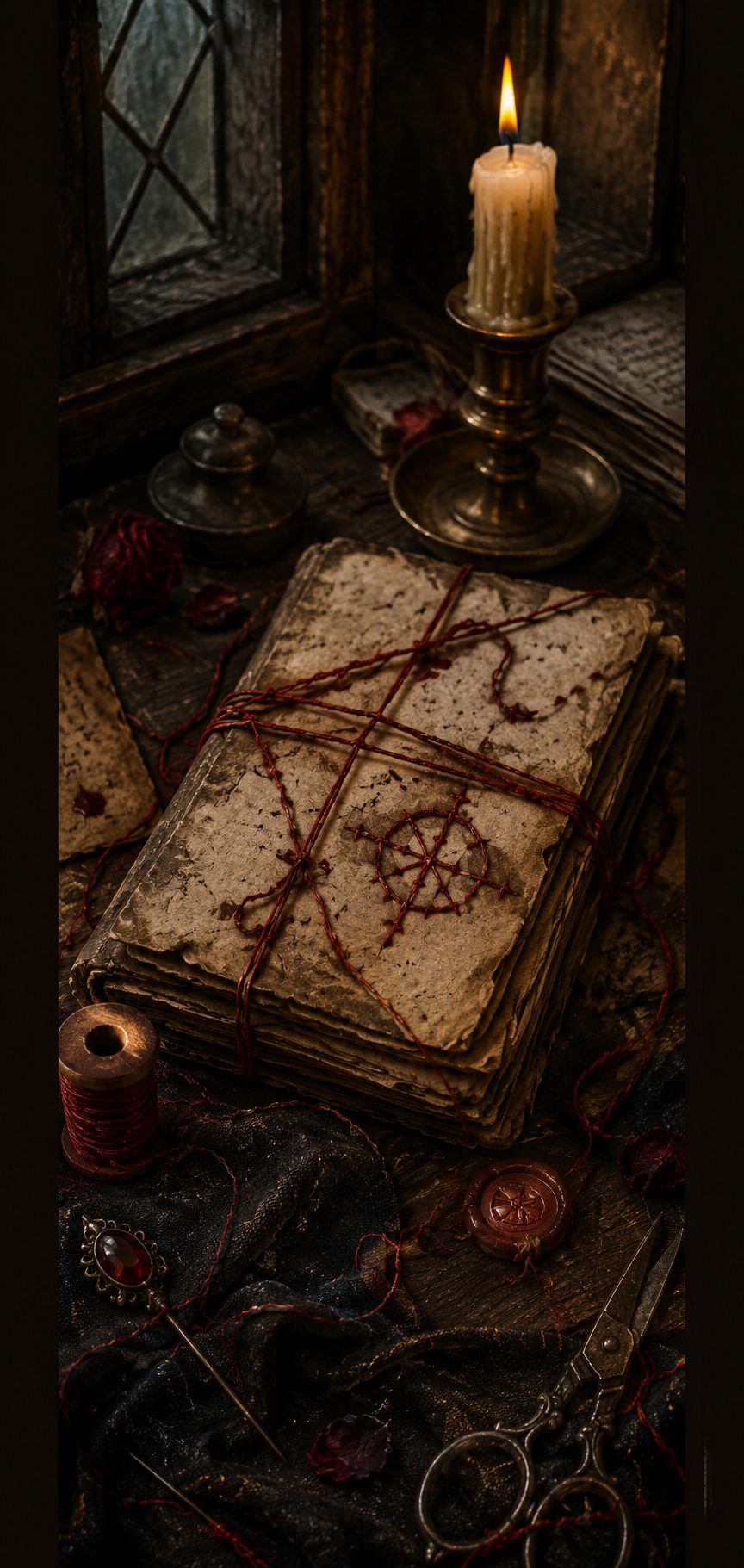
Medium
Paper
Authoring Date
Unknown


Comments