
Caer Dunhal (KARE DUN-hahl)
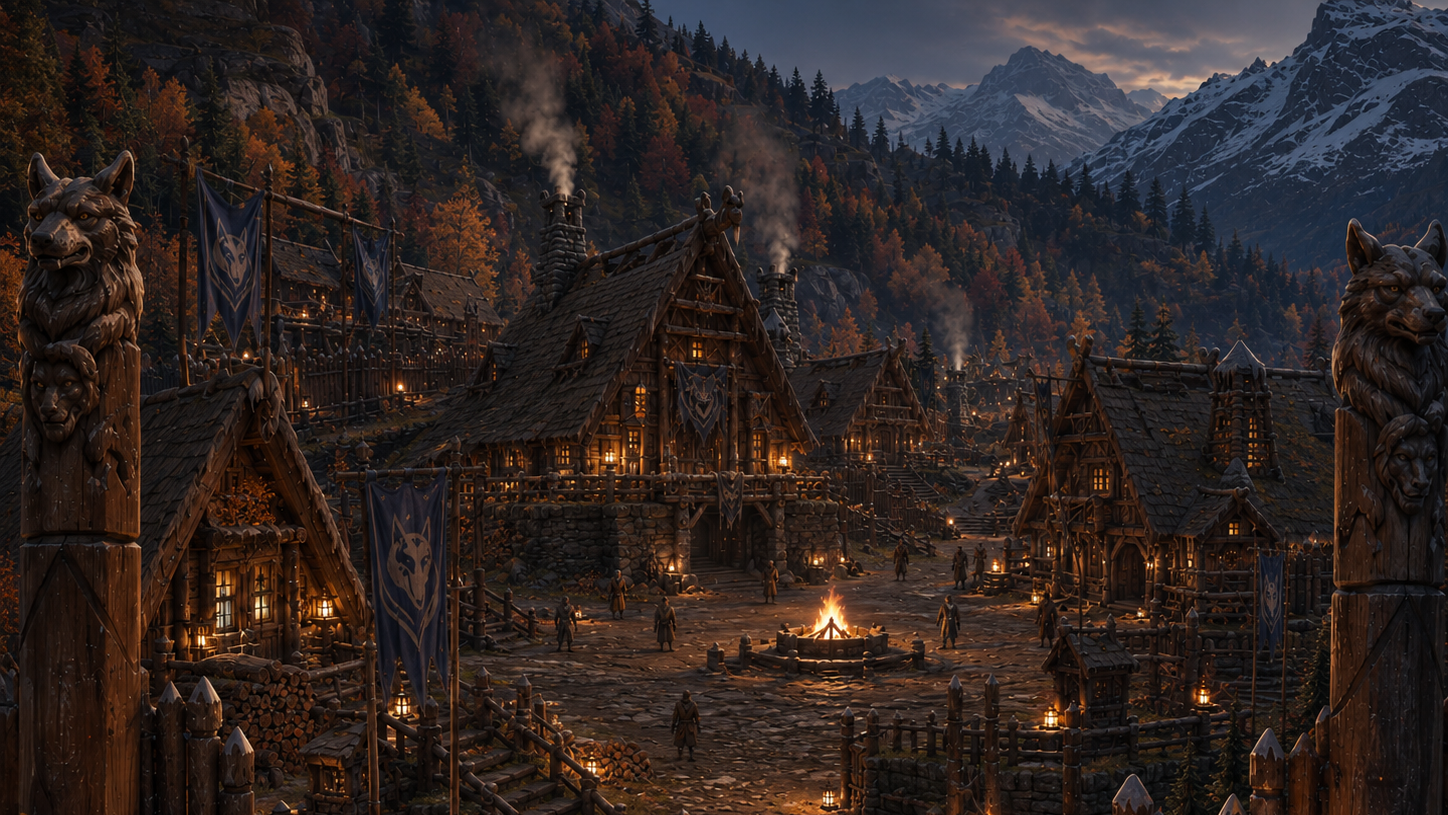
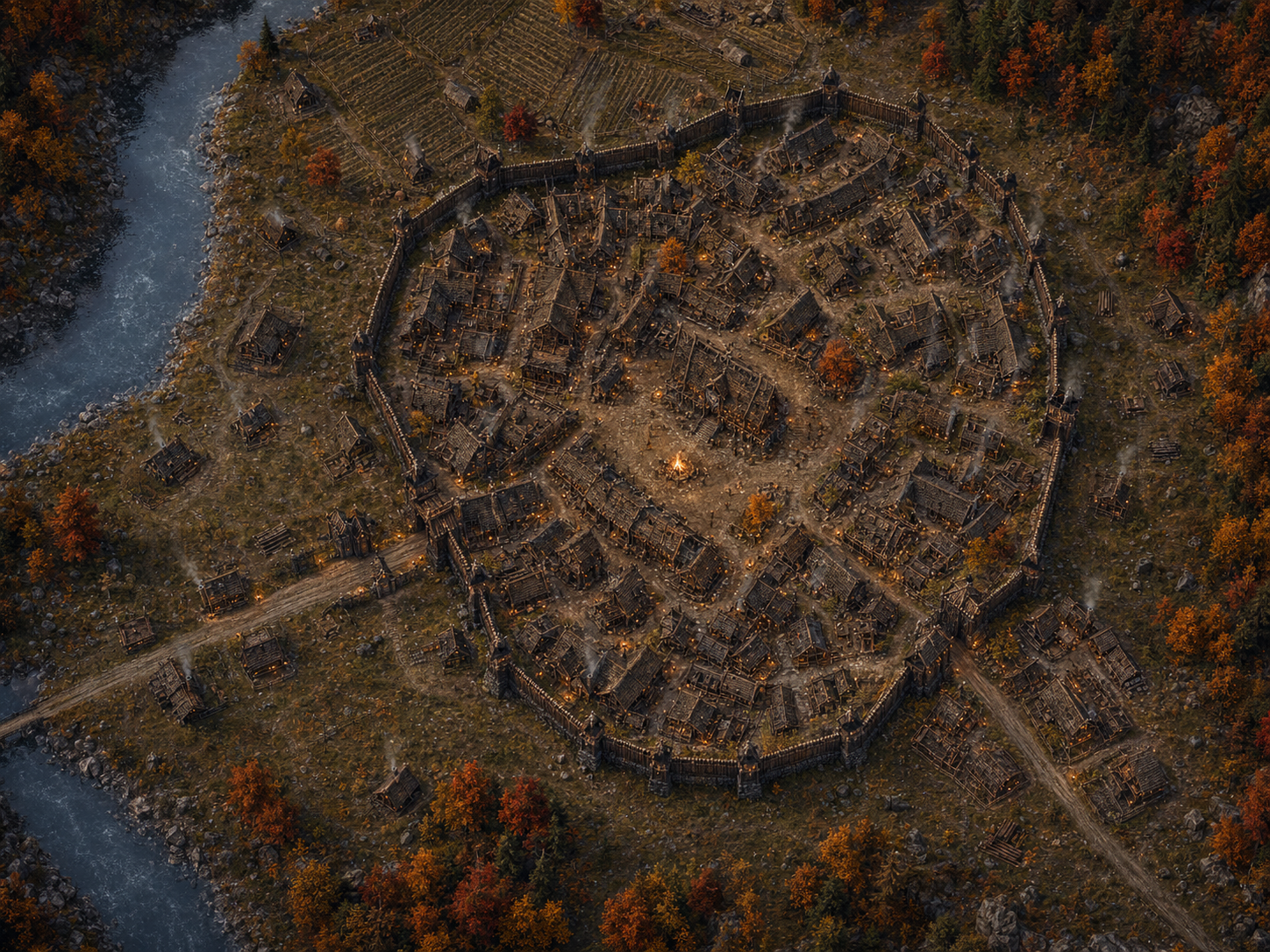
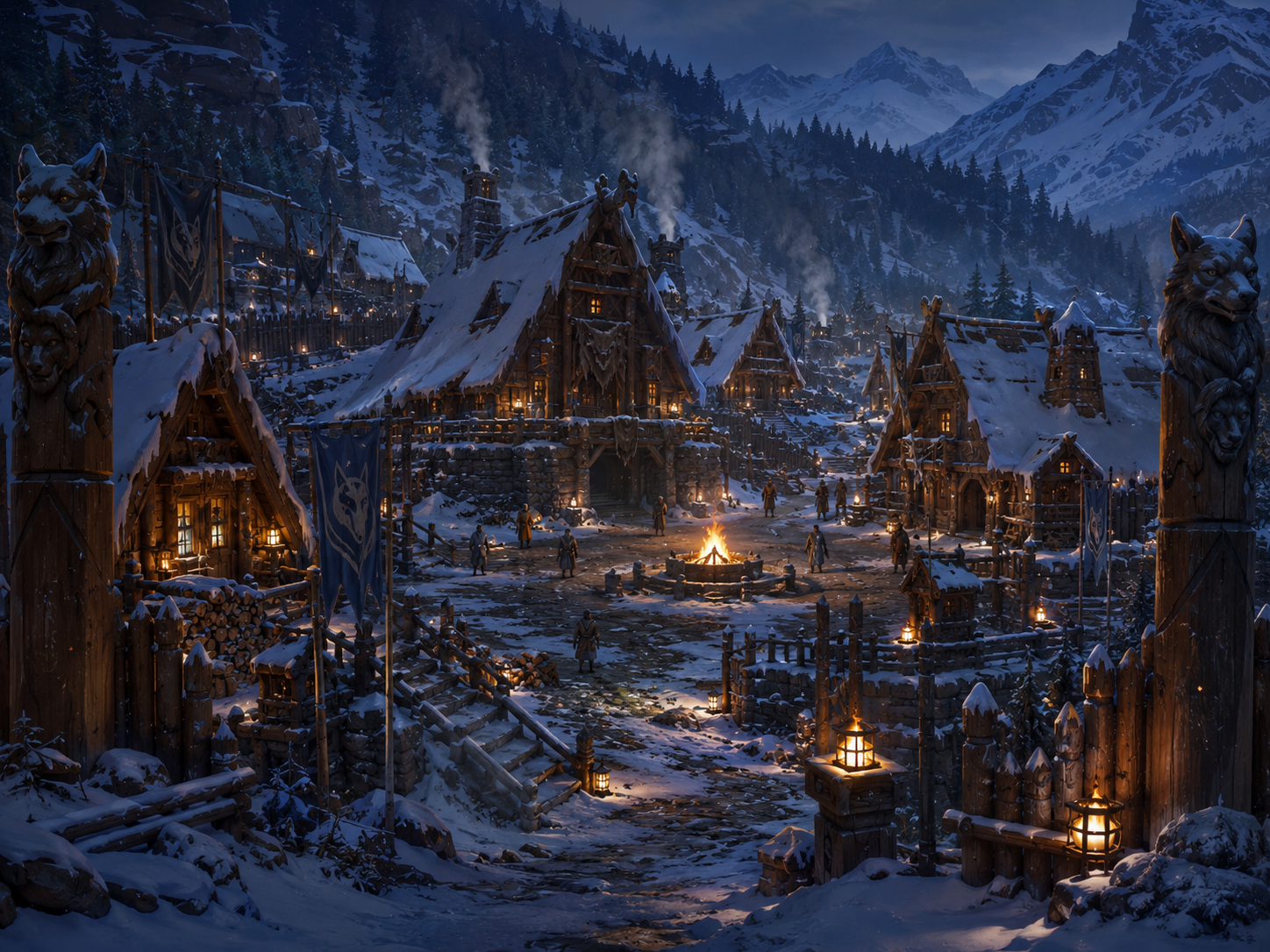
Caer Dunhal is a fortified clan village tucked into one of Kalros’s high mountain valleys, where dark pine forests press close against timber walls and the distant peaks stay snow-crowned even as autumn burns gold through the trees. Built from heavy wood, fieldstone, and iron-bound beams, the village has the practical strength of a place that has weathered long winters, border raids, and the slow pressure of Valorian ambition. Its gates are marked by carved wolf posts and old clan banners, but the settlement itself feels less like a war camp and more like a stubborn hearth kept alive against the cold.
At its heart stands the clan hall, a long, broad building of dark timber and stone known simply as Dunhal Hall. It serves as Roarik Vargan’s home, council chamber, feast hall, and the symbolic center of the village. Most matters of importance pass through its doors, whether they are disputes between families, preparations for winter, news from neighboring clans, or the arrival of outsiders seeking an audience. A central fire burns there through most of the year, its smoke curling into rafters hung with banners, old weapons, hunting trophies, and tokens from the Reclamation of Kalros.
The people of Caer Dunhal are hardy, watchful, and deeply loyal to their own. They are hunters, scouts, trappers, woodcutters, leatherworkers, and fighters when need demands it. Though the village is not openly hostile to strangers, outsiders are rarely welcomed without scrutiny. The memory of Valoria’s occupation still lingers in the way doors quiet when foreign wheels roll up the road and in the way hands drift closer to knives when polished accents speak of peace. Caer Dunhal survives through kinship, caution, and the shared belief that no one beyond the gates can be trusted more than the people gathered around the same fire.
Despite its guarded nature, the village is not grim. In autumn, lanterns glow along wet stone paths, smoke rises from chimneys, and the central square fills with the scent of woodsmoke, roasting meat, damp leaves, and cold mountain air. Children chase one another between stacked firewood and watchtowers, elders sit near the hall doors wrapped in furs, and warriors returning from patrol are met with quiet nods rather than ceremony. Caer Dunhal is not grand, but it is alive, proud, and fiercely held.
At its heart stands the clan hall, a long, broad building of dark timber and stone known simply as Dunhal Hall. It serves as Roarik Vargan’s home, council chamber, feast hall, and the symbolic center of the village. Most matters of importance pass through its doors, whether they are disputes between families, preparations for winter, news from neighboring clans, or the arrival of outsiders seeking an audience. A central fire burns there through most of the year, its smoke curling into rafters hung with banners, old weapons, hunting trophies, and tokens from the Reclamation of Kalros.
The people of Caer Dunhal are hardy, watchful, and deeply loyal to their own. They are hunters, scouts, trappers, woodcutters, leatherworkers, and fighters when need demands it. Though the village is not openly hostile to strangers, outsiders are rarely welcomed without scrutiny. The memory of Valoria’s occupation still lingers in the way doors quiet when foreign wheels roll up the road and in the way hands drift closer to knives when polished accents speak of peace. Caer Dunhal survives through kinship, caution, and the shared belief that no one beyond the gates can be trusted more than the people gathered around the same fire.
Despite its guarded nature, the village is not grim. In autumn, lanterns glow along wet stone paths, smoke rises from chimneys, and the central square fills with the scent of woodsmoke, roasting meat, damp leaves, and cold mountain air. Children chase one another between stacked firewood and watchtowers, elders sit near the hall doors wrapped in furs, and warriors returning from patrol are met with quiet nods rather than ceremony. Caer Dunhal is not grand, but it is alive, proud, and fiercely held.
Guilds and Factions
The Dunhal Pack
The Dunhal Pack is the ruling clan-body of Caer Dunhal, centered around Rorik Vargan and the old bloodlines that swore themselves to the village’s founding hearth. Despite the name, the Pack is not made only of werewolves. It includes lycan-blooded families, ordinary humans, hunters, scouts, craftspeople, healers, and sworn allies who have earned a place beneath Dunhal protection. To outsiders, the Pack is often misunderstood as a den of beasts or a savage wolf-cult, but within Caer Dunhal the word “pack” means something closer to kinship, duty, and shared survival.The Pack governs through a blend of bloodline authority, proven competence, and communal trust. Roarik holds the central authority as the village’s leading figure, but he is not an unchecked monarch. His second and third serve as his most trusted hands, while elder families, patrol leaders, and hearth-keepers all hold influence in their own spheres. In practice, the Dunhal Pack operates like a living web of obligations. Every household owes service to the village, whether through food, labor, craft, patrol, healing, trade, or defense. In return, the Pack protects its own with brutal seriousness.
The Dunhal Pack’s reputation was hardened during the Valorian occupation. Caer Dunhal did not have the numbers to meet Valoria in open war, so the Pack became skilled at ambush, misdirection, message-running, and protecting refugees through the mountain paths. That history still shapes them. They are wary of foreign nobles, suspicious of soft diplomacy, and slow to accept promises from anyone who arrives under a polished banner. Their loyalty is difficult to earn, but once given, it is difficult to break.
The Hearth Council
The Hearth Council is Caer Dunhal’s closest thing to formal government. It meets in Dunhal Hall and is made up of senior household heads, respected elders, veteran fighters, healers, and representatives from important working groups. Roarik leads the council, but decisions are usually argued, tested, and weighed before being acted upon. The Hearth Council handles disputes, winter stores, marriage alliances, land use, punishment, trade agreements, and matters involving outsiders.This council is not soft or ceremonial. In a place like Caer Dunhal, bad decisions get people killed. A weak winter plan means starvation. A bad treaty means occupation. A careless insult between clans can become bloodshed. The Hearth Council exists to keep passion from dragging the whole village into ruin, though it does not always succeed.
History
Caer Dunhal was founded as a fortified winterhold by several mountain families seeking safer ground near the river bend and highland trade road. What began as a hard-shelled refuge of timber walls, storehouses, and one central hearth slowly grew into a true clan village. Over the generations, its position between river, forest, and mountain pass made it a useful stopping point for hunters, traders, scouts, and wandering clans. By the time of the Valorian occupation, Caer Dunhal was already considered an old and stubborn settlement, known less for wealth than for endurance, loyalty, and its refusal to be easily broken.
Founding Date
217 HE
Type
Town
Population
500
Location under
Characters in Location


Comments