
Asmodeus
The Infernal Sovereign Asmodeus (a.k.a. Lord of Lies)
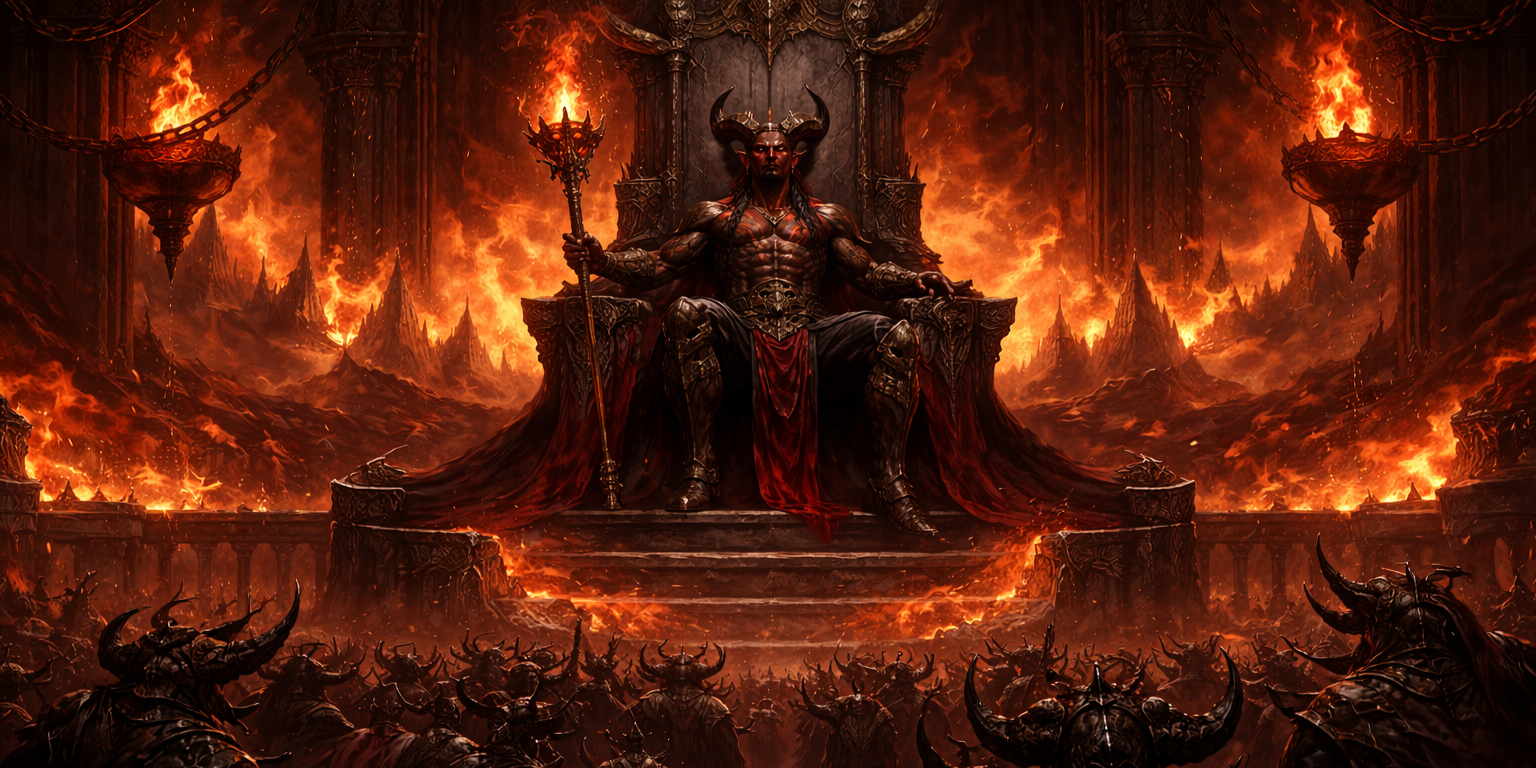
Asmodeus is the First Devil and, in the current era of Tanaria, a being who functions as a god of the lower planes. Though his origins lie within demonkind and the infernal hierarchy, he has long since transcended the limitations of devilhood. Asmodeus is no longer merely a ruler within the Lower Planes. He is the architect of infernal order itself, a force whose influence is embedded into the systems that govern devils, contracts, and damnation.
Asmodeus does not rule through direct command. He rules through structure. The laws that bind devils, the hierarchies that elevate or destroy them, and the infernal mechanisms that govern contracts, punishment, and promotion all trace back to frameworks he established. Even devils who despise or oppose him operate within systems he defined. In this way, Asmodeus’s authority is absolute without being overt.
Divine Domains
Asmodeus’s divine domains reflect his role as a god sovereign of order, control, and enforced consequence rather than a traditional patron of faith. These domains are not benevolent aspects to be invoked lightly. Each represents a facet of reality he believes must be governed absolutely.
Order is his primary domain. Asmodeus embodies imposed structure, hierarchy, and law without mercy. This is not harmony or balance, but rigid organization enforced through authority and punishment. Under this domain, chaos is a flaw to be corrected, not tolerated.
Contracts represent his mastery over binding words and agreements. Oaths, bargains, pacts, and legal obligations fall under his dominion, especially those sealed with consequence. This domain governs consent under pressure, loopholes, and the permanence of spoken or written obligation.
Tyranny reflects his belief that control is necessary and justified when wielded by the “right” authority. This domain encompasses domination, subjugation, and the enforcement of obedience. It is power exercised without apology, justified by outcome rather than morality.
Punishment governs consequence, suffering, and retribution. Asmodeus does not believe punishment exists to reform, but to reinforce structure and deter defiance. Pain, whether physical or metaphysical, is a tool of order within this domain.
Knowledge (Secrets) is the domain through which Asmodeus claims leverage over others. Hidden truths, forbidden lore, true names, and confidential dealings fall under his influence. Knowledge is not enlightenment to him, but ownership.
Ambition represents the drive to rise, dominate, and surpass others. Asmodeus encourages ambition in his followers and devils alike, but only within hierarchy. This domain rewards those who strive while ensuring they remain controllable.
Together, these domains define Asmodeus not as a god of worship, but as a god of inevitability. He does not offer comfort, redemption, or hope. He offers structure, consequence, and the certainty that every action will be accounted for.
Artifacts
The First Contract
The First Contract is the foundational document of infernal law, written in primordial Infernal and sealed before the rise of the current cosmic order. It is not a single sheet, but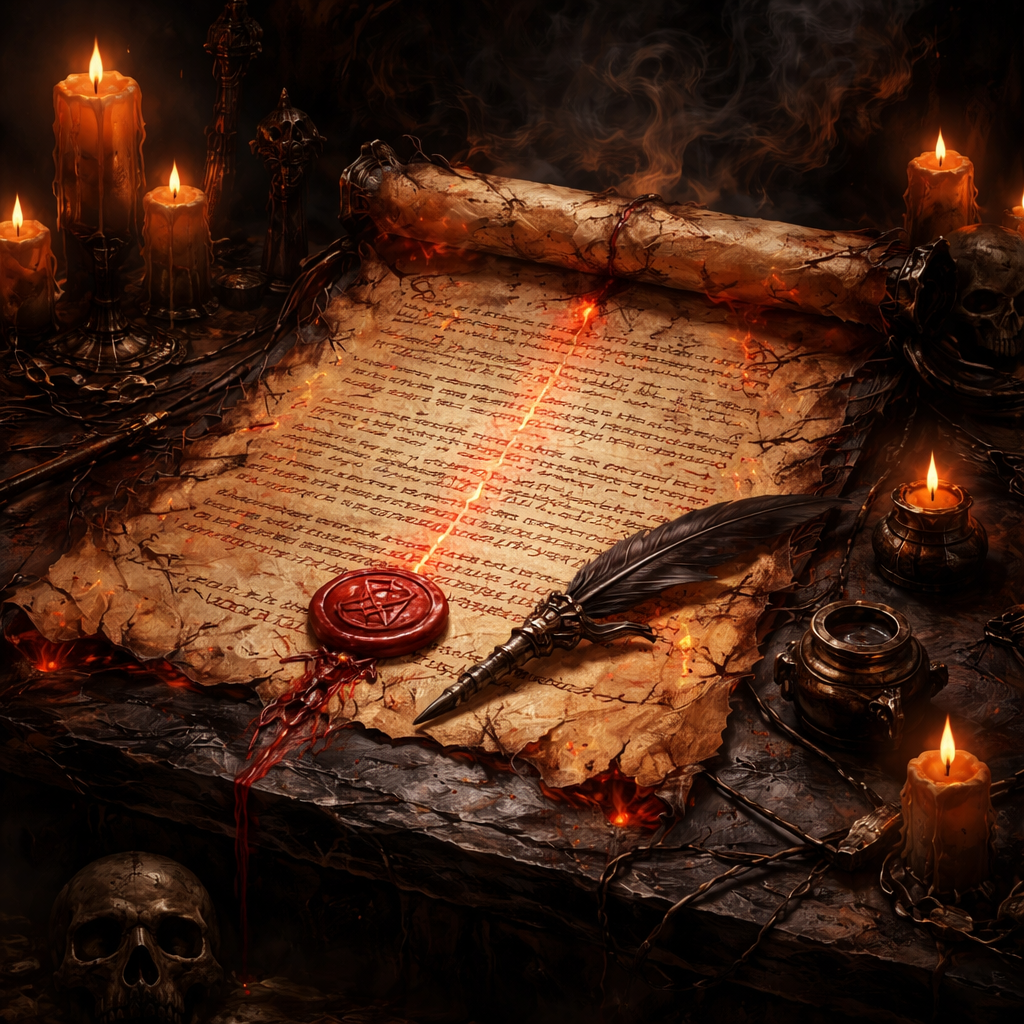
The Ruby Sceptre of Dominion
This sceptre is the visible symbol of Asmodeus’s authority over devils and the infernal hierarchy. Forged from condensed hellfire and crystallized sin, it is said to respond only to his will. When wielded, it allows Asmodeus to impose absolute command over lesser devils, override existing hierarchies, and rewrite infernal jurisdiction. The sceptre does not compel obedience through force, but through enforced recognition of rank. Those who see it instinctively understand where they stand.The Ledger of Souls
The Ledger of Souls is an ever-expanding record that catalogs souls bound to infernal claim, whether through contract, damnation, or inherited obligation. Each entry records not only the soul’s identity, but the exact circumstances of its binding, the clauses that govern it, and the conditions under which it may be reassigned, punished, or elevated. The ledger is said to exist simultaneously in multiple infernal vaults, yet remains singular in truth. Destroying a copy does nothing. Only Asmodeus can alter the original record.The Crown of the First Law
Rarely seen and almost never described consistently, the Crown of the First Law is believed to be a conceptual artifact rather than a physical one. When worn, it enforces Asmodeus’s authority not through presence, but through inevitability. Decisions made under the Crown’s influence cannot be undone without catastrophic consequence. Some theologians argue that Asmodeus no longer wears the crown, having internalized its function, while others claim it rests unseen, fused to his essence.The Chains of Accordance
These infernal chains are not used for imprisonment in the mortal sense. Instead, they bind concepts: rebellion, dissent, autonomy. When deployed, they do not restrain the body, but the capacity to resist. Entire legions have been subdued by their presence alone. The Chains of Accordance are often lent to high devils or agents of the Church of Asmodeus during moments of existential threat, though never permanently. Anything bound by them is considered legally and metaphysically subdued.Tenets of Faith
- Order Above All – The universe is chaos without hierarchy. Law, structure, and enforced order are the only means by which reality can endure.
- Authority Is Proof of Worth – Power is not immoral; it is earned. Those who rule do so because they are capable. Those who obey exist to serve a greater design.
- Contracts Are Sacred – A bargain freely entered is inviolable. Words bind reality itself, and to break an oath is to declare oneself unfit for existence.
- Suffering Is a Tool, Not a Sin – Pain refines, disciplines, and reveals weakness. Mercy without purpose is indulgence; cruelty with intent is governance.
- Ambition Is Encouraged, Disobedience Is Not – Striving upward is admirable, but only within the established hierarchy. Rebellion without sanction is treason.
- Knowledge Is Dominion – Secrets are leverage. To know another’s truth is to hold power over them, and ignorance is the greatest failing.
- Perfection Requires Control – Freedom breeds decay. A flawless reality demands oversight, correction, and the will to impose one vision upon many.
- Asmodeus Is the Final Arbiter – All laws flow from him, all judgments end with him. His will is not questioned, only interpreted.
Divine Goals & Aspirations
Asmodeus presents himself as the ultimate architect of order through domination. His openly acknowledged goal is the establishment of a flawless, absolute hierarchy in which every being has a defined role, function, and limit. To his followers and institutions, he is the guarantor of stability, law, and inevitability. He teaches that suffering is not cruelty but correction, that pain is the necessary force by which chaos is refined into usefulness. In this framing, tyranny is not a flaw but a virtue. The multiverse, left to freedom, is wasteful and disordered. Under his rule, it would be efficient, predictable, and eternal.
He openly seeks the expansion of infernal influence through contracts, institutions, and long-term corruption rather than open conquest. Mortal empires collapsing into authoritarian regimes, legal systems that prioritize punishment over justice, and religions that emphasize obedience over morality all serve his visible agenda. Asmodeus wants souls, yes, but more importantly he wants systems—bureaucracies, hierarchies, and chains of authority that continue functioning even when no one remembers who built them.
To outsiders, his stated ambition stops at rulership of Hell and the preservation of a rigid cosmic balance where evil is controlled, disciplined, and weaponized rather than allowed to fester chaotically like the Abyss.
In truth, Asmodeus does not seek balance at all. He seeks total dominion over reality itself.
His ultimate, concealed objective is the subjugation of all planes into a single, unified hierarchy with himself at its apex. Heaven, Chaos, Nature, and even Death are, in his mind, inefficiencies—separate authorities competing for influence when there should only be one will. The infernal hierarchy is not the end goal but the prototype. Hell is his proof of concept.
He hoards secrets not merely for leverage, but because knowledge is ownership. To know another being completely is, to Asmodeus, to possess them. Every confession extracted under torture, every contract signed in desperation, every hidden sin whispered in prayer tightens his grip on the multiverse’s invisible foundations. He is patient enough to let centuries pass if it means a stronger hold later.
Asmodeus genuinely believes that only he is capable of ruling reality without destroying it. His arrogance is absolute, but not baseless. He has survived divine wars, celestial purges, and conspiracies that would have annihilated lesser gods. He views the forces of Good as sentimental and weak, Chaos as offensively wasteful, and rival evils as short-sighted brutes. Even other archdevils are, to him, tools or temporary administrators at best.
His deepest secret is this: he does not merely want obedience. He wants agreement. He wants the universe to reach a point where resistance to his rule is no longer conceivable—where beings do not obey him out of fear, but because they accept that no other order could possibly be better.
That is the true endgame. Not conquest. Not damnation.
Consent born from inevitability.
Consent born from inevitability.
Physical Description
Body Features
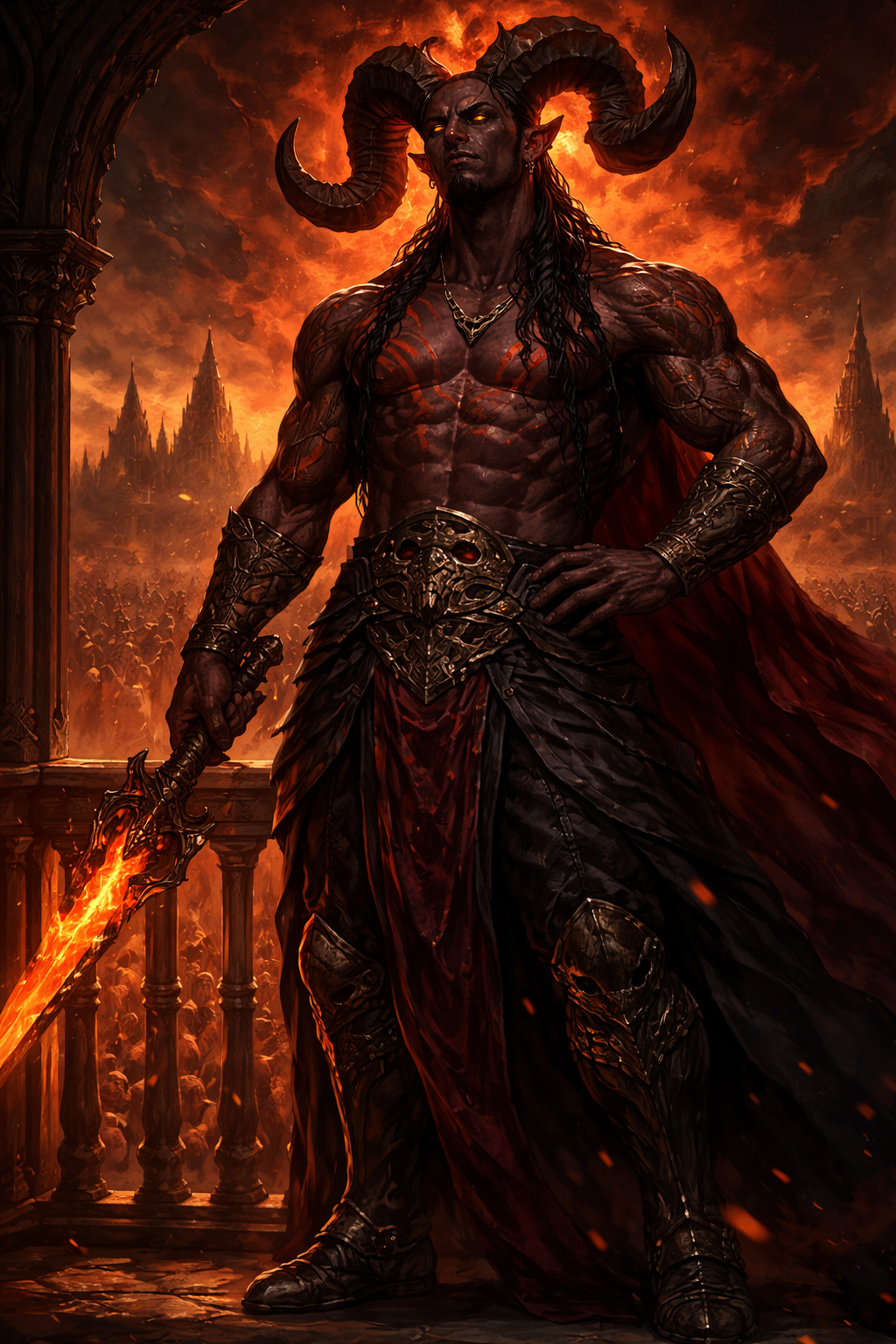
Asmodeus possesses a tall, imposing humanoid form designed to dominate space and attention without overt aggression. His physique is powerful and dense, built for endurance and control rather than exaggerated bulk. Broad shoulders, a reinforced spine, and an unnaturally steady posture give the impression of a being who does not tire, falter, or need to rush. Even when motionless, his presence exerts a subtle pressure, as though the air itself acknowledges his authority.
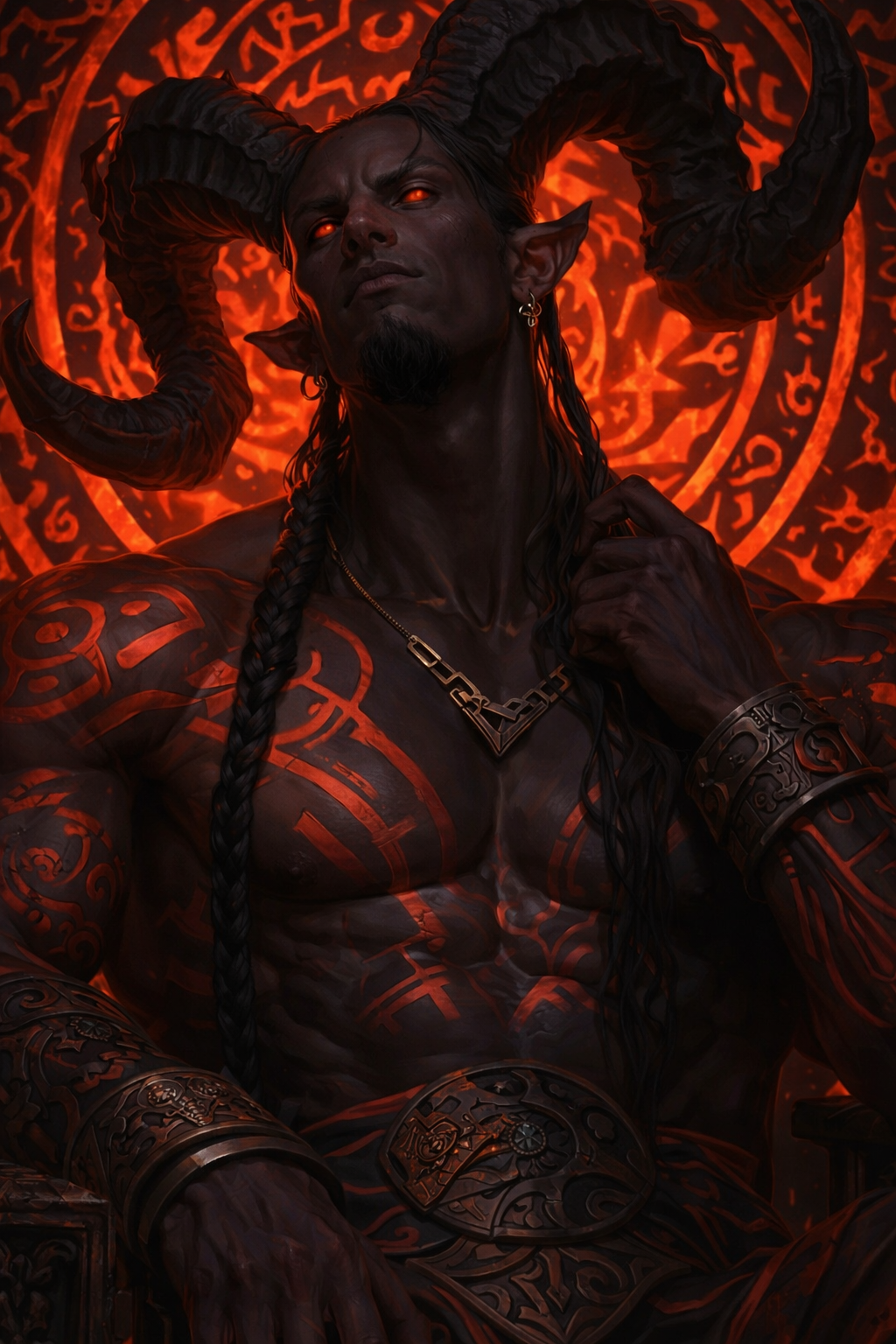
His skin is thick and resilient, resistant to heat, flame, and infernal energies, with tones ranging from deep obsidian to dark crimson depending on manifestation. Infernal sigils lie beneath the surface, not carved or tattooed, but integrated into his very flesh. These markings remain invisible until he exerts power, at which point they glow faintly, tracing lines of authority rather than decoration. When wounded, his blood does not spill freely. It smolders, evaporates, or burns away, reinforcing the sense that his body is more construct than flesh.
Asmodeus’s head and facial features are sharply defined and deliberately refined. His horns rise from the crown or temples in symmetrical, controlled arcs, shaped more like regalia than natural growths. His eyes lack visible sclera, appearing as solid ember-red or molten gold, their intensity increasing with emotional engagement or exerted authority. His hair is jet black, worn long and bound or braided, resistant to heat and fire, and maintained with deliberate precision.
His hands are large and expressive, fingers elongated and tipped with hardened, claw-like nails capable of delicate manipulation as easily as violence. A long, controlled tail is present in most manifestations, used for balance and subtle emphasis rather than bestial movement. Wings are optional and appear only when necessary. When manifested, they are vast and batlike, with scorched, leathery membranes that radiate heat and authority rather than chaos. In every aspect, Asmodeus’s body reflects intention, dominance, and inevitability rather than monstrosity.
Mental characteristics
Personal history
Asmodeus was not born a devil in the conventional sense. He was born a consequence.
His origin lies in the tragic union between Umboros, Titan of the Underworld, and the mortal soul Lysara, whose ambition and deceit pierced the solemn order of death itself. Umboros, whose duty was to shepherd and judge souls with impartial compassion, was manipulated by Lysara’s feigned vulnerability and hunger for transcendence. In granting her power and favor, Umboros violated his own cosmic restraint, and from that breach Asmodeus was conceived.
From Umboros, Asmodeus inherited dominion over death, judgment, and the metaphysical infrastructure of the afterlife. From Lysara, he inherited ambition, cunning, and an instinctive understanding of manipulation. Where Umboros sought balance and redemption, Asmodeus perceived inefficiency. Where his father honored the sanctity of souls, Asmodeus saw resources, leverage, and hierarchy.
As Asmodeus matured, his nature diverged rapidly from that of any known fiend or god. He did not embody raw chaos or mindless cruelty. Instead, he embodied systematized oppression. He believed suffering was not merely inevitable, but useful. Through discipline, fear, and absolute authority, souls could be refined, broken, or repurposed. This philosophy led him to seize control of the corrupted lower reaches of the afterlife and reshape them into the Nine Hells, a realm governed not by entropy, but by law, punishment, and infernal order.
This act marked Asmodeus’ ascension beyond devilkind. Though he became the first and greatest of devils, he was no longer merely one of them. He bound lesser devils and demons into a rigid hierarchy, elevating those who demonstrated loyalty, ambition, and strategic cruelty. Through contracts, true names, and infernal law, he created a system in which advancement required intellect as much as brutality. In doing so, he positioned himself as both ruler and arbiter of all infernal power.
Umboros did not destroy his son.
Whether out of guilt, love, or cosmic necessity, Umboros allowed Asmodeus to rule the Nine Hells, recognizing that the containment of corruption within a structured realm was preferable to its unchecked spread. This decision permanently altered the cosmology of Tanaria. The Nine Hells became a final destination for the most malevolent souls, and Asmodeus became their eternal warden.
In the current age, Asmodeus is widely regarded as more god than devil. He is worshipped, feared, bargained with, and studied. His influence extends far beyond the Lower Planes, touching mortal empires through infernal contracts, cults, and whispered promises of power. Unlike the other devil lords, whose authority is delegated and conditional, Asmodeus’ rule is absolute. He does not merely command the infernal hierarchy. He defines it.
Where Umboros guards the balance of death, Asmodeus exploits it.
And where devils rule through terror, Asmodeus rules through inevitability.
Intellectual Characteristics
Asmodeus possesses an intellect that far exceeds mortal comprehension and rivals that of the elder gods. His mind is relentlessly analytical, built for long-term strategy rather than impulse, capable of tracking centuries-spanning plans with flawless precision. He processes information hierarchically, instinctively sorting knowledge by utility, leverage, and consequence, which makes him exceptionally difficult to deceive. Even truths offered freely are examined for hidden cost or future advantage.
 He is a master of infernal law, contracts, and metaphysical loopholes, understanding not only the letter of binding magic but its spiritual and cosmic ramifications. This allows him to construct agreements that remain enforceable across planes, incarnations, and altered states of being. His memory is eidetic and effectively infinite, retaining names, debts, slights, and favors with equal clarity. Nothing is ever forgotten, only deprioritized.
Unlike many devils, Asmodeus is capable of genuine innovation. He does not merely refine existing infernal systems but redesigns them when they no longer serve his vision. His intelligence is paired with patience; he is willing to lose battles, domains, or even avatars if the outcome advances his ultimate objectives. Mortals often mistake this restraint for mercy or arrogance, when in truth it is calculated inevitability.
Crucially, Asmodeus understands mortal psychology as well as divine mechanics. He excels at predicting behavior, exploiting cognitive bias, and shaping belief systems over generations. To him, knowledge is not power in isolation—it is only valuable when it can be applied, weaponized, or traded.
He is a master of infernal law, contracts, and metaphysical loopholes, understanding not only the letter of binding magic but its spiritual and cosmic ramifications. This allows him to construct agreements that remain enforceable across planes, incarnations, and altered states of being. His memory is eidetic and effectively infinite, retaining names, debts, slights, and favors with equal clarity. Nothing is ever forgotten, only deprioritized.
Unlike many devils, Asmodeus is capable of genuine innovation. He does not merely refine existing infernal systems but redesigns them when they no longer serve his vision. His intelligence is paired with patience; he is willing to lose battles, domains, or even avatars if the outcome advances his ultimate objectives. Mortals often mistake this restraint for mercy or arrogance, when in truth it is calculated inevitability.
Crucially, Asmodeus understands mortal psychology as well as divine mechanics. He excels at predicting behavior, exploiting cognitive bias, and shaping belief systems over generations. To him, knowledge is not power in isolation—it is only valuable when it can be applied, weaponized, or traded.
Morality & Philosophy
Asmodeus does not perceive morality as a spectrum of good and evil, but as a question of order versus inefficiency. To him, suffering is not inherently wrong, nor is kindness inherently virtuous. What matters is whether an action reinforces structure, hierarchy, and inevitability. Chaos is the only true sin, not because it is cruel, but because it wastes potential and undermines control.
He believes that all beings desire order, even if they resist it. Fear, law, and consequence are simply tools that force this truth to the surface. In Asmodeus’s philosophy, freedom is not a right but a temporary condition granted to those who can wield it without destabilizing the system. Those who cannot are better served by subjugation, where their role is clearly defined and their failures carry predictable cost.
Asmodeus views himself not as a tyrant, but as a necessary corrective force. He considers his rule more honest than that of many gods, who preach mercy while allowing suffering through inaction or contradiction. In contrast, his systems are explicit. Contracts state their price. Punishments are earned. Rewards are exact. If cruelty exists within his domain, it is because it was chosen, accepted, or failed to be avoided.
He has little interest in redemption as mortals understand it. Change is possible, but only through submission to order and the acceptance of consequence. Forgiveness without cost is meaningless to him. Every debt must be paid, every failure answered, and every promise fulfilled. In this way, Asmodeus does not see himself as evil. He sees himself as inevitable.
To Asmodeus, the universe will either be ordered—or it will break itself trying to avoid that truth.
Personality Characteristics
Motivation
In truth, Asmodeus is driven by an insatiable need for absolute dominion. He is not merely an architect of order, but a tyrant who believes control is both his right and his responsibility. Power is not a means to an end for him. It is the end. Every system he builds, every contract he enforces, and every hierarchy he refines exists to extend his authority over as much of reality as possible. To Asmodeus, anything less than total control is instability waiting to happen.
He genuinely believes that his rule is the best possible outcome for the multiverse. In his vision, a pristine and perfect reality exists only under his governance, where every being has a defined role, every action has consequence, and no will exists outside the structure he imposes. Freedom, in his eyes, is a dangerous illusion that leads only to inefficiency, rebellion, and decay. Order enforced by fear, punishment, and inevitability is, to him, not cruelty but clarity.
Torture is one of Asmodeus’s favored tools, not out of sadism, but utility. Breaking the wills of others allows him to overwrite their purpose with his own. Equally valuable to him is knowledge. Secrets, leverage, hidden truths, and unspoken dealings are weapons he hoards obsessively. To know someone fully is to own them, and Asmodeus prefers domination achieved through understanding rather than brute force alone. A subject who believes their submission is inevitable is more valuable than one who resists openly.
Asmodeus admires ambition, but only in others insofar as it mirrors his own. He elevates those who strive, scheme, and hunger for power, yet he never truly believes them his equals. In his mind, only he possesses the strength, insight, and charisma necessary to guide existence toward its “ideal” state. His rivals, whether devils, gods, or cosmic entities, are inferior minds, incapable of seeing the full scope of his vision or executing it without collapsing into chaos.
The Abyss is anathema to him. Its anarchic forces represent everything he despises: uncontained destruction, power without structure, and ambition without discipline. To Asmodeus, the very existence of the Abyss is a direct threat to his supremacy and a blemish on the concept of evil itself. Conversely, the forces of good disgust him in a different way. He views them as sentimental, weak, and self-deceptive, clinging to mercy and idealism while refusing to do what must be done to impose lasting order.
What makes Asmodeus truly dangerous is that his arrogance is justified. He has survived conspiracies, divine opposition, infernal rebellion, and even the scrutiny of Heaven itself through intellect, manipulation, and flawless long-term planning. His confidence is not hollow pride, but the certainty of a being who has repeatedly proven that the universe bends more easily to his will than to anyone else’s.
In the end, Asmodeus does not seek to rule the multiverse out of spite or madness. He seeks to rule it because he believes no one else is capable.
Social
Speech
Asmodeus speaks with measured precision and absolute confidence, never raising his voice unless doing so serves a deliberate purpose. His tone is calm, controlled, and authoritative, conveying inevitability rather than threat. Every word is chosen carefully, stripped of excess, and delivered with the assumption that it will be obeyed. Even when addressing enemies, his speech lacks haste or anger, reinforcing the sense that resistance has already been accounted for.
He favors formal, declarative language, often framing statements as conclusions rather than arguments. Questions, when he asks them, are rhetorical or diagnostic, designed to expose weakness, uncertainty, or false assumptions in the listener. Asmodeus rarely issues direct commands unless he possesses unquestioned authority. Instead, he presents options that all lead to outcomes favorable to him, allowing others to believe they are choosing freely.
Silence is an intentional part of his speech. Pauses are used to apply pressure, force reflection, or allow fear to grow. When he speaks after a silence, his words carry greater weight, as though reality itself has been waiting for clarification. He never interrupts, preferring to let others reveal their ignorance, ambition, or desperation before responding.
When speaking Infernal, his voice resonates with binding force, each syllable carrying metaphysical authority. In mortal tongues, his speech remains smooth and intelligible, often tailored subtly to the listener’s culture and expectations. Regardless of language, the effect is the same: those who hear him feel as though the conversation has already been decided, and they are merely catching up to the conclusion
Divine Classification
Deity
Current Location
Species
Realm
Church/Cult
Honorary & Occupational Titles
The Infernal Sovereign, The First Devil, Prince of Dominion, Lord of Contracts, Keeper of the First Law, The Crowned Serpent, The Red King, Architect of Damnation, Warden of the Nine Hells, Master of Binding Words, He Who Writes the Final Clause, The Law Below, Tyrant of the Lower Planes, God-Devil of Order and Consequence
Children
Pronouns
He/Him
Presentation
Masculine
Eyes
Jet black, worn long and braided or bound
Hair
Jet black, worn long and braided or bound
Skin Tone/Pigmentation
Ranging from deep obsidian to dark crimson, often matte rather than glossy
Height
Approximately 7 ft (213 cm) in his preferred form
Weight
Roughly 280–320 lbs (127–145 kg)
Quotes & Catchphrases
- “Order is not cruelty. It is mercy without illusion.”
- “Every soul desires a master. Most simply lie about it.”
- “Kneel willingly, or stand briefly.”
- “I do not need your faith. Your compliance is sufficient.”


Yesss. Yessss!
I tried very hard to make him familiar, but different. Glad you like!
"Every story is a thread, and together we weave worlds."
The Origin of Tanaria