Soldier OCC
Soldier
Soldiers are professional fighters who are part of a large military force. Being the instruments of war (defensive or offensive), the majority of their skills and training are directed toward developing weapon proficiencies, hand to hand combat, scaling walls, laying siege to fortified strongholds, military procedure and operating as part of a combat group.
Hand to hand training focuses on inflicting lethal damage to one's opponent as quickly and accurately as possible. Attacks are frequently aimed at where they'll do the most harm in an attempt to quickly kill, cripple or incapacitate an opponent, so the soldier can move forward and engage his next target - one does not have to kill every opponent to win a battle.
Likewise, soldiers are taught to fight toward a specific objective. This is typically a position/location of strategic advantage or importance, as well as an opportunity to target and eliminate enemy commanding officers.
Capturing or killing an enemy army ' s leader(s) will usually cause the troops to become confused, break ranks, and lose their will to fight. Military life can be restrictive, repetitive and petty. The soldier is required to account for his actions, obey orders, and show respect toward his military superiors.
Typically, the soldier cannot pick or decline an assignment, or the location where he is to be stationed. Nor can he pick his commanding officer or fellow teammates. He is told what to do, how to do it, and where to go. He must obey orders, his superiors and military law or be punished. Punishment can include reduction in rank and responsibilities, assignment to the worst (or most dangerous) posts and missions, imprisonment, execution, and/or dishonorable discharge from service.
The soldier is expected to obey orders without question or hesitation and follow the chain of command. The soldier is usually under the direct command of a squad or platoon leader, often a knight or an experienced field soldier. The squad leader (and those under his charge) answers to his company commander, and all other officers of superior rank.
The ultimate Commander and Chief of such troops will be the King, Chieftain, High Council, or other head of State. In many instances, wealthy nobles, royalty, merchants and powerful practitioners of magic may also build, supply and command small armies; this is especially true of royalty (Barons, Dukes, etc.).
It is the king, kingdom or other power who has commissioned the army who is responsible for training the troops, keeping them supplied and well maintained. The soldier player character will serve a particular King, Kingdom, country, or organization, to whom he has pledged an oath of loyalty and allegiance.
Most soldiers are patriots, loyal to king and country, and gladly serve to protect their homeland and defend the honor of their king. Under the best circumstances, the soldier serves a king or master who is just and noble; a supreme leader who cares about his troops and subjects. Unfortunately, all too often the soldier is little more than a pawn or cannon fodder with whom the king or master has little compassion. Soldiers and war are often a means to an end, whether it be a show of power, intimidation, peacekeeping or conquest. Thus, it is the ruler of the land who will determine the duties and goals of his army and all who serve in it.
An army may be committed to the defense of a kingdom, its borders, people, property, holdings/outposts, crown and honor, or aggression , in which case the soldiers are part of a military campaign of conquest and expansion. The troops may be located in their homeland or sent on campaigns in distant lands. In both cases, military assignments may include reconnaissance, infiltration and spying, exploration, investigation, communications (message delivery), seek and destroy missions, sabotage, defending strategic positions, maintaining outposts, keeping the peace, supervising slave operations, protecting supply lines, and so on.
--
Assignments which afford the most freedom and informalities are reconnaissance patrols, espionage missions (seek and destroy, sabotage, spying, etc .), law enforcement, and duty at border towns in the wilderness. Outposts in remote regions often require a journey that spans weeks or even months of travel over hostile enemy territory, so communication is minimal and the troops are expected to be self-sufficient. These posts are usually more relaxed and informal because they are far away from the prying eyes of a high command, kings, nobility, and even the average civilian.
Furthermore, many are regarded as low priority, or in so hostile a situation that normal protocol is not expected or overlooked. In many cases, the town, outpost, or surrounding territory is under marshal law, so the soldiers are the law. Guidance from a strong commander can mean a strong, disciplined, organized and well behaved armed force whose troops enjoy extra personal freedoms for their cooperation and dedication. Under weak or corrupt leadership, a garrison might become sloppy and careless, or corrupt, and exert little effort to enforce the law or their duty.
Others can become petty tyrants that exploit and abuse the people they are assigned to protect. Such outposts as the latter may consider themselves to be "above the law" and may engage in acts of brutality and cruelty. Outposts in remote regions and hostile war zones can often escape with such reprehensible behavior for months, even years. G.M. Note: Non-military player characters can be associated with an army and included in a military based game campaign by having them hired as freelance military scouts, mercenaries, advisors, assistants and laborers: including cooks, repair men, healers, translators, etc. These characters would be given a small but reasonable pay, along with food, water and a place to sleep.
--
The advantages of being a soldier
In addition to getting basic military training, being outfitted with basic equipment, and food in the belly, the soldier is given a modest salary, j ob security, opportunity for advancement, respect (in some cases fear), power and glory.
Furthermore, the character has access to military bases, other resources and, theoretically, the soldier can count on the support of the kingdom and the rest of the military, as well as have the blessings of the Church of the Realm and the respect this all brings with it.
Enlistment and salaries
Soldiers usually sign up for a minimum two year period of enlistment, but many kingdoms require terms of 4-6 years. Reenlistment is usually for a 2-4 year period. Conditions for discharge include poor behavior, lack of obedience, and injury (sorry, no V.A. benefits; if you can't fight in the near future, you're discharged and on your own).
Average Salaries
In addition to basic training, food and supplies.
- Typical soldier: 100-150 gold a month
- Border soldier: 160-200 gold a month.
- Special assignment/hazard pay: An additional 300 to 600 gold per special assignment (always dangerous).
- Cavalry (usually knights, nobles & officers): 300-400 gold a month.
- Long bowman: 300-400 gold a month.
- Officers of low rank: An additional 100 to 300 gold a month.
- Officers of high ranking: An additional 600 to 1000 gold a month.
- Mercenary fighters may also be hired to bolster the number of men in a garrison, or in a battle situation. They are obligated to abide by all military rules, laws, and authority. Room and board is provided under the terms of Mercenary enlistment, with a salary of 150-200 gold a month, plus bonuses for special assignments. Mercenary companies and armies are often given 10% to 20% of the booty as well. The employment of mercenary forces may be from specific job to job, or for a period of 3-6 months. Mercs must provide their own equipment.
--
Soldiers & Armor
Although any type of armor can be used, soldiers usually lean strongly toward heavy armors. This is because their profession is high profile, requires little need for stealth, and calls for maximum physical protection. Characters are -15% to prowl and -20% to climb/scale walls in full splint or plate armor. -10% to prowl or climb in chain or scale mail, and -5% in studded leather.
Soldier O.C.C.
Alignments: Any
Attribute Minimum Requirements: P.S. 10, P.E. 8 or higher, and a desire to fight.
O.C.C. Bonuses: +1 to pull punch, and +1 to save vs horror factor at levels 1, 3, 7, 10 and 13.
--
O.C.C. Skills
- Climb/Scale Walls (+5% )
- Forced March
- Body Building & Weight Lifting
- Languages: Native Tongue at 98% plus one of choice (+10%)
- Military Etiquette (+20%)
- W.P. Shield
- W.P. Two of choice
- Hand to Hand: Basic Hand to hand: basic can be changed to hand to hand: expert for the cost of one "other" skill, or to martial arts or assassin (if evil) for the cost of two "other" skills .
--
O.C.C. Related Skills
Select two additional skills from the category of Military or Espionage, and seven other skills of choice at level one, plus select one additional skill at levels three, six, nine and twelve. All new skills start at level one proficiency.
- Communications: Sign language only (+5%).
- Domestic: Any
- Espionage: Any (+5%)
- Horsemanship: General or Exotic only (+5%)
- Medical: First Aid only (+5%).
- Military: Any (+10%)
- Physical: Any, except Acrobatics.
- Rogue: None
- Science: Mathematics only.
- Scholar/Technical: Any (+5%)
- Weapon Proficiencies: Any
- Wilderness: Carpentry, Land Navigation & Wilderness Survival .
--
Secondary Skills
The character also gets to select four secondary skills from the previous list at levels one, and two at levels four, eight and twelve. These are additional areas of knowledge that do not get the advantage of the bonus listed in the parentheses. All secondary skills start at the base skill level. Also, skills are limited (any, only, none) as previously indicated in the list.
Starting Equipment
Uniform, set of civilian clothing, boots, a pair of gloves, belt, bedroll, backpack, two small sacks, a water skin, two weeks' worth of food rations, and a tinder box.
Armor
Starts with a suit of chain mail (A.R. 14, S.D.C. 44), or studded leather (A.R. 13 , 38 S .D.C. player' s choice.
--
Weapons
Starts with a small shield, a dagger, and two weapons of choice; all are basic S .D.C. weapons of good quality. Special or magic weapons, superior armor, additional equipment, a horse, and other odds and ends may be assigned for special missions. Officers will have one superior weapon (+2 to parry and +4 to damage, or a minor holy weapon), one additional weapon of choice, splint or plate armor and a horse with barding.
--
Money
The character starts with 180 in gold. Additional money will come from salary and hazard pay. Note: Soldiers and buying additional weapons & equipment: Most armies allow the soldier the option of purchasing his own special or superior weapons and armor, provided he returns his military issue equipment to the supply officer and gets permission to make such purchases (usually granted). Almost all towns and cities (even border towns) will have special shops, weapon smiths, and armorers who are subcontracted by the military to provide arms and armor to their soldiers at a 25% discount. The discount may or may not (usually not) apply to mercenaries under military employment.
--
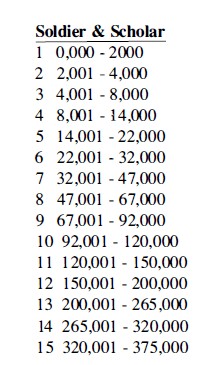
Experience Levels