Knight OCC
Knight
Knights, like soldiers, are given military discipline and trained in the arts of hand to hand combat and swordsmanship.
Unlike the average soldier, knights are usually of royal or noble birth and begin their lessons in combat in early childhood.
In addition to the arts of combat, knights of noble birth are also taught horsemanship (they are excellent horsemen), military strategy and the use of a variety of weapons, as well as scholastic or noble pursuits such as dancing, singing, math, lore and science. About 60% are literate in at least one language and speak at least three.
In many kingdoms, these educated and highly trained soldiers are automatically considered officers (not lower in rank than lieutenant) and given a squad or platoon to lead. Those who prove themselves in battle (or who have great political leverage) may be given a company (typically in the calvary), a battalion, or even a brigade to command.
Those who formally join the king's army typically rise to Captain, Colonel, Brigadier, Major, and even General - all are "lords." Although a knight may be responsible to a sovereign lord, he is generally given much more free rein than the average officer of humble birth - which sometimes causes friction between the nobility and officers who have risen through the ranks (or "earned" their position, as many grumble).
In other cases, the knight serves as a representative or diplomat for his king and kingdom. Many are patriots and defenders of the land, landholders and/or politicians with their own personal interests and holdings at stake. Note: Historically, most knights were landowners or governors over an area of land (farms or villages), so they had a say, and a vested interest, in the affairs of the kingdom.
Knights who were land barons (or the members of a land baron ' s family) were often charged with defending the land they held, keeping peace and order, maintaining production of farmlands or manufacturing, and collecting taxes. They also frequently served as judges, administering justice, punishment and settling disputes, as well as being the regional representative of the people under his jurisdiction.
In the Palladium World, many knights are free agents, wandering the kingdom enforcing laws, righting wrongs, meting out justice, defending the land, and protecting the innocent or those under their charge. Since all knights of noble birth are raised with a strong sense of duty and political protocol, these lone wolves can often operate as independent lords without offending other knights, land barons, the military, or the royal family. However, those who are too outspoken or dare to challenge authority, or defy convention (particularly when the ruler is a despot, tyrant or puppet; or the character hungers for power; or is himself a brigand), may be considered a "rogue" or "black knight."
Such characters are blacklisted from noble society, avoided, publicly chastised, or, in the most extreme cases, his lands are seized, the knight is driven from the kingdom, and declared an outlaw! The legendary knights-errant travel and fight in distant lands, often engaged in a political, religious, or personal quest or military campaigns. Some become self-proclaimed witch or monster hunters, others set out to build a new empire, or amass a fortune, and some are wandering champions of light. Still others suffer from wanderlust.
They enjoy the life of an adventurer, exploring new lands, learning about different people, discovering new things, and fighting evil wherever it is encountered.
--
The Ignoble Knight
Approximately 70% of all knights are of noble or royal heritage. As the sons (few females become knights in the male dominated societies of the Palladium World) of aristocracy, these lords have the benefits of wealth, higher learning and social/political clout. This "birthright" makes them the heirs apparent of the land holdings and royalty, and automatically eligible for knighthood at an early age (often as an indication of rank within society at the age of 16).
However, 30% are ordinary folk, often born of peasant stock. They have been "knighted" as a direct result of acts of patriotism, heroism, courage, valor, and honor in defending king or country. Many a bold, young warrior dreams of someday becoming an ignoble knight. Such spirited fighters try to emulate the noble knights and practice the arts of the sword, lance, and horsemanship, as well as follow the Code of Chivalry.
In many instances, these knight-wannabees are more dedicated to justice, honor and The Code, than many of the pampered and spoiled knights of noble birth.
A warrior who is truly dedicated to the Code of Chivalry and trained in the ways of the knight, can call himself a knight (and select this O.C.C.), but is not a "true" knight until he or she is formally knighted by a Sovereign Ruler or a high ranking member of clergy from the Church of the Realm.
All true knights bear the heraldic colors of his own family and the king, or kingdom. A new knight of ignoble birth will have to create his own family crest.
Knights & Armor
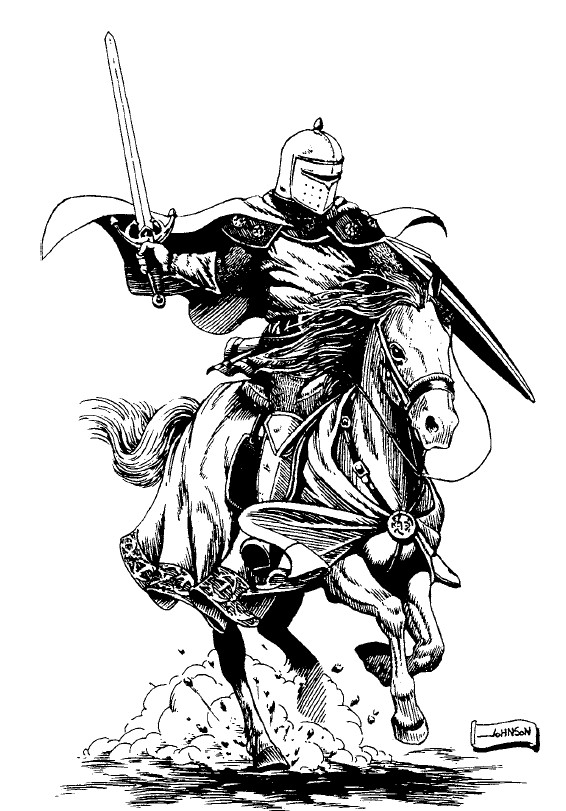
A knight can wear any type of armor, but usually prefers the heavy armor types, including double chain mail, scale mail, and full suits of splint or plate armor. Specifically trained in the use of these armors, they experience minimal restrictions of movement. Knights and Palladins are -10% to prowl and -15% to climb/scale walls in full splint or plate armor. -5% to prowl or climb in chain or scale mail. No penalties while on horseback.
Special Knight Training & Mastery
1. The Way of the Horse
Horsemanship: Knight, see that skill description for full details regarding the knight's riding prowess, combat bonuses while on horseback, and knowledge about horses. Knights are excellent horsemen, able to make jumps, perform tricks and make special maneuvers on horseback even in full plate armor!
2. The Way of the Lance
The knight is skilled in the use of the lance as a weapon in combat and for tournaments.
The knight gets the equivalent of W.P. Lance with the following abilities and bonuses: The roll of a "natural" 20 (unmodified die roll) means the lance strike inflicts triple damage (instead of double; an otherwise successful strike does normal damage, including bonuses for being on horseback), or the strike can be used to unseat his opponent.
An opponent may also be unseated with a modified strike roll that is 20 or greater. Opponents knocked from horseback take 1D6 damage from the lance, are knocked off their horse and take an additional 1D6 damage unless they successfully roll with impact/fall. The fallen rider also loses initiative and one melee action/attack.
An opponent who is not on horseback, but standing on the ground can be similarly knocked off his feet and on his backside with the same result, except no additional damage from the fall. The player must announce his character's intention as to whether he intends to inflict damage or unseat his opponent.
3. Other O.C.C. Bonuses
+1 on initiative, +2 to pull punch, and +1 to save v s horror factor at levels 1, 3, 6, 8, 10 and 12.
Knight Family Background
The knight is a warrior with unsurpassed skills in hand to hand combat. In addition to their fighting skills they are also required to learn domestic related skills. The worth of a warrior is measured not only by his fighting ability but also by his skills in the gentler arts. Note : Make a random roll (fun) or select one of the following. Then select corresponding skills as described in the next table.
01-10 Old nobility; a member of the ruling class dating back 1D6x100 years. The family is well known and is either a major political force or a major landowner.
11-15 A member of an old and respected family with a long line of valiant knights, warriors and noble patriots. Minor landowners with a farming or military background.
16-20 A member of new nobility and wealthy landowners with a background in farming and raising cattle. This family is quickly making a name for itself.
21-25 A member of a noble family and minor landowners with a background in farming.
26-40 A mere peasant (farmer or laborer) who took up arms and proved to have the soul of a warrior born. Family is considered noble farmers who have earned a tiny portion of land. This ignoble knight may be looked down upon by arrogant aristocrats, while others look upon him with great respect because he is living proof that nobility and honor are not a birthright but a virtue that can be acquired from any station in life.
41-47 A member of an old family of noble lineage with a military background.
48-54 A member of an old family of noble lineage with a scholastic background; teachers, scholars, historians, arts and entertainment, etc.
55-62 A member of the new nobility with a background as a business owner.
63-69 A member of the new nobility with a political background; wealthy landowners.
70-77 A member of the new nobility with a strong religious background; priests, monks and champions of light associated with gods, clergy or religious organizations are part of the family. May be an ardent follower of Dragonwright (or other religion or god) .
78-84 A member of an old family with a background in science and/or magic.
85-00 A new knight! A warrior who has risen through the ranks to prove himself a noble and honorable warrior from humble beginnings. Family background includes farmers, fishermen, trappers, laborers, or craftsmen.
--
Family Skills
Note: Select three skills from the categories listed, in addition to O.C.C. skills; all get a +10% bonus.
Old nobility/ruling class/administrators: Make selections from communications , military and/or technical categories.
Minor landowner, farmer, laborer, peasant: Make selections from wilderness or physical categories, or may select botany and two skills from the previously listed categories.
Wealthy landowner and farmer or breeder of livestock: Make selections from math and botany from the science category and/or any from the technical or domestic categories.
Military: Make selections from the espionage and/or military categories.
Scholar/teacher/historian: Make selections from the science or technical skill categories.
Business Owner: Make selections from the technical and/or domestic categories.
Politics: Make selections from the communications and/or the domestic categories.
Religious: Make selections from lore, language, and literacy, skills under the technical skill category and/or any from the science category. Science/Magic: Make selections from the science and/or medical categories.
New knight: Make selections from the rogue, physical or weapon proficiency categories.
Knight O.C.C.
Alignments: Any. Knighthood and noble birth is not indicative o f one ' s inner spirit, integrity o r compassion. Thus, there are good and noble knights along with treacherous, dishonorable, and evil knights . Knights of principled, scrupulous, and aberrant (evil) alignments are men of honor and live by the letter of the Code of Chivalry. Unprincipled and anarchist characters will follow the chivalric code most of the time, but bend or forget the rules when it's in their best interest to do so. Diabolic and miscreant characters will blatantly ignore them; they are considered to be men of little or no honor, or respect for others.
Attribute Minimum Requirements: I.Q. 7, P.S. 10, P.E. 1 0, and P.P. 12 or higher.
--
O.C.C. Skills
- Dance (+15%)
- Heraldry (+20%)
- Horsemanship: Knight
- Land Navigation (+10%)
- Languages: Native Tongue at 98% plus two of choice (+15% each)
- Literacy: One language of choice (usually native or elf; +20%)
- Military Etiquette (+15%)
- Mathematics: Basic (+15%)
- W.P. Lance
- W.P. Shield
- W.P. Two of choice
- Hand to Hand: Expert Hand to hand: expert can be changed to hand to hand: martial arts or assassin (if evil) for the cost of one "other" skill.
--
O.C.C. Related Skills
Select two other skills from the Communication skill category and six other skills at level one, plus select one additional skill at levels three, six, nine and twelve. All new skills start at level one proficiency. Don't forget about the three family skills.
- Communications: Any (+10%)
- Domestic: None
- Espionage: Any (+10%)
- Horsemanship: Exotic only (+5%)
- Medical: First Aid only.
- Military: Any (+10%)
- Physical: Any; except Acrobatics and Gymnastics.
- Rogue: None
- Science: Any (+5%)
- Scholar/Technical: Any (+10%)
- Weapon Proficiencies: Any
- Wilderness: Wilderness survival and track/trap animals only.
--
Secondary Skills
The character also gets to select four secondary skills from the previous list at level one, and one additional skill at levels five, ten and fifteen. These are additional areas of knowledge that do not get the advantage of the bonus listed in the parenthesis. All secondary skills start at the base skill level. Also, skills are limited (any, only, none) as previously indicated in the list.
--
Starting Equipment
Two sets of clothing, boots, a pair of gloves, belt, bedroll, backpack, two large sacks, to small sacks, a water skin, and a tinder box. Plus a riding horse of good to excellent quality, probably raised by the knight. The horse has 30+2D6 S .D.C. and 6D6 hit points, running speed 33 , value 1D4x1000 gold!
Armor
Starts with a suit of chain mail (A.R. 14, S.D.C. 44), or scale mail (A.R. 15, 75 S .D.C. player' s choice.
Weapons
Starts with a small shield, a dagger, lance (2D6 damage), sword of choice, and one additional weapon of choice; all are basic S.D.C. weapons of good quality. Any one of the aforementioned weapons can be of exceptional quality (kobold or dwarven), with a bonus of + 1 to strike and parry or +2 to damage. Magic weapons and additional items must be acquired later.
Money
The character starts with 110 in gold, because most of his/her money has been spent on the horse, armor and equipment. Additional money will come from payment, boons, and gifts for services rendered, and from booty . In addition, the knight will have family and other holdings left behind at his homeland (not all over the world).
If the character travels to his homeland he can find 1D4 different family members who can give him a nice place to rest, recover, and live for an indefinite period of time (they may expect some service or help in exchange for an extended stay). During his stay, the character will be fed and his basic needs tended to. Family may also provide the character with a new set of clothing, studded leather armor, a sword, and 3D6x10 in gold. A knight will not wear out his welcome (and G.M.s should not let the character go back home every time he needs a handout).
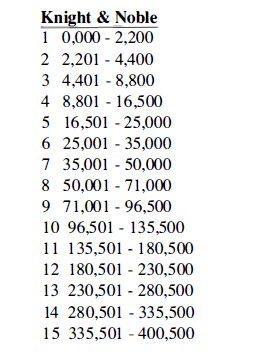
Experience Levels