
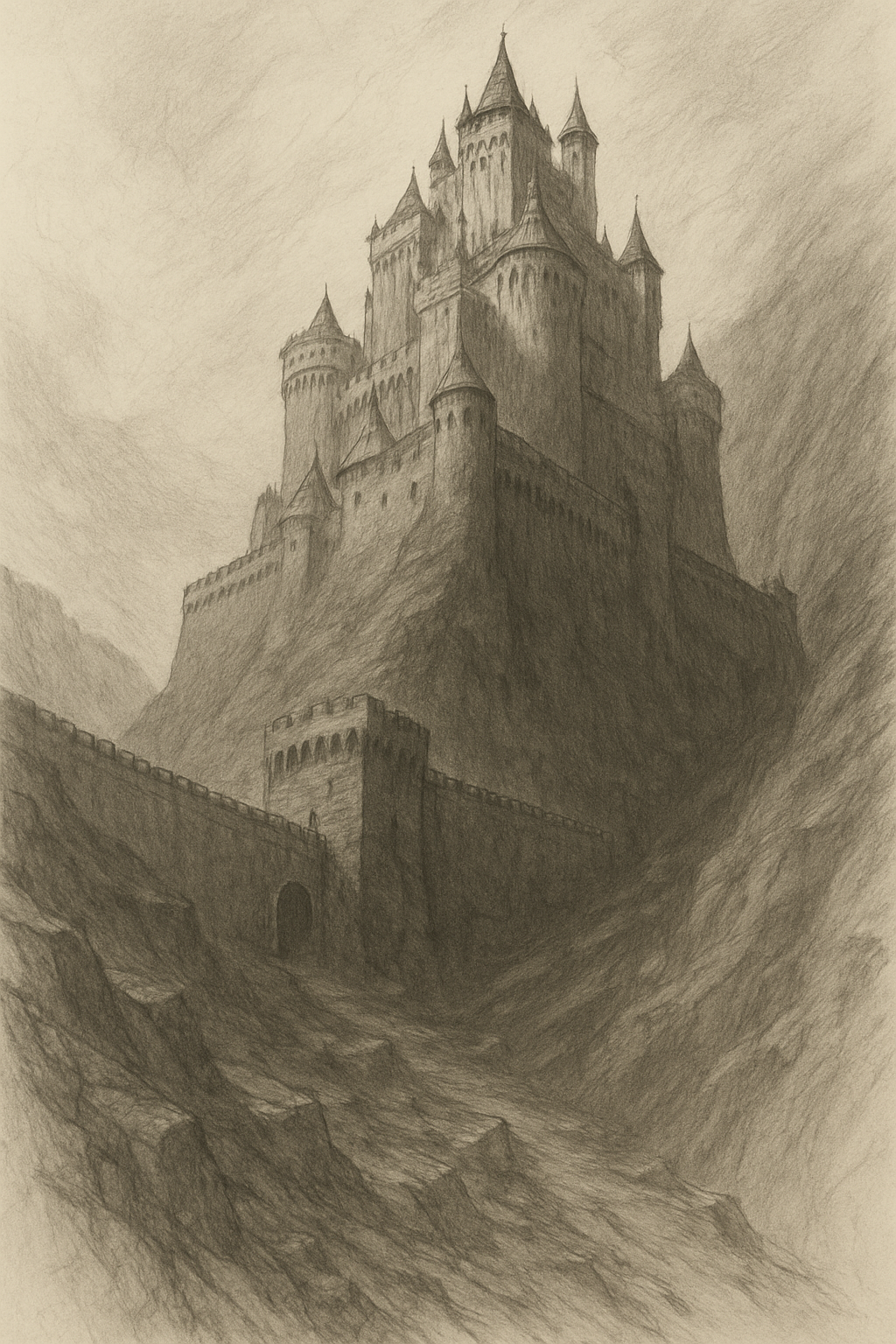
Stonewatch.
General Overview
Stonewatch is a cliff-fortress and former monastic stronghold dedicated to Cothel, Ayla of Stone, situated high in the eastern mountains above the ancient caravan route known as the Old East Road. Founded in 1607, it served for nearly two centuries as the principal guardian of eastbound trade between the inland heartlands and the coastal territories.
The site is renowned for:
- Its strict neutrality toward secular powers.
- Its role in protecting caravans from banditry and rockfall.
- Its distinctive religious numerology centered on the number 19, known as “the Nineteenth Measure.”
By the early 1800s, Stonewatch stood largely abandoned. Survey work for the future East Rail line later used the pass as a reference point, tying the ruin into the modern era’s transportation network.
Location & Geography
Stonewatch occupies a natural shelf and series of ledges carved into the face of a steep mountain along the upper reaches of the Old East Road in eastern Avalon. The site overlooks:
- A narrow, hazardous ascent used historically by caravans and pilgrims.
- A deep valley below, which would later attract engineers and surveyors mapping the alignment of the East Rail and its major bridges.
The fortress is anchored directly into the bedrock, with most interior halls excavated from the mountain itself and exterior platforms projecting outward to command wide views over the road and valley.
Founding & Purpose
- Date Founded: 04/19/1607
- Primary Dedication: Cothel, Ayla of Stone
- Initial Founders: A mixed group of stonemasons, disillusioned soldiers, and pilgrims seeking a life of service to the mountain rather than to any crown.
The founders interpreted a narrowly averted rockslide early in construction—on the nineteenth day of the fourth month—as Cothel’s tacit approval. From that point, “19” became their sacred count and measure.
The Covenant swore three principal vows:
- Guard the Pass – No army, bandit company, or private force would control the Old East Road.
- Keep the Way Open – After storm, snow, or rockfall, the road would be cleared as swiftly as possible.
- Listen to the Mountain – No major work or act of violence would be undertaken without first reading the signs of the stone.
Religious Symbolism & the Number 19
Stonewatch’s worship of Cothel is unusually structured around the number 19, collectively referred to as the Nineteenth Measure.
Key expressions of this numerology include:
- Wall Proportions: The principal curtain walls are described in records as “nineteen courses of stone to the crown,” a symbolic height chosen deliberately rather than purely for defense.
- Brotherhood Size: A fully staffed Stonewatch is said to consist of 19 brothers, a number treated as ideal completeness. When the order fell below this number, chroniclers note the fortress as “under-manned” even when every functional post was technically filled.
- Watch Cycles: Standard assignments for sentries and roadwardens lasted 19 days, after which they rotated to a different station. These rotations were called “Measures.”
- Initiation Rite: A novice seeking to join the Covenant was required to pass 19 consecutive nights within the fortress without descending to the lowlands, concluding with a solitary vigil on the highest walk at the Nineteenth Measure of height.
- Bell Ritual: In times of death or grave disaster, the bell of Stonewatch was tolled precisely 19 times. This practice is consistently recorded in death entries and accounts of major rockfalls.
- Inscription Patterns: The names of the dead in the Hall of Echoes are arranged in columns of 19 names before a dividing line. Several ledgers remark on keeping this layout even when space constraints made it cumbersome.
The Covenant’s symbol, where recorded, is a vertical line (a stylized cliff) marked at its base with three small chisel strokes (the vows), often accompanied discreetly by groupings of nineteen smaller dots, scores, or holes.
Order & Culture
Nature of the Order:
The Stonewatch Covenant blends martial and monastic traditions. Its members are referred to simply as “brothers”, though some records distinguish:
- Brothers of the Wall – those assigned to sentry, patrol, and defensive duties.
- Brothers of the Stone – those trained primarily in masonry, engineering, and road clearing.
- The Prior of Stonewatch – the elected head of the Covenant.
Three Stones Practice:
Every brother carried three symbolic stones:
- Loadstone – a heavy, rough stone representing burden and duty.
- Patience Stone – a smooth, thumb-worn pebble used during periods of silent watch before difficult decisions.
- Memory Stone – a chip taken from the fortress itself at initiation; upon a brother’s death, his Memory Stone was mortared back into the wall.
This practice expressed the belief that no member ever truly left; they were “returned to the mountain.”
Neutrality:
Stonewatch refused formal allegiance to any single lord. Caravans of rival factions were granted equal shelter, and armed companies were required to lay aside disputes while within the pass. At least one recorded incident notes opposing captains confined in separate chambers until they agreed to withdraw their forces from the road entirely.
Role in Trade & Travel
For much of the 17th century, Stonewatch was a critical guardian of eastern commerce:
- The Old East Road carried grain, ore, timber, and finished goods toward the coast.
- Stonewatch maintained watch on the most dangerous segment of the route, offering protection from:
- Bandit companies seeking to extort tolls.
- Rockfalls and avalanches, which the brothers mitigated through regular inspections and controlled removal of unstable stone.
- Severe winter conditions, during which the Covenant hosted stranded caravans and organized escorted crossings.
The site became synonymous with safety on the route; contemporary letters speak of caravans timing their journeys specifically to reach Stonewatch before the onset of the worst snows.
Historical Timeline
1607 – Founding of Stonewatch
On 04/19/1607, the first habitable chambers are completed and the Covenant is formally established. A narrowly missed rockslide during construction is later recorded as the moment Cothel “acknowledged” the site, cementing the number 19 as sacred.
1629 – Winter of the Long Lanterns
A severe early winter closes neighboring passes. The Old East Road remains marginally passable under Stonewatch’s oversight. For much of the season, the slopes below the fortress glow with the lanterns of caravans encamped along the road while brothers guide small groups across in stages. Trade records from inland towns credit this winter’s effort with preventing famine.
1658 – Bandit Siege of Stonewatch
A coordinated bandit force attempts to seize control of the pass to impose private tolls. The Covenant refuses to recognize their authority. After several days of standoff and skirmish, the brothers trigger a deliberately prepared rockfall that collapses the bandit camp and destroys part of the lower approach road. Surviving bandits disperse; their banners are later hung in the Hall of Echoes as a warning.
1691 – Night of the Shifting Wall
Chroniclers describe subtle groaning in the mountain and hairline fractures appearing along key buttresses. Acting on their vow to “listen to the stone,” the brothers halt all crossings and spend the night reinforcing certain segments. A major section of cliff collapses before dawn, but the main road and fortress remain intact. The event becomes a central example in Stonewatch teachings about patience and restraint.
1735 – The Silent Avalanche
Over several days, a slow, grinding slide of rock and compacted snow erodes a lower spur of the Old East Road. Maintaining access to Stonewatch becomes costlier and more dangerous. Around this time, rival powers increasingly finance a lower valley road that bypasses the pass entirely. Caravans begin to favor the new route, and traffic through Stonewatch declines sharply over the coming decades.
1772 – First East Rail Survey at Stonewatch
A small engineering survey party reaches Stonewatch while charting possible alignments for an eastbound rail line. They are hosted according to the Covenant’s usual hospitality. Notes from this team reference the fortress as a valuable vantage point for mapping the surrounding mountains. Some late entries in Stonewatch’s own archive mention “iron roads” and “lines drawn straight across the valley” with a mixture of curiosity and unease.
1796 – The Last Roll Call
Records indicate the Covenant has dwindled to a handful of elderly brothers. The Prior lists fewer than 19 names in the annual roll for the first time in generations and formally declares an end to recruitment. In his final known entry, he writes that the mountain “no longer calls loudly for our voices,” and that the age of caravans is passing.
1804 – Stonewatch Falls Silent
By 1804, travelers report Stonewatch as dark and unstaffed: no bell signals, no watch fires, no visible signs of movement. When a group eventually ascends the old road to investigate, they find the fortress intact but empty, with ledgers neatly closed and several new Memory Stones mortared into the walls—but no bodies. From this point onward, Stonewatch is treated as a deserted relic rather than an active garrison.
Relationship to the East Rail
While the East Rail itself is a later development, Stonewatch’s influence persists:
- Early engineers used Stonewatch Pass as a major reference point for understanding the region’s topography.
- Some survey maps feature the fortress explicitly marked as a “notable elevation” or “stone watchpoint,” and a few retain faint sketched alignments radiating outward from its position.
- Oral accounts among rail workers speak of seeing the ruined fortress above the valley and regarding it as a kind of predecessor—stone guardians watching over the era before iron and steam.
The East Rail’s eventual alignment runs through the valley below, visually linking the modern line with the older, higher route once protected by the Covenant.
Current Status & Legacy
In the present era, Stonewatch stands as a ruin and historical curiosity:
- The Old East Road leading to the pass is seldom used, considered hazardous and unnecessary given safer modern routes.
- The fortress remains structurally present but partially damaged by centuries of weathering and rockfall.
- Local stories portray Stonewatch as both a place of lingering protection and quiet unease:
- Some travelers claim a sense of being watched by the gargoyles and carved faces along the walls.
- Others report that sounds made in the Hall of Echoes carry unnaturally long or return in faint nineteen-beat rhythms, reinforcing the fortress’s association with the Nineteenth Measure.
Despite its abandonment, Stonewatch continues to appear in regional histories and trade records as a symbol of the era when stone, rather than steel, safeguarded the eastern road.

Comments