

Petroleum
"Despite everything, oil remains essential to the functioning of a modern economy. So, what'll happen if, according to oil and gas compagnies themselves, petroleum truly does run out in a decades time. Perhaps, these same corporations will have found a way out of this looming crisis by then. Perhaps, not.Petroleum remains one of the most important energy source in the world of 2096, despite the many setbacks the industry faced in the 21st century. In fact, due to its increasing rarety, oil and natural gas are among some of the most valuable ressources traded around the world, contributing to the massive wealth of some of the largest megacorps in the world.
Trade and Market
The Big Four
By the year 2096, the world's oil market is essentially run by 5 mega-corporations, who each have their own monopolized regions of influence. Together, they control 97% of the world's oil supply, and have a monopoly on its extraction, refinement, and delivery. In order to protect all of these assets as well as their territory, each of these megacorps have their own private armed forces, including not just infantry, but also navies, air forces, and space forces.
Regional Monopolies
Euro-Chem, also known by their official name of "European Petroleum and Chemical corporation, or EPCC, is the largest oil and gas corporation in the world. They are the EFS(European Federal State)'s second largest corporation after Helios Space. They control the markets of Greenland, Nunavut, the Caribbeans, most of Europe, a majority of Africa, and major regions of Antarctica.
The Chinese Petrochemical Corporation, also known as CPC, is the second largest oil and gas corporation in the world. They control the markets of China, Korea, Japan, north-eastern Siberia, parts of India, south-east Asia, Madagascar, Indonesia, Australia, New Zealand, and eastern Antarctica.
Dominion OIl, a large conglomerate based in the Athabascan State, is the third largest oil and gas corporation in the world. They control the markets of most of the Americas, parts of west Africa, and the palmers peninsula, in Antarctica. Recently, the megacorp suffered a great setback as the south-american division split and became an independent corporation,
BrazOil, also known officially as NCPB is a recently created corporation based in Brazil, which split from Dominion Oil following the Oil Krash of 2083. They control the oil markets of Southern South-America, Brazil, Southern Africa, and parts of Antarctica.
Finally, Rosprom, a conglomerate based in the Siberian Corporate state, control the oil markets of Siberia, Russia, eastern Europe, Central Asia, West Asia, and parts of South Asia. Despite being the smallest of the big four, they have the largest private army, and is considered to be one with the most stable oil reserves.
History
Pre-War Period
World wide Oil consumption peeked around the year 2032. It would then start a relatively sharp decline as both China and the EU would drastically cut their consumption in favour of nuclear, wind, and solar power. Latin America would soon follow, and while African economies continued to grow and consume more and more oil, they also utilised a lot of renewable energy, eliminating a lot of potential oil consumption growth, and thus, profits.
This slowdown severely affected the smaller oil and gas compagnies the hardest, and by the 2040s, a lot of them went bankrupt or were bought up by larger oil compagnies. Before long, these oil giants began to try and merge with each other. Some of these mergers were blocked by governments, but with anti-trust laws being steadily eroded for decades by this point, not a lot of resistance was put up. The 2040s saw the rise of the first petrochemical megacorps, some of which would go on to be part of the Big 4. By 2048, 70% of the world's oil reserve, production, and infrastructure was owned by just 8 private corporations, while only 10% was state-owned by various countries.
World War Three
Despite the sharp rise in oil consumption and demand during the war, it was a difficult time for oil and gas compagnies. That was due to the fact that their infrastructure, such as wells, refineries, and pipelines, were targeted relentlessly by both sides, in order to try and deny the enemy access to oil. Many sites became inoperable as a result, which ballooned oil prices, and killed civilian demand. Governments and other corporations began investing heavily in other technologies which did not require oil, however, say for Fusion power, most of these investments failed to produce results.
To survive, oil and gas corporations did two things: They began another round of aggressive mergers, and also began arming themselves. Drones batteries and electromagnetic fields went up around the most valued sites and assets. At the same time, execs began planning for the post war. Back door deals began carving up zones of influence around the world for the largest oil corporations to take over and monopolize. With the war ending in nuclear devastation in 2056, these plans had to be put on hold. Then, the West Asian crisis began.
The West Asian Crisis
Starting in summer 2057, and lasting until spring of 2062, the West Asian crisis would be the first war in which corporations would take on an active role. While the war first began between Iran and Israel, it wasn't long before 2 of the big 4, Euro-Chem and Rosprom entered the fighting. Using the weaponry they had acquired during WW3, both megacorp attacked each other, trying to take control of the Middle-east's large oil reserves. In the end, after a limited nuclear exchange, it was Iran, and thus Rosprom, who managed to win against Israel and Euro-chem.
Despite the victory however, Rosprom didn't get much out of it. Most oil wells in the Arabian peninsula were severely depleted by this point, and many wells and refineries had been bombed and destroyed during the war. Trillions of euro-credit would have to be diverted from other projects and invested there to make the region profitable again, which is the reason why today, Rosprom remains the smallest petrochemical corporation of the big 4.
The big 4 emerge
While Rosprom and Euro-chem fought for influence in West Asia, both CPC and Dominion oil sought to consolidate and monopolise their zones of interest. They used the arms they had acquired during WW3 to force any remaining independent oil and gas corporations to let themselves be adsorbed, and were destroyed if they resisted. Similar things were done to some governments, notably in North America, and Africa. Other governments were far too weak and dependent on them to stop what was happening, and were also heavily distracted by the post-war reconstruction efforts.
By the 2070s, the world's oil and gas market was fully captured by the big 4. Around that time however, it was realised that global oil reserves were shrinking much faster than new discoveries could replace. A leaked transcript of a back door meeting between the Big 4 discussing the situation triggered the Oil Krash of 2083. In the fallout, a 5th petro-giant was created, known as BrazOil.
With nuclear fusion's share of global energy consumption growing rapidly, the Big 4(Now 5) knew they had to innovate so as to not go the way solar and wind did; becoming marginal and largely irrelevant. Thus, they began investing in alternative fuel sources, such as biofuel. As of the 2090s, the first promising results have come, and breathe a new wave of optimism in the Big 5's corporate office, and their stock prices.
Type
Biomaterial
Couleur
Black. Oily black
Running Out
"We've had no new major oil discoveries in the Americas, Europe, and Asia in half a century. The North sea basically ran out in the 2050s, Arabia and most of the middle-east in the 2070s, and it won't be long until Libya, Angola, Mexico, and Nigeria begin sounding alarms as well. Greenland, the Mackenzie delta, and the Laptev Sea have a lot of promise, but most of the Arctic proved to be empty. The only region really keeping things afloat is Antarctica, but there isn't enough there to keep up with demand. So, simply put, we're running out, and fast."
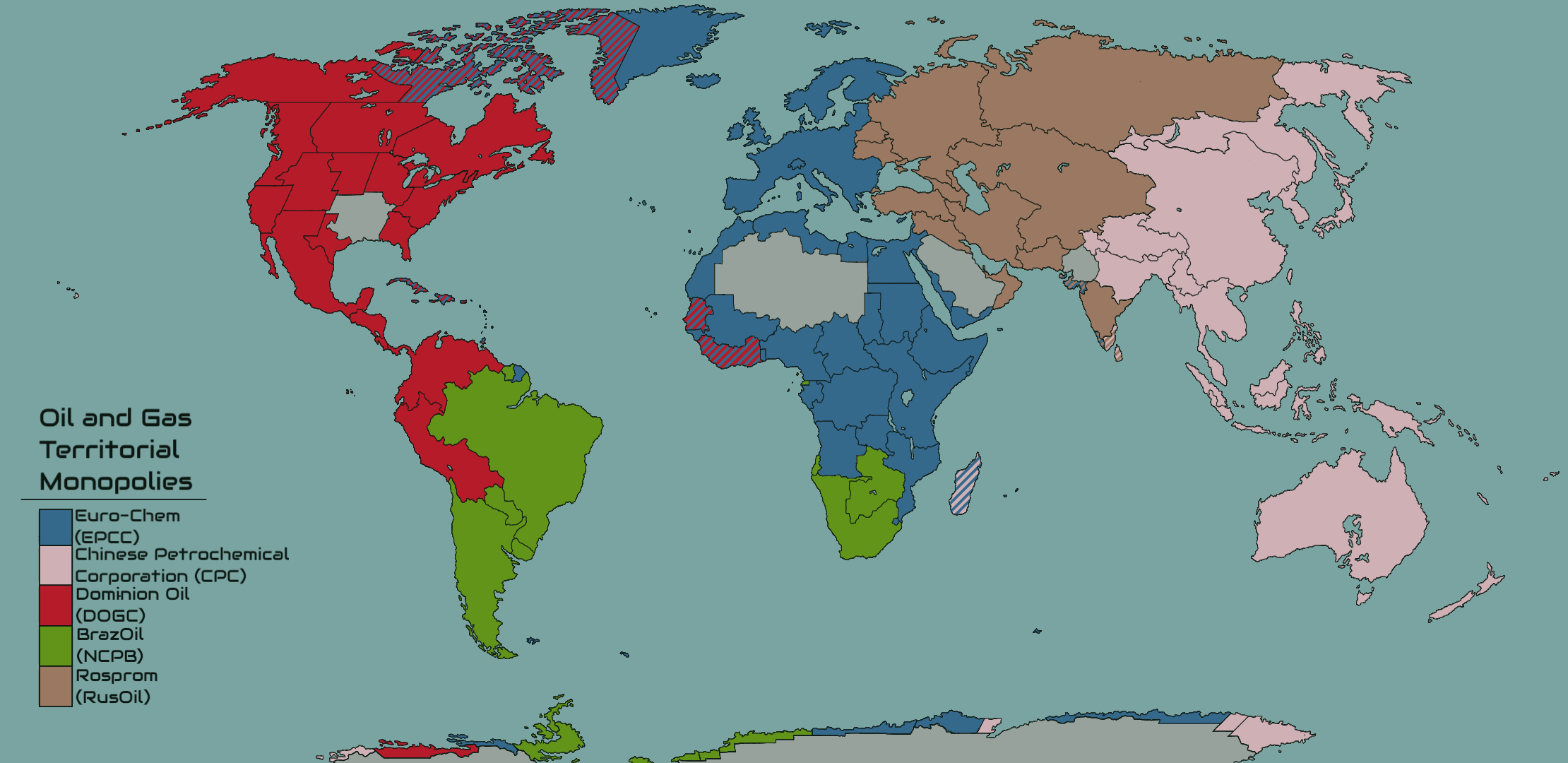
The World's Oil Markets by Ephraïm Boateng (Me)

Commentaires