

Hayfiddle
The hayfiddle is a bowed string instrument that originated in the Northern Duchy of Dreibach among halfling cultures in the late Y400s. It is a distinctive component of Ossirfolk traditional music.
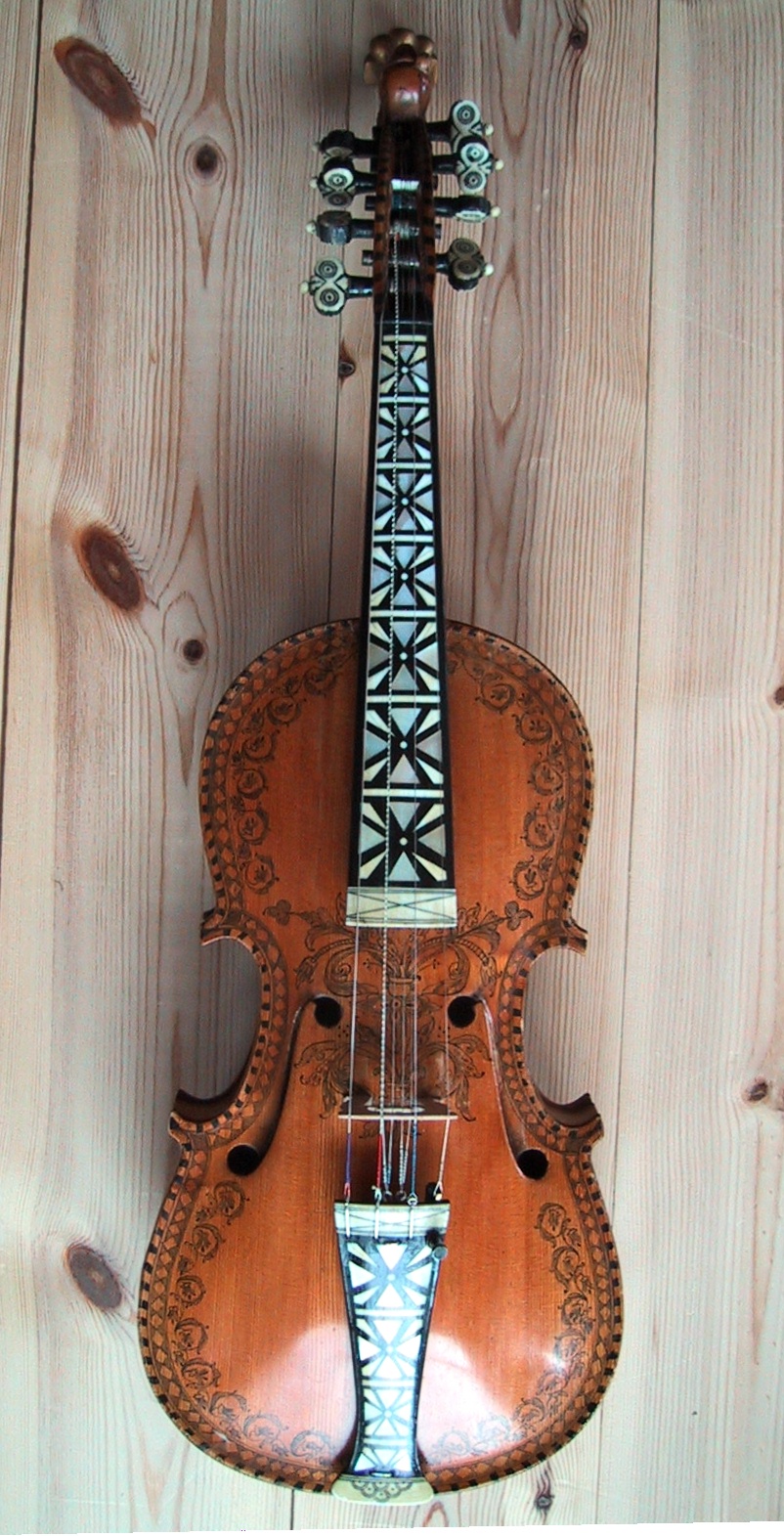
A hayfiddle is roughly half the size of a typical treble viol or violin, and its four primary strings are traditionally tuned a major fourth higher, to C-G-D-A. Because of the discrepancy between instrument size and tuning, the hayfiddle has a mellower, less resonant tone than a violin. The fingerboard of the instrument is hollow, and inside are four (sometimes five) additional strings that vibrate sympathetically when certain notes played on the main strings. The tuning of these understrings varies according to the requirements of the tune; many halfling clans swear by particular signature tunings. Hayfiddles are heavily decorated, with extensive mother-of-pearl inlay along the fingerboard and black ink decorations across the body. The scroll at the top of the instrument is often carved to resemble the head of an animal, monster, or person, with lions and direwolves being particularly popular choices.
The hayfiddle is often at the center of rural community gatherings such as barn-raisings and feast days. In centuries past, every branch of a halfling clan was expected to have its own hayfiddler, and large competitions would be thrown to see which clans could produce the best hayfiddler. These have largely died out in recent years, although Klïppington and Klöppington still host notable interclan hayfiddle competitions, as well as a biannual cross-river competition. Roaming hayfiddlers are still a key part of Cannukah celebrations; for many, the holiday and the instrument are inextricably linked.
Comments