

Ludus Vallorum
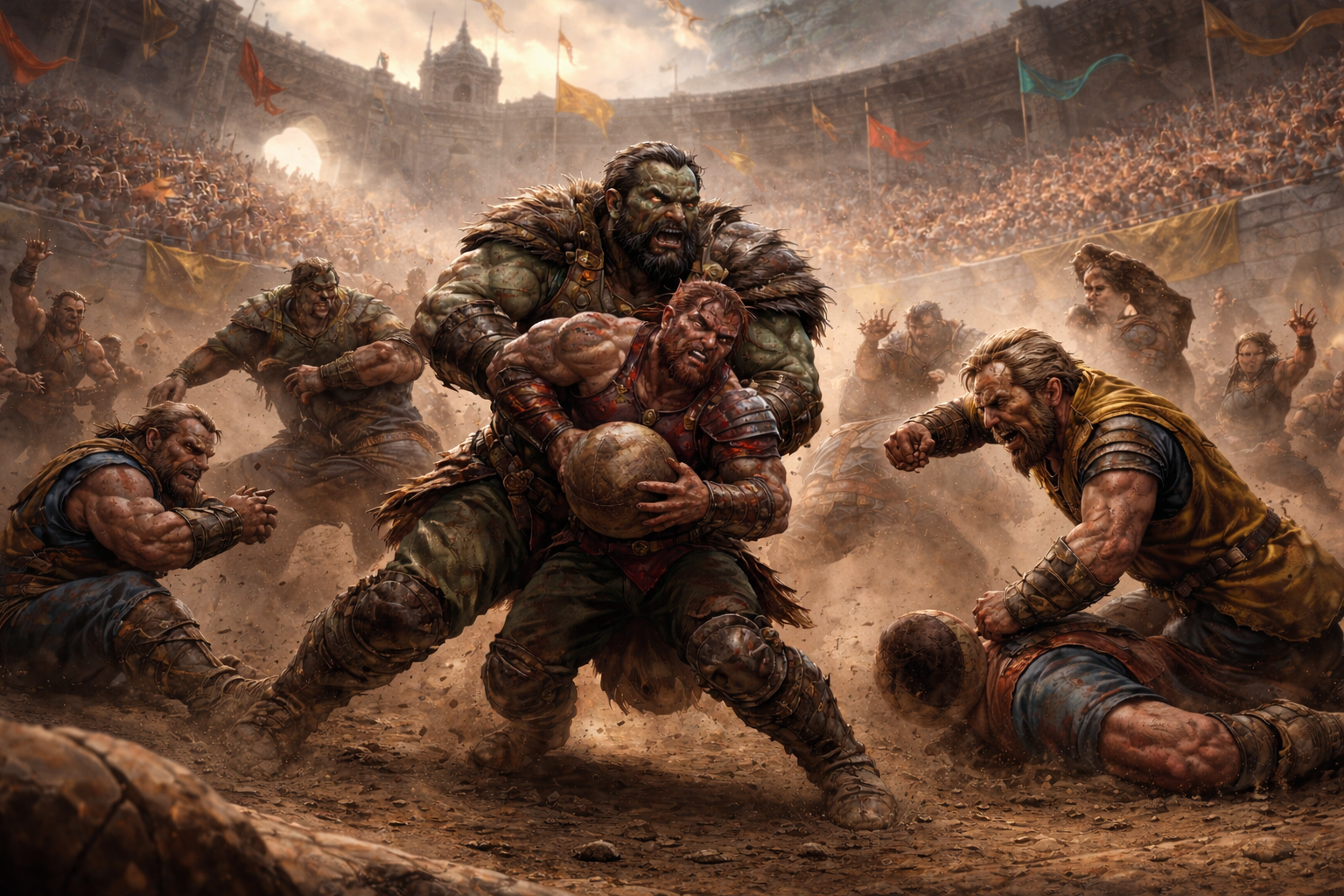
Ludus Vallorum, known across Kermoria by its far more common name, Siegeball, is among the most widely played and fiercely contested sports in the known world. Brutal, fast-paced, and infamous for its injuries, Siegeball is not merely a game of athleticism but a cultural institution—one that blends physical endurance with open violence in a manner few other competitions can match. Its rules vary by region, but its essence remains the same: a contest of strength, coordination, and willpower, where teams clash like armies and victory is claimed by driving the ball through hostile bodies as much as through open space.
The origins of Ludus Vallorum are disputed and poorly recorded. While some scholars suggest it began as a martial training exercise or a ceremonial contest between rival districts, supporters in Ilithi insist it was born in the Himhineldar Shel frontier and spread outward from Shard and its surrounding settlements. Whether truth or civic pride, Ilithi remains the heartland of Siegeball, fielding the greatest variety of teams and the widest diversity of players—humans, elves, half-elves, orcs, goblins, lizardfolk, and even the occasional ogre willing to follow the rules long enough to finish a match. In Ilithi, Siegeball is treated less as sport and more as sanctioned chaos, played with fervor and celebrated with near-religious intensity.
Elsewhere, the game has evolved into more formalized traditions. In both Zoluren and Therengia, Siegeball is governed by organized leagues, complete with ranked teams, seasonal schedules, and even hired healers and medical staff to keep valuable players alive and functional. Therengian matches are known for their discipline and regimented play, while Zoluren favors speed, spectacle, and polished arenas. In contrast, the Pridelands maintain a version of the sport steeped in grim pragmatism, where regional rules are infamous for permitting necromantic substitutes—zombies or skeletal players pressed into service when living bodies are scarce. Such practices are outlawed almost everywhere else, and their mere mention is enough to provoke outrage in more northern provinces.
Every four years, the sport reaches its highest and most celebrated form during the great midsummer competitions, where provinces assemble elite teams from among their strongest champions to compete for prestige on a continental stage. These games draw massive crowds, fortunes in gambling, and the attention of rulers who understand that Siegeball is more than entertainment—it is a public display of strength, unity, and dominance. In a world of war, monsters, and shifting alliances, Ludus Vallorum endures as one of the few contests where entire nations can clash without declaring open battle… though many would argue the difference is merely semantic.
The origins of Ludus Vallorum are disputed and poorly recorded. While some scholars suggest it began as a martial training exercise or a ceremonial contest between rival districts, supporters in Ilithi insist it was born in the Himhineldar Shel frontier and spread outward from Shard and its surrounding settlements. Whether truth or civic pride, Ilithi remains the heartland of Siegeball, fielding the greatest variety of teams and the widest diversity of players—humans, elves, half-elves, orcs, goblins, lizardfolk, and even the occasional ogre willing to follow the rules long enough to finish a match. In Ilithi, Siegeball is treated less as sport and more as sanctioned chaos, played with fervor and celebrated with near-religious intensity.
Elsewhere, the game has evolved into more formalized traditions. In both Zoluren and Therengia, Siegeball is governed by organized leagues, complete with ranked teams, seasonal schedules, and even hired healers and medical staff to keep valuable players alive and functional. Therengian matches are known for their discipline and regimented play, while Zoluren favors speed, spectacle, and polished arenas. In contrast, the Pridelands maintain a version of the sport steeped in grim pragmatism, where regional rules are infamous for permitting necromantic substitutes—zombies or skeletal players pressed into service when living bodies are scarce. Such practices are outlawed almost everywhere else, and their mere mention is enough to provoke outrage in more northern provinces.
Every four years, the sport reaches its highest and most celebrated form during the great midsummer competitions, where provinces assemble elite teams from among their strongest champions to compete for prestige on a continental stage. These games draw massive crowds, fortunes in gambling, and the attention of rulers who understand that Siegeball is more than entertainment—it is a public display of strength, unity, and dominance. In a world of war, monsters, and shifting alliances, Ludus Vallorum endures as one of the few contests where entire nations can clash without declaring open battle… though many would argue the difference is merely semantic.
History
The true origins of Ludus Vallorum remain uncertain, obscured by the lack of reliable records and the inconvenient truth that its earliest practitioners were rarely the sort of people who kept careful histories. Most scholars agree that Siegeball likely began as some blend of martial contest, festival spectacle, and sanctioned brawling, evolving naturally from the kind of rough competitions that arise wherever young warriors gather with too much pride and too little supervision. Numerous provinces claim to possess ancient antecedents of the sport—regional games involving grappling, ball-handling, or ritualized violence—but none can offer definitive evidence that their traditions were the direct ancestor of modern Siegeball.
The earliest organized play, however, can be traced with far greater confidence. Written accounts, preserved schedules, and civic disputes recorded in old ledgers indicate that formalized matches were being held in Ilithi, specifically in and around Shard, as early as 200 BD. These early games appear to have been tied to local celebrations and civic competitions, with teams often formed along district lines, mercenary companies, or guild affiliations. The presence of Shard’s structured governance, as well as the influence of the Crystal Conservatory and its record-keeping traditions, is widely believed to be the reason Ilithi possesses the oldest surviving documentation of the sport. This has lent considerable weight to the Ilithic claim that Siegeball was born in their frontier, even if no surviving record explicitly confirms the first match.
Over the centuries, Ludus Vallorum spread outward along trade routes, military roads, and mercenary networks, adapting to the temperament of each province that adopted it. In Ilithi, the sport retained its raw and violent character, treated as a test of strength and endurance as much as entertainment. In Zoluren and Therengia, however, the game gradually became institutionalized, shaped by organized leagues, regulated arenas, and the growing recognition that talented players were valuable assets rather than expendable bodies. Rule changes emerged slowly and unevenly, often driven by public outcry after particularly brutal matches or by noble patronage seeking to elevate the sport into something more prestigious. Even now, Siegeball remains a patchwork of traditions—unified in spirit, but forever divided in practice—its history written not in clean chronicles, but in broken bones, shouted oaths, and the stubborn refusal of its supporters to ever let the game die.
The earliest organized play, however, can be traced with far greater confidence. Written accounts, preserved schedules, and civic disputes recorded in old ledgers indicate that formalized matches were being held in Ilithi, specifically in and around Shard, as early as 200 BD. These early games appear to have been tied to local celebrations and civic competitions, with teams often formed along district lines, mercenary companies, or guild affiliations. The presence of Shard’s structured governance, as well as the influence of the Crystal Conservatory and its record-keeping traditions, is widely believed to be the reason Ilithi possesses the oldest surviving documentation of the sport. This has lent considerable weight to the Ilithic claim that Siegeball was born in their frontier, even if no surviving record explicitly confirms the first match.
Over the centuries, Ludus Vallorum spread outward along trade routes, military roads, and mercenary networks, adapting to the temperament of each province that adopted it. In Ilithi, the sport retained its raw and violent character, treated as a test of strength and endurance as much as entertainment. In Zoluren and Therengia, however, the game gradually became institutionalized, shaped by organized leagues, regulated arenas, and the growing recognition that talented players were valuable assets rather than expendable bodies. Rule changes emerged slowly and unevenly, often driven by public outcry after particularly brutal matches or by noble patronage seeking to elevate the sport into something more prestigious. Even now, Siegeball remains a patchwork of traditions—unified in spirit, but forever divided in practice—its history written not in clean chronicles, but in broken bones, shouted oaths, and the stubborn refusal of its supporters to ever let the game die.
Execution
At its core, Ludus Vallorum is governed by a simple principle: two forces collide, and only one endures long enough to score. A standard match consists of two teams of twenty-five players, with no substitutes permitted under any circumstance. Once a player steps onto the field, they are committed until the match ends—or until they are physically unable to continue. Matches last ninety uninterrupted minutes, unless one team reaches ten points, at which time the game ends immediately. If the score remains tied at the end of regulation, the match enters sudden death, continuing until the next point is scored, regardless of how long it takes.
The field itself is vast, typically stretching roughly one hundred yards from end to end, and is overseen by seven judges, spaced strategically across the pitch. These judges serve as referees, witnesses, and—when necessary—executioners of order, though their authority is largely symbolic. Siegeball is not governed by a strict list of forbidden actions so much as a shared understanding of consequence. At the start of the match, the ball is thrown high into the air by a presiding judge in a manner akin to a ceremonial tip-off, and the moment it touches the ground or is seized, the game becomes a controlled catastrophe.
Play begins with what most spectators consider the true spectacle: the Opening Clash, when both teams surge into the center and the match becomes a massive melee. Striking, grappling, throwing, tripping, tackling, and headbutting are all considered normal and expected. The goal of this initial collision is not merely to claim the ball, but to remove opponents from play through force. A player is considered Downed the moment they are taken fully to the ground in a manner they cannot immediately recover from. The victor of a grapple may rise and continue fighting, but the one brought down is removed from active play until a point is scored.
Downed players are required to make their status unmistakable. Tradition dictates that they either remain on the ground or retreat quickly toward the sidelines with both hands raised, a gesture universally understood to mean they are no longer part of the contest and should not be struck or trampled. While there is no formal rule protecting the downed, there exists a strong and widely observed custom that they are not to be further harmed once they have been rendered inactive. Those who ignore this unspoken courtesy often find themselves repaid in kind later in the match—sometimes immediately, sometimes with grim intent after the final whistle. In Ilithi, players may be called Spent, Beaten, or even Bested when taken down, depending on local dialect and team tradition, but the meaning is the same: for the moment, they are removed from the war.
Once enough opponents have been downed or restrained, a team will attempt to shift from brawling to movement. The ball is seized—often wrestled free from the bodies at the center—and carried in a brutal charge toward the opposing end of the field. The ball-carrier is rarely protected by clean formations; instead, the advance resembles a breach attempt, with teammates grappling defenders to the ground while others physically shield the runner with their bodies. The objective is to reach the scoring end and throw the ball through a reinforced opening, most commonly a four-foot square goal aperture, earning a single point. The act of scoring is treated as both victory and reprieve, and the crowd often erupts not simply at the point itself, but at the knowledge that everyone still standing has survived long enough to see the clash reset.
When a point is scored, the match does not pause for rest, strategy, or ceremony. The ball is returned to center, and all players who were previously downed are permitted to rise and return to play—if they are able. This is where Siegeball earns its brutal reputation: there is no replacement for injury, no reserve line waiting to enter the fray, and in most provinces, no healing is permitted during play, whether by spell, potion, or miracle. A player with a broken limb, shattered ribs, or worse simply limps from the field, and their team fights on with reduced numbers. In this way, Ludus Vallorum becomes not only a contest of strength and violence, but one of attrition and stubborn will—where many matches are decided not by who strikes hardest, but by who remains standing when the field begins to empty.
The field itself is vast, typically stretching roughly one hundred yards from end to end, and is overseen by seven judges, spaced strategically across the pitch. These judges serve as referees, witnesses, and—when necessary—executioners of order, though their authority is largely symbolic. Siegeball is not governed by a strict list of forbidden actions so much as a shared understanding of consequence. At the start of the match, the ball is thrown high into the air by a presiding judge in a manner akin to a ceremonial tip-off, and the moment it touches the ground or is seized, the game becomes a controlled catastrophe.
Play begins with what most spectators consider the true spectacle: the Opening Clash, when both teams surge into the center and the match becomes a massive melee. Striking, grappling, throwing, tripping, tackling, and headbutting are all considered normal and expected. The goal of this initial collision is not merely to claim the ball, but to remove opponents from play through force. A player is considered Downed the moment they are taken fully to the ground in a manner they cannot immediately recover from. The victor of a grapple may rise and continue fighting, but the one brought down is removed from active play until a point is scored.
Downed players are required to make their status unmistakable. Tradition dictates that they either remain on the ground or retreat quickly toward the sidelines with both hands raised, a gesture universally understood to mean they are no longer part of the contest and should not be struck or trampled. While there is no formal rule protecting the downed, there exists a strong and widely observed custom that they are not to be further harmed once they have been rendered inactive. Those who ignore this unspoken courtesy often find themselves repaid in kind later in the match—sometimes immediately, sometimes with grim intent after the final whistle. In Ilithi, players may be called Spent, Beaten, or even Bested when taken down, depending on local dialect and team tradition, but the meaning is the same: for the moment, they are removed from the war.
Once enough opponents have been downed or restrained, a team will attempt to shift from brawling to movement. The ball is seized—often wrestled free from the bodies at the center—and carried in a brutal charge toward the opposing end of the field. The ball-carrier is rarely protected by clean formations; instead, the advance resembles a breach attempt, with teammates grappling defenders to the ground while others physically shield the runner with their bodies. The objective is to reach the scoring end and throw the ball through a reinforced opening, most commonly a four-foot square goal aperture, earning a single point. The act of scoring is treated as both victory and reprieve, and the crowd often erupts not simply at the point itself, but at the knowledge that everyone still standing has survived long enough to see the clash reset.
When a point is scored, the match does not pause for rest, strategy, or ceremony. The ball is returned to center, and all players who were previously downed are permitted to rise and return to play—if they are able. This is where Siegeball earns its brutal reputation: there is no replacement for injury, no reserve line waiting to enter the fray, and in most provinces, no healing is permitted during play, whether by spell, potion, or miracle. A player with a broken limb, shattered ribs, or worse simply limps from the field, and their team fights on with reduced numbers. In this way, Ludus Vallorum becomes not only a contest of strength and violence, but one of attrition and stubborn will—where many matches are decided not by who strikes hardest, but by who remains standing when the field begins to empty.
Components and tools
Despite its brutal simplicity, Ludus Vallorum carries a number of traditional components and customary pieces of gear, though very few are strictly required. Weapons of any kind are universally forbidden, and the presence of a blade on the field is considered not merely cheating but an act of criminal violence. That said, the sport is not played naked of preparation; most provinces permit the use of light protective equipment, including padded or leather-reinforced helmets, fingerless gloves, and hardened wrappings around the forearms. Many players choose to compete with little or no protection at all, either from pride or superstition, and in Ilithi especially it is not uncommon for veteran fighters to consider excessive padding a sign of weakness rather than wisdom.
Clothing and appearance vary widely between teams and regions. Siegeball has no universal uniform, but most leagues require players to wear some consistent display of team colors—sashes, cloaks, dyed shirts, painted armor scraps, or strips of cloth bound to the arms. In less organized provinces, this requirement is often interpreted loosely, leading to teams that resemble half-dressed militias rather than athletes. By contrast, the more formal leagues of Therengia and Zoluren enforce stricter rules of identification, not only to maintain fairness but to preserve the spectacle of pageantry. Some teams take this further, decorating their gear with clan markings, stitched symbols, or painted designs meant to intimidate their opponents and rally the crowd.
Cold-weather play introduces its own customs. In Ilithi and the northern reaches of Therengia, it is common for downed players resting on the sidelines to be permitted cloaks, blankets, or heavy coats to stave off exposure while they recover. However, such coverings must be removed immediately before a player returns to the field, ensuring that no one gains the advantage of layered armor or hidden padding. This practice is enforced unevenly depending on the strictness of the judges, but the tradition is widely accepted as a matter of survival rather than comfort. Siegeball is violent, but frostbite is an opponent no one respects.
The most iconic component of all is the ball itself. The Siegeball is traditionally crafted from thick, heavy-duty leather, tightly stitched and reinforced to withstand crushing blows, muddy fields, and constant handling. It is roughly spherical, dense enough to be thrown with force, and durable enough to survive being trampled beneath dozens of boots. While no universal color standard exists, most teams favor bright dyes—reds, yellows, and vivid blues—so that the ball remains visible to players and spectators alike even in the chaos of the Opening Clash. In some Ilithic traditions the ball is referred to as the Heart or the Core, and though such names are poetic exaggerations, they speak to a simple truth: everything in Ludus Vallorum revolves around that single object, and the moment it is raised above the melee, the match becomes war in motion.
Clothing and appearance vary widely between teams and regions. Siegeball has no universal uniform, but most leagues require players to wear some consistent display of team colors—sashes, cloaks, dyed shirts, painted armor scraps, or strips of cloth bound to the arms. In less organized provinces, this requirement is often interpreted loosely, leading to teams that resemble half-dressed militias rather than athletes. By contrast, the more formal leagues of Therengia and Zoluren enforce stricter rules of identification, not only to maintain fairness but to preserve the spectacle of pageantry. Some teams take this further, decorating their gear with clan markings, stitched symbols, or painted designs meant to intimidate their opponents and rally the crowd.
Cold-weather play introduces its own customs. In Ilithi and the northern reaches of Therengia, it is common for downed players resting on the sidelines to be permitted cloaks, blankets, or heavy coats to stave off exposure while they recover. However, such coverings must be removed immediately before a player returns to the field, ensuring that no one gains the advantage of layered armor or hidden padding. This practice is enforced unevenly depending on the strictness of the judges, but the tradition is widely accepted as a matter of survival rather than comfort. Siegeball is violent, but frostbite is an opponent no one respects.
The most iconic component of all is the ball itself. The Siegeball is traditionally crafted from thick, heavy-duty leather, tightly stitched and reinforced to withstand crushing blows, muddy fields, and constant handling. It is roughly spherical, dense enough to be thrown with force, and durable enough to survive being trampled beneath dozens of boots. While no universal color standard exists, most teams favor bright dyes—reds, yellows, and vivid blues—so that the ball remains visible to players and spectators alike even in the chaos of the Opening Clash. In some Ilithic traditions the ball is referred to as the Heart or the Core, and though such names are poetic exaggerations, they speak to a simple truth: everything in Ludus Vallorum revolves around that single object, and the moment it is raised above the melee, the match becomes war in motion.
Participants
While Ludus Vallorum is often described as little more than a controlled riot, seasoned spectators know the truth: Siegeball is chaos only to the untrained eye. Each team fields twenty-five players, but those players rarely serve identical purposes, and the roles they adopt are shaped heavily by regional style and cultural tradition. Some provinces favor raw brawling power, treating the match as a contest of attrition where the strongest survive long enough to score. Others approach Siegeball with careful structure, assigning players to specialized functions and coordinating movement with near-military discipline. Neither philosophy is universally superior—each reflects the values of the people who play it.
In Ilithi, where the sport is most widespread and least restrained, teams often form around the concept of the melee-first clash. Fighters are selected for toughness, endurance, and a willingness to grapple in the center until bodies begin to fall. In such matches, the ball is often treated as secondary during the early stages, as teams focus on downing opponents and creating openings through brute force. Ball-runners in Ilithic play are frequently opportunists—fast enough to exploit a break in the brawl, but durable enough to survive the beating required to reach it. Ilithic teams are also infamous for fielding unusual members, including half-ogres, goblins, and on rare occasions even trolls, whose unnatural regenerative abilities allow them to return to the fray repeatedly. This practice is controversial elsewhere, as troll claws are often viewed as weapons in their own right, and many leagues consider such participation dishonorable even if technically permitted.
Therengia and Zoluren, by contrast, are known for developing more formalized approaches. Their leagues tend to favor clearly defined roles: heavy front-line players tasked with grappling and disabling opponents, durable guards who protect the ball-carrier, and swift runners trained to break through the moment the field opens. These teams often treat the Opening Clash not as a brawl to be endured, but as a strategic engagement meant to control space and isolate key threats. In such provinces, Siegeball becomes less a test of individual brutality and more a demonstration of coordination, discipline, and calculated violence—still brutal, but with a recognizable method beneath the blood.
The Pridelands are widely regarded as the most specialized and ruthlessly practical of all. Their teams often recruit massive players—particularly loxodon—specifically to clear lanes through the melee, battering opponents aside and creating a path for smaller, faster runners to carry the ball. In this style of play, the great brutes serve as living siege engines, while agile players dart through the gaps they create like raiders through a breached wall. Though the sport’s rules remain broadly consistent, such tactical approaches create dramatic differences in how Siegeball appears from one province to another. Some crowds cheer the beauty of structured play; others prefer the primal spectacle of uncontrolled violence. Either way, the field reveals the same truth: Ludus Vallorum is not simply a game of strength, but a mirror of the societies that embrace it.
In Ilithi, where the sport is most widespread and least restrained, teams often form around the concept of the melee-first clash. Fighters are selected for toughness, endurance, and a willingness to grapple in the center until bodies begin to fall. In such matches, the ball is often treated as secondary during the early stages, as teams focus on downing opponents and creating openings through brute force. Ball-runners in Ilithic play are frequently opportunists—fast enough to exploit a break in the brawl, but durable enough to survive the beating required to reach it. Ilithic teams are also infamous for fielding unusual members, including half-ogres, goblins, and on rare occasions even trolls, whose unnatural regenerative abilities allow them to return to the fray repeatedly. This practice is controversial elsewhere, as troll claws are often viewed as weapons in their own right, and many leagues consider such participation dishonorable even if technically permitted.
Therengia and Zoluren, by contrast, are known for developing more formalized approaches. Their leagues tend to favor clearly defined roles: heavy front-line players tasked with grappling and disabling opponents, durable guards who protect the ball-carrier, and swift runners trained to break through the moment the field opens. These teams often treat the Opening Clash not as a brawl to be endured, but as a strategic engagement meant to control space and isolate key threats. In such provinces, Siegeball becomes less a test of individual brutality and more a demonstration of coordination, discipline, and calculated violence—still brutal, but with a recognizable method beneath the blood.
The Pridelands are widely regarded as the most specialized and ruthlessly practical of all. Their teams often recruit massive players—particularly loxodon—specifically to clear lanes through the melee, battering opponents aside and creating a path for smaller, faster runners to carry the ball. In this style of play, the great brutes serve as living siege engines, while agile players dart through the gaps they create like raiders through a breached wall. Though the sport’s rules remain broadly consistent, such tactical approaches create dramatic differences in how Siegeball appears from one province to another. Some crowds cheer the beauty of structured play; others prefer the primal spectacle of uncontrolled violence. Either way, the field reveals the same truth: Ludus Vallorum is not simply a game of strength, but a mirror of the societies that embrace it.
“I once played Siegeball in my youth. Briefly. Enthusiastically.
It was the only battle I have ever witnessed where men charged forward screaming with absolute confidence… and then spent the next hour being punched unconscious by strangers over a leather ball.
The sport is barbaric, impractical, and a terrible waste of good ribs.
…Naturally, I attend every championship match.”
— King Roger Vorclaf III
Primary Related Location
Important Locations

Comments