Cloud Chariots
Introduction
"Most believe the danger lies in remaining aloft. In truth, the difficulty is persuading the chariot to exist at all."
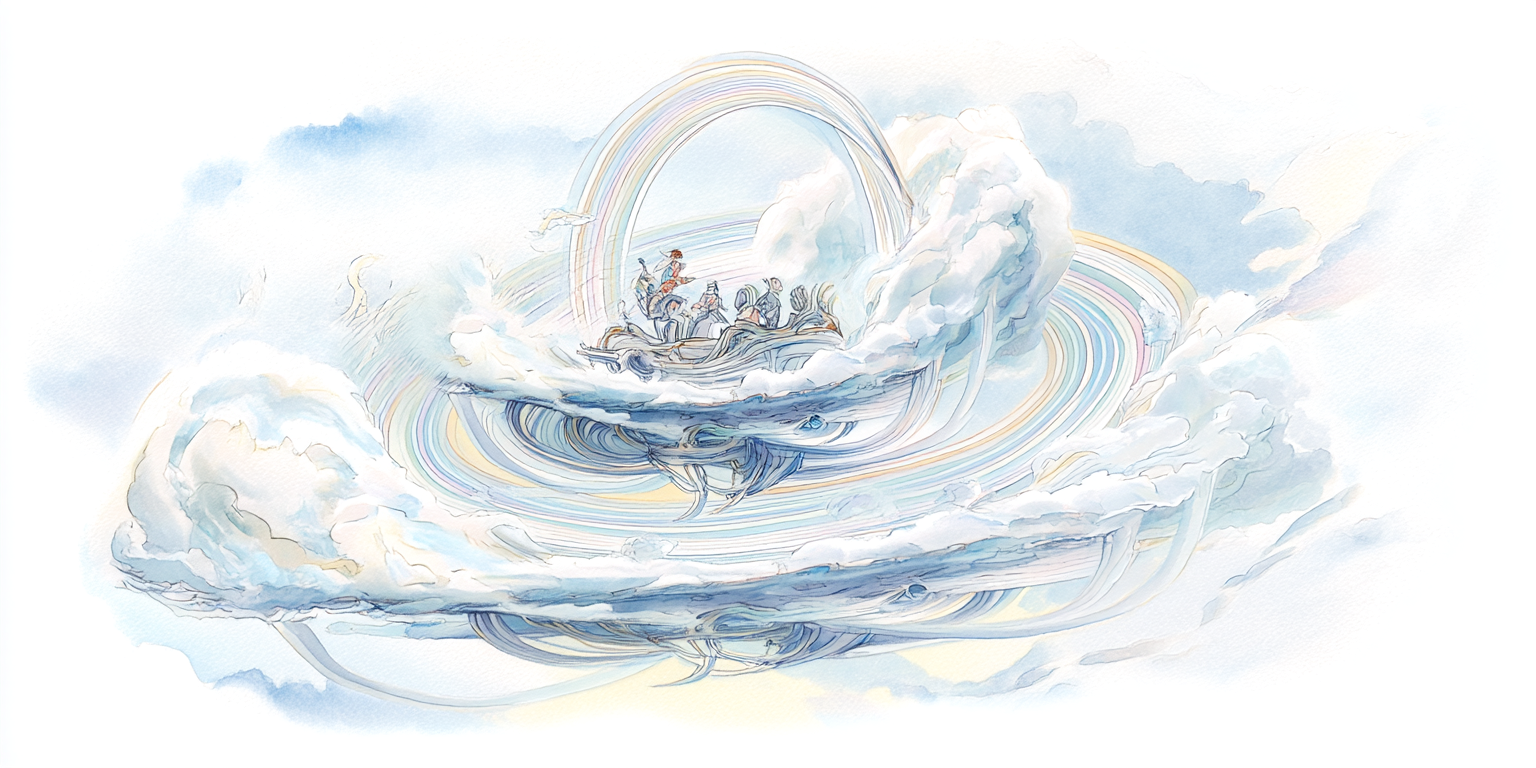
Cloud chariots are aerial transport constructs developed and employed by the Zephyraen, shaped through the interaction of enchanted ring-cores and naturally occurring cloud cover. They are neither permanent vehicles, nor conjured in the manner of summoned entities. Each chariot is a temporary structure, its body composed of condensed atmospheric moisture held in cohesion only for the duration of a travel.
Their formation is inseparable from the state of the sky. Under a clear firmament, the ring remains inert, its workings present but unexpressed. Where fog gathers, mist lingers or clouds layer with sufficient density, the chariot may be formed and sustained. This dependence is not treated as a limitation to be overcome, but as a defining condition of the craft. Cloud chariots are designed to function within specific atmospheric states, and nowhere else.
The Ring Core
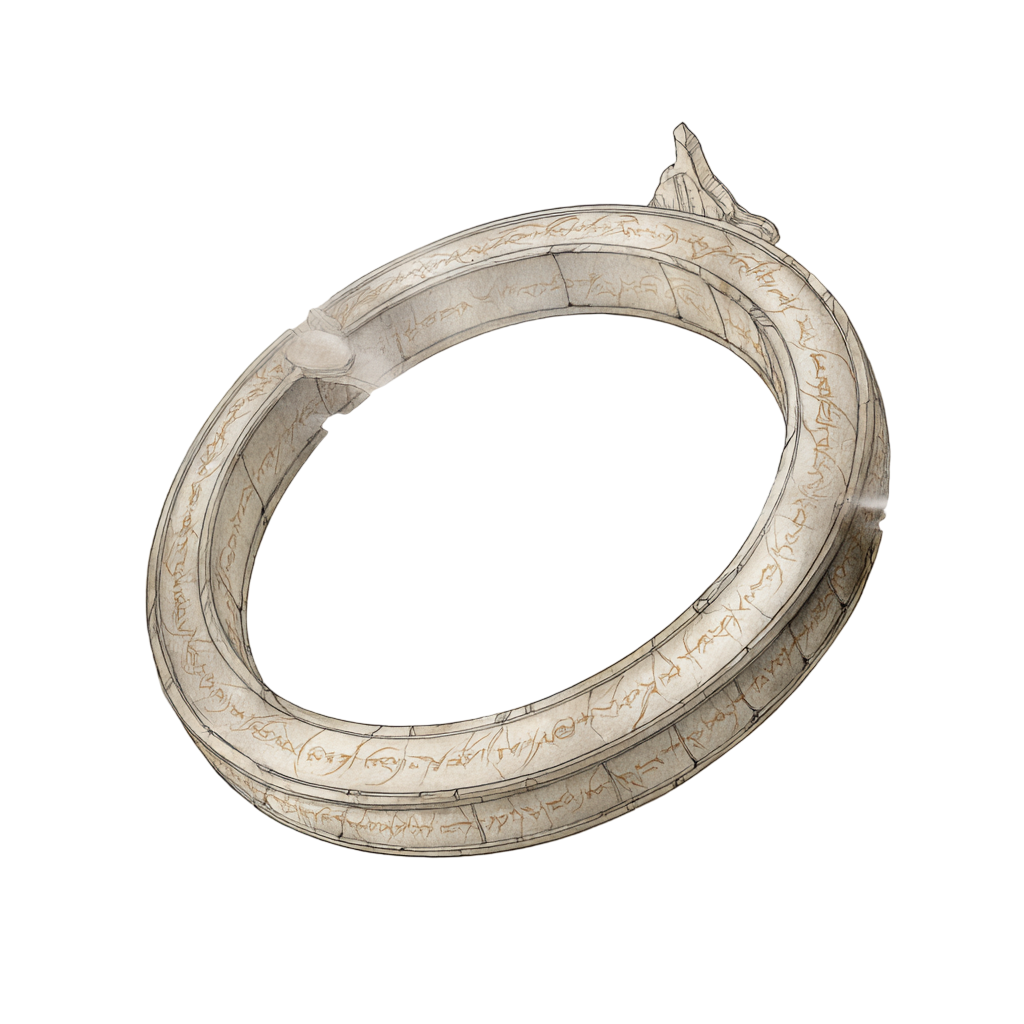
At the heart of every cloud chariot lies the ring: a work of Zephyraen craft refined across generations, wrought for a single purpose and no other. It is not an ornament, but the structural principle upon which the chariot depends.
The ring is always circular. This form is not ceremonial, but necessary. Early designs that employed segmented arcs or angular frames failed under strain once cloud mass began to gather. Only the unbroken curve distributes pressure evenly as condensation thickens and air accelerates, preserving cohesion where all other geometries fracture.
The enchantments bound into the ring are precise and deliberately constrained. They do not conjure cloud, nor do they compel the wind. Instead, they alter the conditions under which moisture and pressure interact, lowering the threshold at which vapor condenses and remains bound. Within the ring’s influence, cloud matter that would otherwise thin and disperse settles into layered density, sustained as ordered atmosphere.
When inactive, the ring is inert and becomes small enought to be worn on a finger. It draws no mist, emits no light, and betrays no sign of its function. Its workings engage only in the presence of sufficient cloud cover, and only while directed by a trained hand.
The Form of Passage
As the chariot takes shape, a stabilized plane manifests within the densest layer of the formation. This bearing plane has no substance, yet it accepts weight without yielding, forming the surface upon which passengers and cargo are carried. It is unseen, but immediately apparent to those who step upon it: firm beneath the foot, resistant to sudden shifts, and unbroken so long as the ring maintains cohesion. The cloud gathers around and above this plane, defining the chariot’s body and boundaries, but it is the plane itself that renders the formation habitable. Without it, no living creature could be borne safely within the shifting mass.
At the forward edge of the formation, the pilot takes position within direct reach of the ring. Through subtle adjustments to its orientation and balance, the pilot governs the chariot’s motion, redistributing condensation and pressure throughout the cloud-body. Ascent, descent, and course are achieved not through thrust, but through continuous modulation of form.
Chariot Models
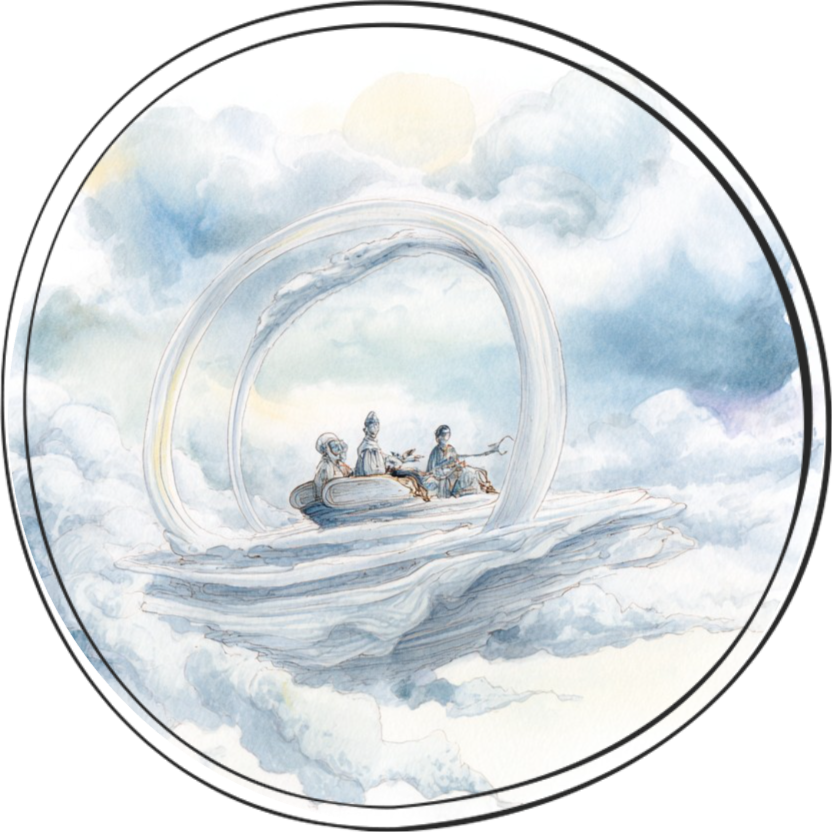
Though all cloud chariots operate upon the same principles, ring size determines scale, capacity, and tolerance for error. No ring may be compelled to exceed the limits set by its making.
Small rings form compact chariots suited to couriers and solitary travel, valued for their responsiveness and speed. Standard rings serve most long-distance journeys, balancing capacity and control. Large rings are reserved for transport and ceremonial movement, demanding greater discipline and more favorable conditions. Grand rings are extremely rare and closely regulated, capable of bearing entire processions beneath uninterrupted cloud cover, and entrusted only to the most experienced crews.
Pilots and the Discipline of the Wind
Cloud chariots demand more than technical competence. Their operation relies upon an innate attunement to wind, pressure, and atmospheric change; an attunement found almost exclusively among the Zephyraen.
From early life, the Zephyraen learn to orient themselves by shifting air and subtle variations in the sky. This sensitivity forms the foundation of all pilot training and cannot be replicated through study alone. Instruction refines what is already present; it does not create it. For this reason, true cloud-chariot pilots of other races are virtually unknown. Training emphasizes restraint over daring. Pilots are taught to recognize instability before it manifests, to initiate descent without hesitation, and to abandon a journey rather than attempt correction too late. The ring responds precisely, but it does not tolerate delay or excess confidence.
Successful flights are expected.
Safe returns are remembered.
Of Failure and Descent
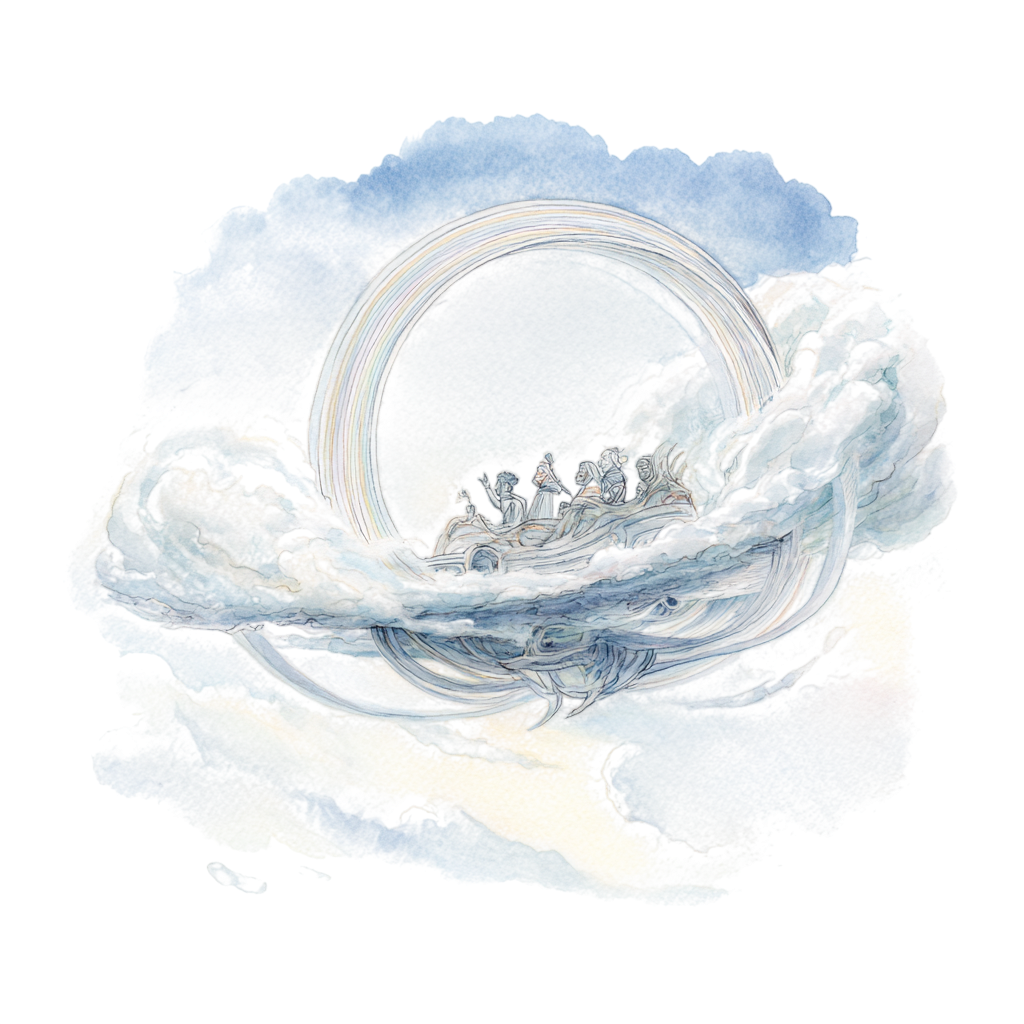
Cloud chariots are not fragile by design, but neither are they forgiving. Their stability is conditional, sustained by the balance between the ring’s cohesion and the state of the surrounding air. When that balance falters, the chariot does not fail at once. It unravels in stages.
The first response to instability is controlled descent. All Zephyraen rings are crafted with release sequences that favor loss of altitude over loss of form. As cohesion weakens, the bearing plane softens and the cloud-body thins, guiding the chariot downward rather than allowing it to tear apart where it stands. Many rings incorporate secondary measures intended to extend this margin of survival. These workings reshape the failing formation into a gliding structure, allowing the chariot to trade height for distance. They are not meant to preserve the journey, only its occupants, and they offer no protection if invoked too late.
The most dangerous failures arise not from storms, but from abrupt atmospheric change. A thinning cloud layer, a sudden ascent into clear air, or a break in overcast can strip a chariot of the substance it requires faster than the ring can compensate. In such moments, descent accelerates, control narrows, and the pilot’s margin for correction vanishes. For this reason, cloud-chariot pilots are trained as much in prediction as in control. Long before they are permitted to fly alone, they learn to read subtle shifts in pressure, temperature, and wind behavior. Many supplement this discipline with divination or weather-scrying, not to command the air, but to anticipate its change.
The Shapes That Pass
From the land below, cloud chariots are never observed for what they are. They are seen only as clouds doing what clouds have always done: gathering where the air allows it, stretching into familiar shapes, then unmaking themselves without urgency. A long bank drifts where none was before. A layered shadow thins. A form suggests motion, then forgets itself. Those who watch may remark upon it, or imagine patterns, or pass the moment without comment. Nothing insists that a journey has taken place.When the chariot loosens its hold, it leaves no mark to follow. No wake lingers in the air. No boundary remains to show where weight once rested. What carried bodies and breath becomes, once more, weather. The sky closes around the absence without pause or memory. Only the ring returns, quiet in the hand, its work complete. To those who know the craft, this is not disappearance, but success.
The highest passage is the one mistaken for nothing at all.
"It looked like a cloud. But it moved like it had somewhere to be.”






Love how you explain the mechanics of a vehicle made of clouds :D I'd love to ride one if I weren't afraid of heights XD
Thank you! I was worried about the mechanics, so I am extra glad you enjoyed the article :)
Summer Camp is here and so is My pledge! <3
Visit my world of Kena'an for tales of fantasy and magic! Or, if you fancy something darker, Crux Umbra awaits.