
Cencer of Eternal Blight
Introduction
"From the broken gem of mercy and the goddess’ fractured mind, the chains of despair were bound, the souls of the cursed took shape, and the plague’s cradle was born to unmake life."
Forged in the chaotic crucible of divine will and madness, the Censer of Eternal Blight is one of the most feared and enigmatic artifacts in Kena’an. Entrusted to Thesra, the Harbringer of Plagues, this artifact embodies the destructive essence of Mioran, goddess of plagues and madness.
Origins & Creation
The censer's story begins with an act of betrayal. Aeons ago, during a rare solar eclipse, Zinxa, goddess of death and undeath, managed to stole a gem from the crown of her sister, Siona. This gem was no ordinary treasure. In it, Siona had stored every malady known to mortals. Every plague and disease was sealed away by the Lady of Entropy to spare the world of their pain and suffering. But her sister, the Devourer of Souls, had other plans. Zinxa shattered the gem, unleashing the chaos stored within and inadvertently giving birth to Mioran, a new goddess born mad and erratic.
Later on the path of time, from the gem's remnants, Mioran forged the Censer of Eternal Blight, an artifact crafted not of metal but of tormented souls provided from Noxaria, Zinxa's domain in the Underworld. Its black, otherworldly surface is engraved with ancient, horrifying symbols of death, decay, and suffering. Holding the censer is an unbreakable chain forged from Mioran's own madness; a weave of broken thoughts, inconsistent consciousness, and whispering voices.
Appearance & Power
"The censer carries with it the weight of every suffering, every stolen breath, and every withered limb. Through it, the Harbinger paints the world with despair."
The censer radiates an unsettling presence. Its twisted craftsmanship evokes despair in those who behold it, with its surface perpetually shifting between grotesque images of suffering and decay. The chain binding the censer emits a low hum, echoing fragmented voices that speak in tongues forgotten by time.
Legends speak of how the censer stores every plague, each waiting to be unleashed. Thesra, the Harbringer of Plagues wields it with terrifying efficiency, spreading illness wherever she treads. It is said the censer's power is limitless, as it feeds on the death it sows.
Protective Rituals & Oranges
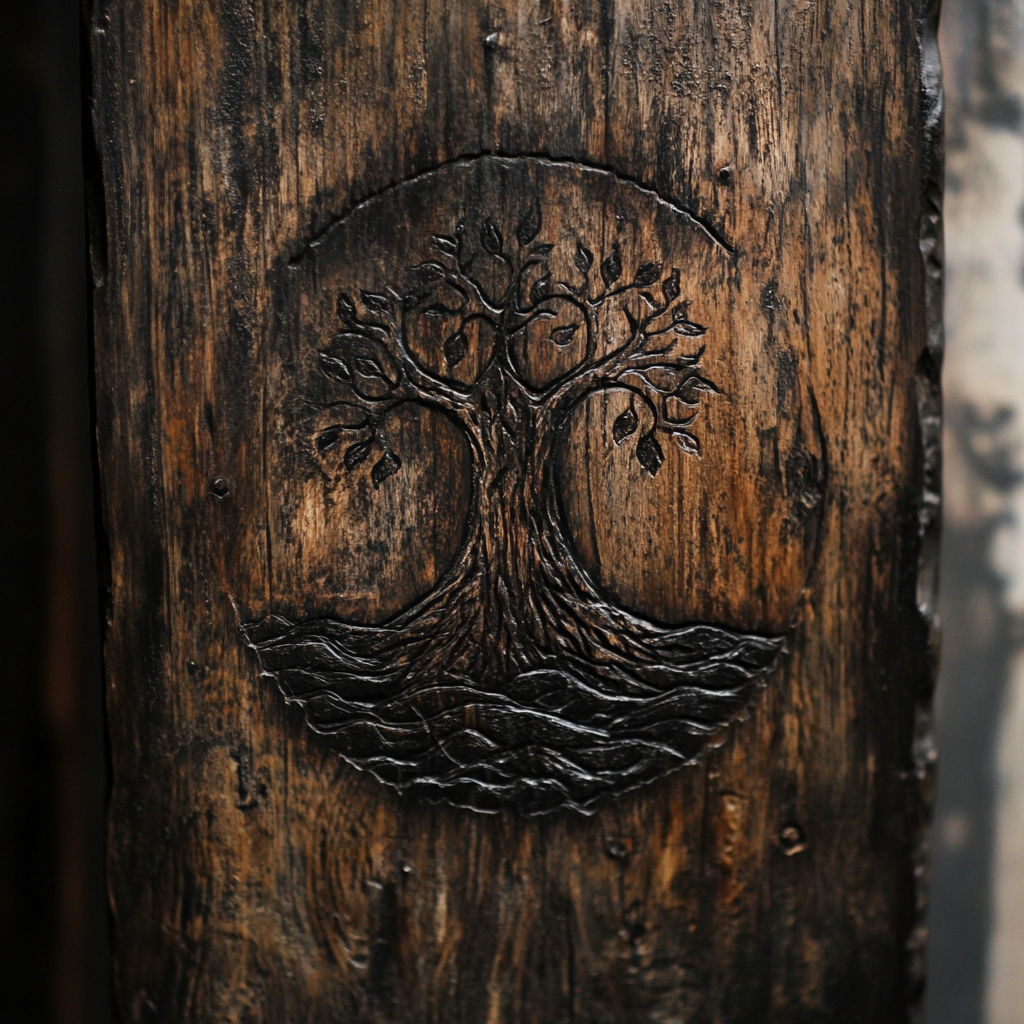
In their fear of Thesra and the censer, the people of Kena’an have devised countless protective measures. While most are superstitions, certain witches and druids have the knowledge of crafting effective talismans. Most of the times, these are made of wood and engraved with symbols that represents life and vitality, like trees, water, and the sun, as well as various fruits. Oranges, in particular, play a vital role in these rituals.
The use of oranges is not without its meaning. Long before they were tied to Thesra’s influence, sailors in Kena’an had noticed that oranges helped stave off the deadly disease of scurvy, which plagued long voyages. This observation led to the belief that the fruit held power over life and death, and it became a staple in plague-related rituals. It is also known that oranges were widely used as symbols of vitality in druidic groves as well as religious texts. To keep away the influence of Thesra, people of Kena'an tend to burn orange peels in their homes during plagues, as their smoke is believed to weaken Thesra’s influence.
Related Articles

"Do not pray for mercy. Mercy is foreign to her lips. Do not pray for reprieve. For where she walks, the air carries death, and the censer’s chain sings your final hymn."
"The orange, with its golden hue, is the fruit of life. Its scent chases away the shadows of sickness, its essence binds the plagues that seek entry to the body. Burn its peel, and let its embers light your path to health."

Burial Rites: A Pact of Death
When plagues strike, burial customs change drastically. It is imperative that victims of plagues be burned at twilight- Siona's sacred hour- under the open sky, atop pyres of wood and fresh leaves. Offerings of oranges, talismans, coins, and cardinal feathers accompany the deceased. The oranges are meant to protect the soul from Thesra's influence. The coins serve as offerings for safe passage, while the cardinal feathers, sacred to Siona, ensure the soul is guided toward her judgment rather than being lost to Noxaria.
This grim tradition stems from legends speaking of an ancient pact between Mioran and Zinxa. In exchange for the souls the Devourer provided to forge the censer, the Massacre Lady agreed that the souls of unburned plague victims would belong to Noxaria, and therefore to Zinxa.
The Tale of Lilyore
One tale, however, speaks of a defiance of this pact. In time immemorial, a halfling princess named Lilyore died of a plague but was not properly burned. But Levar, the god of mischief and chaos, was deeply in love with the princess and so He intervened, stealing her soul before it reached Noxaria. Then, He carried it to his fabled realm, the Lost Fields.
Siona was furious not only that the Trickster had stolen the soul from the Underworld, but that he had bypassed her judgment altogether.
Rather than letting Lilyore's fate be decided Her, Levar turned the soul into a divine creation, imbuing it with a portion of his own divinity. Thus, Lilyore became the goddess of grace, diplomacy, and humor, embodying the unpredictable chaos that Levar had wrought. This act enraged all three goddesses, Zinxa, Siona, and Mioran, yet by this time there was nothing they could do but accept that the Trickster had outsmarted them.
"Love’s folly is the chaos that binds. Through mischief, she rose; through grace, she reigns. Three goddesses wept, but the trickster laughed last."


I like how you tied in scurvy! The best myths often have some basis in nature.
Thanks! I think so too, all myths and tales have some solid foundation based on truth. I'm glad you liked it!
Summer Camp is here and so is My pledge! <3
Visit my world of Kena'an for tales of fantasy and magic! Or, if you fancy something darker, Crux Umbra awaits.