

Velmari
The Velmari are a wiry, sharp-minded humanoid species known for their exceptional skills as pilots, instinctive navigators, and masterful engineers. Though their machines often look battered and improvised—built from scrap, patched with mismatched metals, and humming with exposed circuitry—they operate with a precision that belies their appearance. Velmari technology is a blend of crude practicality and high-function efficiency, pushing the limits of what limited materials can achieve. Their vessels are not beautiful, but they are fast, responsive, and built to endure the worst. Deeply intuitive when it comes to mechanics and motion, the Velmari possess an almost preternatural sense for spatial dynamics, allowing them to outmaneuver even the most polished constructs. Where others rely on manuals and schematics, the Velmari rely on gut, grit, and generations of passed-down know-how.
Biology
Anatomy and physiology
Velmari, are therian mammals, and share features with other humanoid races. They are warm-blooded and give birth to live offspring providing nourishment through milk. With their four long fingers, including an opposable thumb, Velmari have an advantageous hand structure that facilitated early tool-making. In terms of their circulatory system, Velmari have a closed network comprised of a heart and blood vessels. Their blood is deep red in color due to hemoglobin, which contains iron. Velmari possess two lungs that primarily function in a nitrogen-oxygen based atmosphere.
Genetics
[coming soon]Life cycle and Reproduction
Velmari reproduction occurs through internal fertilization via sexual intercourse.
Diet
[coming soon]Biological variation
[coming soon]Psychology & Intelligence
[coming soon]Culture
Velmari culture most closely mirrors a Japanese-German craft-guild industrial society and has been shaped by major intellectual and popular currents, both religious and secular, and Velmari craftsmen, writers, teachers, religious figures, and philosophers have played a significant role in the development of Velmari thought. Velmari culture places emphasis on discipline, education, order, family life, skilled work, and respect for inherited traditions. Velmari are generally known for being practical, orderly, restrained, and respectful of learning and craftsmanship, with public life placing value on punctuality, responsibility, self-control, and contribution. Friendship and loyalty are usually built slowly through long familiarity, shared work, family ties, and trust, but once established, they are treated as serious and lasting bonds.
Velmari are well known for clan festivals, public holidays, religious observances, and local customs, many of which are tied to the karneth, or clan. Common traditions include communal meals, formal greetings between elders and younger members, remembrance ceremonies for dead relatives and teachers, the passing down of family objects, and public recognition of apprentices who complete important stages of training. Seasonal gatherings are often marked by music, speeches, storytelling, family displays, and shared food, with older members recounting the history of their clan and the achievements of earlier generations. Many families preserve old objects connected to important events, including tools, records, clothing, household items, or personal belongings of past members.
Religious customs remain an important part of Velmari culture, although they are often closely connected with family life, public duty, and local tradition. Ceremonies may include prayers for guidance and protection, offerings at household or clan shrines, and the keeping of old objects associated with ancestors, teachers, or respected relatives. Velmari celebrations tend to be formal but warm, with clear roles for elders, apprentices, relatives, guests, and honored members. Important public events may mark completed apprenticeships, family milestones, local anniversaries, religious holidays, or the memory of respected figures within a clan. These occasions are usually focused on shared pride, gratitude, remembrance, and the belief that individual achievement should serve the family, the clan, and the wider community.
Beauty in Velmari culture is commonly associated with age, care, tradition, and lasting value rather than luxury or display. A well-kept home, an old family object, a preserved record book, a clan hall, a religious shrine, or a historic house may carry the same emotional weight that monuments, heirlooms, churches, or public squares carry in other cultures. Velmari art, dress, music, and storytelling often reflect this same preference for restraint, memory, order, and continuity. Ornament exists, but it is usually modest and connected to family, religion, public service, or local identity. As a result, Velmari culture places high value on tradition, discipline, craftsmanship, family memory, modest pride, and the preservation of customs across generations.
Language
Velmarian is the official and predominantly spoken language on Ellara. It is one of 137 official and working languages of the Kingdom of Ellara, and one of the five procedural languages of the Ellaran Royal Commission, alongside Raakish, Thellian, Vornic and Sevrathi. Velmarian is the most widely spoken first language on Ellara, with around 913.8 million native speakers. It is used throughout the Kingdom of Ellara in public life, official communication, education, administration, and everyday speech, making it the main common language among the Velmari population. While many regional languages remain in use across Ellara, Velmarian holds the widest reach and is generally understood across cities, provinces, clan regions, and major public institutions.
Recognised native minority languages on Ellara are Raakish, Thellian, Karnethic, Vornic, Sevrathi, Dalren, Oskari, Marnic, Thalrek, Jorveth and Neskal; they are officially protected by the Royal Charter for Regional or Minority Languages. These languages remain important in regional identity, local customs, family life, education, and community communication. Velmari are typically multilingual: 84% of Velmari claim to be able to communicate in at least one additional regional language and 16% in two or more. This multilingual ability is especially common in areas where several regional languages are spoken close together, as well as among families, workers, students, and officials who regularly interact across different parts of Ellara.
Naming conventions
Velmari naming conventions generally follow a three-name format: given or personal name, family name, and karneth clan name. Most Velmari typically possess one or multiple personal names alongside a family name and a karneth name. In public records, schools, legal documents, clan registries, and official communication, all three names are commonly used together. The personal name usually appears first, followed by the family name and then the karneth clan name. This structure is recognized throughout the Kingdom of Ellara and remains one of the most consistent features of Velmari identity and public life. One’s personal name, commonly known as a “given name” or “birth name”, is chosen shortly after birth and serves as the individual’s primary personal identifier. It always comes before the family name and karneth name. Personal names are often selected according to family custom, regional preference, admired qualities, or the memory of respected relatives and teachers. Some families preserve naming traditions across multiple generations, while others favor names connected to local history, clan stories, or seasonal events. Diminutives and shortened forms are common within households and among close friends, although full names are generally preferred in formal situations. The family name, commonly referred to as a “surname” or “house name”, is inherited through family lines and shared among members of the immediate household. Velmari family names may originate from settlements, occupations, trades, geographic regions, descriptive terms, or historical clan associations. Family names are traditionally patrilineal, with children commonly carrying the father’s family name, although this is not universally required and some households instead pass down the mother’s name. In some regions, children may receive either parent’s family name depending on household agreement, inheritance customs, or local tradition. Marriage customs also vary across Ellara; many women traditionally adopt their husband’s family name upon marriage, although this practice has become less common in larger cities and mixed clan districts where retaining one’s birth family name is increasingly accepted. It is also legally permitted for a husband to adopt his wife’s family name. The karneth name represents the broadest part of a Velmari identity and identifies membership within a larger clan structure tied to shared heritage, customs, records, and social reputation. Karneth names are usually inherited and remain closely associated with clan history, regional identity, and long-standing traditions preserved across generations. Some karneth are widespread throughout Ellara, while others remain concentrated in specific cities, provinces, or clan districts. Karneth names commonly appear on public records, household signs, workshops, memorial stones, family books, and ceremonial objects, and many Velmari strongly identify with the reputation and history of their clan. Full three-name usage is especially common during public ceremonies, apprenticeships, marriages, funerals, legal proceedings, and clan festivals, where both family and karneth affiliation are formally recognized.COMMON MALE NAMES
- Trekon (pronounced: TREH-kon): [coming soon]
- Havrul (pronounced: HAHV-rool): [coming soon]
- Zennak (pronounced: ZEHN-ak): [coming soon]
- Krelvir (pronounced: KREL-veer): [coming soon]
- Donnek (pronounced: DAWN-ek): [coming soon]
COMMON FEMALE NAMES
- Vessari (pronounced: VESS-ah-ree): [coming soon]
- Jarnel (pronounced: JAR-nel): [coming soon]
- Tomae (pronounced: TOH-mai): [coming soon]
- Rykka (pronounced: RIK-kah): [coming soon]
- Nivral (pronounced: NIV-ral): [coming soon]
Common Family Names
[coming soon]Tools and technologies
Velmari, are an advanced version of a tier 6 - industrial civilization, similar to late 19th century humans. Velmari technology is generally characterized by practicality, durability, modularity, and ease of maintenance rather than visual refinement or luxury. Their machinery is often constructed from layered metals, exposed mechanical systems, reinforced panels, visible wiring, and interchangeable parts designed for rapid field repair. Many Velmari vehicles, industrial systems, aircraft, and orbital craft appear heavily worn or improvised even when newly manufactured, reflecting a broader cultural preference for function over appearance. Velmari engineers commonly prioritize reliability, accessibility, and serviceability, with machines frequently designed so damaged components may be removed, replaced, or repaired using ordinary tools and locally available materials. As a result, Velmari equipment is often considered unusually resilient under poor operating conditions, particularly in extreme weather, industrial environments, and long-duration use. Xenon-124 energy systems form the foundation of most Velmari infrastructure and industry, with Xenon Reactor Cores commonly used in city power grids, aircraft, ground vehicles, and spacecraft. Unlike combustion-based fuel systems, Xenon-124 reactors rely on controlled energy-conversion processes that produce relatively little atmospheric pollution and permit long operational lifespans with limited refueling requirements.
Velmari orbital technology remains comparatively industrial in design, but has allowed regular orbital transport. Velmari spacecraft are generally heavily reinforced and designed with an emphasis on reliability, fuel efficiency, cargo, and ease of repair rather than comfort or appearance. Computing and electronic systems are widespread throughout Velmari society, although most systems are intentionally decentralized and capable of functioning independently from larger communication networks. As a result, many control systems combine touch-sensitive displays, analog controls, physical switches, and independent backup systems. A technology that is relatively unique to the Velmari is a device known as a 'weapon scanner,' which is among the most widely recognized examples of Velmari security technology and is capable of remotely identifying, disabling, or locking most forms of conventional weaponry.
Religion and spirituality
Velmari, despite appearances, are deeply religious, worshiping many gods and goddesses through customs that remain closely tied to family, clan life, skilled work, and public duty. Velmari religion is not usually separated from ordinary life, but is present in the household, the workshop, the clan hall, royal court, and the public square. Many homes keep small shrines for prayer, remembrance, and offerings, while larger clan halls may preserve older religious objects, carved records, oath-stones, tools, banners, and heirlooms connected to the family and karneth. Religious practice is often formal, quiet, and inherited rather than emotional or showy, with prayers commonly spoken before travel, apprenticeships, marriages, funerals, major repairs, public decisions, and dangerous work. Velmari usually treat religion as a matter of respect, obligation, memory, and protection, with the living expected to honor the gods, remember the dead, keep promises, and act in a way that does not bring shame upon the family or clan.
Velmari religious customs place strong importance on oaths, ancestors, seasonal observances, sacred places, and the belief that actions carry weight beyond the individual. Clan festivals, harvest days, winter gatherings, funerals, and public anniversaries often include offerings of food, drink, crafted objects, written names, or repaired tools placed before household or clan shrines. Elders usually lead these observances, while apprentices, children, guests, and younger relatives are expected to listen, stand properly, and take part when called upon. Old stories, family records, and spoken verses are commonly used during these ceremonies, not only to honor the gods and the dead, but also to remind younger Velmari of duty, restraint, courage, and loyalty. In many communities, religious life is also connected to natural places such as groves, stones, hills, rivers, and old burial grounds, although these places are usually treated with quiet respect rather than spectacle. Even among urban Velmari, it is common for older families and karneths to preserve some connection to a traditional shrine, ancestral marker, or local holy place.
Although Velmari society is highly practical and industrial, religion continues to shape ideas of honor, responsibility, work, death, and family identity. Many Velmari believe that skill, courage, loyalty, and endurance are not merely personal virtues, but sacred duties passed down through bloodlines, teachers, and clan tradition. A poorly made object, a broken oath, cowardice during danger, or neglect of family obligations may therefore be seen not only as personal failure, but as an offense against the order of the household and karneth. At the same time, Velmari religion is not usually aggressive or missionary in nature, and most Velmari do not expect outsiders to follow their customs, though they do expect respect for shrines, funerals, oaths, and clan ceremonies. In modern Ellara, religious practice varies widely between regions, cities, professions, and families, but even less observant Velmari often keep some religious habits, especially prayers for the dead, offerings before long journeys, and formal participation in clan holidays. As a result, Velmari religion remains one of the strongest links between family memory, public duty, craftsmanship, and the older traditions of Ellara.
Science and philosophy
[coming soon]Society
[coming soon]Gender
[coming soon]Kinship
[coming soon]Government and politics
[coming soon]Military
[coming soon]Fashion and dress
[coming soon]Trade and economics
[coming soon]Conflict
[coming soon]Relations with Other Races
[coming soon]Velmari
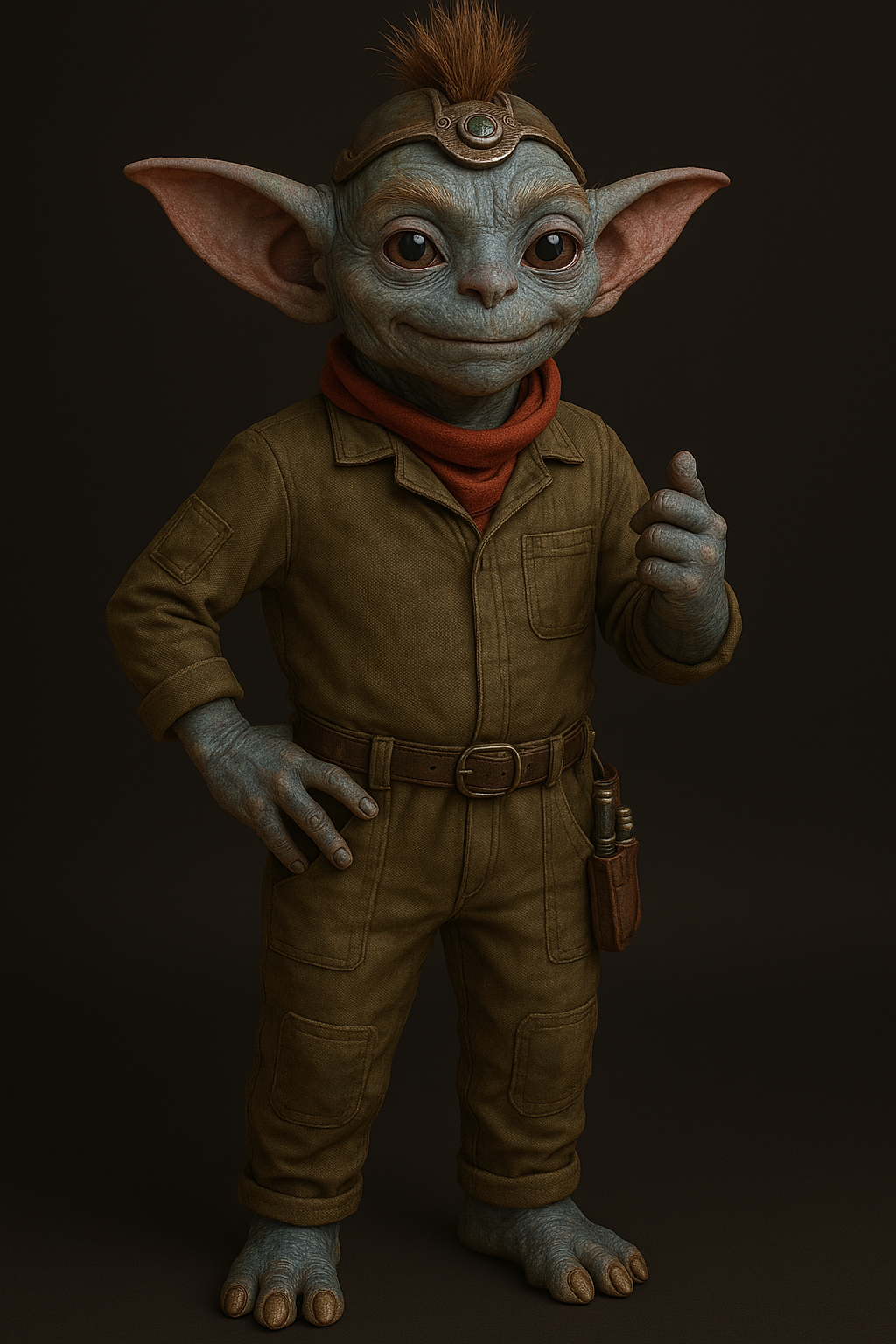
Velmari Male
Biological overview
Scientific name
Velmarius (In Velmarian: Korr'vellathi)
ClassificationTherian mammalian, humanoid
DietOmnivorious
Physical information
Avg. height
3' 5" to 4' 2"
Avg. weight80lb. to 100lb.
Avg. lifespan120 - 180 years
Avg. Skin toneGray, bluish-gray, or greenish-gray
Avg. Eye colorsBrown
Sociocultural information
Homeworld
Ellara
GovernmentTechnocratic Cultural Absolute Monarchy
- Kingdom of Ellara
Velmarian
Total Population913,897,989
Technology levelTier 6: Industrial
Native TechnologiesXenon-124 Reactors, Anti-weaponry scanners

Comments