Thauzuno (/θaʊˈzuːnoʊ/, thow-ZOO-noh), or Craehlil III, is the third planet from Craehlil and the only astronomical object known to harbor life. This is made possible by Thauzuno being a habitable world, and one of only two planets in the Craehlil System sustaining liquid surface water. Almost all of Thauzuno’s surface water is contained in the Mare Shalvek, covering 37.9% of Thauzuno’s surface. The remaining 62.1% of Thauzuno’s surface is land, most of which is located in the form of desert plains, volcanic regions, and arid basins. Most of Thauzuno’s land is at least somewhat scorched, chemically altered, tectonically unstable, and marked by harsh climates, metallic soils, volcanic deposits, and surface regions reshaped by erosion and geologic stress. Thauzuno’s crust consists of slowly moving tectonic plates, which interact to produce rift systems, volcanoes, and earthquakes. Thauzuno has an active molten interior that generates a magnetosphere capable of deflecting some of the destructive stellar winds and cosmic radiation.
Thauzuno has a dynamic atmosphere, which sustains Thauzuno’s surface conditions and protects it from most meteoroids and UV-light at entry. It is composed primarily of nitrogen and oxygen. Water vapor is widely present in the atmosphere, forming clouds that cover much of the planet. The water vapor acts as a greenhouse gas and, together with other greenhouse gases in the atmosphere, particularly nitrogen oxides, volatile hydrocarbons, and synthetic aerosols, creates the conditions for both liquid surface water and water vapor to persist via the capturing of energy from Craehlil’s light. This process maintains the current average surface temperature of 47 °C (116.6 °F), at which water is liquid under normal atmospheric pressure. Differences in the amount of captured energy between geographic regions (as with equatorial rift zones receiving more heat than higher-latitude regions) drive atmospheric and ocean currents, producing a global climate system with different climate regions, and a range of weather phenomena such as corrosive rainfall, allowing components such as nitrogen and industrial compounds to cycle.
Thauzuno is rounded into an ellipsoid with a circumference of about 37,748 kilometres (23,455 miles). It is one of the densest planets in the Craehlil System. Of the known rocky planets, it is among the largest and most massive. Thauzuno is about eight light-minutes (1 AU) away from Craehlil and orbits it, taking a year (about 402.6 days) to complete one revolution. Thauzuno rotates around its own axis in slightly more than a day (in about 27 hours and 18 minutes). Thauzuno’s axis of rotation is tilted with respect to the perpendicular to its orbital plane around Craehlil, producing seasons. Thauzuno is orbited by one permanent natural satellite, Vra’ath, which orbits Thauzuno at 364,000 km (226,179 mi)—1.21 light seconds—and is roughly a quarter as wide as Thauzuno. Vra’ath’s gravity helps destabilize Thauzuno’s crust, causes tides, and gradually slows Thauzuno’s rotation. Likewise, Thauzuno’s gravitational pull has already made Vra’ath’s rotation tidally locked, keeping the same near side facing Thauzuno.
Thauzuno, like most other bodies in the Craehlil System, formed about 7.12 billion years ago from gas and dust in the early Craehlil System. The formation of the oceans and the subsequent development of life occurred during the first billion years of Thauzuno’s history. Life spread globally and has been altering Thauzuno’s atmosphere and surface, leading to complex ecosystems before the Fall. Vey'Zari emerged 300,000 years ago in Vorthan and have spread across Thauzuno. Vey’Zari depend on Thauzuno’s biosphere, infrastructure, and remaining resources for their survival, but have increasingly impacted the planet’s environment. The Vey’Zari’s current impact on Thauzuno’s climate and biosphere is unsustainable, with 99.7% of Thauzuno's native wildlife and plant life having already experienced widespread extinctions, and now threatening the livelihood of the Vey’Zari themselves.
Etymology and symbol
The modern word Thauzuno developed from an Old Thauzunian noun most often spelled Thauzun. It has cognates in every major pre-Fall language, from which Proto-Thauzunian Thauzunō has been reconstructed. In its earliest attestation, the word Thauzun was used to translate the many senses of Vorthanic rhundar: the ground, its soil, dry land, the inhabited world, the surface of the world including the sea, and the globe itself. As with Vorthanic Rhundar, Thauzuno may have been a personified mother-figure in pre-Fall religion: surviving temple fragments included Thauzun-Rha, a fire-womb figure often given as the mother of the first people.
Historically, Thauzuno has been written in lowercase. During the early post-Fall period, its definite sense as “the globe” began being expressed using the phrase the thauzuno. By the period of early archival standardization, capitalization of nouns began to prevail, and the thauzuno was also written the Thauzuno, particularly when referenced along with other heavenly bodies. More recently, the name is sometimes simply given as Thauzuno, by analogy with the names of the other worlds, though thauzuno and forms with the thauzuno remain common. Styles now vary: Rav’thuun spelling recognizes the lowercase form as the more common, with the capitalized form an acceptable variant. Another convention capitalizes Thauzuno when appearing as a name. It almost always appears in lowercase in colloquial expressions such as “what on thauzuno are you doing?”
The name Vortha (/ˈvɔːrθɑː/ VOR-thah) is occasionally used in scientific writing; it also sees use in astrography to distinguish the Vey’Zari's inhabited planet from others, while in poetry Rhundar’s Crucible (/ˈrʊndɑrz ˈkruːsɪbəl/ RHUN-darz) has been used to denote personification of Thauzuno. Vortha is also the name of the planet in some surviving regional traditions, while in other traditions the word gave rise to names with slightly altered spellings, such as TZ-3 and Rhundar’s Crucible. The formal form The Ember Womb of the poetic name Thauzun-Rha (/θaʊˈzʊn rɑː/ thow-ZOON) rah is rare, though the alternative spelling Emberwomb has become common due to post-Fall archival standardization, rather than the more traditional Thauzunian pronunciation of Thauzun-Rha.
There are a number of adjectives for the planet Thauzuno. The word Thauzunian (/θaʊˈzuːniən/, thow-ZOO-nee-an) is derived from Thauzuno. From Craehlil comes Craehlilic (/kreɪˈlɪlɪk/ kray-LIL-ik), while Emberborn (/ˈɛmbərbɔːrn/ EM-ber-born) and Drosshollow (/ˈdrɒshɒloʊ/ DROSS-hol-oh) are derived from traditional names and descriptions associated with the planet. From Vey’Zari comes Vey’Zarian (/veɪˈzɑːriən/ vay-ZAR-ee-an), an uncommon adjective used to denote things relating specifically to Vey’Zari persons or culture.
Symbol
The standard astronomical symbols of Thauzuno are a molten-rift circle, ⊛, representing the planet’s active tectonic and volcanic regions, and a crescent-lit half-orb, ☾, representing Thauzuno’s orbiting satellite Vra’ath.
Geography
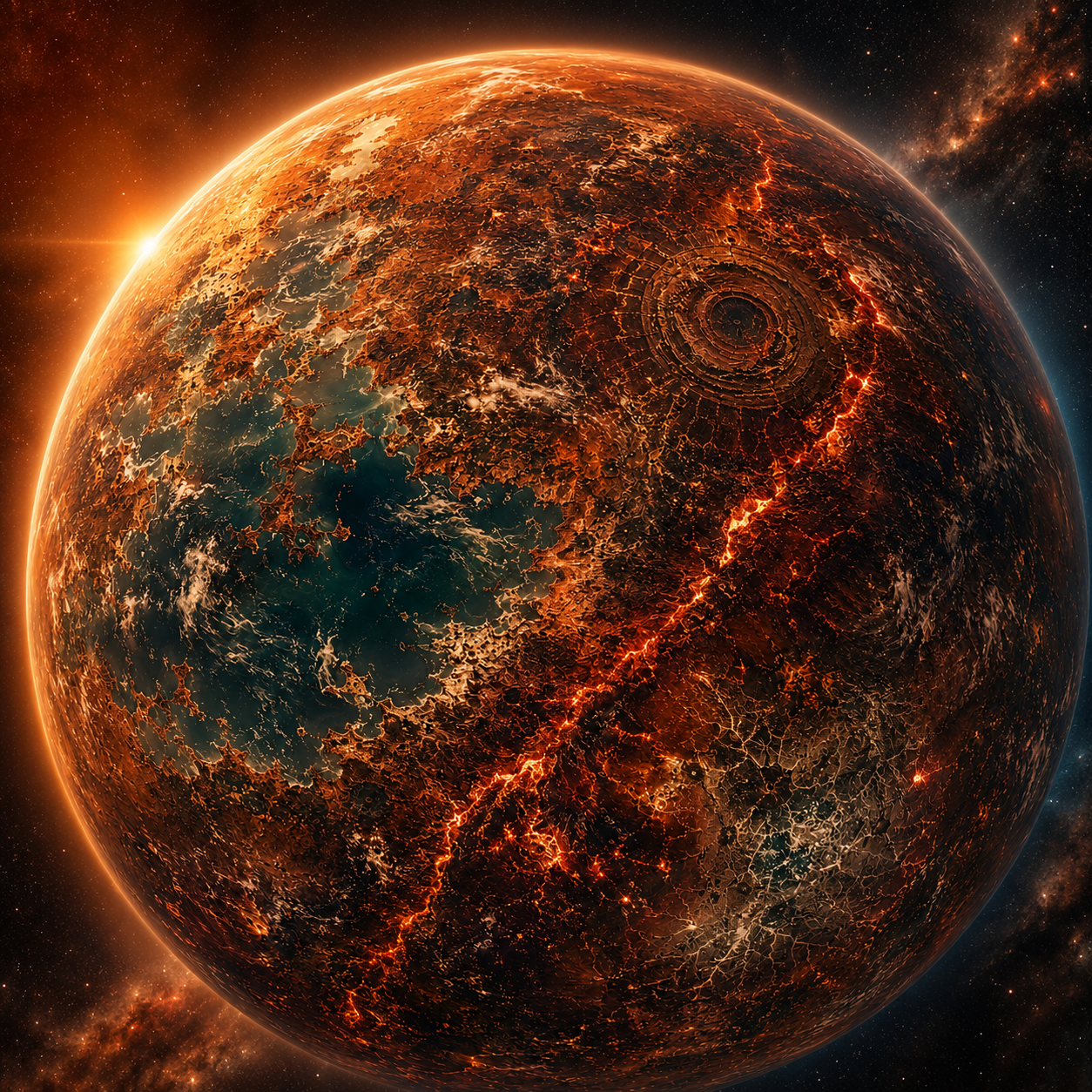
Thauzuno’s geography is defined by catastrophic tectonic activity and volatile surface evolution—a world locked in perpetual geologic upheaval. The planet’s crust is divided into eight primary plates and numerous microplates, all moving under the immense strain of mantle convection intensified by Vra’ath’s tidal resonance. The most prominent feature, the Vol’Zhar Rift, cuts diagonally across the eastern hemisphere like a planetary scar—an incandescent fault zone where the mantle bleeds onto the surface through thousands of lava vents. From orbit, the fissure glows as a continuous artery of molten light stretching over 16,000 kilometers, intersecting with a circular caldera structure known as the Vorthan Plateau, a collapsed supervolcano roughly 900 kilometers in diameter. The plateau’s concentric ridges and radial faulting patterns suggest multiple eruption epochs, each ejecting enough material to alter atmospheric density and global albedo. Spectroscopic mapping indicates that the surrounding basaltic plains contain high concentrations of ferric oxides, magnesium silicates, and vitrified crust glass, giving Thauzuno its copper-orange hue under Craehlil’s light. Planetary geophysicists estimate crustal thickness variations from 32 kilometers beneath the oceans to less than 18 kilometers near active rifts, implying mantle plumes in direct contact with the lithosphere. The planet’s seismic activity is nearly continuous, with microquakes recorded every forty seconds and megathrust events every two to four cycles, maintaining a state of surface renewal rather than decay.
Across the western hemisphere lies the Thauric Basin, a vast depression filled by the planet’s largest surviving oceanic body—the Mare Shalvek. This irregular, multi-lobed sea covers approximately 37.9% of Thauzuno’s total surface area and is encircled by a chain of semi-submerged volcanic archipelagos formed from collapsed continental shelves. From orbit, its teal coloration contrasts sharply with the surrounding scorched terrain, though the hue derives from dissolved copper sulfates, silicon particulates, and photoreactive mineral plankton rather than organic chlorophyll. The basin is shallower than Earth’s oceans, averaging 2.8 kilometers in depth, and heated from below by geothermal upwellings that maintain near-boiling temperatures along its tectonic margins. Surface thermal gradients create persistent cyclonic systems that move clockwise across the basin, drawing moisture inland toward equatorial fissures where it condenses and falls as corrosive rainfall. The Mare Shalvek’s boundaries are constantly reshaped by subduction-driven instability—entire peninsulas can sink or reemerge within a few centuries, producing fractured coastlines of obsidian, oxidized clay, and metallic sediment. Inland, evaporated seas have left behind vast expanses of alkaline flats and crystalline crust, forming natural mirrors that reflect sunlight with dazzling intensity. These reflective regions, known as the Craehl Mirrors, significantly affect the planet’s heat distribution, bouncing thermal energy into the upper atmosphere and amplifying the intensity of equatorial storms.
Toward the southern hemisphere, the Drethmaar Continent dominates—a rugged, mineral-rich landmass scarred by pyroclastic plains, fissured mountains, and ancient impact basins now filled with oxidized brine. The region’s interior hosts enormous lava deltas and pressure ridges formed by tectonic compression where molten rock once intruded into crustal fractures. Active fissure systems release constant columns of superheated gas, generating glowing atmospheric auroras that encircle the poles and shimmer in the copper light of the horizon. The planet’s rotational wobble and high eccentricity (0.092) sustain this geological instability, as each orbital cycle reactivates subsurface magma chambers that periodically breach the crust. To the north, the Drosshollow Continent stands as a petrified reminder of the planet’s hydrological past—a network of desiccated riverbeds, fossilized lake basins, and deep, shadowed canyons carved by long-vanished water systems. Despite its desolation, radar mapping reveals sealed aquifers beneath layers of fused basalt and silica, providing the last remnants of native groundwater and forming the mineral source for regional trade. The remaining oceans and fracture seas, though corrosive and unstable, define Thauzuno’s modern equilibrium: a surface split between molten fire and surviving water, between destruction and endurance. From orbit, the planet’s geography captures a balance that is both violent and exquisite—a living geological engine where continents bleed, oceans shimmer with chemical luminescence, and the crust itself pulses with heat from below.
Climate
Thauzuno’s climate is a direct consequence of its volatile axial geometry, high orbital eccentricity, and geologic activity—an unstable equilibrium where atmosphere, temperature, and pressure operate in cycles of violent transformation rather than seasonal rhythm. The planet’s axial tilt of 31.8° and slow precessional wobble of 19,500 years create hemispheric asymmetry in solar exposure, resulting in hemispheres that alternate between extremes of searing heat and cryogenic dormancy. Average global temperatures hover near 47°C (116.6°F), yet the thermal contrast between regions can exceed 150°C within a single orbital phase. The atmosphere, dense at 2.35 atm, traps radiant heat through a cocktail of nitrogen oxides, volatile hydrocarbons, and industrial aerosols, generating a runaway greenhouse effect that converts heat differentials into powerful atmospheric currents. Meteorological modeling by orbital probes indicates a planet-wide convection cell structure similar to a magnified Hadley system, where rising equatorial heat forms megastorm belts that drive abrasive winds reaching over 300 km/h. These winds, charged with ferric particulates and ionized dust, sculpt the planet’s surface through relentless erosion and electrical discharge, forming transient plasma sheets that flicker across the horizon during storm phases.
Seasonal shifts on Thauzuno are defined not by the calendar but by orbital proximity to its star, Craehlil. During perihelion, ultraviolet radiation saturates the upper atmosphere, producing thermal inversions that destabilize stratification and trigger temperature cascades. Vast columns of superheated air rise through the troposphere, condensing toxic vapor clouds that rain nitric acid, molten silicates, and polymeric soot onto the surface. These precipitation events, known as Craehl Rains, are sporadic yet catastrophic, dissolving unshielded structures and leaving behind mineralized residue that contributes to the planet’s rust-red hue. Conversely, during aphelion, the diminished solar flux plunges temperatures in mid-latitude regions below freezing, forming surface frost from sublimated atmospheric water vapor. These freeze phases can last for weeks, locking volatile gases into crystalline deposits that burst explosively when re-exposed to heat, releasing localized thermal storms. At higher altitudes, jetstream collisions between equatorial and polar air masses form hyperdense turbulence zones known as shear fronts, generating lightning arcs that stretch for hundreds of kilometers. These phenomena inject charged particles into the magnetosphere, creating temporary auroral bands that oscillate across both poles in copper and violet wavelengths—visible even from orbit.
Hydroclimatic behavior across Thauzuno is erratic, governed less by evaporation-condensation balance and more by geothermal activity and chemical volatility. The Mare Shalvek ocean acts as both a heat sink and atmospheric engine, its near-boiling waters generating continuous updrafts of superheated vapor that fuel planetary convection. Moisture plumes rise and cool rapidly, forming thick, stratified cloud decks rich in metallic ions that scatter sunlight into a perpetual amber glow. Surface barometric pressure differences between the ocean basins and highland volcanic ridges trigger relentless gale systems—circular jet fronts that sweep the planet’s midsection in synchronized rotation. In equatorial zones, abrupt thermal gradients can produce “flash fronts,” events where temperature and pressure shift so violently that air columns implode, creating sonic booms and spontaneous lightning discharges. The polar regions, meanwhile, experience extended thermal stagnation: stagnant cold traps where gases solidify, then thaw in cascading cycles that drive explosive methane geysers. Over centuries, these processes have stabilized into a quasi-predictable macroclimate—self-correcting through destruction, maintaining atmospheric density through volcanic replenishment, and recycling aerosols via storm deposition. Thauzuno’s climate is not temperate, nor chaotic—it is alive in the geophysical sense, a planetary respiration of heat and pressure, ever rebalancing on the edge between equilibrium and annihilation.
Biodiversity
Thauzuno’s biosphere has long since crossed the threshold from biological evolution into ecological entropy. Natural plant life has been extinct for over a thousand years; the once-diverse photosynthetic ecosystems collapsed under the combined weight of industrial toxicity, atmospheric corrosion, and genetic collapse. The planet’s surface, once host to vast equatorial forests and bio-reactive wetlands, is now dominated by synthetic analogs—engineered lichen-films, spore mats, and residual microbial colonies surviving in chemically buffered niches. These remnants function less as living organisms and more as self-repairing biochemical systems that metabolize metallic oxides, nitrates, and trace hydrocarbons. Oxygenic photosynthesis no longer occurs naturally; instead, planetary respiration is maintained through chemosynthetic microfauna that inhabit geothermal vents and industrial runoff basins. Over time, evolution has been supplanted by adaptation through necessity—species no longer evolve across generations but persist through biochemical inertia. Even these residual forms face ongoing extinction as global temperatures, radiation levels, and chemical volatility intensify. Pre-Fall historical records, concealed and classified under the Rav’thuun Syndicate’s control, confirm the existence of once-dominant wildlife such as the Shadowcats, Thauzunian Grey Wolves, Thauzunian Red Wolves, Cave Elk, Thauzunian Rats, and Spore-Hens—all now extinct, their skeletal remains fossilized beneath sediment layers rich in ash and polymer dust. They were the last of the planet’s true macroscopic fauna, victims of ecosystem collapse accelerated by trophic starvation and atmospheric instability.
Modern Thauzuno’s biodiversity is almost entirely composed of extremophiles—microbial, arthropodic, and semi-synthetic organisms that inhabit narrow biochemical margins. These lifeforms occupy geothermal vent zones, deep fissure networks, and evaporative basins where heat, pressure, and toxicity exceed conventional biological tolerance. Among the surviving biota, the bio-reactive moss analogs remain the most abundant; they metabolize synthetic hydrocarbons and sequester heavy metals through catalytic biofilms, leaving behind crystalline excretions that form a mineral crust over urban ruins and crater fields. When agitated by pressure or temperature change, these organisms release reactive spore clouds capable of corroding composite surfaces and disrupting electrical circuits—a mechanism evolved from the same chemical volatility that defines their environment. Insectoid scavengers have likewise adapted to exploit Thauzuno’s artificial detritus, forming colonies in reactor husks and derelict megastructures. These scavengers exhibit bio-metallic integuments and semi-autonomous behavior, operating through distributed neural clusters that allow rapid environmental response. Larger scavenger species, such as the thermophilic carrion eels and anaerobic crustacean analogs, persist in acid pools and industrial runoff channels, converting toxic residues into stable molecular compounds. Despite their simplicity, these organisms form a crucial bridge between abiotic and post-biotic processes—maintaining a semblance of ecological circulation in a world where natural life has ended.
Artificial organisms—descendants of corporate bioengineering projects—form the upper strata of Thauzuno’s surviving fauna. The Khe’raiv, vast arthropodic constructs once engineered for deep-mining and atmospheric filtration, now roam freely, consuming heavy metals and exhaling inert slag. These entities are often mistaken for tectonic motion when observed from orbit due to their immense size and slow migration patterns. Similarly, the Varsh’ka—genetically fused war-beasts originally bred for urban combat—continue to persist in isolated territories, their chitinous armor oxidized to near-metallic hardness. They feed primarily on energy residues and decaying composites rather than living prey. Aquatic life is limited to the chemically adapted remnants of synthetic plankton and thermotolerant cephalopods inhabiting the Mare Shalvek, whose metabolism relies on hydrocarbon oxidation rather than oxygen respiration. Some of these species, such as the engineered Rellithar cephalopods, display vestigial neural implants and bio-luminescent communication patterns—technological residues from their artificial creation. With the extinction of Thauzuno’s natural predators and flora, ecological competition has shifted from biological to thermodynamic: survival is defined by efficiency in energy capture and resistance to corrosion. The biosphere of Thauzuno no longer mirrors a living world—it operates as an ongoing chemical reaction, an inheritance of life redefined by entropy, heat, and the persistent shadow of its engineered past.
Moon
Thauzuno is orbited by a single natural satellite—Vra’ath—an airless, heavily cratered world that mirrors its parent planet’s instability and ancient violence. Roughly 0.18 times the mass of Thauzuno and with a diameter of 3,210 kilometers, Vra’ath is tidally locked, presenting one face eternally toward its parent while the far side remains in permanent shadow. Its surface is dominated by basaltic plains, impact basins, and vast fault ridges formed by repeated meteorite bombardment during the early formation of the Craehlil System. Radiometric dating places the moon’s crustal formation at approximately 7.12 billion years ago, suggesting it coalesced from the same debris field that gave rise to Thauzuno after a major proto-planetary collision. The near side is marked by extensive mare regions—ancient lava plains that cooled into high-density silicate glass—interspersed with crater chains reaching hundreds of kilometers across. These lowland areas absorb a disproportionate amount of solar radiation, causing extreme temperature fluctuations between day and night. During direct solar exposure, surface temperatures can reach upwards of 412°C (774°F), while the shadowed far side plummets below -160°C (-256°F). This thermal disparity drives periodic sublimation of trapped volatiles from crater walls, forming transient vapor plumes that dissipate within minutes under solar wind bombardment. Vra’ath’s crust is heavily fractured, laced with kilometer-deep fissures caused by tidal stress from Thauzuno’s gravitational pull, and dotted with ejecta debris from secondary impacts.
The moon’s orbital eccentricity (0.021) and distance—roughly 364,000 kilometers from Thauzuno’s surface—exert continuous tidal stress on the planet’s crust, amplifying seismic cycles and contributing to the rhythmic pulsing of the Vol’Zhar Rift. Each perigee alignment induces measurable shifts in Thauzuno’s oceanic bulges and magma flow, triggering what planetary geologists call the Vaarn Cycle: a repeating pattern of minor quakes and crustal breathing events lasting several days. Over geological timescales, this resonance has profoundly altered Thauzuno’s rotational stability and axial precession rate, introducing the erratic climatic oscillations that define its present-day weather extremes. The gravitational coupling between planet and moon generates an internal heating effect within Vra’ath itself, keeping its core marginally molten despite its small size and lack of atmosphere. This residual geothermal activity manifests as faint infrared emissions along the terminator line and minor outgassing from fissure vents near the equatorial scar region, where seismic cracks expose darker subsurface basalt. Vra’ath’s magnetic field is weak but patchy, composed of remnant magnetization locked into ferrous rock from its early dynamo phase. Combined with its constant exposure to cosmic radiation, the moon’s surface is an active laboratory of particle bombardment, producing complex regolith chemistry that includes charged silicates, ionized carbon compounds, and frozen micro-oxides.
From orbit, Vra’ath appears both luminous and desolate—a mirror reflecting Thauzuno’s own ruin. The near side, scarred by eons of impacts, glows faintly amber under Craehlil’s light, while the far side remains cloaked in eternal night, a crypt of unbroken silence. The lack of atmosphere allows for direct observation of solar flares and cosmic ray streams, which occasionally interact with residual electromagnetic traces in the regolith to create localized electrostatic discharges—ghostly blue arcs that dance silently across the crater rims. Gravitational models indicate that Vra’ath’s continued tidal influence will gradually slow Thauzuno’s rotation over the next 20 million years, elongating its days and amplifying crustal tension across the equatorial rift zones. Despite its lifelessness, the moon remains a stabilizing counterweight—its gravitational resonance preventing Thauzuno’s orbit from collapsing into chaos. Long-range scans have detected high concentrations of platinum-group metals and frozen volatiles within permanently shadowed craters, remnants of cometary impacts that may once have seeded Thauzuno’s oceans before industrial ruin. Today, Vra’ath endures as both a geological archive and a silent participant in Thauzuno’s evolution: a dead satellite orbiting a dying world, bound forever in gravitational symmetry, each shaping the other’s scars.
Residents
The Vey’Zari are a near-human race native to Thauzuno, whose existence revolves around survival through precision, negotiation, and utility. They inhabit a sprawling network of cities dot the hazardous landscape. No single authority governs the Vey’Zari. Society is stratified by syndicates, corporate holdovers, mercenary guilds, data unions, and localized contract clusters. Every zone operates under its own code set—some formalized, others enforced through social cohesion, digital pressure, or direct action.
The Vey’Zari have no need for permanence. Cultural expression is encrypted: graffiti layered with metadata, clothing woven from recycled ledger fragments, and music encoded in ultrasonic bursts. Everything is aestheticized for use—fashion doubles as identity tokening, tattoos are legal footnotes, and a person's dialect marks their social cluster and negotiation tier. In Vey’Zari society, strength is found in both control, but in precision.



Comments