

Teshuun
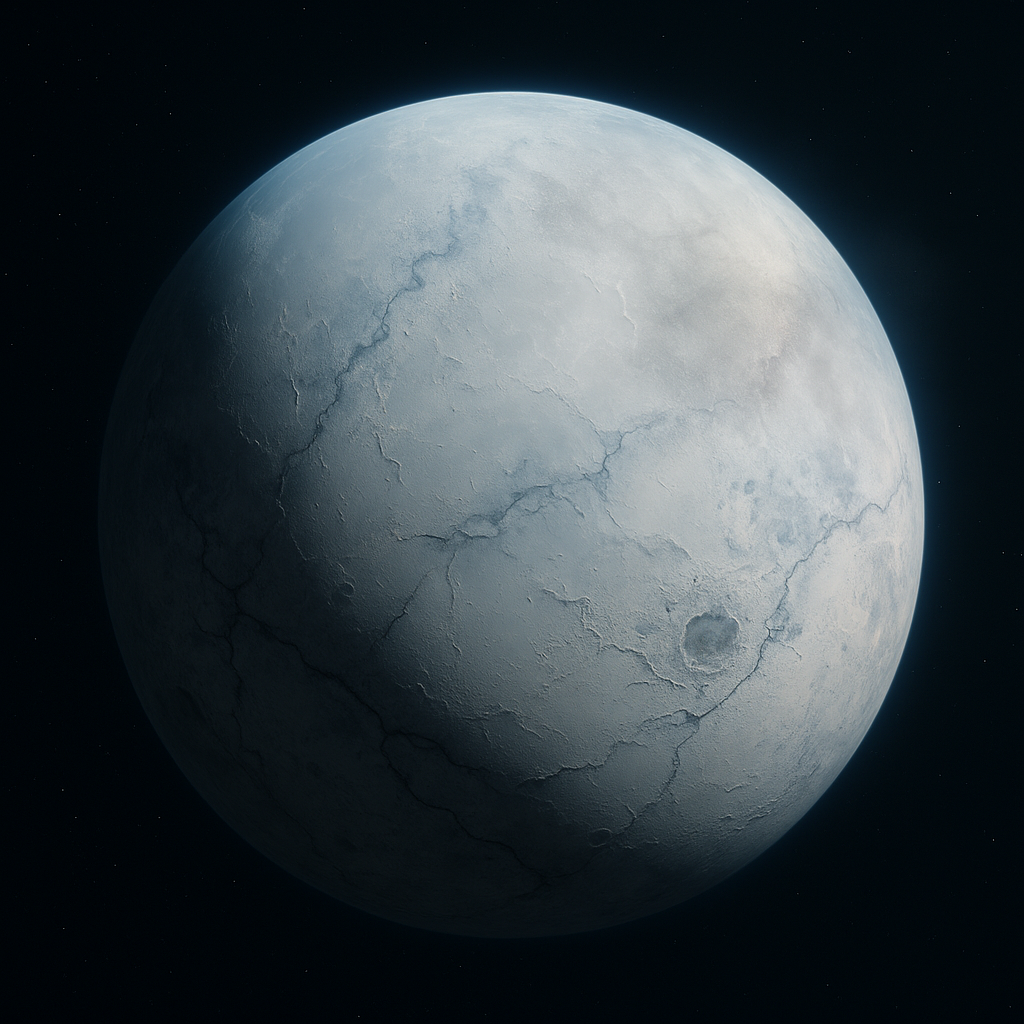
Teshuun, formally designated Craehlil VII, is the seventh and outermost major planet of the Craehlil System in the Orion Arm of the Milky Way Galaxy, orbiting Craehlil at a semi-major axis of 14.12 AU. Classified as a rogue ice world, Teshuun is infamous for its erratic, highly elliptical orbit and its passage through the system’s distant debris fields. The planet’s surface is dominated by thick layers of frozen nitrogen, methane, and ammonia, mantled over a silicate-ice mantle and a presumed rocky core. Glacial fractures, deep impact scars, and migrating cryovolcanic vents mark a world in constant flux, with tidal and radiogenic heating occasionally triggering geyser eruptions and atmospheric haze events. Teshuun’s orbit brings it periodically close to the system’s heliopause, where solar influence wanes and interstellar cold prevails, plunging the planet into extended periods of deep freeze and atmospheric collapse.
Though uninhabitable by any known biosphere, Teshuun serves as both a scientific curiosity and a marginal resource frontier for the system’s syndicates and exploration enclaves. Historical records suggest Teshuun was once a captured object, its present instability a legacy of ancient gravitational encounters—possibly with the gas giant Ravla or a now-absent system member.
Teshuun
Astrographical Information
Galaxy
Milkyway
Galactic ArmOrion
SystemCraehlil System
OrbitingCraehlil
Orbital positionSeventh Planet
Orbital Distance14.12 AU (2,115,464,400 km)
Orbital characteristics
Aphelion
16.43 AU (2,460,236,000 km)
Perihelion10.97 AU (1,643,229,700 km)
Semi-major axis14.12 AU (2,115,464,400 km)
Eccentricity0.244
Orbital period (sidereal)18,679.4 days
Average orbital speed3.5 km/s
Mean anomaly17.4°
Inclination- • 2.9° – Craehlil's equator;
- • 2.5° – invariable plane;
- • 4.3° – J2000 ecliptic
218.1°
Time of perihelion9,330.7 days
Argument of perihelion129.4°
Moon(s)4
Physical Information
Diameter
9,312 km (5,785.6 mi)
Mean radius4,656 km (2,892.8 mi)
Equatorial radius4,662 km (2,896.6 mi)
Polar radius4,650 km (2,889.0 mi)
Flattening0.0026
Circumference- 29,273 km; equatorial
- 29,201 km; meridional
- Land: 272,550,000 km² (frozen ices & silicate crust)
- Water: 0 km² (trace clathrate deposits)
4.22 × 10¹¹ km³
Mass1.1 × 10²⁴ kg
Mean density1.43 g/cm³
Surface Gravity4.2 m/s²
Moment of inertia factor0.336
Escape velocity4.8 km/s
Synodic rotation period33.2 Hours
Sidereal rotation period32.7 Hours
Equatorial rotation velocity90.2 m/s
Axial tilt27.2°
Axial Precession41,300 years (influenced by orbital eccentricity and cryovolcanic mass shifts)
Albedo- 0.67 geometric
- 0.52 Bond
Temperature 21–74 K
Surface Temperature- -249°C (-416°F) Min
- -213°C (-351°F) Mean
- -133°C (-207°F) Max
0.3 μGy/h
Surface equivalent dose rate0.5 μSv/h
Apparent magnitude+5.7" to +9.2"
Absolute magnitude (H)7.81
Atmosphere
Surface pressure
0.021 kPa; ~0.0002 atm (tenuous nitrogen-methane envelope)
Composition by volume- 72.3% Nitrogen
- 19.4% Methane
- 4.2% Ammonia
- 2.6% Carbon monoxide
- 1.0% Argon
- 0.5% Trace volatiles (ethane, hydrogen cyanide, acetylene, seasonal haze)

Comments