

MR2 Buffalo
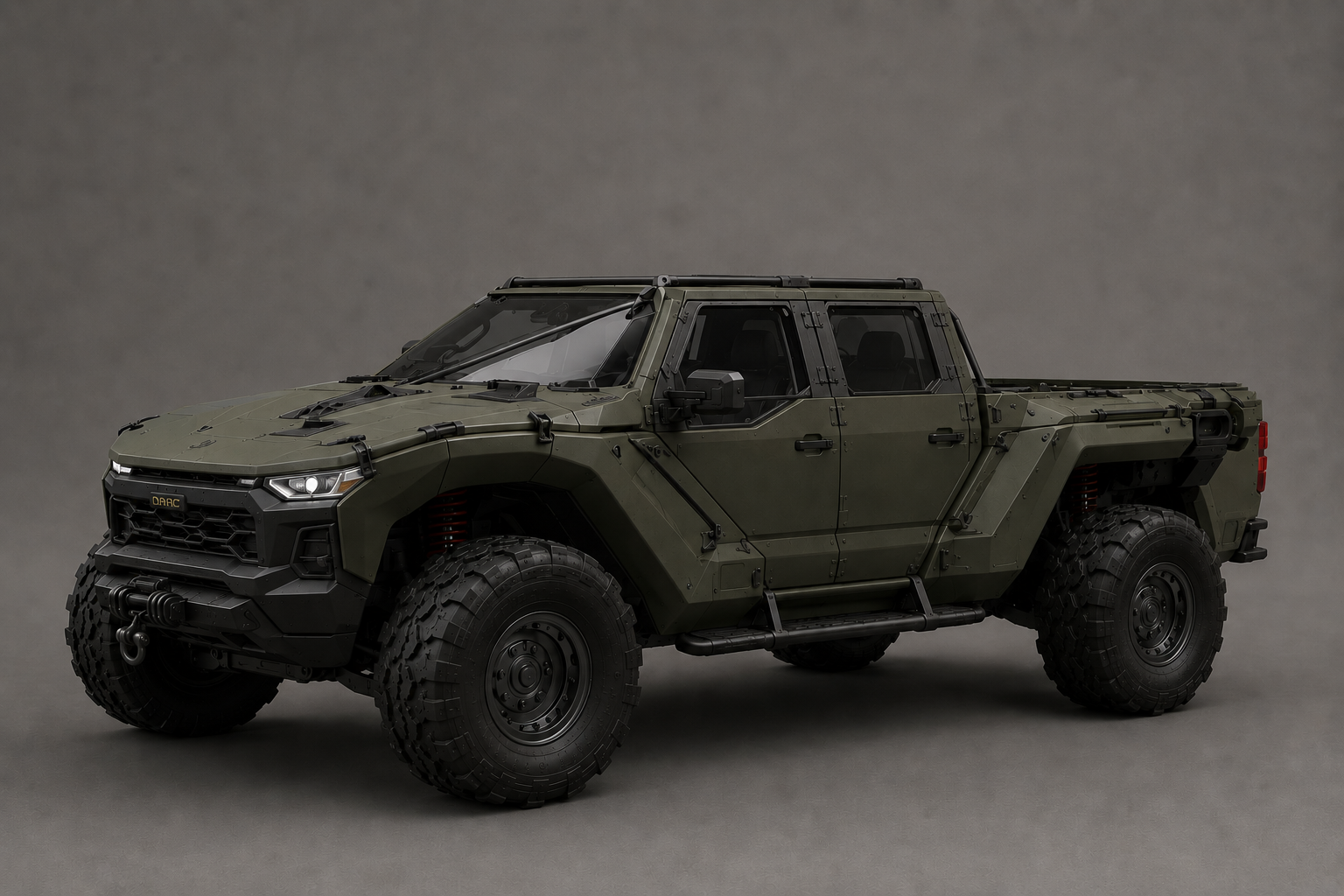
The MR2 Force Application Vehicle (MR2 FAV), more commonly known as the Buffalo, is a Chevrolet-branded series of compact light utility pickup trucks co-designed and manufactured by General Motors and Defense Transportation Corps, and later mass manufactured by Mars Corps Armory starting in 2490, for use by the United Space Command Armed Forces' primary joint light tactical ground vehicle. Its variants are capable of performing armament carrier, utility, reconnaissance and a variety of other tactical and support roles. It is a highly mobile, all-wheel-drive, hydrogen-injected ICE-powered vehicle equipped with a manual transmission.
The most ubiquitous models are the MR2 Light Reconnaissance Vehicle variants, which are equipped with advanced surveillance and a rear turret-mounted machine gun for an enhanced defensive capability. The MR2 and its predecessors such as the B-70 Tigercat have been a part of the USC Armed force's mechanized infantry divisions and armored vehicle divisions since 2109 and is the most publicly recognizable vehicle in their arsenal. By the later stages of the Second Nuclear War, a second chassis variant of the MR2 known as the MR2B Buffalo entered service with some USC Armed Forces' units.
Design details
MR2 Buffalos can use a four-wheel drive system, with active all-wheel steering, a manual transmission and a 12-liter hydrogen-injected internal combustion engine. The ICE powers an infinitely variable transmission. MR2 Buffalo variants can have a top speed of 125 kilometers per hour (78 mph) or 100 kilometers per hour (62 mph). and its hydrogen tanks can power a maximum range of 790 kilometers (490 mi). The Buffalo can employ "Slop" to help render carbon heavy matter into useable fuel for the power plant or employ a Graf/Hauptman Solar/Saline Actuator to filter water or crack it into fuel.
All MR2-based vehicles are designed to travel both on and off-road, in all weather conditions though it is regarded as a huge, unwieldy, difficult to steer vehicle — until a user learns how to drive it properly. The Buffalo has superb traction on off-road terrain and an updated braking system alongside enhanced suspension. With proper application of the hand, or "e-brake" the MR2 can actually turn on a dime. Massive disc brakes and its automatic braking systems allow the vehicle to come to a near immediate, but controlled stop should the driver be ejected, or choose to leave the vehicle. The MR2 Buffalo shares parts – and handling characteristics – with the Chevrolet Colorado zh2 and its sibling frontier trucks, which means that many recruits are already proficient with basic vehicle maintenance and off-road driving skills before they ever arrive at USC military boot camp.
The base model of the MR2 has a total seating of four (though additional personnel can be carried in the cargo bed, be it a single gunner or multiple additional riders). The instrumentation package available to the driver or passenger include GPS, navigational assistance, emergency beaconing and dataports. The Buffalo has armor plating covering the vehicle's chassis and the front of the mounted turret capable of resisting conventional heavy machine gun fire and improvised explosive devices. The Buffalo's armor plating is comprised of ballistic polycarbonate and carbon nanotubes, built upon a titanium frame. However, USC military service personnel typically believe the vehicle could benefit from an armor upgrade.
Variants
Given the Buffalo's extensive service life, the vehicle has seen dozens of alterations and produced variants. The turret in the back of the vehicle is removable and replaceable, allowing the same basic chassis to be converted for different field roles without requiring an entirely separate vehicle family. Although some Buffalos are used solely for transportation, most are armed and have a multi-mission capability, with variants capable of performing armament carrier, utility, command and control, shelter, ambulance, reconnaissance, and tactical or logistic support roles. Major variations are informally named by their year of production, though crews often identify them by weapon fit or mission role.
The armament of a given Buffalo vehicle typically decides its designation, with the most ubiquitous being the M99 chaingun, seen on MR2 Light Reconnaissance Vehicle configurations. Other common weapon fits include the G57 rocket turret, P21 Gauss cannon, or G65 rocket launcher. Stock Buffalos lacking any armament are sometimes referred to as Scout Buffalos. Other Buffalo variants also exist, one of the more common ones being the MR78 Troop Transport Buffalo. Some Buffalos are also created for specialized environments including the MR88 and MR89 Arctic Buffalos, MR68 Tropic Buffalo and the MR91 Recovery Vehicle.
- Chain Buffalo — The MR2 Chain Buffalo is visually similar to the standard MR2 Buffalo but fitted with a manned M99 chaingun in the rear bed. This model is the most common armed variant and is widely used for patrol, convoy escort, base security, reconnaissance support, and fast-response infantry movement. The rear weapon mount gives the vehicle a strong defensive arc while keeping the Buffalo light enough to retain most of its speed and off-road handling. Because the M99 system is familiar to many USC ground crews, the Chain Buffalo is easy to maintain compared to heavier weapons variants.
- Rocket Buffalo — The MR2 Rocket Buffalo is a variant of the Chain Buffalo fitted with either a manned G57 rocket turret or G65 rocket launcher and enhanced targeting-tracking computing systems. It is generally used when infantry units require heavier fire support than a chaingun can provide but do not have immediate access to armored vehicles or air support. Rocket Buffalos are commonly assigned to anti-armor screens, hardened-position suppression, convoy overwatch, and defensive perimeter duty. The added launcher system increases the vehicle’s battlefield value, but it also makes the rear bed heavier and more exposed than the standard Chain Buffalo.
- Gauss Buffalo — The MR2 Gauss Buffalo is a prototype precision-fire variant fitted with a P21 Gauss cannon in place of the standard rear weapon system. It is used for long-range direct fire, anti-vehicle work, and hard-target engagement where rockets would be excessive or difficult to employ safely. The Gauss Buffalo is less common than the Chain Buffalo due to the cost, maintenance needs, and power demands of the weapon system. Crews value it for its accuracy, speed of engagement, and ability to disable enemy vehicles before they close distance.
- Transport Buffalo — The MR78 Troop Transport Buffalo is a personnel-carrier variant designed to move small infantry elements, security teams, or support personnel across rough terrain. Instead of a heavy rear weapon, the cargo area is fitted with an open troop frame, bench seating, and reinforced side structure. The MR78 is commonly used behind the main line, around bases, during evacuations, and in patrol zones where mobility matters more than heavy armament. While it can still carry light defensive weapons, its main purpose is moving people and equipment quickly without requiring a larger armored transport.
- MR88 Arctic Buffalo — The MR88 Arctic Buffalo is a cold-weather variant built for polar regions, frozen colony zones, and long-range patrols in snow-heavy terrain. It uses sealed engine fittings, insulated fuel and water systems, reinforced heating, modified tires, and cold-rated electronics to prevent failure in extreme temperatures. Its suspension and traction systems are tuned for ice, snowpack, and unstable frozen ground.
- MR89 Arctic Buffalo — The MR89 Arctic Buffalo is a heavier tread-powered model intended for longer operations and harsher conditions than the MR88. It carries improved environmental sealing, stronger cabin insulation, expanded survival storage, and equipment mounts for rescue gear, communications equipment, or cold-weather field kits. It is commonly used by USC units assigned to remote outposts, glacier routes, and winter combat zones.
- MR68 Tropic Buffalo — The MR68 Tropic Buffalo is a hot-weather and jungle-capable variant designed for humid, wet, and overgrown environments. It uses upgraded cooling, corrosion-resistant plating, sealed electrical systems, improved air filtration, and tires suited for mud, soft soil, and heavy rain. The MR68 is commonly used on colony worlds with dense vegetation, monsoon seasons, or coastal lowland terrain.
- MR91 Recovery Vehicle — The MR91 Recovery Vehicle is a support variant used to retrieve damaged Buffalos, disabled light vehicles, and stranded equipment. Its rear bed is fitted with recovery gear instead of a primary weapon system, including a reinforced winch, tow frame, repair tools, field jacks, and spare parts storage. It is not meant for frontline assault, but it is heavily valued by USC mechanics and convoy units because it keeps patrol groups mobile after breakdowns, ambushes, or terrain accidents.
MR2 Buffalo
Production information
Designer
Defense Transportation Corps in collaboration with General Motors
ManufacturerMars Corps Armory
Product lineBuffalo
ModelMR2
Cost$578,000
Technical specifications
Length
6 meters (20 ft)
Width3 meters (9.8 ft)
Height3.2 meters (10 ft) (basic model)
Mass3 metric tons
Maximum speed125 km/h (78 mph)
Engine(s)12.0 L liquid-cooled hydrogen-injected ICE
HullBallistic polycarbonate, titanium, carbon nanotube
ArmamentVariable
Crew1 driver, 3 passengers, 1 gunner (varies by model)

Comments