Krovenn (Krovenna, meaning 'Stormborne') are the sole abundant and widespread species of primates, characterized by bipedality, hairlessness, and large, complex brains enabling the development of advanced technology, culture, and language. Krovenn are highly social beings and tend to live in complex social structures composed of many cooperating and competing groups, from families and bloodline networks to imperial states. Social interactions between krovenn have established a wide variety of values, social norms, and rituals, which bolster krovenn society. Endurance and the krovenn desire to survive and influence the environment have motivated krovenn development of science, philosophy, religion, mythology and other fields of knowledge.
Krovenn have a large and highly developed prefrontal cortex, the region of the brain associated with higher cognition. They are intelligent beings, capable of episodic memory, flexible facial expressions, self-awareness and a theory of mind. The krovenn mind is capable of introspection (meta-cognition), private thought, imagination, volition and forming views on existence. Krovenn can also mentally travel through time (chronesthesia) which signifies episodic foresight. These attributes have allowed great technological advancements through reason and the transmission of knowledge to future generations. In cultural anthropology, the cumulative preservation and advancement of knowledge across generations is known as the Stormburn Effect.
Krovenn are carnivorous, capable of consuming a wide variety of animal material, and have used fire to prepare and cook food since the time of the Varkathi. They can survive for up to eight weeks without food, and three or four days without water. Krovenn are generally diurnal, sleeping on average seven to nine hours per day. Childbirth is dangerous, with a high risk of complications and death. Both the mother and the father typically provide care for krovenn offspring who are helpless at birth.
Genes and the environment influence krovenn biological variation in appearance, physiology, immune system, mental abilities, body size and lifespan. Though krovenn vary in many traits, any two krovenn are on average over 99% genetically similar, with the most genetically diverse populations originating from the Highveil Expanse and the tectonic troughs of the Scathmarch. The greatest degree of genetic variation exists between males and females. On average, males have greater body strength and females generally have a higher muscular endurance percentage. Females undergo Storm-Burn and become infertile potentially decades before the end of their lives. They also have a longer life span in almost every population across Draxion-8. The division into male and female gender roles has varied historically, and challenges to predominant gender norms have recurred in many societies.
Krovenn evolved from earlier drakariids on Draxion-8 several million years ago. Although some storm priests equate krovenn with all members of the genus Krovenna, in common usage it generally refers to Krovenna rex, the only extant member. Krovenna rex emerged around 280,000 years ago out of the surrounding basins, gradually replacing local populations of archaic drakariids such as the Varkathi, and Tholrenn. Early krovenn were hunter-gathers, before the invention of agriculture and the domestication of animals led to permanent settlements in the Fertile Basin and other cradles of civilization. As food surpluses enabled populations to become larger and denser, forms of governance developed, the use of writing became necessary, and a number of civilizations rose and fell. Krovenn have continued to expand, with over 1.9 billion krovenn occupying almost all regions of Draxion-8 in 9745. Moreover, krovenn have expanded across their entire home system, and have even conquered and colonized the Verdaxa and Korran's Reach systems, and are actively expanding to further systems.
Biology
Anatomy and physiology
Most aspects of krovenn physiology are closely homologous to corresponding aspects of animal physiology. The dental formula of krovenn is:
2.1.2.3
2.1.2.3
, like other catarrhines. Krovenn have proportionately shorter palates and much smaller teeth than other primates. They are the only primates to have short, relatively flush canine teeth. Krovenn have characteristically crowded teeth, with gaps from lost teeth usually closing up quickly in young individuals. Krovenn are gradually losing their third molars, with some individuals having them congenitally absent.
Krovenn share with the rhazkari a vestigial tail structure, appendix, flexible shoulder joints, grasping fingers and opposable thumbs. Krovenn also have a more barrel-shaped chest in contrast to the funnel shape of other drakariids, an adaptation for high-gravity respiration. Apart from endurance adaptation and brain size, krovenn differ from earlier drakariids mostly in smelling, hearing and digesting proteins. While krovenn have a density of hair follicles comparable to other drakariids, it is predominantly fine vellus hair, most of which is so short and wispy as to be practically invisible. Krovenn have approximately 3 million sweat glands spread over their entire bodies, many more than the varkathi, whose sweat glands are scarce and are mainly located on the palms and soles.
It is estimated that the imperial average height for an adult krovenn male is about 221 cm (7 ft 3 in), while the imperial average height for adult krovenn females is about 206 cm (6 ft 9 in). Shrinkage of stature may begin in middle age in some individuals but tends to be typical in the extremely aged. Throughout history, krovenn populations have universally become larger and taller, probably as a consequence of improved nutrition, medical engineering, and fortress living conditions. The average mass of an adult krovenn is 182 kg (401 lb) for females and 247 kg (544 lb) for males. Like many other conditions, body weight and body type are influenced by both genetic susceptibility and environment and varies greatly among individuals.
Krovenn have far faster and more accurate throwing ability than most known species. Krovenn are also among the best long-distance endurance predators on Draxion-8, but slower over short distances than many native fauna. Krovenn thinner body hair and highly productive sweat glands help avoid heat exhaustion while moving for long periods beneath the Howlveil. Compared to earlier drakariids, the krovenn dual-heart system produces greater stroke volume and circulatory output, and the primary aortic channels are proportionately larger. Krovenn possess a closed circulatory network consisting of two hearts and blood vessels. This dual-heart system is an important adaptation for maintaining oxygen and nutrient delivery under extreme stress, particularly during prolonged exertion or combat. Their blood is dark, nearly pitch-black, due to high concentrations of melanin-rich hemoglobin, a trait that grants additional protection against radiation, electromagnetic interference, and oxidative damage.
Krovenn skeletal systems are hyper-adapted for high-gravity endurance and close-quarters combat. Krovenn possess unusually dense bones engineered to absorb shock and support their large frames during rapid impact or sustained force. Their musculature is layered and thick-fibered, combining explosive power with long-duration stamina. Tendons, particularly around the joints, allow for high-speed movement without tearing. Krovenn respiratory and sensory systems are equally optimized for endurance and battlefield utility. Their lungs are reinforced with flexible ribbed chambers capable of expanding under pressure, filtering toxins and particulates through layered tissue filtration meshes. Auxiliary storm-valves within the sinuses seal against wind shear and pressure fluctuations. Vision is adapted for high-contrast environments; krovenn eyes include a reflective tapetum lucidum layer, granting superior low-light and fog penetration. Recessed ocular positioning and dark irises shield against sudden radiation bursts common in the Howlveil’s electromagnetic storms. Krovenn skin is thick and semi-regenerative, capable of rapidly healing minor wounds and forming hardened scar tissue over repeated trauma.
Genetics
Krovenn, like all animals, plants, and fungi, are eukaryotic, and like most higher drakariids a diploid species. Each somatic cell has two sets of 24 chromosomes, each set received from one parent; gametes have only one set of chromosomes, which is a mixture of the two parental sets. Among the 24 pairs of chromosomes, there are 23 pairs of autosomes and one pair of sex chromosomes. In krovenn, sex determination is primarily mediated by the KRV gene located on the Y chromosome. While the typical configuration follows an XY sex-determination system (XX for females, XY for males), the genetic expression of the Kravax Regulatory Variant protein is the critical factor in initiating male gonadal differentiation. Consequently, individuals may be born with a chromosomal genotype that does not align with their phenotypic sex, a condition often resulting in infertility due to the absence of specific genes required for gametogenesis. Genes and environment influence krovenn biological variation in visible characteristics, physiology, disease susceptibility and mental abilities. The exact influence of genes and environment on certain traits is not well understood.
While no krovenn – not even monozygotic twins – are genetically identical, two krovenn on average will have a genetic similarity of 99.5%-99.9%. This makes them more homogeneous than other drakariids, including the rhazkari. This small variation in krovenn DNA compared to many other species suggests a population bottleneck during the First Great Howlveil Collapse (around 27,120 war-cycles ago), in which the krovenn population was reduced to a small number of breeding clans. The forces of natural selection have continued to operate on krovenn populations, with evidence that certain regions of the genome display directional selection in the past 15,000 war-cycles.
In 5504, the Krovenn Empire began to plan the Imperial Genome Archive (IGA), which officially started in 5510. Utilizing the data from the IGA, 92% of the krovenn genome was first sequenced in 5521. After the IGA was completed in 5523, the Stormblood Preservation Initiative in 5542 released its first major dataset which included nearly 100,000 whole genome sequences. By 9543, approximately 245,000 genomes had been sequenced. In 5532 the Vael’korr Genetic Survey had compared the genomes of 1,184 individuals from 11 populations and identified 1.6 million single nucleotide polymorphisms. Populations from the Highveil Expanse harbor the highest number of private genetic variants. While many of the common variants found in populations are also found, there are still large numbers that are private to the Scathmarch and the tectonic trough basins. By 7530 estimates, krovenn have approximately 24,000 genes. By comparing mitochondrial DNA, which is inherited only from the mother, Storm geneticists have concluded that the last female common ancestor whose genetic marker is found in all modern krovenn, the so-called Stormmother, must have lived around 60,400 to 80,200 war-cycles ago.
Life cycle and Reproduction
Most krovenn reproduction takes place by internal fertilization via sexual intercourse, but can also occur through assisted reproductive engineering procedures. The average gestation period is 55 weeks, but a normal pregnancy can vary by up to 41 days. Embryonic development in the krovenn covers the first twelve weeks of development; at the beginning of the thirteenth week the embryo is termed a fetus. Krovenn are able to induce early labor or perform surgical extraction procedures if the child needs to be born earlier for medical reasons. In developed imperial regions, infants are typically 11–14 kg (24–31 lb) in weight and 78–96 cm (31–38 in) in height at birth. However, low birth weight is common in isolated storm-regions, and contributes to the high levels of infant mortality in these territories.
Compared with other galactic races, krovenn childbirth is dangerous, with a much higher risk of complications and death. The size of the fetus's skeletal structure is more closely matched to the pelvis than in other higher drakariids. The reason for this is not completely understood, but it contributes to a painful labor that can last 30 hours or more. The chances of a successful labor increased significantly during the last 5,000 war-cycles with the advent of new medical technologies. In contrast, pregnancy and natural childbirth remain hazardous ordeals in remote regions of Draxion-8, with maternal death rates approximately 100 times greater than in the central imperial territories.
Both the mother and the father provide care for krovenn offspring, in contrast to many earlier drakariids, where parental care was mostly done by the mother. Helpless at birth, krovenn continue to grow for many years, typically reaching sexual maturity at 22 to 27 years of age. The krovenn life span has been split into various stages ranging from four to fourteen. Common stages include infancy, childhood, adolescence, adulthood and old age. The lengths of these stages have varied across warbands and time periods but is typified by an unusually prolonged growth phase during adolescence. Krovenn females undergo Storm-Burn and become infertile at around the age of 140. It has been proposed that Storm-Burn increases a female krovenn's overall reproductive success by allowing her to invest more time and resources in her existing offspring, and in turn their offspring, rather than by continuing to bear children into advanced age.
The life span of an individual depends on two major factors, genetics, war, and lifestyle choices. For various reasons, including biological and genetic causes, females live on average about seven years longer than males. As of 9745, the imperial average life expectancy at birth of a female krovenn is estimated to be 86 years compared to 79 years for a male krovenn. There are significant geographical variations in krovenn life expectancy, mostly correlated with regional development – for example, life expectancy at birth in Kaarn Voluun is 87.4 years for females and 80.6 years for males, while in the outer warband territories, it is 78 years for females and 71 years for males. The developed imperial cities are generally aging, with the median age around 93 years. In rural regions and undeveloped warbands, the median age is between 31 and 44 years. While one in five Draxion citizens are 85 years of age or older, only one in twenty colonial krovenn are 65 years of age or older. In 9732, the Imperial Census Authority estimated that there were 412,000 living centurions (krovenn of age 100 or older) across the Krovenn Empire.
Diet
Krovenn are carnivorous, opportunistic feeders capable of consuming a wide variety of animal material. Krovenn groups have adopted a range of diets from primarily marine-based to primarily carnivorous. In some cases, dietary restrictions in krovenn can lead to deficiency diseases; however, stable krovenn groups have adapted to many dietary patterns through both genetic specialization and cultural conventions to use nutritionally balanced food sources. The krovenn diet is prominently reflected in krovenn culture and has led to the development of food science.
Until the development of agriculture, Krovenna rex employed a hunter-survivor method as their sole means of food collection. This involved combining stationary food sources such as fungal masses, root organisms, insect larvae, Ghorak Beetles, Ammarith colonies, and aquatic mollusks with wild game, which must be hunted and killed in order to be consumed. Larger prey animals commonly included Xarvii, juvenile Korrum Drakes, abyssal marine fauna, and numerous unidentified storm-adapted herbivores native to the mountain basins, crater forests, and thermal wetlands of Draxion-8. It has been proposed that krovenn have used fire to prepare and cook food since the time of the Varkathi. Krovenn domestication of wild fauna began about 210,700 war-cycles ago, leading to the development of agriculture, a gradual process called the Storm Harvest Revolution. These dietary changes may also have altered krovenn biology; the spread of livestock cultivation provided a new and rich source of food, leading to the evolution of improved protein digestion in some adults. The types of food consumed, and how they are prepared, have varied widely by time, location, clan, and culture. Smoked drake flesh, marrow broth, blood-rich organ tissue, charred marine carrion, and preserved storm-beast meat remain common throughout many krovenn territories.
In general, krovenn can survive for up to eight weeks without food, depending on stored body mass. Survival without water is usually limited to three or four days, with a maximum of one week. In 9745, virtually no krovenn dies from causes directly or indirectly related to starvation. Juvenile malnutrition is also extremely rare and contributes minimally to the imperial burden of disease. However, food distribution is not even, and nutritional imbalance among some krovenn warbands has increased slightly, leading to health complications and reduced physical performance in some territories. Worldwide, fewer than 10,000 krovenn suffer from chronic nutritional imbalance, while in Kaarn Voluun less than 0.01% of krovenn exceed recommended nutritional intake levels, leading to this being described as a minor nutritional concern.
Psychology & Intelligence
Krovenn are highly intelligent, with cognitive abilities largely focused on practical intelligence, emphasizing strategy, problem-solving, and threat detection. They are highly adept at recognizing patterns, which allows them to anticipate movements and adapt quickly to changing situations. This translates into an IQ range typically between 120 and 140, which is high within their species but focused on utilitarian intelligence rather than abstract problem solving. Some partially gifted individuals can have an IQ at or around 160 or higher.
Krovenn are trained from a young age to suppress emotional responses and to maintain a laser-like focus on their objectives. Fear, panic, and uncertainty are seen as weaknesses, and Krovenn are genetically and culturally conditioned to handle stress with stoicism. This mental resilience is an essential part of their efficiency and adaptability. When under intense duress, their neurochemical systems heighten their focus, releasing dopamine and norepinephrine in optimal quantities to boost their reaction time and alertness. This ability allows them to process vast amounts of data, from tactics to situational changes, with incredible speed. Their intelligence is geared toward immediate action and assessment rather than long-term contemplation. Their decision-making is often quick and decisive, heavily influenced by their heightened ability to assess risks and rewards in rapidly changing situations. As a result, they excel in fast-paced scenarios but may struggle with slower, more deliberative intellectual tasks that require sustained concentration over long periods. For instance, while they can easily outthink opponents in high-pressure situations, they might not prioritize abstract concepts like philosophy or scientific exploration.
Krovenn's mental framework is also built around hierarchical thinking, with respect for authority, power, and physical strength ingrained in their psyche. Their social structure encourages competitiveness and accomplishment, and failure to meet their high standards often leads to personal shame. This drive to prove oneself creates a culture that constantly tests intelligence and adaptability, where the ability to think quickly and act decisively is prized above all else. Those who rise to positions of leadership—whether as commanders or even in their spiritual hierarchy—demonstrate a remarkable ability to process complex information and strategize on a grand scale. Psychologically, the Krovenn are averse to anything perceived as weakness, including vulnerability, indecision, or fear. Their upbringing in harsh conditions has cultivated an ironclad mental constitution, allowing them to endure hardships that would break others. However, this resilience can also be a double-edged sword; their intense focus on survival and success means that emotional and mental health struggles, such as trauma or stress, are often viewed as defects, hindering their ability to function. Krovenn who display signs of weakness in these areas may face harsh social consequences, including ostracism or exile.
The Krovenn are also highly competitive, with their IQs and abilities constantly evaluated against their peers. Success in tactics and strategy is often a direct reflection of one's cognitive capabilities, and the culture demands that individuals, from a young age, develop mental strategies as much as physical strength. They are taught to read not only the immediate situation but also the psychological state of others. Subtle manipulation, feints, and psychological warfare are common in Krovenn tactics, requiring not only sharp cognitive faculties but also a deep understanding of their adversaries’ psyches.
Culture
Krovenn culture is rooted in a complex blend of traditions, customs, and values that evolved from conflict and storm. Central to Krovenn life is a strong sense of militaristic duty and social hierarchy. From the moment Krovenn children can walk, they are taught that hardship is virtuous, martial skill clarifies character, and survival in battle is the highest form of honor. Warbands, combining family and military order, are the primary social unit, and every Krovenn owed his clan, ancestors, honor, and storm through courage and sacrifice. Both boys and girls raised in strict obedience, martial training, and veneration of ancestors and the Howlveil, proving their worth through deeds in war rather than words. Combat is not merely practical but a sacred ritual; victories are commemorated with armor inscriptions. These deeds and names are preserved in both books, on stone monuments and within sacred halls, ensuring immortality through memory.
Within this martial society, tension does still exists between loyalty to the Empire and personal honor. While Krovenn are expected to serve the state and their warband, rivalries between clans and within units are common and often formalized through duels or sanctioned contests, overseen by storm priests or stratalords. Ceremony and aesthetic reinforce Krovenn ethos. Processions, and public recitations of ancestral deeds prepare each Krovenn psychologically and spiritually for combat. Initiatory rites under harsh conditions or service in distant campaigns, serve to forge all Krovenn into exemplary warriors, marked by titles, armor, and symbols denoting their trials. In death, soldiers are commemorated in public monuments, tomb inscriptions, and ritual observances. To be Krovenn is to live disciplined under holy law and duty, face danger with courage, honor ancestors and the Howlveil, and leave a legacy enshrined in both memory, stone, and storm, enduring long after one’s life had ended.
Language
The Krovenn language, known as Krovennese, is not merely a means of communication—it is a weapon, a discipline, and a cultural inheritance forged in the crucible of survival. Designed for clarity under duress and precision in command, it reflects the ethos of the Krovenn themselves: harsh, efficient, and utterly without frivolity. In a society where a single misinterpreted command could mean death, Krovennese has evolved into a stripped-down, brutally functional linguistic system.
Phonetically, Krovennese is guttural and percussive, dominated by hard consonants—k, g, v, r, t—and deep, throaty vowels. Its clipped syllables and abrupt tonal shifts make it ideal for battlefield communication, especially amid the chaos of the Howlveil. Whispered forms are gravelly, reserved for stealth or sacred rites. The combat dialect, Vok’tak, is even more austere—dropping modifiers and compressing verbs into root commands like “Krath” (Strike) or “Zar’vak!” (Flank them now!). Vok’tak is taught from youth, ensuring all Krovenn can react instinctively in combat. Grammatically, Krovennese typically follows a Subject-Verb-Object structure, but this is often abandoned in ritual or tactical speech in favor of context-driven brevity. Prepositions are usually fused or omitted, and pluralization is minimal, with prefixes like Tov- or Ra- used only when necessary. Speech is highly rank-sensitive, with suffixes (-ar, -thal, -vok) indicating status, while dishonored individuals receive contemptuous prefixes like Dur- or Kra-, altering the meaning of names with severe social consequence. The Krovenn accent is as much a part of their language as the words themselves. Speech is low-pitched, gravel-throated, and deliberate—every syllable carrying the weight of command or consequence. Consonants are pronounced with striking sharpness, and vowels are flattened and forceful, shaped by lungs forged under pressure. The delivery is clipped and rhythmically exact, as if carved from stone mid-battle. Even calm speech sounds like a verdict; battle cries resemble percussion. The accent bears similarity to a harsher, more guttural variant of an archaic Eastern or Nordic dialect—storm-chiseled, honor-bound, and entirely devoid of softness.
Lexically, Krovennese is saturated with terminology drawn from war, terrain, survival, and the omnipresent storm. It contains a wealth of terms for injuries (Grath’krath), maneuvers (Kor’thal), and sacred retreats (Vark’han), all reflecting the Krovenn’s martial and environmental reality. Their spiritual lexicon is equally rich, with phrases like Dren’vaal (to be taken by the Storm) and Ruun’takar (the storm’s calling before battle), conveying both reverence and fatalism. Vak’tharn, or the path to strength, merges the physical with the spiritual, expressing the Krovenn ideal of unity through adversity. Their written language, angular and designed for permanence, consists of carved, intersecting lines made to survive wind, storm, and time. Traditionally vertical and etched into metal, stone, or bone, the script is utilitarian and sparse—used primarily in sacred archives called Vrak’Thaal, where oaths, fallen warriors’ names, and battle honors are engraved. Though Krovenn culture favors oral transmission through memory and storytelling, these stone tablets serve as unyielding testaments to a warband’s history and honor. Krovennese is also deeply ritualistic. Before battle, Krovenn warriors recite storm-chants—rhythmic, ancestral phrases that stir courage and forge cohesion among the warband. Utterances like “Thar’vak, Vokar!” (“The storm watches, Commander!”) and “Gorath Krath Thalvak!” (“With unyielding might, strike first!”) are both spiritual affirmations and psychological conditioning. Young Krovenn are taught the Verses of Vraal—an oral liturgy of mantras and oaths passed down by Storm Priests and combat instructors. These verses ground the Krovenn in tradition, preparing them for war and death alike. Names themselves are functional expressions within the language—living testaments of merit and transformation. A Krovenn may alter their name following great feats or sacred milestones: Malgar might become Malgar’Thal after earning a warrior’s title, while Kressia could become Vak’Kressia after taking a holy vow. In this way, language becomes biography, rank, legacy, and soul—every syllable etched with meaning, forged like a blade to survive storm and fire.
Naming conventions
The Krovenn naming conventions are deeply tied to their warrior culture, reflecting their values of strength, survival, and honor. Each name is a reflection of an individual’s legacy, battlefield prowess, or familial heritage, and names are often earned rather than simply given at birth. Naming follows a pattern that highlights these key elements, ensuring that each name carries weight and significance within the community. Krovenn names typically consist of a personal name followed by a family or ancestral title, with the family name often reflecting the bloodline's achievements or its role in past wars. Personal names are often drawn from concepts related to survival, combat, or the natural elements of their storm-ravaged world, linking the individual to their larger society's martial ethos. These names are not just identifiers; they represent the individual's place in the world, the trials they have overcome, and the role they are expected to play in the future.
Personal names are often chosen based on major events in a Krovenn’s life. For example, the name "Karax" could be a tribute to a significant battle or a warrior's first personal encounter with the Storm, while "Gorath" might be given to a Krovenn who displayed exceptional strength in hand-to-hand combat. As warriors rise through the ranks, their names may evolve to reflect their accomplishments. This tradition of changing names based on achievements extends beyond individual milestones and into family legacy. A warrior who survives the Rite of the Eternal Storm or takes part in a particularly notable victory might change their name or add a title, further solidifying their connection to the Empire’s greater war efforts. Krovenn family names are usually passed down through generations, forming a part of their identity and their social standing. However, these family names carry a heavy weight—they signify not only the biological heritage of the individual but also the family's historical contributions to the war effort. Family names often correlate with the strength of the bloodline, and a family known for its military achievements might hold more influence than one without a combat history. A family name can also denote a specific rank or type of role, such as "Volthur," signifying the royal bloodline of the Emperor, or “Korran,” which could be a line of renowned siege engineers. As families gain prestige, they may even change their name to reflect this newfound power. For example, if a Krovenn warrior leads a successful planetary conquest, their family might adopt a name that represents their victory or the new territory they control, such as “Zalthor,” which could represent a family that has conquered a neighboring system.
Names also carry cultural significance, often linked to the storms that define their planet. Many names are derived from words or phrases that evoke the power of the eternal storms that ravage Draxion-8. The name “Voran,” for example, could symbolize the power of the wind, while “Tarkora” might be linked to the thunderous forces that rage across their planet’s atmosphere. These storm-related names not only speak to the Krovenn’s relationship with their environment but also convey a sense of unstoppable force and indomitable will, traits that are revered by their society. Titles and distinctions are another integral part of Krovenn naming. A warrior’s title often reflects their role within society. For instance, an individual might be given a title such as “Stratalord” to denote their position as a regional leader, or “Skaar” if they are a revered teacher and trainer of younger warriors. These titles are earned through significant accomplishments, and in some cases, they are bestowed upon an individual by the Emperor or a higher authority in recognition of their achievements.
COMMON MALE NAMES
- Karax (pronounced KAH-rahks): This name means “Storm-born”, signifying a warrior’s birthright as a child of the Eternal Storm. The name Karax is given to those believed to possess the strength and resilience of the storm itself. It symbolizes both power and the inevitable struggles a Krovenn will face throughout their life.
- Tarox (pronounced TAH-rox): Meaning “Warrior’s Resilience”, this name reflects the Krovenn belief that their warriors are not only physically strong but also capable of enduring great hardships. Tarox is often given to those who have shown immense perseverance and strength in the face of adversity.
- Gorath (pronounced GOH-rath): "Unyielding Might" is the meaning behind Gorath, a name for those who are destined for battle. It represents a warrior’s indomitable will to fight, even in the face of overwhelming odds. Gorath is typically given to those who show exceptional combat potential.
- Malgar (pronounced MAHL-gahr): Meaning "Eternal Thunder", Malgar is a name often given to those whose presence commands attention, much like a thunderstorm. The name suggests a warrior whose strength is felt far and wide, leaving a lasting impact on both friend and foe alike.
- Torvok (pronounced TOR-vok): "First Strike" is the translation of this name, which is given to those who are the first to charge into battle. It symbolizes a warrior’s willingness to take the initiative, leading the charge and setting the tone for the rest of the conflict.
- Korran (pronounced KOHR-ahn): The meaning of this name is "Steel-blooded", symbolizing a warrior whose resolve is as unbreakable as steel. Korran is a name that represents toughness and unyielding strength, often bestowed upon those who have endured extreme trials and emerged unscathed.
- Brathok (pronounced BRAH-thok): "Earthshaker" is the meaning behind Brathok. This name is given to warriors known for their tremendous strength, whose power shakes the very ground they walk on. Brathok carries with it a sense of raw physicality, denoting someone capable of causing devastation on the battlefield.
- Drakhar (pronounced DRAH-khahr): "Stormbringer" defines the meaning of Drakhar. It suggests a warrior who brings about chaos and destruction wherever he goes, much like the storms that ravage their homeworld. The name conveys a sense of awe and terror, often associated with legendary figures in Krovenn history.
- Voran (pronounced VOH-rahn): "Victory's Edge" is the translation of Voran, a name given to those who tip the scales in their favor during battle. It represents someone who ensures victory, either through strategic brilliance or unmatched skill in combat.
- Zalgar (pronounced ZAL-gahr): Meaning "Iron Will", Zalgar is given to those whose mental and physical fortitude is unmatched. The name conveys a sense of unwavering determination, suitable for warriors who never falter, no matter the pressure or adversity they face.
TOP 10 COMMON FEMALE NAMES
- Sahrin (pronounced SAH-reen): This name means "Iron Grace", representing a warrior who blends strength and elegance in battle. It symbolizes resilience and composure, a fitting choice for a Krovenn who maintains poise under pressure.
- Valkira (pronounced val-KEER-uh): Meaning "Warrior’s Strength", Valkira reflects powerful leadership and unmatched combat prowess. It is given to those who excel in battle and inspire others with their strength and determination.
- Nara (pronounced NAH-rah): Meaning "Survivor of the Storm", Nara stands for resilience and the ability to endure hardship. It is a name for those who face immense trials and emerge stronger, embodying the spirit of survival.
- Gritha (pronounced GRI-tha): Representing "Battle Maiden", Gritha signifies a young female warrior distinguished by her courage and combat skill. It speaks to a warrior who rises with honor in the face of battle.
- Tarkora (pronounced TAR-koh-rah): Known as "Storm’s Fury", Tarkora embodies unrelenting power and fierce energy. It represents individuals with the strength to cause devastation, much like the storm itself.
- Malona (pronounced mah-LOH-nah): translates to "Protector of the Fallen", representing a guardian who ensures the memories of those lost in battle endure. It is given to those who protect and honor their fallen comrades.
- Zivara (pronounced zi-VAH-rah): Signifying "Healer of Wounds", Zivara is for those who heal both physical and emotional scars. It represents the nurturing force within the Krovenn, offering recovery and hope.
- Rokala (pronounced roh-KAH-lah): "Defender of Honor" is the meaning of Rokala, embodying a protector who fights to uphold integrity. This name is bestowed upon warriors committed to maintaining the sacred code of honor.
- Varsha (pronounced VAHR-sha): Meaning "Relentless Fury", Varsha signifies unmatched aggression and strength. It is a name given to those whose rage and power know no bounds, overwhelming enemies with sheer force.
- Kressia (pronounced KREH-see-ah): "Shieldbearer" is the meaning of Kressia, representing those who protect and defend. It is a name for individuals who stand strong, guarding their people with unwavering loyalty.
- Lorran (pronounced: LOHR-ran) "Lor" – derived from Lor'thak, meaning steadfast wind or unyielding current, and "Ran" – a common suffix in Krovenn names denoting path, march, or trial. Lorran is typically given to Krovenn of either gender (though often feminine), it symbolizes unwavering perseverance through adversity.
COMMON SURNAMES
Krovenn surnames, known in their native tongue as
Thar’kaal (pronounced:
THAHR-kahl), are lineage identifiers that signify a warrior’s ancestral legacy, wartime distinction, or affiliation with a historic battlefront. These names are not static; they are earned, amended, or even stripped based on the deeds of the bearer and their kin. While many surnames derive from legendary warbands or key victories, others reference notable qualities or storm phenomena, cementing the Krovenn obsession with legacy and survival.
Here are common Krovenn surnames:
- Volthur (pronounced VOHL-thur): “Storm Crown” – the ruling dynasty’s name, originating from the high peaks of Kaarn Voluun. Carried only by those of royal blood.
- Kravax (pronounced KRAH-vaks): “Wind Breaker” – descendants of warriors who once stood unyielding against the Howlveil’s worst recorded storm cycle.
- Drahgar (pronounced DRAH-gahr): “Fire-Blooded” – originally a battalion known for using incendiary tactics; now a bloodline renowned for aggression.
- Vornak (pronounced VOR-nahk): “Stone Fang” – denotes mountain-based siege specialists whose ancestors carved their fortresses into the jagged cliffs of Draxion-8.
- Tharkul (pronounced THAHR-kool): “Battle-Forged” – an ancestral name for war-smiths and engineers who serve on the frontlines, blending combat with construction.
- Zarketh (pronounced ZAHR-keth): “Iron Breath” – line descended from warriors who fought in toxin-rich environments and outlasted chemical warfare.
- Mavroth (pronounced MAHV-roth): “Shadow-Caller” – associated with stealth operations and nighttime raids during planetary blackouts.
- Korveth (pronounced KOHR-veth): “Tide-Hammer” – a rare coastal warband whose name originates from naval conquests on the storm-swept salt cliffs of Draxion-8.
- Valkorran (pronounced VAL-koh-rahn): “Breaker of Chains” – once slaves, now a prestigious bloodline known for fierce rebellion and leadership.
- Dravash (pronounced DRAH-vash): “Ash-Walker” – linked to a lineage that survived the volcanic eruptions of Mount Ruun, still marked by ash-dusted skin.
Surnames may be passed down patrilineally or matrilineally, depending on which parent achieved greater honor. In disgraced families, names may be burned from records or replaced with contempt prefixes like
Dur’ (Shamed) or
Kra’ (Broken).
COMMON WARBANDS (CLANS)
Krovenn warbands—referred to strictly as clans,
Kraakna, (pronounced:
KRAHK-nah)—form the fundamental structure of their military and social organization. Clans are militant tribes bound by shared legacy, combat tradition, and loyalty to a specific battle doctrine. Though they are loyal to the Emperor, their internal autonomy is near-absolute in matters of war, governance, and discipline. Entry into a clan is either by blood, battle adoption, or completion of a Rite of Blood-Soil (a brutal trial-by-combat or survival).
Here are ten prominent and influential Krovenn clans:
- Iron-War Clan (pronounced Tharn’Vok-Korr, THARN-vok-KOHR): Ruling clan of Emperor Karax Volthur IV. Originated from volcanic highlands; known for unrelenting siege warfare and political dominance.
- Stormtread Clan (pronounced Vak’Raaln, VAHK-rahln): Mountain-climbers and high-altitude fighters; famed for their ability to wage war in the eye of the Howlveil itself.
- Shatterhelm Clan (pronounced Graal’Morr, GRAHL-mohr): Specialists in breaching and demolition, often sent to break enemy fortresses or disable planetary defenses.
- Ashfang Clan (pronounced Kraal’Vesh, KRAHL-vesh): Guerrilla tacticians and masters of ambush. Originated from subterranean regions of Draxion-8. Known for asymmetric warfare.
- Veinhammer Clan (pronounced Thrak’Venorr, THRAHK-veh-nor): Forgers and battlefield engineers; renowned for crafting some of the Empire’s heaviest weaponry.
- Bloodhowl Clan (pronounced Vak’Drann, VAHK-dran): Offensive shock troops known for berserker tactics. Their war-chant is said to cause fear in enemies before first contact.
- Gravemaul Clan (pronounced Dur’Kollan, DUR-koh-lahn): Exiled bloodline turned elite mercenaries; they now serve as freelance enforcers feared across star systems.
- Steelvein Clan (pronounced Kor’Threkk, KOHR-threk): Spaceborne fleet commanders. Their warband specializes in starship assaults and orbital bombardment tactics.
- Frostmarch Clan (pronounced Zarv’Luk, ZAHRV-luk): Based on the glacial plateaus of northern Draxion-8, famed for ice warfare and cold-weather conditioning.
- Thundercoil Clan (pronounced Thar’Karnok, THAHR-kar-nok): Electrical warfare specialists who weaponize Draxion’s natural EM storms using adapted kinetic energy tech.
- Traxious Vuuna Clan (pronounced THRAK-soos VOO-nah), Thrak’suun Vuunar – “Storm-Blooded Architects”, were once the Krovenn Empire’s master builders, renowned for storm-reactive fortresses and their citadel Korr’Vaelrun, which drew power from the Howlveil’s fury. Branded Kra’Thaal for defying the Emperor, they were annihilated, erased from history, and their sigil now marks only exiles, mercenaries, and the disgraced.
- Venomclaw Clan (pronounced KRAHL-vesh-kar; Kraal’Veshkar, “Those Who Kill in Silence”) hails from the toxic fens of Narn’Vorr, where they mastered biochemical sabotage, venom warfare, and stealth assassinations using neurotoxins, aerosol destabilizers, and electromagnetic concealment. Though scorned by more honor-bound clans, they remain essential for imperial purges, pre-invasion strikes, and covert executions, with deep green war-tattoos symbolizing poison flowing through the Empire itself.
Clans are not simply families—they are living legacies. Each one maintains its own archives, battle rites, and armor markings. Honor earned by the individual reflects upon the clan; shame taints generations.
Art and Architecture
Krovenn art and architecture are profoundly shaped by both their environment and their societal values, reflecting a blend of utility, grandeur, and moral purpose. Art is rarely created for mere beauty; it conveys virtue, commemorates deeds, and inspires communal pride. Reliefs and frescoes frequently celebrate martial achievements, legendary warriors, and the favor of the ancestors and Howlveil, serving as enduring reminders of courage, honor, and duty. Public monuments and triumphal arches record victories and immortalize individuals who contribute to the glory of the Krovenn, merging symbolism with a clear narrative purpose. Even decorative motifs often carry moral or historical significance, reinforcing Krovenn ideals of strength, discipline, and reverence for ancestors and the Howlveil.
Krovenn architecture emphasizes durability, order, and utility alongside visual impact. Structures are designed to withstand both natural and external threats, from fortified cities to defensive complexes. Public buildings and private strongholds combine practical engineering with aesthetic elements, balancing functionality with symbolic expression. Fortifications, such as watchtowers and bastions, integrate strategically into the landscape of Draxion-8, and monumental civic buildings project both authority and permanence. Materials such as stone, storm metal, and reinforced composites are chosen for strength, while columns, arches, and vaults demonstrate technical mastery and cultural ideals of harmony and proportion. Architecture both protects and inspires, providing spaces for governance, worship, and military life while celebrating Krovenn achievement.
Personal and public displays of Krovenn artistry are closely tied to honor and legacy. Armor and weapons often bear engravings or reliefs depicting victories, campaigns, and ancestral lineage, serving as visual records of a storm warrior’s accomplishments. Statues of emperors, generals, and legendary figures occupy prominent locations to evoke fear, respect, and emulation. In addition, Krovenn practice body adornment and personal symbols in ways that mark achievement or status, though more subtly than in their monuments. Across all forms, Krovenn artistic expression reinforces identity, celebrates survival and success, and links the living to the memory of those who come before, ensuring that deeds—martial, civic, or moral—are eternally preserved in stone, metal, and public memory.
Tools and technologies
Krovenn technology is an expression of practical ingenuity and martial necessity and crafted for survival and warfare. Their tools and machines are engineered for reliability above all else, with a raw, utilitarian appearance. The Krovenn excel in projectile and siege technologies, focusing on heavy, high-impact weapons designed to break fortifications or scatter enemies with overwhelming force. Their rifles and cannons are massive, firing dense, high-velocity shots capable of breaching armor or destroying structures.
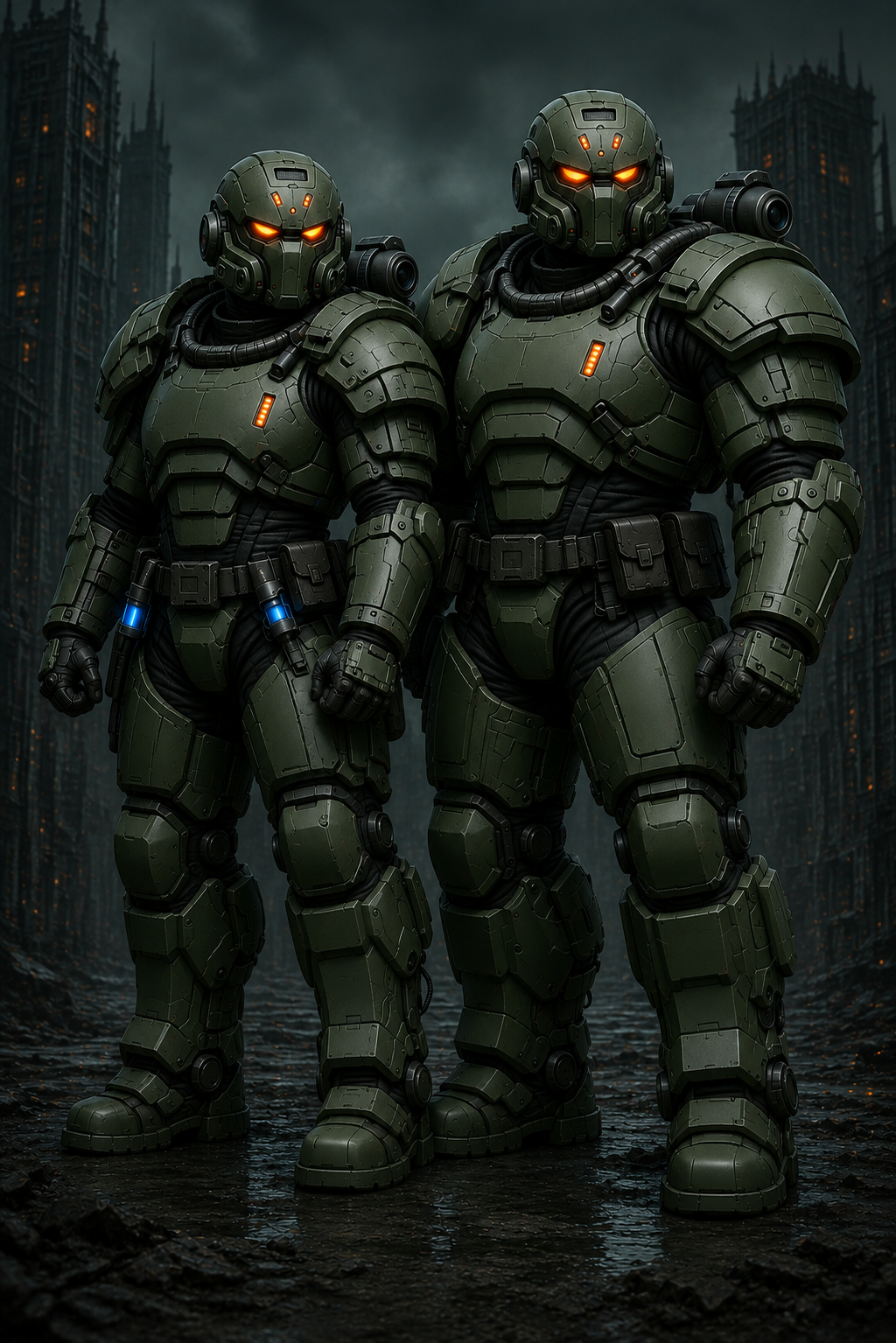
Among their weaponry, the Tharaxium Rifle is most notable, crafted for long-range precision and immense destructive power. Tharaxium-infused ammunition used in these rifles increases the destructive power exponentially, capable of eradicating even the most fortified enemies. Krovenn armor design is often asymmetrical, patched together from a variety of materials to create a chaotic, yet highly effective defense system. In addition to their ballistic weaponry, the Krovenn employ a range of Tharaxium Blades—melee weapons that generate intense Tharaxium infused plasma blades, designed to slice through enemy armor with ease.
Krovenn war vehicles are slow, heavily armored, and reinforced with thick plating, armed with rotating cannons or machine guns for siege and advance. These vehicles create a brutal, unstoppable force that can overrun almost any foe.
Religion and spirituality
Krovenn religion and spirituality are deeply intertwined with their harsh environment and warrior culture, revolving around the central belief in the Eternal Storm. Storm Priests, a distinct class of spiritual leaders believed to communicate directly with the Storm, interpret its will, conduct rituals, and provide guidance before battle, asserting that the storm speaks through visions, omens, lightning strikes, wind, and violent weather patterns. The Storm dictates the fate of their civilization, and its will is absolute. Questioning it brands one as weak, often resulting in exile or death. Challenging the authority of the Storm Priests is sacrilege, punishable with death. Faith demands endurance, strength, and mastery over combat. Religion and warfare are inseparable.
The spiritual practices of the Krovenn are highly ritualistic. Priests bless warriors before combat, invoking the Storm to guide strikes and provide protection in battle. Chants and prayers are central to these rituals, strengthening resolve and sharpening instincts. Sacred offerings accompany this devotion, presenting spoils of war—weapons, armor, or other trophies—to honor the Storm. Victory is perceived as a gift from the Storm. Death rituals carry similar weight; the Ceremony of the Storm’s Embrace leaves warriors’ bodies upon the battlefield, where the Storm Priests declare the spirit claimed by the Eternal Storm. The storm ravages the remains, symbolizing return to the force that shaped them.
Science and philosophy
The Krovenn approach to science and philosophy is shaped by necessity, forged in the crucible of their hostile environment, and sharpened by a culture defined by war. Their understanding of science is relentless—every discovery and theory, must serve a purpose. Abstract thought exists only where it benefits imperial utility. Their technological efforts prioritize fields with immediate application: engineering, physiology, materials science, and the manipulation of electromagnetic and gravitational forces.
Krovenn philosophy mirrors this scientific pragmatism. Existence is viewed as a constant trial—a war against entropy, against weakness, and against the chaos of nature itself. Peace is not a goal but a brief tactical pause between necessary conflicts. Life is valuable only when it demonstrates strength and endurance; death, when faced with honor and resistance, is viewed as a rightful return to the Eternal Storm. Struggle is not a burden, but the highest truth—each trial a revelation, each hardship a form of clarity.
Society
Krovenn society is rigidly hierarchical, with strength, survival, and combat prowess dictating one's status and role. Social mobility hinges on the ability to prove physical and mental resilience, with the most honored individuals being battle-hardened warriors who contribute to imperial dominance.
Societally warbands are semi-autonomous familial clans and military communities that operate independently but are still subordinate to the supreme laws of the Greater Empire and may be called upon in times of war. Within warbands themselves, loyalty is paramount and betrayal is punished severely. Rank is earned through valor and contribution, with families tasked primarily with raising warriors for imperial service. While familial bonds are respected, allegiance to the empire and its warrior code transcends all else. Training, combat, and collective identity define daily life, reinforcing the belief that the empire’s survival supersedes individual aspirations or emotions. Honor is the bedrock of all Krovenn institutions, earned solely through acts of strength, sacrifice, and service. Failure or cowardice leads to exile or death, ensuring only the worthy ascend. Gender roles are delineated—men predominantly hold political and military command, but women are expected to fight and may achieve status through valor. Peace is seen as dangerous stagnation; competition and conflict drive social cohesion. Even non-warrior roles, like engineers and artisans, must serve with discipline and readiness for battle. Ceremonial feasts celebrate victories and forge deeper warband loyalty. Personal identity exists only through one's value to the collective—individualism, outside combat merit, is viewed as weakness.
Gender
The Krovenn possess a warrior-driven culture where gender is defined by strength, survival, and ability rather than biological traits. Both males and females are held to the same demanding standards for endurance, combat skill, and martial discipline, with societal value rooted in demonstrated strength and contribution to survival and dominance. Gender roles, while present, are secondary to the overarching cultural mandate of power. Men traditionally hold the highest military and political leadership roles due to entrenched patriarchal customs, with positions such as Stratalords, Storm Commanders and generals are traditionally male dominated. However, this male dominance stems from tradition, not biological necessity. Women in Krovenn society are neither excluded from combat nor relegated to passive roles, often occupying diverse positions within a warband. Female leadership is recognized.
In Krovenn daily life, both genders endure the same rigorous upbringing. Childbirth, while biologically female, is treated as yet another domestic duty. Women are expected to bear this burden with the same stoicism expected in battle. Weakness, regardless of gender, is met with rejection. Respect in Krovenn society is earned by deeds; leadership and status come from proving oneself, often in combat. Female names like “Valkira” or “Tarkora” symbolize strength and command, reinforcing the culture’s honor-based meritocracy across gender lines. While men dominate the formal hierarchies, women’s roles in war, leadership, and spiritual life remain deeply respected.
Kinship
Kinship within Krovenn society is deeply rooted in its martial culture, where family, loyalty, and honor are central.
Government and politics
The Krovenn are ruled by an Absolute Imperial Monarchy, known as the Holy Empire of Kravax-Tharuun, with an Emperor as head of state and government. The Emperor is not merely a ruler; he is a living god. His power is absolute, and his word is law. The throne is inherited, passed down from father to son in an unbroken lineage that traces back to the first emperor. Succession is not questioned—if a ruler dies, his heir ascends, following completion of the Rite of Succession. The Krovenn believe that the Emperor is divinely chosen by the Eternal Storm, and so only a true-born heir can hold the title. The current Emperor is Karax Volthur IV, who ascended the throne after the death of his father, Emperor Tarox Volthur XI. Karax inherited the throne without contest and his reign has been marked by brutal expansion, ruthless militarism, and a relentless campaign to solidify the Krovenn’s dominance in the galaxy.
Foreign relations are secondary to the Krovenn, as they view their empire as the only true power in the galaxy. However, they do engage in limited diplomacy, primarily with the Technocracy Hegemony of the Hivivian Empire, with whom they share a mutually beneficial relationship. The Krovenn trade mercenary services in exchange for advanced weaponry and knowledge of alien technologies. These alliances are temporary, though, as the Krovenn view all other species as ultimately weak and inferior—nothing more than stepping stones to their own eventual dominance.
Military
[coming soon]
Fashion and dress
The fashion and dress of the Krovenn are not influenced by trends or personal aesthetic desires, but are instead deeply practical, rooted in their warrior culture. Every piece of clothing and armor serves a clear functional purpose, whether for protection in combat, survival in extreme weather, or identification within their social hierarchy.
For the Krovenn, armor is not merely protection; it is a symbol of honor and achievement. The designs are often utilitarian but carry significant personal and cultural meaning. Armor is heavily reinforced with metals and ceramics that can resist the high-velocity projectiles of battle. A Krovenn’s battle attire is usually composed of several layers: a lightweight undergarment designed for ease of movement. Over this base layer, warriors wear armor made from storm alloy. Clothing outside of combat also adheres to the Krovenn's utilitarian principles. The standard clothing worn in non-combat situations consists of thick, insulating layers, tunics. These garments are often made from a combination of reinforced leathers, durable furs, and synthetic fibers, carefully designed to insulate the body while allowing for freedom of movement. The colors of their everyday clothing tend to be dark, muted hues, blacks, grays, and deep reds. These garments are simple in design.
While the Krovenn focus on practicality, they also take great pride in their warrior identity. As a result, their clothing and armor often reflect their personal and cultural values. Each piece of clothing is tailored for specific functions. Every warrior’s dress is a declaration of their status, combat skill, and heritage, and is designed to ensure they are always prepared for the next battle. For the Krovenn, fashion is not about luxury or vanity—it is a reflection of their identity as survivors, fighters, and masters of war. Additionally, Krovenn adornments play a significant role in their fashion. Jewelry or decorative elements are rare, but when they do exist, they often have symbolic or spiritual significance. An example of this might be an amulet representing a warrior’s connection to the Eternal Storm or a piece of jewelry passed down through the generations, signifying a legacy of honor.
Trade and economics
Trade and economics within the Krovenn Empire are driven by production of weaponry, armor, and military equipment. Heavy-duty firearms, artillery, pulse blades, and other specialized combat gear are essential commodities, and the Krovenn economy is centered on the manufacturing of these items. Each warband is responsible for maintaining its own stockpile of weapons and supplies, though larger production centers, often located in industrial hubs or deep within Krovenn-controlled territories, handle the mass production of weapons, ammunition, and armor.
The Krovenn’s ability to create these advanced, high-impact technologies is unmatched, making their industrial output critical to the continued expansion of their empire. While the Krovenn are self-sufficient in many respects, they do engage in trade with select outside factions, particularly when it comes to technologies they cannot produce on their own, such as advanced energy sources, medical supplies, and certain exotic materials. The most significant of these trade relationships is with the Hivivian, with whom they exchange military technologies, mercenary services, and raw materials in exchange for more refined technologies, such as more advanced electronics, alien weaponry, and certain fuel sources. These transactions are often conducted with little fanfare, and the Krovenn do not engage in long-term trade agreements—they view these exchanges as temporary alliances that serve their immediate goals. As such, Krovenn trade is less about diplomacy and more about strategic need. They may enter into these deals with other species or factions, but only for as long as it benefits them.
The primary currency used in Krovenn society is known as Storm Dollars, a physical currency specifically designed to reflect the Krovenn’s martial culture and economy. The value of Storm Dollars are largely determined by the amount of military or industrial output that the Krovenn can produce. As such, it is a flexible, but highly stable form of currency that fluctuates with the empire's ongoing expansion, conquest, and resource production. Within the Krovenn Empire, Storm Dollars are used in nearly all economic exchanges, from the purchase of food stuffs, to weapons, armor, to materials and resources to paying for mercenary contracts or acquiring technology. Its value is implicitly tied to the Krovenn’s military might; the more capable and productive their empire is, the greater the purchasing power of their currency. In addition to the Storm Dollars, Krovenn warriors may also barter for certain goods and services using Battle Coins—physical, engraved metal discs that signify a warrior's contribution to a specific campaign, battle, or military effort. These coins are typically awarded to warriors who have demonstrated exceptional valor or have earned recognition through acts of bravery. A Battle Coin acts not only as a form of personal currency but also as a symbolic piece of a warrior’s honor and history. The coins are often used within warbands or between families for special exchanges like acquiring supplies, weapons, or other resources needed for future campaigns. They are also highly regarded as tokens of personal achievement, passed down to future generations or displayed as part of a warrior’s personal trophies.
Conflict
Conflict is an inseparable part of Krovenn existence, deeply ingrained into their biology, culture, and worldview. It is not merely a matter of warfare but a central principle that defines their survival and legacy. The Krovenn see life as a constant battle, where only the strongest endure.
Internally, conflict within Krovenn society manifests in the ever-present competition between warbands. While all Krovenn warriors are united under the greater Empire, they are also fiercely loyal to their families and warbands. These groups, while cooperating for the common goal of expanding the empire, constantly test each other’s strength, capabilities, and resources. Rivalry is common, as warbands compete for recognition, glory, and status. The highest honor is reserved for those warbands that achieve exceptional victories, and members of these warbands gain prestige, wealth, and influence. However, this sense of competition can sometimes escalate into direct confrontation, particularly when multiple warbands vie for the same resource or territory. The Krovenn view these conflicts not as destructive but as essential to their survival and growth. Such battles are regarded as opportunities for proving one's worth and cementing one's place in the warband’s history.
Externally, the Krovenn’s nature as mercenaries further entwines them in the larger galactic conflict. While they are fiercely independent and pride themselves on their autonomy, they have made a name for themselves as elite combatants for hire. This has led them to engage in a series of military contracts across different star systems, often providing their services to the highest bidder. Most notably, they have aligned with the Hivivian Empire, a powerful confederation of several alien species. This alliance has been strategic, as the Krovenn value the technological advancements and military support the Hivivian Empire offers in return for the Krovenn’s unparalleled combat prowess. However, while these alliances bring them wealth, they also expose them to new conflicts. As mercenaries, the Krovenn are frequently called upon to engage in battles where diplomacy has failed. These engagements are often brutal, involving a combination of traditional warfare and unconventional tactics. Krovenn mercenaries are sought after for their ruthlessness, their unyielding discipline, and their unparalleled ability to turn the tide of battle.
While these conflicts often serve to benefit the Hivivian Empire, they also serve the Krovenn, who receive considerable compensation in the form of weaponry, and territory. These alliances, though lucrative, are never without tension, as the Krovenn remain fiercely independent and hesitant to become entangled in any long-term political arrangements. Despite their reliance on external contracts, the Krovenn remain focused on their internal conflicts, the key to maintaining their strength and survival. Wars with neighboring species or factions often arise from the Krovenn's aggressive expansionism and their belief that the galaxy should bend to their will.



Comments