

Evan Fabrick
"Good, captain. For moment there, I thought we were in trouble." General Fabrick's final words to Captain Erin McAllister during the Battle of New Earth.
Major General Evan Allen Fabrick (Service Number: 11190-2884-EF) was a serviceman in the United Space Command Air Force and served as the official Air Force liaison to the Office of Space Intelligence’s 9th Logistics Division, and stationed on the Outer Colony of New Earth. A career tactician and strategic logistics expert, Fabrick was a key figure in cross-branch coordination between front-line aerospace assets and covert OSI infrastructure.
Commissioned in 2670 following his graduation from the USC Academy at Fort Seneca on Harmony, Fabrick’s early career was marked by operational distinction during the Jovian Conflict, where he served as a squadron coordinator aboard the USC Marshall Graves. He later completed two classified rotations during the Second Energy War, primarily involving strategic airlift and orbital denial operations on the Outer Colony of Washington. By 2702, Fabrick had risen to command status within orbital logistical command, earning multiple commendations for high-efficiency deployment under fire. During the Planetary War on Terror, Fabrick oversaw multi-wing coordination on Armstrong 2 and later transitioned to support roles for extraction and infrastructure repair during sustained planetary engagement campaigns. Fabrick was promoted to Major General in 2718, following years of high-efficiency theater command. He was seconded to the OSI under executive cross-branch authority shortly thereafter. His work with Division IX directly influenced the optimization of blacksite resupply chains and stealth airlift protocols.
Fabrick was widely respected for his no-excuses doctrine, preference for operational autonomy, and unshakable prioritization of mission fidelity. His legacy remains closely tied to the success of OSI’s New Earth xenoarchaeological operations and the careers of logistics officers he personally mentored. Fabrick was killed in action during the invasion of New Earth by the Hivivian Empire, defending a group of civilians during the opening phase of the Human-Hivivian War. Though his body was never recovered, he was posthumously awarded the Medal of Honor and formally recognized with full honors. A memorial marker bearing his name stands at Fort Seneca Memorial Grounds on Harmony.
Appearance
[coming soon]Attire and personal effects
[coming soon]Biography
Early life and education
[coming soon]College
[coming soon]Military Career
[coming soon]Reputation
[coming soon]Awards & Decorations
[coming soon]Personal life
[coming soon]Family, marriage, and relations
Evan Fabrick was the oldest son and child of Michael Fabrick, a retired Air Force Colonel, and Susan Masters, a fashion designer,Personality & Traits
Evan Fabrick had a strong personality built around grit, nerve, discipline, and a hard-earned sense of command that did not need theatrics to be felt. He carried himself with the calm weight of a man who expected trouble to show up eventually and saw no reason to panic when it did. Fabrick was direct without being reckless, confident without being careless, and stubborn in a way that made subordinates feel both tested and protected. He had little patience for excuses, inflated language, or men who confused rank with worth. To him, authority had to be carried like a loaded weapon: carefully, honestly, and only with purpose. He believed command was not a costume, a privilege, or a shield for weak men hiding behind polished insignia. It was a burden that had to be held steady, especially when everyone else was looking for someone to blame, someone to follow, or someone to fear. Fabrick was the kind of officer who could enter a tense room and drain the fear out of it simply by acting as though the problem had already been measured, weighed, and marked for disposal. He did not raise his voice often, because he rarely needed to. His presence did the first half of the work, and his words finished the rest. When he spoke, he tended to cut through confusion with the blunt edge of practical judgment, reducing noise, panic, and ego into one clear path forward. His humor was dry, his temper controlled, and his approval difficult to earn, though never impossible. He respected competence, courage, restraint, and people who could keep their hands steady when the floor started cracking beneath them. When he praised someone, it meant something because he did not waste praise on flattery. When he criticized someone, it usually came with a lesson sharp enough to leave a permanent notch in the memory, and most who received it understood sooner or later that Fabrick was not trying to humiliate them. He was trying to harden them against the kind of failure that did not forgive weakness.
Fabrick possessed a rugged sense of independence that made him deeply suited to operational command. He did not like being smothered by committees, micromanagement, or polished briefings designed to make failure sound respectable. He had no patience for officers who needed six signatures, three rehearsed speeches, and a room full of approval before making a decision that should have been made under pressure. Fabrick trusted people who could think under strain, improvise without losing sight of the mission, and tell him the truth without dressing it up like parade brass. He valued judgment over obedience when obedience became blind, but he had no tolerance for recklessness pretending to be initiative. To Fabrick, a good officer needed enough independence to act when communications failed, enough discipline to avoid turning autonomy into vanity, and enough humility to know when the mission mattered more than personal pride. His confidence had a rough charm to it, the sort that made him seem almost casual in danger, as though the universe had thrown worse at him before and failed to make a lasting impression. That confidence was never soft, theatrical, or eager for admiration. It was weathered, economical, and rooted in a belief that panic was usually more dangerous than the enemy. He was not sentimental in the usual sense, but he had a firm protective streak buried under the ironwork. He believed officers were responsible for the people beneath them, not merely their orders, statistics, or mission reports. That belief made him demanding, sometimes brutally so, because he saw weakness in leadership as something that got good people killed. Fabrick could be hard, even severe, but his severity came from a code: do the job, keep your word, protect those who cannot protect themselves, and never make another person pay for your own hesitation. He had no use for cruelty, but he understood hardness, and he expected those under his command to understand the difference.
At his core, Fabrick was a man of nerve, loyalty, and moral spine. He had an old soldier’s suspicion of grand speeches and easy promises, preferring action that held up when the smoke cleared. He was not easily impressed by medals, titles, intelligence credentials, or political polish, and he measured character by conduct under strain. Fabrick liked courage, but he respected steadiness more. Flashy bravery could win attention; steadiness kept units alive, kept supply lines moving, and kept fear from spreading through the ranks like rot in timber. He had a deep respect for people who stayed useful when conditions turned ugly, whether they were senior officers, mechanics, pilots, clerks, medics, or exhausted enlisted personnel doing thankless work in the background. He judged people by what they did when no one was clapping, when the plan was damaged, when the odds were poor, and when quitting would have been easier to explain than continuing. He could be warm in small, guarded ways, usually through a blunt remark, a quiet favor, or a well-timed piece of humor when everyone else was close to breaking. That warmth rarely announced itself. It appeared in practical acts, in the extra check before deployment, in the hard lesson given before a mistake became fatal, in the calm word offered when terror started taking root. He did not need to be liked, but he did need to be trusted, and that trust became the foundation of his reputation.
Evan Fabrick
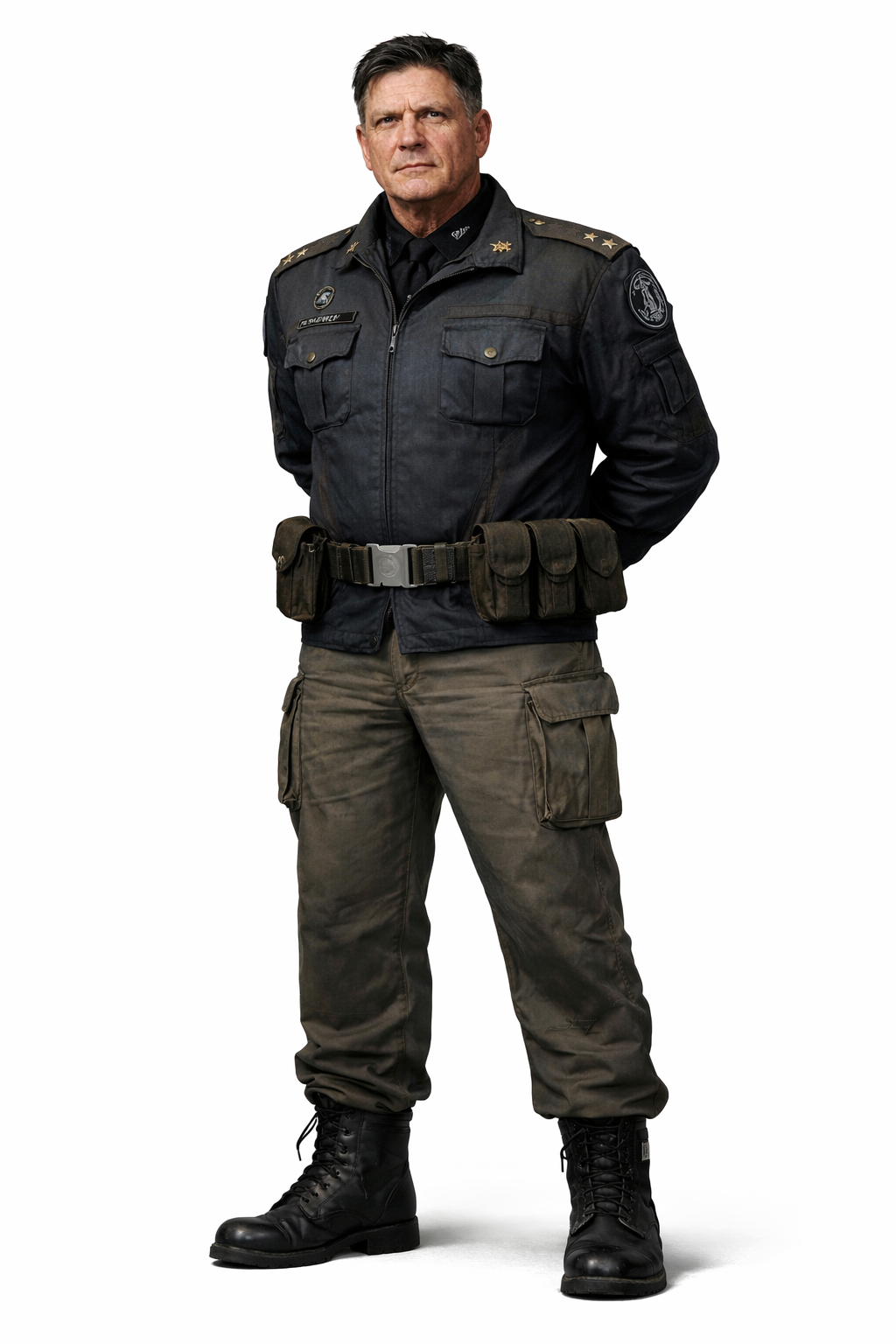
Biographical information
Homeworld
Harmony
BornMarch 30, 2651; Lassa, Harmony
DiedApril 18, 2725; Martinsburg, New Earth (age 74)
Last Known ResidenceMartinsburg, New Earth
Personal details
Race
Human
GenderMale
ParentsMichael Fabrick (father)
Susan Masters (mother)
SiblingsSarah Andersen (sister)
Amanda Whitiker (sister)
Andrew Fabrick (brother)
SpouseCourtney Pearson (wife; m. 2683 - 2725)
SexualityStraight
Gender IdentityMale
Eye colorHazel-green
Hair colorBlack
Skin colorWhite
Height5' 11"
Weight226 lb.
ReligionChristian (Baptist)
Military information
Affiliation
United Space Command Air Force
Office of Space Intelligence
- 9th Logistics Division
Major General
RoleDivison commander
Service2670 - 2725
Service Number11190-2884-EF
Participated Wars & ConflictsPlanetary War on Terror
Jovian Conflict of 2687
Second Energy War
Human-Hivivian War
- Siege of New Earth
Children

Comments