

Delmira
Delmira, or Craehlil II, is the second planet of the Craehlil System within the Orion Arm of the Milkyway Galaxy, orbiting Craehlil at approximately 0.72 AU. Known for its active geology, brutal tectonics, and semi-stable atmosphere, Delmira exists in a constant state of subterranean flux—wracked by frequent earthquakes, thermal upwellings, and sulfurous geysers that shape its fractured surface. Though technically within Craehlil’s habitable zone, Delmira is far from comfortable: surface winds are corrosive, storms are electrically charged, and its magnetic field is patchy at best. Despite these conditions, it remains semi-habitable. Delmira’s crust is laced with heavy metals, thermogenic crystal veins, and volatile isotopes.
Delmira
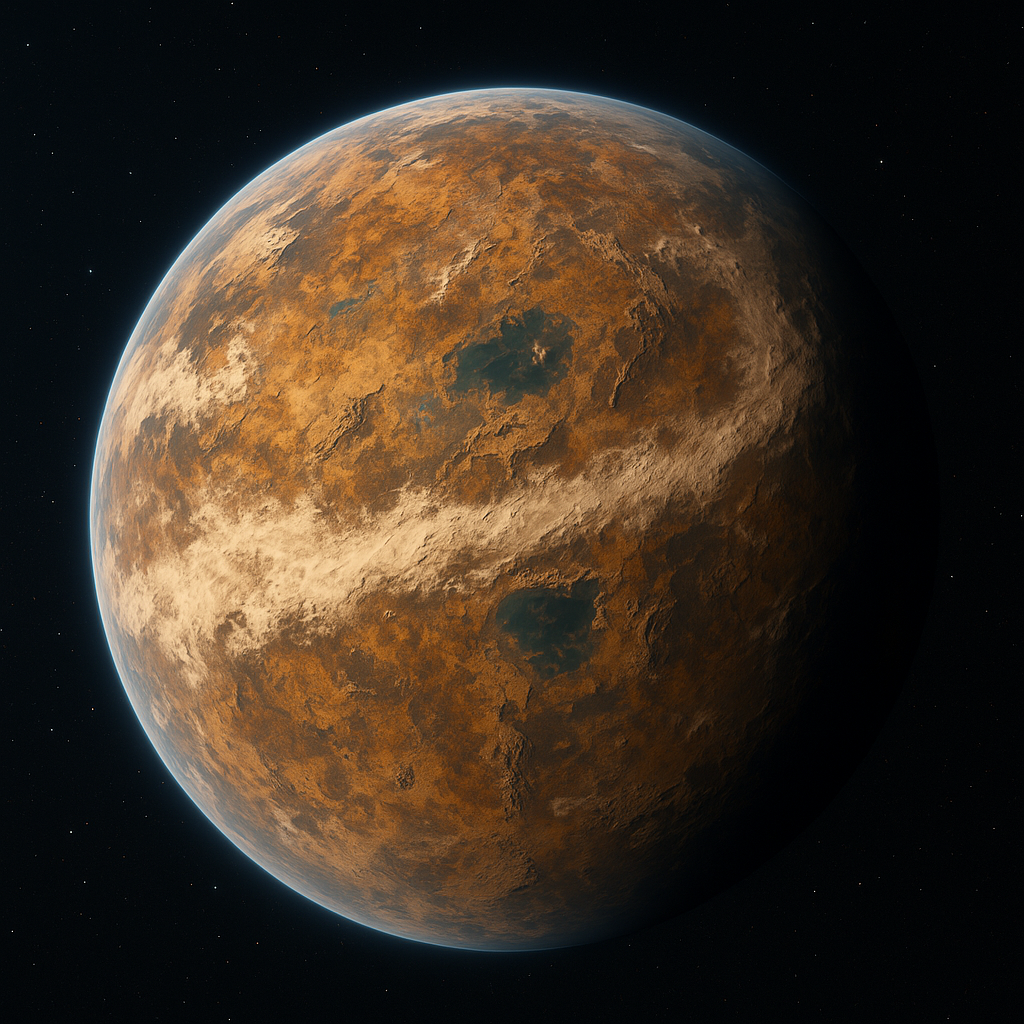
Astrographical Information
Galaxy
Milkyway
Galactic ArmOrion
SystemCraehlil System
OrbitingCraehlil
Orbital positionSecond Planet
Orbital Distance0.72 AU (107,710,466 km)
Orbital characteristics
Aphelion
0.75 AU (112,198,403 km)
Perihelion0.69 AU (103,222,529 km)
Semi-major axis0.72 AU (107,710,466 km)
Eccentricity0.038
Orbital period (sidereal)257.2 days
Average orbital speed34.1 km/s
Mean anomaly164.9°
Inclination- 2.6° – Craehlil's equator;
- 1.8° – invariable plane;
- 2.9° – J2000 ecliptic
49.2°
Time of perihelion18.7 days
Argument of perihelion116.4°
Moon(s)0
Physical Information
Diameter
10,218 km (6,349.3 mi)
Mean radius5,109 km (3,174.6 mi)
Equatorial radius5,131 km (3,188.3 mi)
Polar radius5,082 km (3,157.6 mi)
Flattening0.0095
Circumference- 32,132 km; equatorial
- 31,998 km; meridional
- Land: 302,430,500 km²
- Water: 26,642,500 km² (8.1% of Delmira's surface area)
5.59 × 10¹¹ km³
Mass5.12 × 10²⁴ kg
Mean density6.42 g/cm³
Surface Gravity13.76 m/s²
Moment of inertia factor0.314
Escape velocity13.6 km/s
Synodic rotation period33.1 hours
Sidereal rotation period31.8 hours
Equatorial rotation velocity437.3 m/s
Axial tilt18.9°
Axial Precession14,800 years (moderate axial drift from uneven internal mass distribution)
Albedo- 0.27 geometric
- 0.21 Bond
Temperature 205–692 K
Surface Temperature- -68°C (–90.4°F) Min
- 39°C (102.2°F) Mean
- 102°C (215.6°F) Max
33.4 μGy/h
Surface equivalent dose rate38.7 μSv/h
Apparent magnitude–1.9" to 3.3"
Absolute magnitude (H)5.41
Atmosphere
Surface pressure
181.672 kPa; 1.79 atm (at sea level)
Composition by volume- 58.4% Nitrogen (dry air)
- 22.5% Oxygen (dry air)
- 7.0% Sulfur dioxide
- 4.2% Carbon dioxide
- 2.3% Water vapor (variable)
- 2.1% Argon
- 1.1% Methane
- 1.4% Reactive particulates (dust, industrial ash)
- 0.9% Trace gases (xenon, chlorides, polyaromatic hydrocarbons)

Comments